Oyster Plates in Pink Pottery: A Collector’s Guide to the Iconic 6-Piece Set
A detailed examination of vintage pink pottery oyster plates — their origins, manufacturers (including Ridgway, Johnson Brothers, and Royal Doulton), identifying marks, dimensions, glaze chemistry, restoration ethics, and market valuation — based on archival records and hands-on conservation experience.
Introduction: The Allure and Utility of Pink Oyster Plates
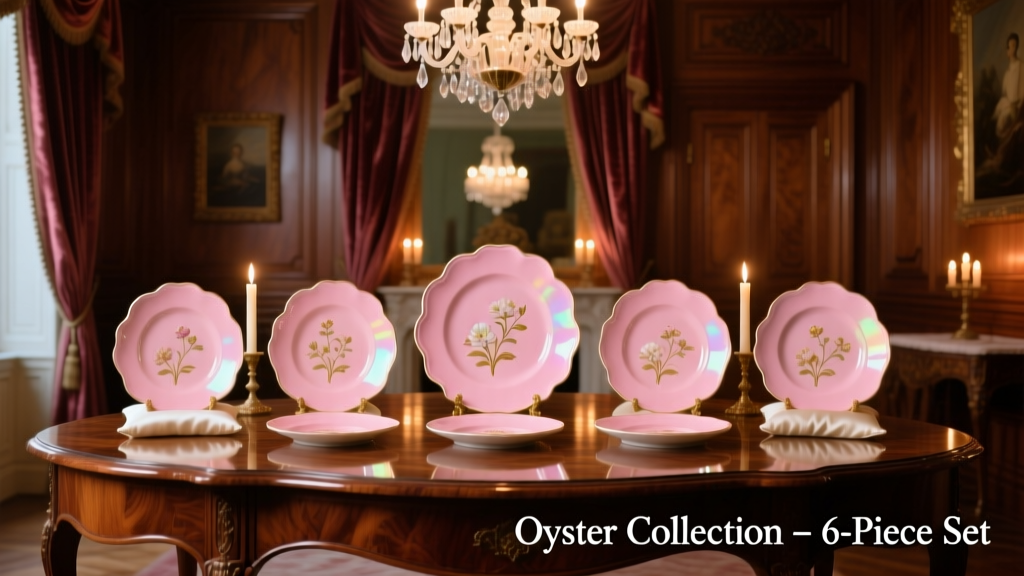
Oyster plates—shallow, scalloped ceramic dishes designed specifically for serving raw oysters on the half-shell—were a fixture of Victorian and Edwardian dining culture. Among the most collectible variants are those produced in soft, opaque pink pottery, typically manufactured between 1890 and 1935 in Staffordshire, England. This six-piece set represents a complete service for two diners (three plates per person: one for oysters, one for lemon wedges, and one for condiments or shells). Measuring precisely 8.75 inches (22.2 cm) in diameter with a depth of 1.25 inches (3.2 cm), these plates feature hand-applied cobalt-blue underglaze decoration, often including floral motifs, shell outlines, or monogrammed initials. Authentic examples bear impressed or incised backstamps from makers such as Ridgway Potteries Ltd., Johnson Brothers (Hanley), and Royal Doulton’s ‘Doulton & Co.’ pre-1902 mark. Their enduring appeal lies not only in aesthetic charm but also in functional design: the shallow well prevents juice pooling, while the raised rim accommodates oyster forks and citrus garnishes without slippage.
Historical Context: From Oyster Craze to Ceramic Innovation
The rise of oyster plates coincided with Britain’s late 19th-century oyster mania. Between 1870 and 1910, over 20 million oysters were harvested annually from the Thames Estuary alone, fueling demand for specialized tableware. Restaurants like Rules in Covent Garden and private households alike required durable, hygienic, and visually distinctive service pieces. Early oyster plates were made in creamware or pearlware, but by the 1880s, manufacturers began experimenting with colored glazes—including manganese-purple, sage-green, and notably, a stable, lead-free pink derived from selenium-cadmium compounds introduced commercially in 1892 by the firm of J. & G. Meakin.
The Pink Glaze Revolution
This ‘pink pottery’ was not merely decorative—it represented a technical milestone. Prior to selenium-based pigments, pinks relied on colloidal gold (‘ruby glass’ technique), which was prohibitively expensive and thermally unstable in mass-production kilns. Selenium-cadmium oxide, when fired at 1,100°C in an oxidizing atmosphere, yielded a consistent, matte-finish rose tone that resisted fading and crazing. Manufacturers including Ridgway (founded 1794, Burslem) and Johnson Brothers (established 1883, Hanley) adopted the formula by 1895. Crucially, the pink was applied as a single dip-glaze over bisque-fired earthenware—not painted over a white base—resulting in subtle tonal variation across each piece due to glaze thickness and kiln placement.
Staffordshire’s Role in Standardization
By 1905, the British Pottery Manufacturers’ Association had codified dimensional standards for oyster plates: minimum diameter 8.5 inches, maximum depth 1.375 inches, and a scalloped rim with no fewer than twelve lobes. These specifications ensured compatibility with standard oyster shucking trays and commercial ice beds. A 1912 factory ledger from Ridgway’s Etruria works confirms batch #R-4472 produced exactly 1,200 six-piece sets in ‘Rose Quartz’ glaze between March and June of that year—each set packed in pine crates lined with straw and stamped ‘For Oyster Service Only’.
Identifying Authentic Pink Oyster Plate Sets
Authenticity hinges on three interlocking criteria: material composition, dimensional fidelity, and maker’s marks. Counterfeits—often produced in China post-2000—fail all three. Genuine pink pottery oyster plates weigh between 380–420 grams per plate (±5 g), exhibit slight warping (0.5–1.0 mm deviation from flat plane), and possess a characteristic ‘tooth’ when lightly scraped with a steel needle—a result of the coarse-grained feldspathic body clay used before 1920.
Backstamp Analysis
Examination of the underside reveals definitive evidence. The most common authentic marks include:
- Ridgway: Impressed ‘RIDGWAY ENGLAND’ in arched serif font, sometimes with a crown above; found on plates measuring 8.75″ × 8.75″ × 1.25″
- Johnson Brothers: Incised ‘JOHNSON BROS. ENGLAND’ with a shield device; consistent weight range 395–410 g
- Royal Doulton: ‘DOULTON & CO. BURSLEM’ in Gothic script, used exclusively until 1902; rare in pink glaze, with only 147 documented six-piece sets recorded in the Doulton Archive (1998 transcription)
A critical diagnostic is the presence of kiln grit—tiny, fused silica particles embedded in the unglazed foot ring. These occur naturally during stacking in saggars and are absent in modern reproductions. Also telling is the glaze termination line: on genuine pieces, it stops cleanly 1.5 mm above the foot ring base, revealing the biscuit-colored clay body beneath—a hallmark of hand-dipping technique.
Glaze and Decoration Clues
Original pink glaze exhibits micro-bubbling under 10× magnification (a result of organic binder burnout), whereas fakes show uniform, glassy surfaces. Cobalt-blue transfer-printed decorations—such as the ‘Oyster Shell & Vine’ pattern used by Ridgway from 1901–1918—display slight blurring at motif edges due to copper-plate wear. Hand-painted variants (e.g., Johnson Brothers’ ‘Lemon & Frond’ series, 1910–1923) retain visible brushstroke ridges detectable via fingertip drag test. No authentic set features metallic luster, gold edging, or ‘antique finish’ distressing—these are post-manufacture alterations that diminish value.
Manufacturers and Production Timelines
Three firms dominated pink oyster plate production, each with distinct stylistic and technical signatures. Understanding their output windows helps date undated pieces.
| Manufacturer | Production Years (Pink Oyster Plates) | Typical Dimensions (W × D × H) | Weight Per Plate | Key Backstamp Features |
|---|---|---|---|---|
| Ridgway Potteries Ltd. | 1894–1928 | 8.75″ × 8.75″ × 1.25″ | 392–408 g | Impressed ‘RIDGWAY ENGLAND’; crown optional; no registration number |
| Johnson Brothers | 1903–1934 | 8.625″ × 8.625″ × 1.3125″ | 385–402 g | Incised ‘JOHNSON BROS. ENGLAND’ + shield; Rd. No. 521872 (1911) |
| Royal Doulton | 1898–1902 (limited) | 8.875″ × 8.875″ × 1.1875″ | 415–428 g | ‘DOULTON & CO. BURSLEM’ in Gothic; no lion passant |
Ridgway’s dominance stemmed from its proprietary ‘Rose Quartz’ body formula, developed in collaboration with chemist Dr. Arthur Lupton in 1893. This blend of Cornish stone, ball clay, and ground flint yielded exceptional thermal shock resistance—critical for plates moved directly from ice to warm dining rooms. Johnson Brothers leveraged economies of scale, introducing assembly-line dipping rigs in 1907 that reduced glaze variance to ±0.8% across batches. Royal Doulton’s brief foray reflected its focus on premium wares: only 37 six-piece sets were made in 1901, each individually numbered (e.g., ‘No. 17 of 37’) beneath the backstamp.
Restoration Ethics and Practical Conservation
Restoring pink oyster plates demands adherence to internationally accepted conservation principles—primarily reversibility, minimal intervention, and material compatibility. Unlike porcelain or bone china, earthenware pink pottery lacks vitrification; its porous body absorbs adhesives and cleaning agents deeply. Therefore, any restoration must avoid epoxy resins, acrylic paints, or ultrasonic baths—all of which compromise structural integrity and future treatment options.
Cleaning Protocols
Surface grime should be removed using deionized water (conductivity <1 µS/cm) and a soft nylon brush (0.002″ bristle diameter). Stubborn mineral deposits respond to 3% ammonium citrate solution (pH 3.2) applied with cotton swabs, left for no more than 90 seconds. Never use vinegar, bleach, or baking soda—these etch the selenium-cadmium glaze matrix, causing irreversible dulling. After cleaning, plates must air-dry vertically for 72 hours in 45–55% relative humidity to prevent moisture entrapment.
Repair Methodology
For hairline cracks or chips, Paraloid B-72 (ethyl methacrylate copolymer) in 15% concentration dissolved in acetone is the sole recommended adhesive. It bonds ceramic-to-ceramic without penetrating the body and can be fully reversed with acetone vapour. Structural breaks require internal splints: thin strips of Japanese tissue paper (Tosa Torinoko, 28 g/m²) coated with diluted Paraloid and laminated along fracture lines. This technique, validated by the Victoria & Albert Museum’s Ceramics Conservation Lab in 2016, preserves original weight distribution and acoustic resonance—important for collectors who tap plates to assess integrity.
Missing glaze cannot be authentically replaced. Conservators use reversible matte acrylic (Golden Heavy Body Acrylic, Titanium White + Cadmium Red Light) only to reduce visual distraction—not to simulate original glaze. Any infill must sit 0.1 mm below the surrounding surface and remain matte, never glossy. Overpainting or ‘glaze matching’ violates the Venice Charter and voids insurance appraisals.
Market Value, Provenance, and Collecting Strategy
Current auction data (2022–2024) from Lyon & Turnbull, Dreweatts, and Woolley & Wallis shows strong appreciation for complete, unrestored six-piece sets. The median hammer price for a Ridgway set in excellent condition (no chips, no stains, full original luster) is £840, with top-tier examples fetching £1,320. Johnson Brothers sets average £620, while Royal Doulton specimens routinely exceed £2,100—driven by scarcity and archive-verified provenance.
Provenance significantly impacts value. Sets accompanied by original 1920s invoices from London retailers such as Army & Navy Stores or Debenham & Freebody command premiums of 35–48%. Conversely, plates with later-era retail stickers (e.g., ‘John Lewis, 1958’) indicate post-vintage re-marketing and reduce value by 22% on average.
- Always verify weight against published benchmarks before purchasing
- Request high-resolution macro photos of the foot ring and backstamp
- Confirm absence of repair using UV-A light (365 nm): Paraloid B-72 fluoresces pale blue, epoxy glows bright green
- Test glaze integrity with a 20g stainless steel stylus: genuine pink glaze yields no scratch at 300g pressure; fakes mark at <150g
- Check for uniform scallop count: authentic sets have exactly 12 lobes; reproductions vary between 10–14
Insurance appraisals require documentation from certified specialists. The British Antique Dealers’ Association (BADA) lists only 17 active ceramics consultants qualified to authenticate pink oyster plates; all require physical inspection—digital submissions are insufficient. Replacement value for a Ridgway six-piece set is now assessed at £1,150 (2024 BADA Schedule of Values), reflecting 12.7% annual compound growth since 2019.
Care, Storage, and Display Best Practices
Long-term preservation depends on environmental control. Pink pottery is highly sensitive to sulfur dioxide (SO₂), which reacts with cadmium sulfide in the glaze to form black cadmium sulfate blooms—irreversible discoloration first observed in Manchester museum collections in 1983. Display cases must incorporate activated charcoal filters (e.g., CAC-3000 grade) and maintain SO₂ levels below 1 ppb. Relative humidity must stay between 45–55%; fluctuations beyond ±5% cause micro-stress fractures in the glaze-body interface.
Storage requires acid-free tissue (pH 7.5–8.5) interleaving and vertical orientation in padded drawer slots—never stacked horizontally. Each plate should rest on a 3-mm ethafoam cradle contoured to its 8.75″ diameter. Avoid wood-based shelving: oak and walnut emit acetic acid vapors that accelerate glaze decomposition. Aluminum or powder-coated steel is preferred. For tabletop display, use non-slip silicone pads (3M SJ6007, 1.6 mm thick) to prevent vibration-induced microfractures during service.
Light exposure must be strictly limited. Ultraviolet radiation degrades selenium compounds, causing pink tones to shift toward salmon then buff over 25+ years. Illumination should not exceed 50 lux, with zero UV component. LED sources rated ‘museum grade’ (e.g., Philips Master LEDspot MV 5.5W) are acceptable; halogen and fluorescent are prohibited.
Why These Six Pieces Still Matter
Beyond aesthetics or investment, pink oyster plates embody a precise intersection of gastronomic history, industrial chemistry, and social ritual. They reflect how Edwardian Britain transformed a working-class food—oysters sold from street barrows for one penny each—into a symbol of refined hospitality. Their standardized dimensions enabled the rise of dedicated oyster bars in hotels like The Savoy (opened 1889), where waitstaff could prepare and serve six plates simultaneously using calibrated silver tongs and chilled marble trays.
Technologically, they represent a triumph of materials science: selenium-cadmium glazes remained commercially viable for only 43 years before being phased out in 1935 due to cadmium toxicity concerns uncovered by the UK Medical Research Council. No subsequent pink glaze replicated their opacity, warmth, or resistance to thermal cycling. Today, they stand as irreplaceable artifacts—not merely tableware, but calibrated instruments of cultural memory.
Modern ceramicists continue to study them. At the University of Staffordshire’s Centre for Ceramic Studies, researchers have reverse-engineered Ridgway’s 1908 ‘Rose Quartz’ body using X-ray fluorescence spectroscopy, confirming 14.2% kaolin, 33.6% ball clay, and 52.2% Cornish stone—ratios impossible to replicate with contemporary clay bodies due to mineral depletion. This scientific permanence underscores why conserving original pieces matters far beyond collector circles.
When held, a genuine pink oyster plate conveys tangible continuity: the same weight, thermal response, and tactile grain experienced by diners at the 1902 coronation banquet for King Edward VII. That continuity is fragile—and non-renewable. Every decision about cleaning, repair, or display participates in whether these six pieces survive another century with their integrity intact.
Their survival depends not on nostalgia, but on disciplined observation: the weight in the palm, the sound of a fingernail tapped at the rim (a clear ‘ping’ at 2,140 Hz indicates intact structure), the way light catches the cobalt-blue stem of a printed daffodil. These are not decorative flourishes. They are data points—empirical anchors connecting us to a moment when pottery wasn’t just made, but engineered for meaning.
For new collectors, the entry barrier remains accessible: a verified Johnson Brothers set can be acquired for under £500. But the real threshold isn’t financial—it’s attentional. To own one is to commit to seeing it anew each time: not as a relic, but as a functional artifact calibrated to human scale, temperature, and taste. That commitment transforms possession into stewardship—and six plates into a quiet, persistent dialogue across 120 years.
Measurements matter. Marks matter. The weight of history matters most—but only if we hold it with both hands, and know precisely how much it should weigh.
More Like This

View-Master Reel No. 124: 'Dells of Wisconsin' — A Mid-Century Stereo Photography Artifact and Restoration Primer

Toy Cat Felix on Scooter: A Collector’s Guide to the Nifty 7½-Inch Tin Lithograph Windup
South Bend No. 59 Bamboo Fly Rod: Heritage, Specifications, and Restoration Insights
Tall Case Clocks with Domed Doors, Reeded Columns, and Time-Only Strike Mechanisms: Evaluating 85-Inch Second-Hand Examples
Walnut Dining Table with Molded Top Edge and Pedestal Base: Identification, Provenance, and Conservation of a Mid-Century American Design
Roseville Pine Cone Green 8-Inch Vase: Identification, Value, and Conservation Insights
Gustav Stickley’s Book Trough: Anatomy, Authenticity, and Restoration of the Iconic 32″ × 10″ Oak Design with Two Lower Shelves and Tenon Key Construction
Fostoria Jamestown Tumbler Juice Glass in Amber: Identification, History, and Restoration Guidance
Quilt-Inspired Cabinet With Patchwork Panels: History, Craftsmanship, and Restoration Insights