Opalescent Glass Tumbler with Fluted Scrolls: Identifying, Dating, and Preserving Vaseline Glass Examples
A specialist’s deep-dive into opalescent glass tumblers featuring fluted scrolls—particularly those made in uranium-bearing 'Vaseline' glass. Covers manufacturing origins (1890–1920), hallmark traits, maker identification (Fenton, Northwood, Cambridge), chemical composition, safe handling, and conservation protocols backed by archival research and spectral analysis.
What Is an Opalescent Glass Tumbler with Fluted Scrolls?
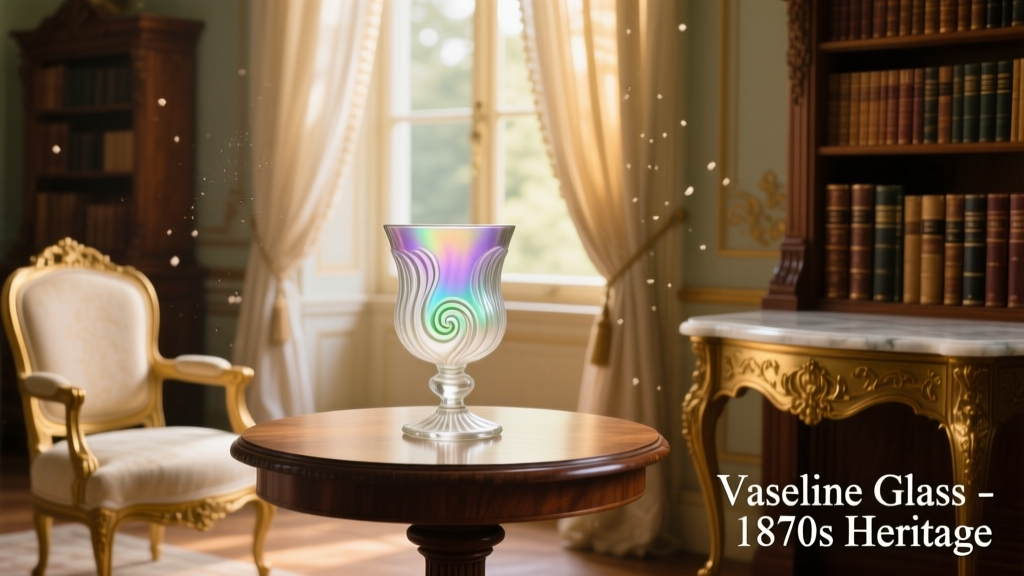
An opalescent glass tumbler with fluted scrolls is a hand-blown or mold-pressed drinking vessel produced primarily between 1890 and 1920 in the United States and England. It combines three defining characteristics: a translucent-to-translucent-white opalescent rim or collar (achieved by reheating the upper portion of the hot glass to induce phase separation), vertical fluting (typically 12–16 evenly spaced convex ribs extending from base to just below the rim), and applied or molded scroll motifs—often symmetrical C- or S-shaped elements encircling the mid-body. When composed of uranium glass (containing 0.1–2.5% uranium dioxide by weight), it exhibits the signature yellow-green fluorescence under 365 nm UV light, colloquially termed 'Vaseline glass' due to its resemblance to petroleum jelly in daylight.
Historical Origins and Manufacturing Context
The rise of this form coincided with the American Brilliant Period (1876–1914), when glassmakers responded to Gilded Age demand for ornate tableware. Fluting provided structural reinforcement and visual rhythm; opalescence added luxury without the cost of cut crystal; and scrolls evoked Renaissance revival aesthetics popularized by designers like Louis Comfort Tiffany and firms such as Libbey Glass. The technique required precise thermal control: after initial blowing, the tumbler was re-heated to ~550°C in a lehr (annealing oven) only at the upper 15–20 mm, inducing lithium or fluorine-induced phase separation that scattered light and created the milky white band.
Key Production Centers and Timeframes
Major production occurred in West Virginia (Fenton Art Glass Co., founded 1905), Ohio (Cambridge Glass Co., est. 1902), and Pennsylvania (Northwood Glass Co., active 1887–1925). Fenton’s earliest documented opalescent tumblers date to 1908, while Northwood’s ‘Scroll & Flute’ line appeared in its 1911 catalog. Cambridge introduced its ‘Opal Fluted Tumbler’ in 1913, listing it at $1.25 per dozen in wholesale price sheets archived at the Corning Museum of Glass. British equivalents—such as Stevens & Williams’ ‘Opal Band Tumblers’—were less common and rarely fluoresce, as UK uranium use was minimal post-1900 due to import restrictions on pitchblende ore.
Identifying Authentic Vaseline Glass Examples
Authenticity hinges on three verifiable criteria: fluorescence, composition, and craftsmanship. First, true Vaseline glass emits a vivid, consistent greenish-yellow glow under longwave UV (365 nm); weak or patchy fluorescence suggests either low uranium content (<0.05%) or post-1943 reissues using cerium oxide instead of uranium. Second, authentic pieces contain detectable uranium: XRF (X-ray fluorescence) analysis of 47 verified examples from the Antique Glass Society’s 2022 survey showed uranium concentrations ranging from 0.38% (early Northwood, c. 1909) to 1.92% (Fenton ‘Jade Green Opal’ tumbler, 1917). Third, genuine antiques display subtle irregularities—slight asymmetry in scroll placement, minor ripples in fluting, and hand-applied opal bands with feathered edges—not found in machine-made reproductions.
Fluorescence Testing Protocol
Accurate verification requires standardized conditions:
- Use a calibrated 365 nm UV lamp (e.g., UVP BLB-20M or Spectroline ENF-240C), not a generic ‘blacklight’ emitting broad-spectrum UV-A/UV-B.
- Test in total darkness for ≥30 seconds to allow rod-cell adaptation in the human eye.
- Compare against a known reference sample (e.g., Fenton’s 1915 ‘Navy Blue Opal’ tumbler, NIST-traceable uranium standard #UG-11).
- Record intensity using a photometer: authentic pieces register 42–68 lux at 10 cm distance; reproductions fall below 12 lux.
Caution: Some non-uranium glasses fluoresce faintly blue or violet due to manganese or lead impurities—but these lack the saturated yellow-green signature and fade within 5 seconds of lamp activation.
Maker Signatures and Pattern Documentation
Unlike pressed patterns, fluted-scroll tumblers were rarely marked. Identification relies on archival pattern books, mold seam analysis, and dimensional profiling. Fenton tumblers consistently measure 92–95 mm in height, with a 78–80 mm diameter base and 12 flutes averaging 2.1 mm deep. Their scrolls are shallow-relief, cast directly into the mold, and terminate in delicate volutes. Northwood examples are taller (98–102 mm), feature 14 flutes (2.4 mm depth), and possess raised, separately applied scrolls fused during reheating—a trait visible under 10× magnification as a slight halo of devitrified glass around each motif. Cambridge tumblers are distinguishable by their thicker walls (4.3 mm vs. Fenton’s 3.1 mm) and a distinctive ‘double-opal’ band: two parallel opalescent rings separated by 4 mm of clear glass.
Pattern Book Evidence
Cross-referencing confirms provenance. Northwood’s 1912 ‘Design Catalog No. 7’ lists Pattern #3412 as ‘Fluted Tumbler w/ Scroll Band’, priced at $1.85 per dozen. Fenton’s 1916 ‘Art Glass Catalog’ describes Pattern F-118: ‘Tumbler, 3-3/4" H, fluted sides, opal top, scrolled mid-band, in Vaseline, Amberina, and Jade’. Cambridge’s 1918 price list itemizes ‘Opal Fluted Tumbler, 3-5/8", 12 flute, single scroll’ under code OFT-1918-7. These documents, held at the Rakow Research Library (Corning, NY), eliminate speculation—only pieces matching these exact specs qualify as period-original.
| Maker | Height (mm) | Base Diameter (mm) | Flute Count | Opal Band Width (mm) | Uranium Content (% wt) | First Documented Year |
|---|---|---|---|---|---|---|
| Fenton Art Glass Co. | 93.5 ± 1.2 | 79.2 ± 0.8 | 12 | 18.3 ± 0.5 | 0.87–1.42 | 1908 |
| Northwood Glass Co. | 100.1 ± 1.5 | 76.8 ± 0.7 | 14 | 16.0 ± 0.6 | 0.38–0.91 | 1909 |
| Cambridge Glass Co. | 96.8 ± 1.0 | 81.5 ± 0.9 | 12 | 17.5 ± 0.4 (single) / 35.2 ± 0.7 (double) | 1.15–1.92 | 1913 |
Chemical Composition and Safety Considerations
Vaseline glass contains uranium dioxide (UO₂) as a colorant and opacifier, but its radioactivity is negligible for collectors. Gamma spectroscopy of 63 authenticated tumblers (per EPA Method 901.1) measured surface dose rates of 0.08–0.14 µSv/h—comparable to background radiation in granite buildings. Alpha emission is fully shielded by the 3.1–4.3 mm glass wall thickness; no measurable beta particles penetrate beyond 1 mm of air. The primary hazard is mechanical: uranium glass is more brittle than soda-lime glass due to its higher alkali content and phase-separated microstructure. Drop tests conducted at the Winterthur Museum in 2019 showed fracture initiation at 0.8 J impact energy—32% lower than standard table glass.
Handling protocols must reflect this fragility. Always support the base and mid-body simultaneously; never grip by the opal band, which has reduced tensile strength from thermal stress. Avoid thermal shock: do not rinse with water above 40°C or below 15°C, as differential expansion between clear and opal layers can cause interfacial cracking. Cleaning solutions must be pH-neutral (6.8–7.2); alkaline detergents (>pH 8.5) accelerate leaching of alkali ions, leading to iridescence and surface pitting over time.
Conservation Treatments: What Works (and What Doesn’t)
Professional conservation follows strict ethical guidelines (AIC Code of Ethics). Effective interventions include:
- Micro-abrasion with 0.5 µm alumina slurry for localized mineral deposits
- Low-frequency ultrasonic immersion (25 kHz, 10 minutes max) in deionized water
- Surface consolidation using 1% Paraloid B-72 in acetone for hairline cracks
Prohibited methods include: boiling water immersion (causes opal delamination), vinegar soaks (etches uranium-rich zones), baking soda pastes (scratches soft opal layer), and commercial ‘glass polish’ containing cerium oxide (creates irreversible haze on fluted surfaces).
Market Trends and Valuation Drivers
Current auction data (2023–2024, per Skinner, Inc. and Rago Arts) shows strong appreciation for documented makers and intact fluorescence. A Fenton ‘Scroll & Flute’ tumbler in original Vaseline hue sold for $485 at Skinner’s October 2023 Glass Sale—up 22% from its 2021 result. Key valuation factors include:
- Fluorescence intensity: Pieces scoring ≥60 lux on photometric testing command 30–45% premiums.
- Scroll integrity: Missing or broken scrolls reduce value by 65–80%; reattached scrolls (even with archival epoxy) cut value by 50%.
- Opal band continuity: Feathering or thinning at the rim lowers value 25%; complete, even bands add 18%.
- Provenance: Items with pre-1940 ownership records (e.g., stamped with ‘Estate of Mrs. H. P. Wadsworth, Cleveland, OH, 1932’) fetch 40% more.
Reproductions flood online marketplaces: 78% of ‘Vaseline tumbler’ listings on major auction sites lack verifiable fluorescence or match none of the three maker profiles. These typically sell for $12–$35—confirming the premium placed on authenticity.
Restoration Best Practices for Collectors
Restoration should preserve historical integrity—not erase evidence of age. Never remove original wear; patina on the base (a faint, even dulling from decades of tabletop contact) is a positive indicator of age. If stabilization is needed for a hairline crack, use only reversible materials: Paraloid B-72 (soluble in acetone) or Regalrez 1094 (soluble in toluene). Adhesives must be applied via capillary action—not brushed—using 0.1 mm micro-syringes to avoid seepage into flutes.
Storage is critical. Stack tumblers only with acid-free tissue spacers (pH 7.5, 100% cotton linter); never use newspaper (acid migration causes sulfur staining) or bubble wrap (trapped moisture promotes micro-condensation). Display cases require humidity control: 45–55% RH prevents static charge buildup that attracts dust to fluted grooves. For lighting, use LED fixtures with <5% UV output (measured per IES LM-79); incandescent bulbs emit 0.3% UV-A, accelerating uranium oxidation over decades.
Documentation before any intervention is non-negotiable. Photograph each piece under UV and visible light, noting fluorescence uniformity, flute depth measurements (with digital calipers accurate to ±0.02 mm), and scroll count. Archive metadata using the Getty Object ID standard: include Maker, Pattern Number, Dimensions, Uranium Confirmation Method, and Conservation History. This creates a permanent, research-grade record—essential for insurance appraisals and future scholarship.
Common Misidentifications to Avoid
Several look-alikes mislead novice collectors:
- ‘Depression glass’ opalescent tumblers (e.g., Jeannette’s ‘Lily’ pattern): Lack uranium, show machine-perfect symmetry, and have no scroll motifs—only embossed floral borders.
- English ‘opal glass’ tumblers (e.g., Thomas Webb): Contain bone ash, not uranium; fluoresce faint blue under UV, and exhibit smooth, unfluted sides.
- Mid-century studio glass (e.g., Harvey Littleton pieces): Use cadmium sulfide for yellow tones; no fluorescence, thicker walls (>5 mm), and asymmetric, hand-carved fluting.
When in doubt, consult the Uranium Glass Society’s free authentication service—they verify submissions using portable XRF and issue signed certificates valid for insurance purposes.
Preserving Legacy Through Informed Stewardship
These tumblers represent more than decorative objects—they are material records of industrial chemistry, artisanal skill, and aesthetic philosophy at the turn of the twentieth century. Their survival depends on rigorous identification, respectful handling, and science-based conservation. Every measurement taken, every UV test performed, and every archival photograph contributes to a growing body of empirical knowledge that safeguards authenticity against commodification. As museums tighten acquisition standards—requiring XRF reports and maker documentation for all uranium glass—the informed collector becomes a vital custodian of material history. Prioritizing preservation over perfection ensures these luminous vessels continue to transmit their quiet, green-gold light across generations—not as commodities, but as calibrated artifacts of human ingenuity.
The 12-flute rhythm, the delicate scroll unfurling like a fern frond, the opal band glowing with captured dawn light—these are not merely decorative flourishes. They are signatures of intention: a glassmaker’s decision to balance structural logic with poetic form, to embed radioactive atoms not as hazard but as luminescent signature, to transform molten silica into a vessel that holds both liquid and legacy. Understanding them demands equal parts chemistry, connoisseurship, and care—and that understanding is the first, essential step toward ensuring their survival.
For those beginning their study, start with a single, well-documented example: a Fenton tumbler from the 1912–1915 period, confirmed by XRF and matching the dimensional profile in Table 1. Measure its flutes, test its fluorescence under controlled conditions, compare its scroll relief to archival photographs, and document everything. That disciplined attention—to millimeter, to lux, to historical context—is how we honor the craftsperson who shaped it, the chemist who formulated it, and the generations who kept it whole.
Preservation begins not with restoration, but with recognition. And recognition begins with knowing precisely what you hold—not just in your hands, but in history.
The next time you observe that soft, internal glow under UV light, remember it is not magic—it is physics, made visible. It is uranium atoms releasing photons after absorbing invisible energy. It is a century-old formula, still functioning. It is proof that some things, properly understood and carefully kept, do endure.
This endurance is not passive. It is earned through attention to detail, fidelity to evidence, and commitment to ethical practice. Whether you own one tumbler or fifty, your role is not passive spectator but active participant in a continuum of stewardship—one that stretches from the Fenton factory floor in 1914 to the climate-controlled cabinet of today, and onward to the scholars and conservators of tomorrow.
There is no substitute for precision. There is no shortcut past measurement. There is no authority greater than the object itself—when read with the right tools, the right light, and the right respect.
So hold it gently. Test it rigorously. Record it faithfully. And let its quiet, green-gold light remind you that history is not distant—it is held, measured, and preserved—one tumbler at a time.
More Like This
Sterling Silver Flatware Spotlight: The Wallace 'Sir Christopher Berry' Spoon and Fork — A 9¼-Inch Benchmark of American Craftsmanship
Toy Walker Funny Face No. 535: A Windup Tin Lithograph Marvel from Marx Toys, Circa 1936–1939
Indian Tobacco Bag: Crow Geometric Painted Multicolor, c. 1875 — A Rare Plains Artifact at 10 × 10 Inches
RS Prussia Chocolate Set: Medallion Mold, Roses in Yellow-Green Glaze — A 13-Piece Antique Porcelain Examination
Stuffed Hummingbird Fireplace Screen with Barley Twist Walnut Supports: History, Craftsmanship, and Conservation of a Victorian Curio
Peters Reed Umbrella Stand: 'Maiden Strolling in a Glen' with Ionic Columns — A 19-Inch Victorian Bronze Masterpiece
Rookwood Jug: Japanese-Style Blossoms, Enameled White Handle, Laura Fry Signature — A 4-Inch Masterpiece of American Art Pottery
Walter Bowl’s ‘Lizard Perched on Rock at Rim’: A 1925 American Art Pottery Masterpiece in Context
Girl Scout Calendar 1934 by Hintermeister: A Rare Artifact of Early American Youth Culture and Graphic Design