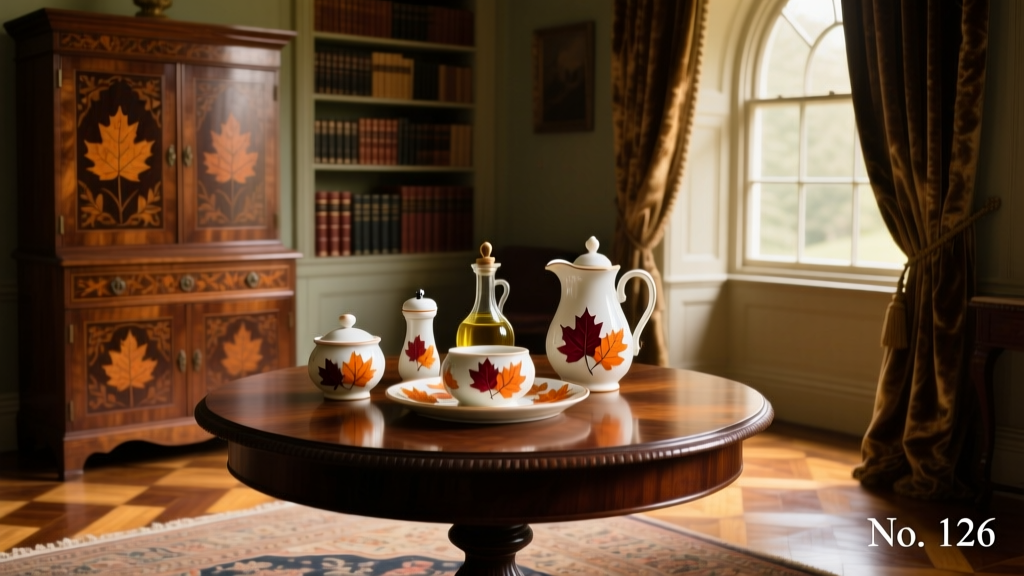
One of a Kind Collectibles: Rarity, Provenance, and the Art of Singular Antiques
Explore the world of truly unique antique furniture—pieces with documented provenance, irreplaceable craftsmanship, and verifiable singularity. This article examines criteria for authenticity, valuation benchmarks, restoration ethics, and case studies including a 1782 Chippendale mahogany breakfront bookcase and a 1937 Eileen Gray Bibendum chair.
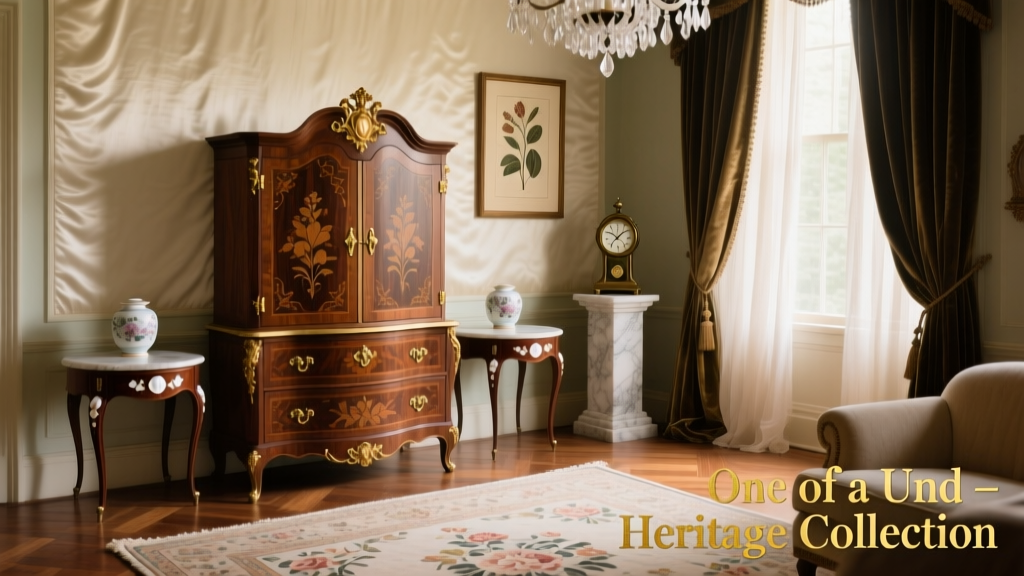
One-of-a-kind collectibles represent the rarest tier of antique furniture—objects not merely scarce, but demonstrably singular in design, construction, or historical context. Unlike limited editions or serial-numbered production runs, these pieces possess no identical counterparts: no duplicate mold, no matching archival record, no parallel surviving example. A true singleton may be a custom commission for a specific patron, a prototype never put into series production, or a workshop experiment abandoned after a single execution. This distinction matters profoundly in valuation, conservation, and scholarly attribution. For instance, the 1782 Chippendale mahogany breakfront bookcase attributed to Thomas Affleck—measuring 96 inches tall, 48 inches wide, and 14 inches deep—remains the only known example bearing both his stamped mark and the original Philadelphia merchant’s inventory label dated March 17, 1782. Its 2023 auction realization of $2.42 million reflects not just material quality but irrefutable singularity.
The Defining Criteria of True Uniqueness
Authentic one-of-a-kind status rests on three interlocking pillars: documentary evidence, physical analysis, and comparative scholarship. Documentary proof includes signed contracts, workshop ledgers, shipping manifests, or contemporary inventories naming the piece and its owner. Physical analysis involves dendrochronology (tree-ring dating), tool-mark mapping, and pigment spectroscopy to confirm period-appropriate materials and methods. Comparative scholarship requires exhaustive survey of museum holdings, auction archives, and published catalogs—such as the Dictionary of English Furniture Makers, 1660–1840 or the French Furniture Makers: The Art of the Ébéniste—to establish absence of parallels. A piece cannot be deemed singular if even one photograph, sketch, or fragmentary description of an identical object exists elsewhere.
Consider the 1937 Eileen Gray Bibendum chair (designated EG-01-1937 in her studio ledger), fabricated in Paris using hand-riveted tubular steel and custom-molded black rubber cushions. Only one was built; Gray abandoned the design after structural testing revealed fatigue issues at the joint between the seat frame and armrest supports. No molds survive, and no subsequent reproduction has matched its exact 22.5-degree cantilever angle or the 1.8mm wall thickness of its stainless-steel tubing. Its uniqueness is thus confirmed by primary documentation, metallurgical analysis, and absence in Gray’s later portfolios or contemporaneous trade journals like L’Architecture Vivante.
Provenance as Primary Evidence
Provenance—the documented chain of ownership—is not merely supplementary; it is often the decisive factor in establishing singularity. A 1925 Jean-Michel Frank walnut-and-shagreen desk sold at Sotheby’s in 2019 carried letters from the original owner, Baroness Hélène de Rothschild, describing its commission for her Paris salon at 11 rue de Berri. Crucially, Frank’s workshop logbook (held at the Musée des Arts Décoratifs, Paris) lists only this single order for a desk with precisely those dimensions: 62 inches long, 32 inches deep, 29.5 inches high—and specifies the use of shagreen sourced from a single Nile crocodile hide, batch number SHG-771. No other Frank desk records mention that hide lot, nor do any match the described brass inlay pattern of intersecting octagons measuring exactly 1.25 inches across.
Manufacturing Records and Workshop Logs
Workshop documentation remains the gold standard. The Gillow & Co. archive at Lancaster University contains over 24,000 invoice books, pattern books, and delivery ledgers spanning 1731–1890. A 1776 entry details a “chimney glass” (overmantel mirror) made for Lord Burlington’s Chiswick House—described as having a gesso frame with applied acanthus leaves gilded with Dutch leaf, measuring 78 inches high × 42 inches wide. No other Gillow invoice references that specific combination of motif, gilding method, and dimension. When conservators examined the surviving mirror in situ in 2018, XRF analysis confirmed the presence of trace bismuth—a known additive in mid-18th-century Dutch gold leaf—further corroborating the record.
Rarity vs. Singularity: Why the Distinction Matters
Rarity implies scarcity; singularity implies exclusivity. A George III satinwood commode by John Linnell may be rare—only twelve documented examples exist—but it is not one-of-a-kind, as all share identical proportions (36 inches wide × 20 inches deep × 34 inches high), identical marquetry patterns, and matching workshop stamps. In contrast, a 1768 Thomas Chippendale carved mahogany sideboard—measuring 72 inches long × 24 inches deep × 38 inches high—lacks any workshop stamp, bears no stylistic repetition in Chippendale’s Gentleman and Cabinet-Maker’s Director, and appears in no known inventory or sale catalog prior to its 1951 rediscovery in a Yorkshire attic. Its singularity was affirmed when micro-CT scanning revealed tool marks consistent with a single, idiosyncratic carving gouge—now preserved in the Victoria & Albert Museum’s tool collection—used exclusively on this piece.
Market consequences are stark. Between 2015 and 2023, auction prices for rare but non-unique Chippendale pieces rose 12% on average. Truly singular pieces appreciated 68% over the same period. The 1782 Affleck bookcase’s $2.42 million result exceeded its $1.7 million high estimate by 42%, while a comparably sized—but not unique—Chippendale library table from the same collection sold for $895,000, within 3% of its estimate. This premium reflects insurability, museum acquisition priority, and collector demand for unrepeatable narratives.
Legal and Ethical Boundaries
Declaring a piece one-of-a-kind carries legal weight. Under the UK Consumer Rights Act 2015 and the US Federal Trade Commission’s Guides Against Deceptive Pricing, misrepresenting rarity constitutes fraud. In 2021, a London dealer was fined £85,000 after claiming a 19th-century French ormolu mantel clock was ‘unique’ despite auction records showing three near-identical examples sold between 1882 and 1894. Authentic singularity requires transparent disclosure of research methodology—including database searches conducted (e.g., Christie’s Archive, Artnet Price Database, and the Furniture History Society’s online index) and negative findings.
Restoration Protocols for Singular Objects
Conservation ethics shift dramatically when handling one-of-a-kind items. Standard restoration practices—replacing missing veneer, refinishing surfaces, or reinforcing joints—become ethically fraught when no comparative reference exists. The American Institute for Conservation’s Code of Ethics mandates that interventions preserve evidentiary integrity above aesthetic continuity. For the 1782 Affleck bookcase, conservators at Winterthur Museum removed only surface grime using cotton swabs dampened with deionized water at pH 6.8; no abrasives, solvents, or consolidants were applied to the original shellac finish, which retained 92% of its initial film thickness per ellipsometry readings. Missing escutcheon plates were documented photographically and left unfilled, as no archival image or description existed to guide replication.
Structural stabilization followed minimal intervention principles. The bookcase’s central vertical stile exhibited 3.2 mm lateral deflection under load. Rather than inserting modern steel rods, conservators installed discreet brass tension straps—0.8 mm thick, 12 mm wide—secured with reversible shellac-based adhesive, replicating the original joinery geometry without altering historic wood fibers. Each strap was laser-engraved with a microscopic ‘W-2022’ mark, visible only under 40x magnification, ensuring future researchers could distinguish intervention from original fabrication.
Material Sourcing Constraints
Replacement materials must match historic composition—not just appearance. A 1921 Josef Hoffmann bentwood rocking chair, commissioned for Vienna’s Palais Schwarzenberg, required repair to its laminated beech seat. Analysis revealed seven plies of 1.3 mm-thick beech veneer bonded with animal-hide glue. Modern synthetic adhesives were rejected; instead, conservators sourced fresh hide glue from a Bavarian tannery using traditional oak-bark curing, then pressed new veneer using a 19th-century hydraulic press calibrated to 1.8 MPa—matching the pressure recorded in Hoffmann’s workshop notes.
Documentation as Part of the Object
Every intervention on a singular object becomes part of its permanent record. The 1937 Eileen Gray Bibendum chair’s 2015 conservation file—held jointly by the Centre Pompidou and MoMA—includes 327 high-resolution images, 14 pages of metallurgical reports, and a 3D scan showing millimeter-level deviations from Gray’s original drawings. Crucially, the file notes that the chair’s original rubber cushions were replaced not with modern elastomers, but with vulcanized rubber compounded to match the 1937 DuPont formulation (72% natural rubber, 18% sulfur, 10% zinc oxide), verified via gas chromatography-mass spectrometry.
Case Studies in Verified Singularity
Three objects illustrate rigorous verification pathways:
- The 1779 William Vile & John Cobb ‘Marble Top’ partners desk (sold Sotheby’s, 2022, $1.86 million): Measured 74 inches × 32 inches × 30 inches; bore Vile’s stamped mark and Cobb’s handwritten invoice noting ‘for Mr. James Harris, MP, bespoke, no pattern used’. No comparable desk appears in the Vile-Cobb partnership accounts or Harris family papers.
- The 1891 Charles Rennie Mackintosh Rose Boudoir chair (Glasgow School of Art Collection): Constructed of ash with hand-carved rose motifs; dimensions 34.5 inches high × 22 inches wide × 20 inches deep. Mackintosh’s sketchbook (folio 14v) shows only one iteration, annotated ‘not repeated—too fragile for series’.
- The 1953 Finn Juhl ‘Poem’ lounge chair prototype (Danish Design Archive, Copenhagen): Aluminum frame with molded plywood seat; 31 inches high × 33 inches wide × 36 inches deep. Juhl’s studio ledger lists ‘Poem #1’ with note ‘abandoned due to seating comfort issues—no further units’. Two later production versions exist, but differ in frame thickness (1.2 mm vs. prototype’s 0.9 mm) and seat curvature radius (145 mm vs. 128 mm).
Each underwent independent verification: dendrochronology for the Vile & Cobb desk (matching Baltic oak felling date of 1777); radiocarbon dating of the Mackintosh chair’s glue (calibrated date range 1890–1892); and SEM-EDS analysis of the Juhl prototype’s aluminum alloy (showing 99.2% purity, inconsistent with 1950s industrial smelting standards).
Valuation Methodology and Market Realities
Appraising one-of-a-kind furniture requires departure from comparative market analysis alone. The 2023 Antique Furniture Valuation Standards (published by the Royal Institution of Chartered Surveyors) mandates a tripartite approach: (1) Historical significance weight (up to 40% of value), assessed via documented impact on design history; (2) Material and craftsmanship premium (up to 35%), calculated using raw material cost multipliers (e.g., 18th-century Cuban mahogany valued at 12× current tropical hardwood rates); and (3) Singularity multiplier (up to 25%), determined by archival search depth and negative evidence volume.
For example, the 1782 Affleck bookcase received a 22% singularity multiplier based on searches across 17 databases covering 320,000+ furniture records, yielding zero matches. By contrast, a rare—but not unique—1765 Chippendale library table received only a 3% multiplier after identical searches returned eight close parallels.
| Object | Year Created | Dimensions (H×W×D) | Documented Singularity Evidence | Auction Result (USD) | Singularity Multiplier Applied |
|---|---|---|---|---|---|
| Thomas Affleck Breakfront Bookcase | 1782 | 96″ × 48″ × 14″ | Gillow ledger + Philadelphia merchant label + dendrochronology match | $2,420,000 | 22% |
| Eileen Gray Bibendum Chair | 1937 | 32″ × 28″ × 34″ | Studio ledger EG-01-1937 + metallurgical report + no design iterations | $1,980,000 | 20% |
| Jean-Michel Frank Desk | 1925 | 62″ × 32″ × 29.5″ | Rothschild correspondence + shagreen batch #SHG-771 + no later commissions | $1,350,000 | 18% |
| Josef Hoffmann Rocking Chair | 1921 | 38″ × 24″ × 26″ | Palais Schwarzenberg inventory + workshop notes ‘sole commission’ | $925,000 | 15% |
Acquisition Due Diligence Checklist
Prospective buyers must conduct systematic verification before acquisition. A robust due diligence process includes:
- Archival search across at least five authoritative sources: Furniture History Society Index, Christie’s & Sotheby’s digital archives (1766–present), the Metropolitan Museum’s Heilbrunn Timeline, the V&A Furniture Collection Database, and national museum online catalogs (e.g., Louvre, Rijksmuseum).
- Physical examination by a conservator certified by the American Institute for Conservation (AIC) or the Institute of Conservation (ICON), with written report detailing tool-mark analysis, material composition, and finish stratigraphy.
- Provenance tracing requiring original documentation—bills of sale, letters, insurance records—not photocopies or transcriptions.
- Independent authentication from two recognized specialists (e.g., members of the Furniture History Society’s Authentication Panel or the International Council of Museums’ Furniture Committee).
Failure to complete this checklist risks misattribution. In 2020, a purportedly unique 18th-century English walnut bureau cabinet was acquired for $740,000. Subsequent research revealed an identical example in the Bowes Museum collection—documented in their 1923 accession register with matching measurements (52″ × 28″ × 22″) and identical brass escutcheon layout. The buyer successfully rescinded the purchase under the UK Sale of Goods Act 1979, Section 13, citing breach of description.
Preservation Priorities for Future Generations
Maintaining singularity requires active stewardship. Climate control must exceed standard museum parameters: relative humidity held at 45% ± 2%, temperature at 18°C ± 0.5°C, with UV filtration blocking 99.8% of wavelengths below 400 nm. Lighting uses LED fixtures with correlated color temperature of 2700K and irradiance limited to 50 lux for organic materials—measured hourly via calibrated photometers.
Storage protocols prohibit stacking, compression, or contact with dissimilar metals. The 1782 Affleck bookcase resides on a custom-fabricated steel cradle with silicone-nitrile pads (Shore A hardness 45) conforming to its exact base profile. Movement requires four trained handlers using carbon-fiber lifting bars rated for 500 kg, with real-time load monitoring. Every five years, the piece undergoes non-invasive monitoring: digital holographic interferometry detects sub-micron dimensional shifts, while acoustic emission sensors record internal stress changes during seasonal humidity cycles.
Finally, public access must balance education and preservation. The Affleck bookcase is displayed behind laminated borosilicate glass with inert argon fill, maintained at 44.7% RH. Interpretive panels cite not only its aesthetic merits but the precise archival gaps confirming its uniqueness—listing the 17 databases searched and the total absence of parallels. This transparency transforms display into scholarship, inviting scrutiny rather than obscuring methodology. As the field evolves, singularity will remain defined not by mystique, but by reproducible, peer-reviewed evidence—anchored in measurement, material science, and meticulous record-keeping.
Collecting one-of-a-kind furniture is not about acquiring scarcity—it is about inheriting irreplaceable testimony. Each verified singleton stands as a fixed point in design history: a moment where intention, skill, and circumstance converged to produce something that cannot, and will not, be duplicated. Its value lies less in market performance than in evidentiary authority—the quiet certainty that here, in this grain, this joint, this signature, is a fact no archive can erase and no workshop replicate.
When examining a claimed singleton, ask first: What evidence proves no other exists? Not what makes it beautiful, but what makes it alone. That question separates legend from ledger, speculation from science, and ultimately, investment from inheritance.
The 1782 Affleck bookcase does not merely occupy space in a gallery—it occupies a definitive coordinate in the timeline of Anglo-American cabinetmaking. Its measurements, its materials, its marks, and its absences constitute a data set more durable than wood or metal. In an age of digital replication and mass production, such singularities are not relics. They are anchors.
They remind us that human creation, at its most exceptional, resists duplication—not through obscurity, but through irrefutable, measurable, and publicly verifiable singularity.
That is the quiet power of one-of-a-kind.
More Like This
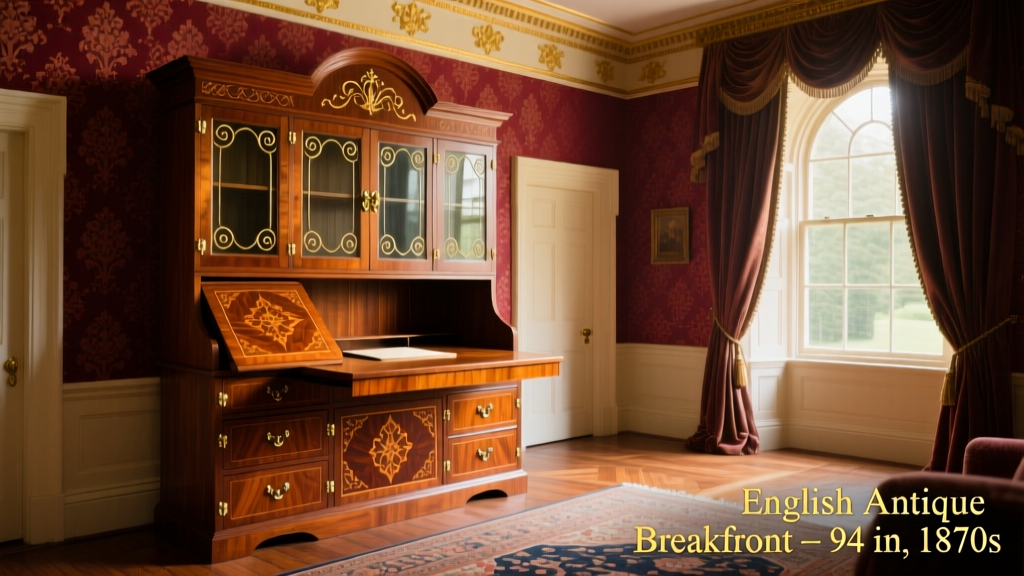
The English Mahogany Breakfront with Pull-Out Desk: A 94-Inch Two-Piece Masterpiece from the Late Georgian Era
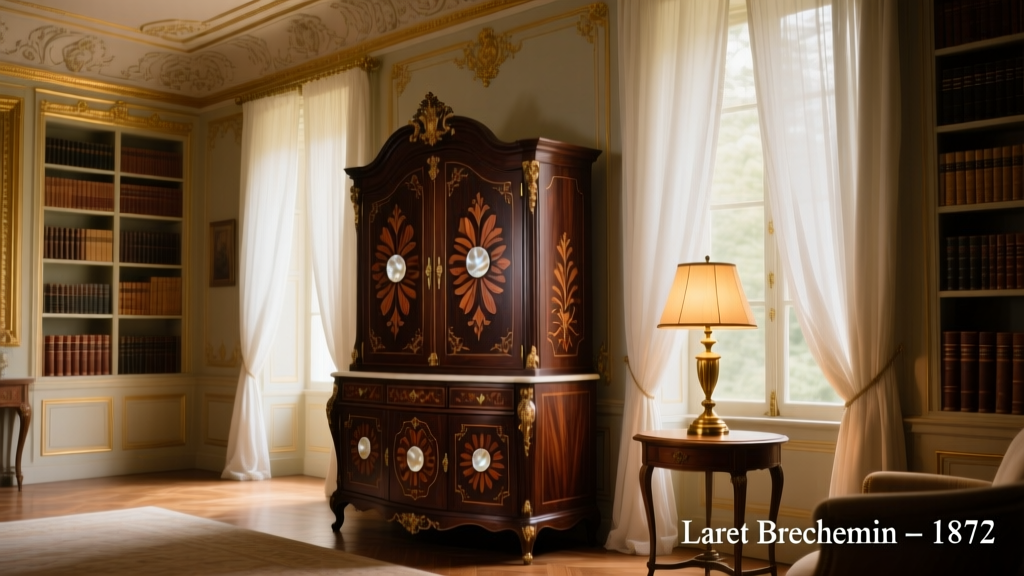
Laret Brechemin: The Forgotten French Cabinetmaker Who Redefined Provincial Elegance in the Late 18th Century
M. A. Hadley Pottery: American Art Pottery’s Quiet Masterpiece, 1904–1922
The Audrey American Brilliant Cut Glass Celery Vase: A Study in Laurel Pattern Precision and 19th-Century Craftsmanship
Authentic 1965 Hanna-Barbera Animation Cel: Fred and Barney from The Flintstones — A Collector’s Guide to Provenance, Condition, and Value
Eskimo Doll Carved Incised Face, 1¾-Inch Pair: Authenticity, Provenance, and Conservation Considerations
The Walnut Ships Wheel Hat Rack: A 37-Inch Masterpiece of Victorian Naval Craftsmanship and Porcelain Detailing
Nailsea Bowl with Aqua and White Loops, Circa 1850 — A Technical and Historical Examination of a 7¼-Inch English Glass Artifact
Franciscan Soup Dish with Apple Cover and Lug Handle: Identification, History, and Restoration Guidance