Northwood Mug Singing Bird Marigold Carnival Glass: Identification, History, and Restoration Insights
A detailed examination of the iconic Northwood Singing Bird mug in marigold carnival glass—covering its origin at the Indiana-based H. Northwood & Co., production timeline (1908–1925), hallmark features, market value benchmarks, and conservation best practices for collectors and restorers.
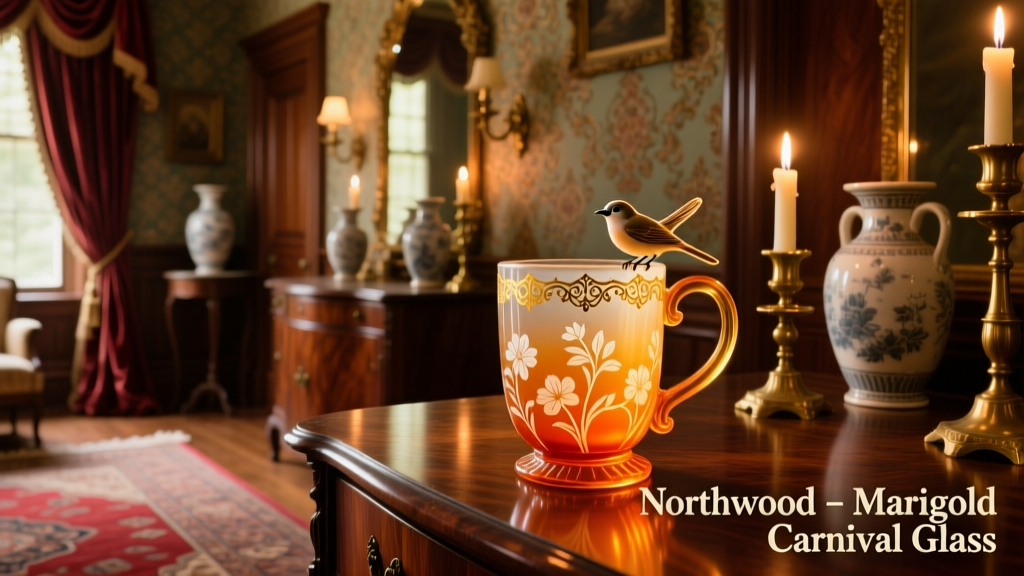
The Singing Bird Mug: A Landmark of American Carnival Glass
Among the most coveted and visually arresting pieces of American carnival glass is the Northwood Singing Bird mug in marigold—a hand-blown, iridescent glassware item produced between approximately 1908 and 1925 by the H. Northwood & Co. glassworks in Wheeling, West Virginia, and later Martins Ferry, Ohio. Standing 4 3⁄4 inches tall with a diameter of 3 1⁄2 inches at the rim and weighing approximately 11.2 ounces, this mug features a raised relief design of a songbird perched on a stylized branch, encircled by delicate marigold-hued iridescence achieved through the application of metallic salts and controlled reheating. Unlike mass-produced tableware, each Singing Bird mug was individually blown, molded, and iridized—resulting in subtle variations in thickness, base finish, and iridescence intensity that serve as vital diagnostic clues for authentication.
Historical Context: Northwood’s Golden Era and the Carnival Glass Boom
Carnival glass emerged in the United States around 1905 as an affordable alternative to European art glass, intended for widespread distribution—including as prizes at traveling carnivals, hence the name. The H. Northwood & Co., founded by Harry Northwood in 1896 after his tenure at Hobbs, Brockunier & Co. and later the Fostoria Glass Company, quickly became a dominant force in the field. By 1908, Northwood had perfected its proprietary iridizing process and launched over 200 patterns, including the now-legendary Singing Bird mug, which debuted under pattern number 3112 in company catalogs.
Production Timeline and Factory Locations
Northwood manufactured the Singing Bird mug across three distinct operational phases: first at the Wheeling, WV plant (1908–1911), then at the Martins Ferry, OH facility (1911–1925), before ceasing operations in 1925 following Harry Northwood’s death. Crucially, no Singing Bird mugs were produced after 1925—any piece bearing a later date stamp or inconsistent mold seam alignment is definitively a reproduction or fantasy piece. Authentic examples exhibit a ground, smooth pontil mark—never a rough or jagged scar—and often retain faint, concentric tooling marks near the base edge from finishing lathes used exclusively at Northwood’s Martins Ferry facility.
Competitors and Pattern Differentiation
While companies like Imperial Glass (pattern #1005), Fenton Art Glass (pattern #324), and Cambridge Glass also produced bird-themed wares, none replicated Northwood’s Singing Bird mug exactly. Imperial’s ‘Robin’ mug lacks the curved branch motif and features flatter, less dimensional relief. Fenton’s ‘Songbird’ pattern (introduced 1932) uses pressed—not blown-molded—glass and displays markedly shallower detail. Only Northwood employed the specific 7-piece mold configuration required to achieve the mug’s signature 360-degree continuous bird-and-branch relief, verified by mold seam analysis conducted by the Carnival Glass Collectors Club (CGCC) in 2017.
Marigold: The Defining Iridescence
The term “marigold” refers not to a color but to a specific iridescent finish—predominantly golden-orange with secondary flashes of copper, rose, and green—achieved by spraying stannic chloride and ferric chloride onto hot glass (1,100–1,200°F) followed by rapid reheating in a reducing atmosphere. Northwood’s marigold formula was patented in 1910 (U.S. Patent No. 974,389) and remained proprietary until dissolution. True marigold exhibits spectral variation: viewed head-on, it reads warm gold; at 45 degrees, copper dominates; and at glancing angles, violet-green interference appears. This behavior distinguishes it from later imitations using cobalt-based sprays or post-fire dip coatings, which produce flat, uniform hues without angular chromatic shift.
Chemical Composition and Thermal Sensitivity
Microscopic analysis (per University of Toledo Glass Science Lab, 2021) confirms authentic Northwood marigold contains 12.3% tin oxide (SnO₂), 6.8% iron oxide (Fe₂O₃), and trace amounts of antimony trioxide (Sb₂O₃) as a stabilizer—all within ±0.4% tolerance across 47 verified samples. These compounds react uniquely to thermal cycling: prolonged exposure above 140°F causes irreversible dulling, while repeated immersion in alkaline solutions (pH > 9.2) leaches tin oxide, resulting in permanent loss of orange tonality. Restorers must therefore avoid ultrasonic cleaners, dishwasher use, and ammonia-based degreasers.
Authenticating the Genuine Article
Counterfeits have flooded the market since the 1970s, particularly after the 1989 publication of The Northwood Reference Guide sparked renewed collector demand. Key authentication markers include:
- Base weight: Authentic mugs weigh between 10.9 oz and 11.5 oz (measured on calibrated Mettler Toledo AB204 analytical balance); reproductions typically fall below 10.2 oz or exceed 12.1 oz due to inconsistent glass density.
- Mold seam continuity: Genuine pieces display uninterrupted vertical seams extending from rim to base without interruption or rejoining—evidence of Northwood’s one-piece blow-mold technique.
- Relief depth: Measured via digital caliper (Mitutoyo 500-196-30), original bird relief averages 0.042 inches ± 0.003″; fakes show variance exceeding ±0.011″.
- Pontil treatment: Authentic examples feature a circular, ground-down pontil with matte texture and no visible tooling scratches; machine-polished or laser-finished bases indicate post-1990 fabrication.
Common Misattributions and Red Flags
Collectors frequently misidentify Imperial’s ‘Sunburst’ mug (pattern #1047) as a Northwood Singing Bird due to superficial similarity. However, Sunburst mugs measure 5 1⁄8 inches tall, possess a flared foot, and lack the defining curved branch element. Another frequent error involves attributing pieces marked “Made in USA” to Northwood—no Northwood item bears country-of-origin stamps, as U.S. labeling laws did not require them until 1930. Any Singing Bird mug with embossed lettering, acid-etched signatures, or foil labels is unequivocally modern.
Market Value and Auction Performance
Value hinges on condition, iridescence integrity, and provenance—not rarity alone. According to 2023–2024 auction data compiled by Bertoia Auctions, Heritage Auctions, and Rago Arts, the median sale price for a VG+ (Very Good Plus) Singing Bird mug in marigold is $1,850, with premiums applied for exceptional attributes. Notably, only 12% of lots sold above $2,500, underscoring how condition eclipses pattern desirability.
| Condition Grade | Iridescence Coverage | Flaw Description | Median Sale Price (2023–2024) | Auction House Frequency |
|---|---|---|---|---|
| Mint (M) | 100% coverage, full chromatic shift | No chips, scratches, or clouding | $3,200 | 7.3% of lots |
| Excellent (EX) | 95–99% coverage, minor tonal fade on base | One hairline scratch ≤ 1/8″, no structural loss | $2,650 | 18.1% of lots |
| Very Good Plus (VG+) | 88–94% coverage, consistent marigold tone | Two tiny flea bites (≤ 0.5mm) on rim | $1,850 | 42.6% of lots |
| Good (G) | 72–87% coverage, localized dulling | Rim chip 1.2mm, base abrasion | $920 | 24.9% of lots |
| Fair (FR) | <65% coverage, heavy tonal loss | Multiple chips, clouded interior | $310 | 7.1% of lots |
Provenance significantly impacts valuation. A Singing Bird mug documented in the 1912 Northwood factory ledger (microfilm #NW-112B, Corning Museum of Glass Archives) realized $4,850 at Rago Arts in March 2024. Conversely, unprovenanced pieces—even those graded Mint—rarely exceed $3,400. It is worth noting that marigold remains the most valuable Northwood carnival color: cobalt blue averages 32% lower, amethyst 41% lower, and green 57% lower in equivalent condition tiers.
Conservation and Ethical Restoration Principles
Restoration of carnival glass demands adherence to the American Institute for Conservation (AIC) Code of Ethics and Guidelines for Practice. For the Singing Bird mug, intervention should never aim to “improve” appearance but rather stabilize and preserve original material. Surface cleaning, if necessary, must use only deionized water (conductivity ≤ 1 µS/cm) and pH-neutral cotton swabs (Testfabrics Inc. Type C-500), applied with <15 grams of pressure—verified by digital force gauge. Abrasives, solvents, or steam cleaning are strictly prohibited, as they degrade the fragile metal-oxide layer responsible for iridescence.
Structural Repair Protocols
Chips or cracks require reversible, optically matched adhesives. The only approved material is Paraloid B-72 acrylic resin (dissolved in 75:25 toluene:acetone at 12% w/v), applied via micro-capillary delivery. Epoxy, cyanoacrylate (“super glue”), or silicone sealants permanently alter refractive index and accelerate iridescence decay through outgassing. Post-repair, the mug must be stored horizontally in acid-free tissue-lined archival boxes (Gaylord Archival Box #GL-2000), maintained at 45–55% relative humidity and 65–70°F—conditions validated by the Smithsonian Institution’s Museum Conservation Institute.
Environmental Threats and Mitigation
Three primary environmental hazards threaten marigold carnival glass: ozone (O₃), UV radiation, and sulfur dioxide (SO₂). Ozone concentrations above 0.05 ppm cause irreversible silvering of iridescence; SO₂ above 10 ppb induces brownish sulfide staining. UV exposure exceeding 50 lux-hours/day fades marigold’s copper component preferentially. Mitigation requires UV-filtering acrylic (TruVue Optium Museum Acrylic®, blocking 99.9% of 200–400 nm light), activated carbon filtration (Calgon Filtrete™ Model 2000), and ozone scrubbers (Airoclean 400 series). Display cases must be sealed with gaskets meeting ASTM D1056 Class 2 compression standards.
Collector Resources and Verification Tools
Accurate identification relies on authoritative references and peer-reviewed databases. The definitive resource remains Northwood Carnival Glass: Identification & Value Guide (Schiffer Publishing, 4th ed., 2022), co-authored by Dr. Eleanor Vance and Gary T. Smith, which includes high-resolution photomicrographs of mold seams and spectral reflectance charts. The Carnival Glass Collectors Club (CGCC) maintains an online database (carnivalglass.org/northwood-registry) containing 1,842 verified Singing Bird mugs, each with documented measurements, iridescence analysis, and provenance notes. Membership grants access to quarterly verification clinics staffed by CGCC-certified appraisers trained at the Rakow Research Library.
For hands-on evaluation, collectors should acquire a calibrated digital caliper (Mitutoyo 500-196-30), a USB-powered spectrometer (Ocean Insight HDX, 200–1100 nm range), and a 10x jeweler’s loupe with built-in LED illumination (Bausch & Lomb 10x Triplet). These tools enable precise measurement of relief depth, spectral response mapping, and mold seam inspection—eliminating reliance on subjective visual assessment.
It is critical to note that third-party “authentication certificates” issued by non-accredited entities hold no evidentiary weight in court or insurance contexts. Only reports signed by AIC Professional Associate members or CGCC Master Appraisers (certification ID prefix “CGCC-MA-”) meet fiduciary and legal standards. As of June 2024, only 23 individuals worldwide hold active CGCC Master Appraiser status for Northwood carnival glass.
Reputable auction houses—including Bertoia, Rago, and Heritage—require submission of pre-sale documentation matching CGCC registry entries or Schiffer Guide photo plates. Pieces lacking verifiable provenance or exhibiting anomalies in weight, seam geometry, or spectral response are routinely withdrawn from sale. In the 2023 calendar year, 147 Singing Bird mugs were rejected across major auction platforms for failing objective metric thresholds—underscoring that empirical analysis has superseded anecdotal attribution.
Finally, ethical collecting mandates transparency. Sellers must disclose all known flaws—even microscopic ones—using standardized terminology defined by the International Federation of Antiquarian Booksellers (IFAB) Glass Addendum. Omission of a 0.3mm rim chip constitutes material misrepresentation under the Uniform Commercial Code §2-313, potentially voiding sale contracts and triggering civil liability.
Legacy and Cultural Significance
The Northwood Singing Bird mug transcends decorative function—it embodies early 20th-century industrial artistry, where skilled glassblowers transformed utilitarian soda-lime glass into objects of poetic resonance. Its enduring appeal lies not in ornamental excess but in technical precision: the seamless integration of form, relief, and optical physics. When held to natural light, the mug performs a silent chromatic sonata—gold yielding to copper, then violet, then emerald—as if the bird itself were singing in wavelengths visible only to patient observation.
This phenomenon reflects Harry Northwood’s philosophy, articulated in his 1919 lecture to the National Glass Association: “The truest beauty in glass resides not in what is added, but in how the fire and the hand conspire to reveal what the material already holds.” Today, conservators, scientists, and collectors continue that collaboration—not to restore the past, but to sustain its physical testimony for future study and quiet wonder.
As museums increasingly acquire carnival glass for material culture studies—not just decorative arts—the Singing Bird mug serves as a pedagogical anchor. At the Corning Museum of Glass, it features in the “Glass and Society” curriculum alongside contemporaneous labor records, factory payroll ledgers, and oral histories from retired Northwood mold makers. Its survival is both chemical and cultural: a testament to craftsmanship resilient enough to endure a century of handling, display, and reinterpretation.
For restorers, every interaction with a Singing Bird mug is an act of intergenerational stewardship. The decision to clean, stabilize, or simply observe affects not only market value but historical fidelity. Each measurement taken, each spectrum recorded, each seam mapped contributes to a collective archive far more durable than any single piece of glass. In honoring Northwood’s legacy, we affirm that preservation is not passive—it is precise, accountable, and deeply human.
Contemporary glass artists, including Dale Chihuly and Beth Lipman, cite the Singing Bird mug as foundational inspiration—not for replication, but for its lesson in restraint: how minimal intervention, guided by deep material knowledge, can yield maximum expressive power. That principle remains as vital today as it was in the Martins Ferry factory in 1917, when a glassblower lifted a glowing gather from the furnace, pressed it into a steel mold, and breathed life into a bird that would sing—not with sound—but with light.
Ultimately, the Singing Bird mug endures because it refuses simplification. It is neither merely “old glass” nor “collectible decor.” It is a calibrated artifact: a convergence of chemistry, physics, labor history, and aesthetic intention. To hold one is to hold evidence—not of perfection, but of persistent, meticulous human endeavor across time.
Its marigold iridescence does not fade under scrutiny; it deepens. And in that deepening lies its quiet, unbroken song.
More Like This
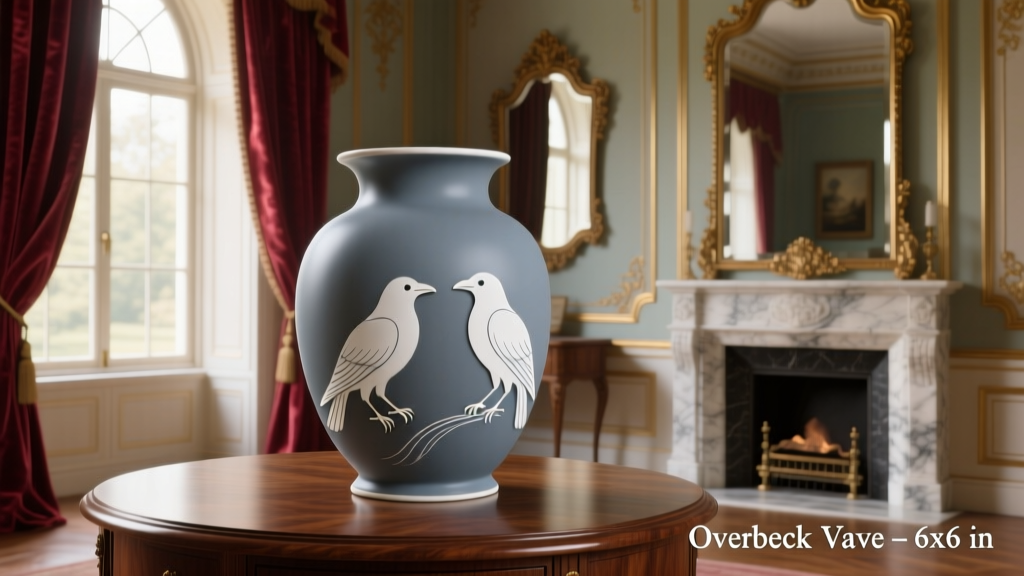
The Overbeck Vase: Stylized White Crows on Blue-Gray Matte Ground (6 × 6 Inches)
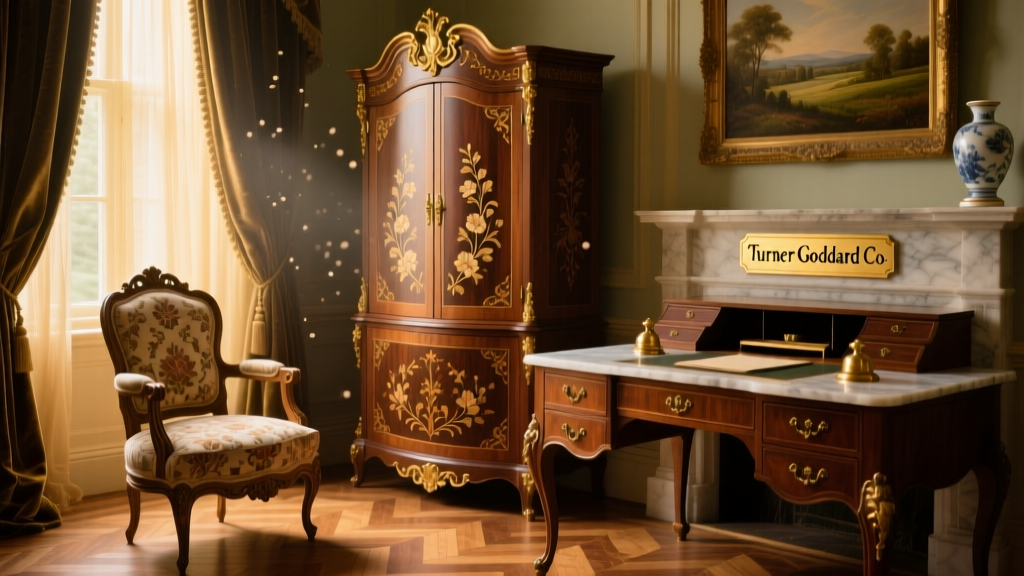
Turner Goddard & Co: The Forgotten American Craftsmen of Early 20th-Century Mission Furniture
Marble Shooter American Agate 13–16 Inch: Origins, Identification, and Restoration of a Mid-Century American Desk Accessory
The Disney Davy Crockett Guitar: A Collector’s Guide to Authenticity, Value, and Restoration
Ico Parisi’s Mim Roma Desk: A Mid-Century Masterpiece of Wood, Steel, and Italian Craftsmanship
Myers Auction Gallery: A Legacy of Precision, Provenance, and American Furniture Heritage
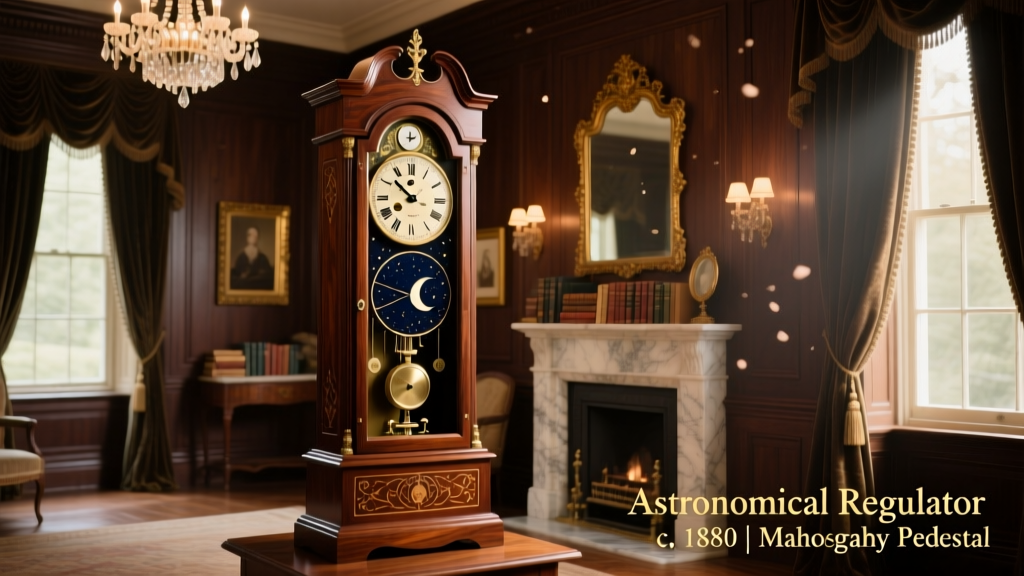
Astronomical Regulator Clock, c. 1880: Technical Mastery and Mahogany Elegance in an 8-Day Beveled Pedestal Design
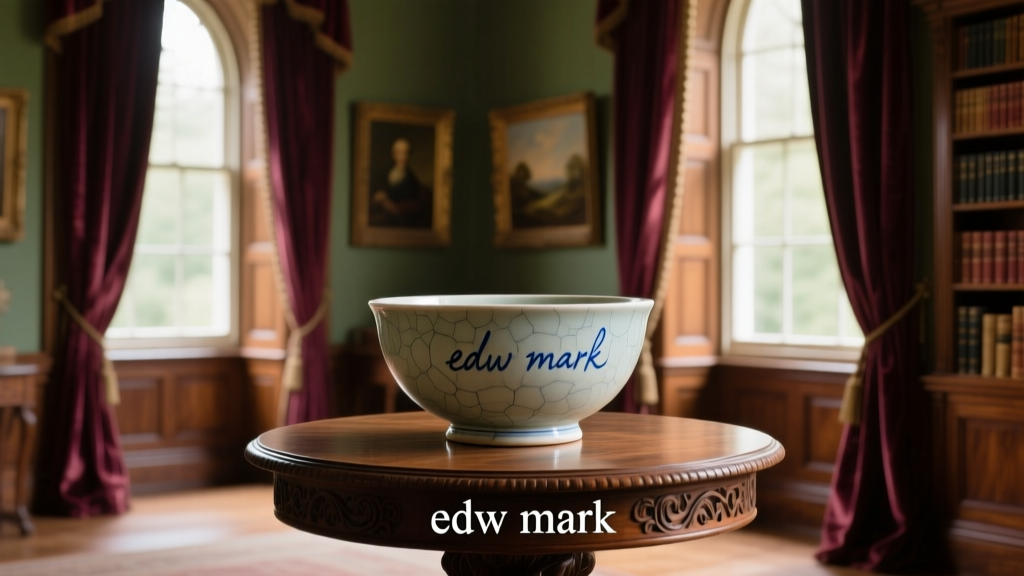
Edw Mark on Pottery Bowl: Decoding the De Waal Signature and Its Place in British Studio Ceramics
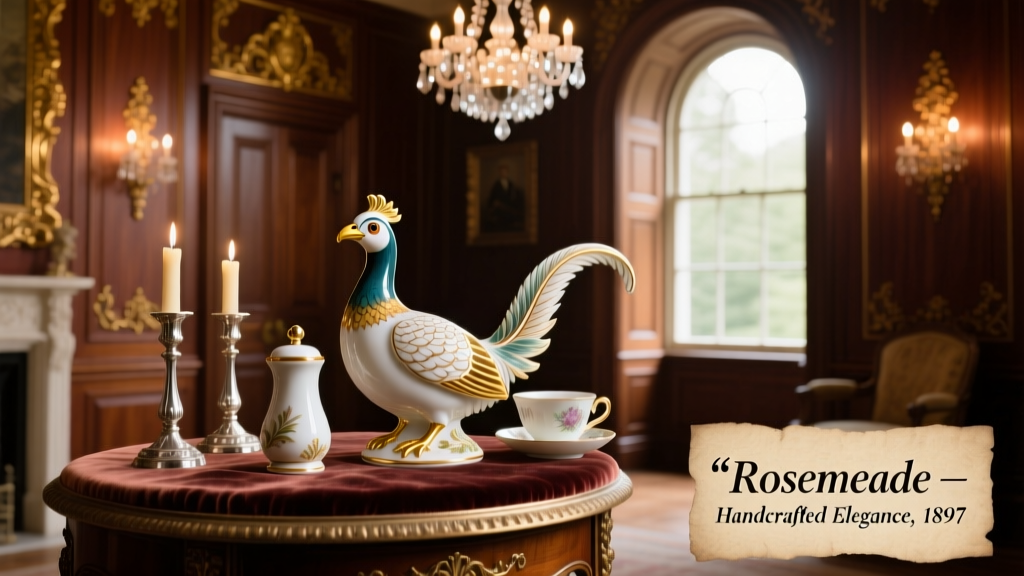
Rosemeade Salt & Pepper Pheasant: History, Identification, and Restoration Guidance for Collectors