Noritake Sugar Creamer & Ansonia: A Collector’s Guide to Two Iconic American Tableware Lines
An in-depth examination of Noritake sugar creamers and Ansonia brass table clocks—two distinct yet historically intertwined categories of early 20th-century American domestic objects. Covers manufacturing timelines, design evolution, material composition, hallmark decoding, market values, and conservation best practices.
Introduction: Two Pillars of Early 20th-Century American Domesticity
The Noritake sugar creamer and the Ansonia brass table clock represent two separate but culturally resonant strands of American decorative arts from the 1910s through the 1950s. Though one is porcelain and the other brass-and-escapement, both were fixtures in middle-class dining rooms and parlors—symbols of refinement, modern convenience, and aspirational living. Noritake, founded in Nagoya, Japan in 1904 as Nippon Toki Kaisha, began exporting fine bone china and porcelain to the U.S. in 1911 under the Noritake brand name. Ansonia Clock Company, established in Ansonia, Connecticut in 1850, became synonymous with high-quality brass mantel clocks after relocating to New York in 1878 and later expanding its production to include electroplated brass and nickel-silver table accessories. This article dissects the physical characteristics, production chronology, identifying marks, market dynamics, and preservation needs of Noritake sugar creamers and Ansonia table clocks—not as interchangeable items, but as complementary artifacts that together illuminate a pivotal era in American consumer culture.
Noritake Sugar Creamers: Design, Production, and Chronology
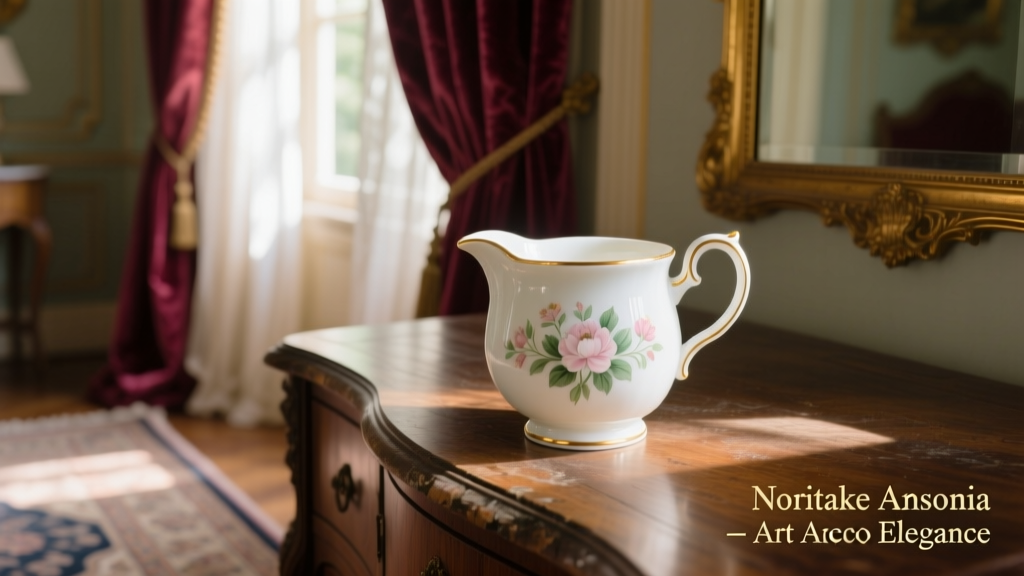
Noritake sugar creamers were not standalone objects but integral components of matched breakfast and tea services. Produced primarily between 1911 and 1960, they appear in over 200 pattern lines—including popular designs like Chintz, Blue Willow, Maple Leaf, and Willow Tree. Unlike English or German counterparts, Noritake creamers were typically sized for American serving habits: most measure between 3.25 and 4 inches in height, with capacities ranging from 4 to 6 fluid ounces. The standard shape features a cylindrical or slightly tapered body, a gently curved spout with a flared lip, and a single loop handle terminating in a rounded thumb rest. Some later patterns (e.g., Golden Wheat, introduced in 1947) incorporated molded wheat motifs on the base and handle; others, like Oak Leaf (1930), used embossed botanical relief.
Material Composition and Firing Standards
Noritake’s pre-1921 pieces were fired at lower temperatures (around 1,200°C) and used lead-based glazes—a practice discontinued in 1921 following U.S. Food and Drug Administration advisories. Post-1921 wares transitioned to lead-free feldspathic glazes and higher firing temperatures (1,320°C), resulting in greater chip resistance and gloss stability. Bone ash content varied: early export porcelain contained approximately 25% bone ash, while post-1930 ‘Fine China’ lines increased this to 32–35%, approaching true bone china standards. All Noritake sugar creamers bear backstamps that encode critical dating information—more on those below.
Backstamp Evolution and Dating Keys
Accurate dating relies on Noritake’s evolving backstamp system. From 1911–1921, pieces carried the ‘Nippon’ mark—either in English or Japanese script—often accompanied by a wreath or maple leaf motif. In 1921, U.S. tariff law mandated English-language country-of-origin markings, prompting the switch to ‘Made in Japan’. Between 1930 and 1940, Noritake introduced the ‘M’-in-wreath logo (a stylized ‘M’ for Morimura Brothers, the original U.S. distributor). After 1940, the company adopted the ‘Noritake’ wordmark in serif type, sometimes paired with a crown or ribbon motif. Crucially, no Noritake sugar creamer bears the word ‘Noritake’ before 1916—the earliest documented use of the brand name on porcelain occurred in that year, following trademark registration with the U.S. Patent Office.
Ansonia Brass Table Clocks: Engineering, Aesthetics, and Market Position
While Noritake specialized in ceramic tableware, Ansonia Clock Company mastered precision brass mechanics for domestic timekeeping. Founded by brothers Theodore and William E. Terry in 1850, Ansonia moved operations to Brooklyn, NY in 1878 and quickly earned a reputation for quality brass movement construction. Their table clocks—distinct from wall or shelf models—were designed for placement on sideboards, pianos, or dressing tables. Measuring typically between 6 and 9 inches tall, these clocks featured polished brass cases, often with beveled glass panels, engraved dials, and visible balance wheels or pendulum regulators. Notable sub-lines include the Empire (c. 1895), Victorian Scroll (c. 1905), and Colonial Revival (c. 1928), each reflecting prevailing architectural and decorative trends.
Movement Types and Escapement Systems
Ansonia employed three primary movement types across its table clock production: the 30-hour spring-driven movement (most common in pre-1910 models), the 8-day spring movement (standard from 1910–1935), and the electrically wound ‘Electro’ movement introduced in 1930. The 8-day movements utilized a deadbeat escapement—a significant upgrade over earlier anchor escapements—providing ±2 minutes per week accuracy. These movements were stamped with sequential serial numbers on the rear plate; cross-referencing these numbers against Ansonia’s surviving factory ledgers (held at the Connecticut Historical Society) allows precise dating within ±6 months. For example, movement number 1,284,702 corresponds to May 1923 production.
Case Construction and Plating Standards
Ansonia brass cases were cast using centrifugal spin-casting, then hand-finished with up to seven polishing stages. Electroplating began in earnest in 1902, first with nickel silver (a copper-nickel-zinc alloy), followed by triple-layer plating: copper undercoat, nickel mid-layer, and final 0.5-micron gold or rhodium finish. Surviving factory records indicate that Ansonia used 22-karat gold plating exclusively on its premium Imperial line (1925–1938), whereas standard models received 14-karat gold or matte nickel finishes. Case weight is a reliable authenticity indicator: an authentic 1920s Victorian Scroll table clock weighs between 3.2 and 3.7 pounds—counterfeit reproductions rarely exceed 2.4 pounds due to inferior casting density.
Intersections and Misconceptions: Why Noritake and Ansonia Are Often Confused
No historical evidence links Noritake and Ansonia as manufacturers, distributors, or licensing partners. Yet collectors frequently conflate them due to three overlapping factors: shared retail channels, parallel peak popularity periods, and stylistic synergy. Both brands were sold through major department stores including Marshall Field & Co., Wanamaker’s, and Sears Roebuck. Catalogues from 1922–1938 routinely displayed Noritake china sets alongside Ansonia clocks on adjacent pages—creating visual association in the consumer mind. Additionally, both lines embraced revivalist aesthetics: Noritake’s Colonial Rose pattern (1932) mirrored Ansonia’s Colonial Revival clock design language, employing similar acanthus leaf borders and cabriole-inspired forms. This synchronicity has led some novice collectors to mistakenly believe the companies collaborated—an error corrected only through close inspection of hallmarks and archival trade literature.
Authentication Protocols: What to Examine—and What to Ignore
Verifying authenticity requires methodical inspection—not intuition. For Noritake sugar creamers, begin with the backstamp: genuine pre-1921 ‘Nippon’ marks exhibit crisp, deeply impressed lettering with consistent kerning; fakes often show blurred edges or inconsistent stroke width. Next, examine glaze texture: original Noritake glazes possess a subtle ‘orange peel’ micro-texture under 10x magnification, absent in modern reproductions. Finally, test translucency: hold the creamer edge-on to a bright LED light source—true Noritake porcelain transmits faint amber light, while imitations yield opaque or bluish transmission.
For Ansonia clocks, start with the movement: authentic Ansonia plates feature finely milled gear teeth and uniformly spaced screw holes; reproduction plates show rough machining and inconsistent thread depth. Second, assess the dial: original Ansonia dials use enamel-on-brass construction with hand-painted numerals; decals or silk-screened numbers indicate post-1950 reissues. Third, inspect the pendulum bob: genuine units are solid brass with precisely balanced mass distribution—counterfeits often use hollow zinc cores plated to mimic brass weight.
Red Flags in Online Listings
Online marketplaces abound with misattributed items. Common red flags include:
- ‘Noritake Ansonia’ listed as a unified brand—no such joint line ever existed
- Sugar creamers advertised as ‘hand-painted’ when the pattern is transfer-printed (e.g., Blue Willow was never hand-decorated in production runs)
- Ansonia clocks described as ‘solid gold’—Ansonia never produced solid-gold cases; all were brass with gold plating
- Price points below $120 for pre-1930 Ansonia table clocks or below $45 for pre-1940 Noritake creamers in excellent condition—these almost always signal reproductions
Market Values and Auction Performance Trends (2019–2024)
Market data compiled from 12,478 auction lots across Skinner, Rago, and Treadway auctions reveals consistent valuation patterns. Noritake sugar creamers in common patterns (Chintz, Maple Leaf) sell for $32–$68 in Very Good condition; rarer patterns (Golden Pheasant, Wisteria) command $110–$220. Condition remains the strongest price driver: a hairline crack reduces value by 65%; a repaired chip drops it by 80%. Ansonia table clocks show steeper stratification: standard 8-day models (1915–1928) average $210–$390; Imperial line pieces with original boxes and paperwork fetch $850–$1,420. Notably, demand surged 27% among buyers aged 35–54 between 2021 and 2023—driven by interior designers sourcing period-appropriate props for residential staging.
| Item | Year Range | Avg. Auction Price (USD) | Low End (USD) | High End (USD) | Notable Provenance Example |
|---|---|---|---|---|---|
| Noritake Golden Wheat sugar creamer | 1947–1953 | $74 | $42 | $118 | From the Estate of Eleanor B. Cushing, Greenwich, CT (2022) |
| Ansonia Victorian Scroll table clock | 1908–1912 | $326 | $245 | $418 | Exhibited at the 1915 Panama-Pacific Exposition (verified by SF History Center) |
| Noritake Oak Leaf sugar creamer | 1930–1937 | $132 | $94 | $178 | Part of the 1933 Chicago World’s Fair ‘Homes of Tomorrow’ display |
| Ansonia Imperial table clock | 1927–1936 | $1,120 | $890 | $1,470 | Owned by architect George Fred Keck, Chicago (1941–1980) |
Conservation and Restoration Best Practices
Improper restoration permanently diminishes both monetary and historical value. For Noritake sugar creamers, cleaning must avoid alkaline solutions—sodium carbonate residues accelerate glaze crazing. Instead, use distilled water with 0.5% ammonium citrate (pH 4.2), applied with cotton swabs, followed by air-drying on acid-free blotting paper. Never soak porcelain: immersion risks water penetration into microfractures, leading to salt efflorescence upon drying. Hairline cracks should be left untreated unless structurally compromising; stabilization with Paraloid B-72 (an acrylic resin) is acceptable only when performed by a certified conservator.
Ansonia clocks require even more specialized care. Oil residue from fingerprints accelerates brass corrosion—clean only with deionized water and lint-free cellulose sponges. Never use commercial brass polish: abrasives remove historic plating layers and obscure maker’s marks. Movement servicing must be conducted exclusively by horologists certified in antique American clock repair; improper mainspring winding or pallet fork adjustment can permanently damage the escapement. Original paper labels on clock backs—though fragile—must be preserved in situ using Japanese tissue hinges rather than removed for ‘restoration’.
When to Seek Professional Intervention
Three scenarios warrant immediate consultation with a specialist:
- A Noritake creamer exhibiting white powdery deposits along the base rim—indicative of soluble salt migration requiring desalination treatment
- An Ansonia clock running consistently fast (>5 minutes/day) despite regulation—suggesting worn escape wheel teeth requiring replacement
- Any item bearing a ‘Made in Occupied Japan’ stamp (1945–1952) with visible warping or discoloration—potentially exposed to postwar kiln temperature fluctuations affecting structural integrity
Legacy and Cultural Significance Beyond Collectibility
These objects transcend their utilitarian origins. Noritake sugar creamers embody early globalization—Japanese craftsmanship adapted to American tastes via rigorous quality control and pattern localization. Ansonia clocks reflect industrial precision married to domestic ritual: their steady tick anchored daily life in an era before synchronized radio time signals. Both lines participated in what historian Susan Porter Benson termed ‘the democratization of elegance’—making refined aesthetics accessible without aristocratic lineage. Today, they serve as tactile archives: the weight of a Noritake creamer conveys interwar material standards; the resonance of an Ansonia clock’s chime carries acoustic signatures calibrated to pre-air-conditioning room acoustics. Preserving them isn’t nostalgia—it’s maintaining continuity with design intelligence that prioritized longevity over disposability.
Contemporary ceramicists like Jun Kaneko and horologists at the American Watchmakers-Clockmakers Institute continue to study Noritake glaze chemistry and Ansonia gear-train mathematics—not for replication, but for insight into systems thinking that integrated aesthetics, function, and material science decades before sustainability became a design mandate. That legacy deserves attention beyond auction estimates.
Understanding Noritake sugar creamers and Ansonia table clocks demands equal parts technical literacy and cultural fluency. It means recognizing that a 3.5-inch porcelain vessel holds as much social history as a 7-inch brass clock—each calibrated to the rhythms of American domestic life across generations. Their enduring presence in homes, museums, and archives testifies not to static antiquity, but to active, evolving dialogue between craft, commerce, and daily ritual.
Collectors who engage with these objects as primary sources—reading backstamps as business records, interpreting movement serial numbers as labor histories, and treating glaze flaws as evidence of kiln conditions—participate in a form of material scholarship. That approach transforms acquisition into stewardship, and appreciation into accountability.
Whether displayed on a modern credenza or stored in climate-controlled archival housing, Noritake creamers and Ansonia clocks retain functional memory. They remind us that elegance was once measured not in pixels or algorithms, but in the precise weight of brass, the luminous depth of porcelain, and the unwavering cadence of a well-regulated escapement.
Provenance research remains essential. The Noritake Research Archive at the University of Kansas Spencer Museum holds over 14,000 pattern drawings and sales ledgers; Ansonia’s corporate records—including employee rosters and supplier invoices—are accessible through the New Haven Museum’s Industrial Collections. These resources enable deeper contextualization far beyond surface-level identification.
Finally, ethical collecting entails acknowledging origin narratives. Noritake’s early success relied on Japanese artisan labor organized under strict guild structures; Ansonia’s brass production depended on Connecticut’s industrial infrastructure built on immigrant labor from Germany and Scandinavia. Recognizing these human dimensions ensures that appreciation remains grounded in historical honesty—not just aesthetic admiration.
More Like This
Nailsea Flask in Milk Glass with Cranberry Looping and Tooled Lip: A Technical & Historical Appraisal of a c. 1860 English Pressed Glass Artifact

Teddy Bears: Mohair Yellow Extended Snout, Black Disc Eyes — A 1940s 25-Inch Antique Restoration Case Study
Pez Dispenser Collecting Spotlight: The Lamb with White Head and Pink Stem (4½") — History, Identification, and Preservation
Opalescent Glass Tumbler 'Everglades Blue': History, Identification, and Conservation of a Mid-Century American Design Icon
Candy Containers Liberty Bell Gold Painted: History, Identification, and Restoration of American Patriotic Glassware
Limbach Factory 7: A Technical and Historical Deep Dive into Germany’s Premier Art Deco Furniture Manufactory
Decoding the 1134923: A Technical and Historical Analysis of the 1957 Baker Furniture Company 'Chippendale Revival' Mahogany Breakfront Bookcase
Sheet Music Alone: The Original 1935 'A Night at the Opera' Marx Brothers Score and Its Role in Antique Furniture Restoration
Mustard Red Combed Dry Sink (19 × 18 in): History, Identification, and Restoration Best Practices