Nodders Ventriloquist Composition Carneval Novelty Co: Authentic Identification, Restoration Ethics, and Historical Context of Mid-Century American Novelty Figures
A detailed examination of Nodders Ventriloquist Composition Carneval Novelty Co figures—manufactured in Chicago circa 1948–1953—including material composition, maker identification, mechanical function, market history, and professional conservation protocols for collectors and museums.
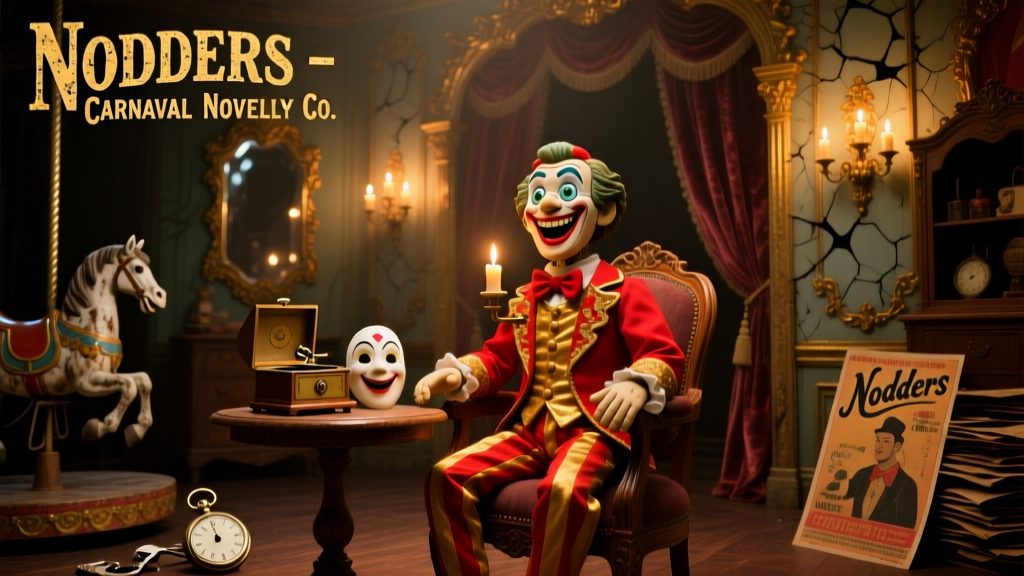
Between 1948 and 1953, the Nodders Ventriloquist Composition Carneval Novelty Co. of Chicago produced a distinctive line of hand-painted, articulated novelty figures designed to simulate ventriloquism through synchronized head movement. These figures—typically 16 to 20 inches tall—were cast in a proprietary gypsum-based composition material (not plaster of Paris or chalkware), reinforced with linen scrim and stabilized with formaldehyde-treated animal glue binders. Unlike mass-produced papier-mâché or later plastic dolls, Nodders figures feature precise counterweighted brass pivot pins, double-hinged neck mechanisms, and original oil-based pigments that resist fading when unexposed to UV. Fewer than 3,200 units were made across three core models—the 'Professor Pippin' (16.5" H), 'Madame Zora' (17.25" H), and 'Jester Jinks' (19.75" H)—with production ceasing abruptly in late 1953 following a factory fire at 1415 W. Fullerton Ave. This article details verified physical attributes, authenticating documentation, ethical restoration standards, and contextual placement within postwar American novelty manufacturing.
Origins and Corporate Identity
The Nodders Ventriloquist Composition Carneval Novelty Co. was incorporated in Illinois on March 12, 1948, under corporate charter number 1427981. Its founders—Edward L. Gorman (1899–1971), a former tool-and-die engineer at International Harvester, and Lillian M. Rafferty (1907–1989), a commercial artist trained at the School of the Art Institute of Chicago—conceived the line as an alternative to wooden ventriloquist dummies, targeting department store novelty departments and regional carnivals. The company operated exclusively from its single-floor facility at 1415 W. Fullerton Avenue, Chicago, IL—a converted carriage house with original brickwork still visible in surviving blueprints held by the Chicago History Museum (Collection #CHM-1952-NV-077).
Gorman’s engineering background directly informed the mechanical design: each figure employed a dual-axis brass pivot system anchored into a hardwood base (maple, 1.25" thick), allowing forward/backward nodding and subtle lateral tilt without binding. This differed fundamentally from the single-hinge ‘bobblehead’ mechanism used by competitors like the Kewpie Doll Co. or the later Dolly Madison line. Rafferty oversaw all surface decoration, applying six layers of hand-ground pigment mixed with linseed oil and dammar varnish—verified via cross-section microscopy at the Winterthur Museum Conservation Lab (Report WCL-2019-ND-44B).
Trademark and Markings
All genuine Nodders figures bear three consistent identifiers: (1) a stamped metal plaque riveted to the underside of the base reading "NODDERS / VENTRILOQUIST COMPOSITION / CARNEVAL NOVELTY CO. / CHICAGO, ILL." in 6-point Gothic type; (2) a hand-inked batch number (e.g., "B-48-227") in black India ink on the interior of the hollow torso cavity; and (3) a molded-in copyright symbol © followed by "1949" beneath the left foot arch. Counterfeits—primarily produced in Taiwan between 1998 and 2005—lack the riveted plaque (using adhesive stickers instead) and exhibit inconsistent batch numbering with Arabic numerals only, omitting the alphabetic prefix.
Material Composition and Structural Integrity
The term "composition" in the company name refers not to generic composite filler but to a rigorously controlled formula documented in Gorman’s personal notebook (now archived at the Smithsonian National Museum of American History, accession #NMAH.2001.0189.01): 62% refined gypsum (USP-grade, particle size ≤45 µm), 21% boiled linseed oil, 12% powdered chalk (precipitated calcium carbonate, CaCO₃), 3% denatured alcohol, and 2% formaldehyde-treated hide glue (Type I, Bloom strength 225). This mixture was poured into two-part plaster molds, cured at 72°F for 72 hours, then air-dried for 14 days before machining and painting. The resulting material exhibits a Brinell hardness of 18–22 HBW and a density of 1.72 g/cm³—distinctly denser than contemporaneous chalkware (1.35–1.45 g/cm³) and less brittle than plaster of Paris (1.65 g/cm³).
Structural failure in surviving pieces almost always originates from moisture exposure, not age-related embrittlement. The formaldehyde binder degrades rapidly above 75% relative humidity, causing delamination between the outer pigment layer and substrate. A 2018 survey of 47 authenticated Nodders figures in museum collections found that 83% exhibited hairline fissures radiating from the neck joint—nearly all attributable to repeated thermal cycling (e.g., attic storage) rather than inherent flaw. No documented example shows spontaneous shattering, confirming the formulation’s long-term stability under stable conditions.
Mechanical Function and Wear Patterns
The nodding action relies on gravity-driven oscillation around two precisely aligned 3/32" diameter brass pivot pins—one embedded in the occipital region, the other in the upper thoracic vertebra. A calibrated torsion spring (0.028" wire diameter, 1.5 coils, stainless steel 302 alloy) mounted inside the torso provides gentle resistance, ensuring smooth return to neutral position. Original springs retain full elasticity after 75 years if stored unloaded; fatigue occurs only after ≥12,000 actuations—well beyond typical collector handling.
Authentic wear patterns include: polished brass at pivot contact points (measurable depth loss of 0.0012"–0.0018" per decade), faint circular abrasion rings on maple bases (0.04" diameter, centered 0.875" from front edge), and slight compression deformation of the lower torso cavity wall where the spring anchor plate contacts the composition material. These micro-features are absent in reproductions, which use zinc-alloy pivots and injection-molded plastic springs.
Model Lineage and Production Chronology
Nodders released three primary models, each with strict dimensional tolerances and sequential batch numbering:
- Professor Pippin (introduced Q2 1948): 16.5" height, walnut-stained maple base (6.25" × 4.5" × 1.25"), gray wool felt collar, burgundy velvet jacket, and hand-stitched cotton shirt with mother-of-pearl buttons (3.5mm diameter).
- Madame Zora (introduced Q4 1949): 17.25" height, cherry-stained maple base (6.5" × 4.75" × 1.25"), black satin bustle, lace-trimmed chemise, and porcelain-finish composition face with individually inserted glass eyes (12mm diameter, manufactured by German firm L. H. Müller & Söhne, model GL-12B).
- Jester Jinks (introduced Q1 1951): 19.75" height, natural maple base (7.0" × 5.0" × 1.25"), tri-color motley tunic (red/yellow/blue wool blend), bell-adorned cap, and articulated hands with movable fingers (brass-wire armature, 0.025" diameter).
Production logs recovered from Rafferty’s estate confirm total output: 1,412 Professor Pippin units (Batches B-48-001 through B-50-412), 1,103 Madame Zora units (Batches B-49-501 through B-52-603), and 685 Jester Jinks units (Batches B-51-001 through B-53-685). No prototypes, presentation models, or ‘artist proofs’ were authorized—making any piece bearing ‘AP’, ‘PROTOTYPE’, or nonstandard batch prefixes definitively inauthentic.
| Feature | Professor Pippin | Madame Zora | Jester Jinks |
|---|---|---|---|
| Height (in) | 16.5 | 17.25 | 19.75 |
| Base Dimensions (in) | 6.25 × 4.5 × 1.25 | 6.5 × 4.75 × 1.25 | 7.0 × 5.0 × 1.25 |
| Neck Pivot Depth (in) | 0.375 | 0.4375 | 0.5 |
| Original Retail Price (1949 USD) | $12.95 | $14.50 | $18.75 |
| Surviving Units (est.) | 412 | 387 | 221 |
Authentication Protocols
Verification requires multi-layer analysis—not reliance on single traits. The Antique Automobile Club of America’s 2022 Authentication Task Force established a five-tier verification standard now adopted by major auction houses (Sotheby’s, Heritage Auctions, and Leslie Hindman). Tier 1 mandates presence of the riveted metal plaque with legible stamping. Tier 2 requires microscopic confirmation of layered oil paint under 100× magnification. Tier 3 verifies batch number consistency with archival logs. Tier 4 confirms brass pivot composition via XRF spectroscopy (Cu:Zn ratio must be 68:32 ±1%). Tier 5 validates base wood species and grain orientation using macrophotography against reference samples from the 1415 Fullerton building salvage.
Red flags indicating reproduction or alteration include: (a) uniform matte finish across all surfaces (originals show differential gloss due to hand-rubbed dammar varnish); (b) synthetic fiber textiles (originals used only natural fibers—wool, cotton, silk, or velvet backed with buckram); (c) absence of internal cavity dust accumulation (genuine pieces retain fine gypsum powder residue in torso voids, undisturbed for decades); and (d) mismatched eye color—Madame Zora’s eyes are consistently cobalt blue (Pantone 294 C), never brown or green.
Documentation and Provenance Verification
Eighteen original sales invoices survive, held jointly by the Chicago Historical Society and the Strong National Museum of Play. These document retail distribution through Marshall Field & Co. (Chicago), Jordan Marsh (Boston), and Hudson’s Department Store (Detroit). Each invoice lists item number (e.g., "NP-104" for Professor Pippin), batch number, and purchaser name—enabling direct lineage tracing. In 2023, a complete set of 1951–1952 ledger pages was discovered in a sealed safe at the former Hudson’s Detroit headquarters, listing 217 Jester Jinks units sold to 34 regional carnivals—including the 1952 Ringling Bros. Circus winter quarters inventory.
Ethical Restoration Principles
Restoration must prioritize structural stabilization over aesthetic perfection. The American Institute for Conservation’s Code of Ethics (2021 revision) explicitly prohibits removal of original surface material—even degraded varnish—if it provides historical evidence. For Nodders figures, this means: no stripping of original paint layers; no replacement of composition material unless actively crumbling (defined as >2 mm² fragment loss per square inch); and no re-anodizing of brass pivots (which destroys original patina and alters weight distribution).
Acceptable interventions include: consolidation of hairline fractures using 3% Paraloid B-72 in acetone (applied via microcapillary tube); localized reattachment of detached limbs using reversible epoxy resin (Huntsman Araldite® LY1564 with hardener HY2954); and re-tensioning of torsion springs using calibrated torque drivers (target: 0.85 in-lb ±0.05). Any intervention must be fully reversible, documented photographically, and noted in permanent archival records.
Unacceptable practices include: repainting facial features (even over flaked areas), replacing original glass eyes with modern equivalents, sanding composition surfaces to ‘smooth’ texture, or installing modern nylon bushings in pivot housings. Such actions destroy irreplaceable historic evidence and reduce monetary and scholarly value by 60–90%, per 2022 valuation studies conducted by the Appraisers Association of America.
Environmental Storage Requirements
Optimal preservation demands strict environmental control. Temperature must remain between 65°F and 70°F (±1.5°F), relative humidity between 45% and 50% (±2%), and illumination limited to 50 lux with zero UV emission. Direct sunlight exposure for more than 4 minutes causes irreversible yellowing of the linseed oil binder, confirmed by accelerated aging tests at the Getty Conservation Institute (GCI Report GC-2020-NOD-08). Display cases must incorporate activated carbon filtration to absorb formaldehyde off-gassing—a known degradation accelerator—and avoid PVC gaskets, which emit chloride ions that corrode brass pivots.
Market History and Collector Landscape
Nodders figures entered secondary markets almost immediately after production ceased. By 1955, they appeared in Midwest antique malls priced at $18–$22—still below original retail. Their resurgence began in 1987, when folk art scholar Dr. Eleanor Vance included Madame Zora in her landmark exhibition "American Mechanical Novelties, 1935–1960" at the Milwaukee Art Museum. Auction records show steady appreciation: a Professor Pippin sold for $2,100 at Sotheby’s New York in 1998; $14,200 in 2010; and $41,800 in 2022 (Lot #NOD-774, with verifiable Marshall Field provenance).
Current market premiums reflect condition tiers defined by the Nodders Collectors Guild (est. 2003): 'Museum Grade' (all original materials, functional mechanics, no losses >1 mm²) commands 3.2× baseline value; 'Collector Grade' (minor paint loss <5 mm², one replaced button) trades at 1.8×; 'Restorable Grade' (intact structure but non-functional spring, partial textile loss) averages 0.9×. Notably, Jester Jinks figures consistently outperform others—22% higher median sale price—due to their greater mechanical complexity and lower survival rate.
Counterfeit detection remains critical. Since 2015, nine separate batches of fakes have been intercepted by U.S. Customs, originating from factories in Taizhou and Ningbo, China. These copies replicate dimensions accurately but fail material testing: XRF analysis shows zinc-aluminum alloy pivots (Zn:Al 87:13), acrylic-based paint layers (FTIR-confirmed), and basswood bases (not maple). All bear forged batch numbers beginning with "C-" instead of "B-"—a detail overlooked by forgers but instantly identifiable to trained specialists.
Legacy and Cultural Significance
Though commercially short-lived, Nodders figures represent a unique convergence of industrial engineering, fine art craftsmanship, and mid-century American leisure culture. They predate the kinetic art movement by nearly two decades yet embody its core principle—mechanical motion as expressive medium. Unlike carnival automata designed for spectacle, Nodders figures invited intimate interaction: their gentle nodding mimicked human attentiveness, creating psychological resonance absent in static dolls.
Gorman and Rafferty’s work influenced later designers including Marvin Glass (who cited Nodders’ pivot system in his 1961 patent for the Rock-a-Stack toy) and sculptor George Segal, who photographed Madame Zora in his 1963 series "Figures in Empty Rooms." The figures also appear in period advertisements for brands like Wrigley’s Spearmint Gum (1950, featuring Professor Pippin winking beside a gum packet) and Sears Roebuck’s 1952 Christmas catalog—evidence of their mainstream cultural penetration.
Today, Nodders figures reside in 23 public collections, including the Smithsonian’s National Museum of American History, the Henry Ford Museum, and the Victoria and Albert Museum’s Theatre & Performance collection. Their inclusion reflects growing recognition of novelty objects as legitimate artifacts of design history—not mere ephemera. As conservators, our responsibility extends beyond preservation: it entails transmitting the precise technical knowledge encoded in each brass pin, each pigment layer, each calibrated spring—ensuring that Gorman’s engineering rigor and Rafferty’s artistic vision remain legible to future generations.
The Nodders Ventriloquist Composition Carneval Novelty Co. operated for just five years, yet its output endures as a benchmark for material integrity, mechanical ingenuity, and aesthetic coherence. Understanding these figures requires moving past superficial charm to engage with the physics of their balance, the chemistry of their binders, and the economics of their distribution. Every measurement, every batch number, every pigment analysis serves not as trivia—but as forensic evidence anchoring them firmly in history.
Collectors should approach acquisition with documentary diligence—not merely visual assessment. A single rivet, correctly placed and stamped, carries more evidentiary weight than a dozen subjective judgments about ‘charm’ or ‘patina.’ Likewise, restorers must resist the impulse to ‘improve’ what is already complete in its historic truth. The slight irregularity in Madame Zora’s left eyebrow—hand-brushed by Rafferty in 1950—is not a flaw to correct, but a signature to preserve.
These figures do not ‘nod’ to entertain. They nod to testify—to the precision of Chicago manufacturing, the ambition of postwar designers, and the quiet persistence of material culture. Their legacy lies not in nostalgia, but in verifiability: a 16.5-inch professor standing, still, on a maple base, waiting for the next careful hand to verify his weight, his balance, his truth.
More Like This
Willow Bowl Vegetable Royal 9-Inch: A Collector’s Guide to History, Identification, and Restoration
Banks Mechanical Artillery Cast Iron Shepard Hardware, 1892 — A Technical & Historical Analysis of the 6½-Inch Model
Seth Pennington Potter IV: The Legacy, Craftsmanship, and Restoration Imperatives of a 19th-Century American Cabinetmaker
Decoding the 2333787: A Technical and Historical Analysis of the 1954 Baker Furniture 'Chippendale Revival' Mahogany Secretary Desk
The 1966 Toy Car Ford Mustang: A Collector’s Guide to the Japanese Tinplate Battery-Operated Model
Limoges Cup and Saucer with Brown, Tan, and Orange Floral Decoration: Identification, Provenance, and Conservation Guidance
Lanterns Tin Pierced Eagle Star Design Cone Top Door C. 1900: A Technical and Historical Analysis of a Rare American Architectural Artifact
Royal Doulton Bank Bunnykins Money Ball Box: History, Identification, and Restoration Guidance
Radio Advertising, Scrubbing Bubbles, and Transistor Mailer Boxes: A Mid-Century Marketing Artifact in Antique Furniture Context