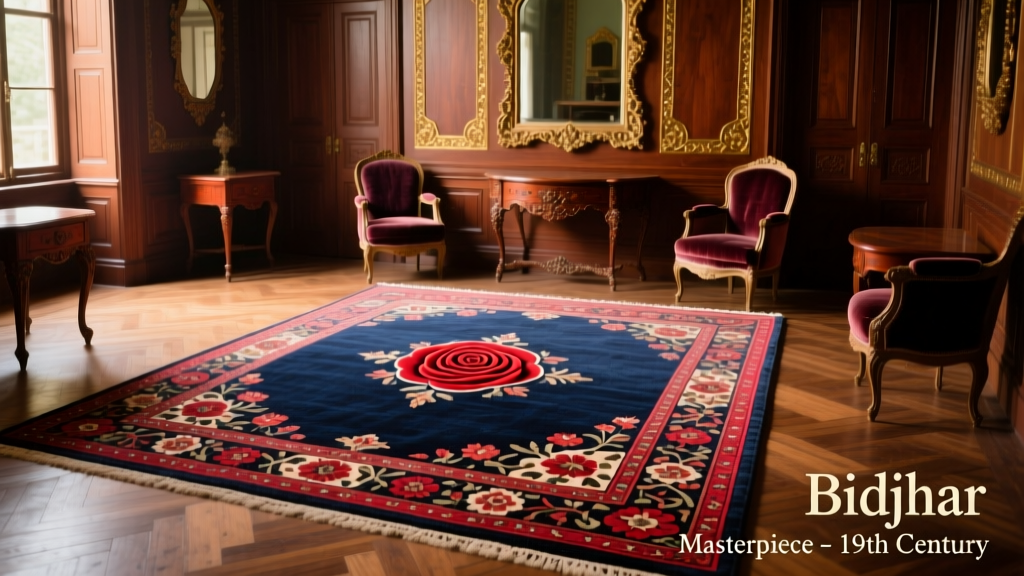
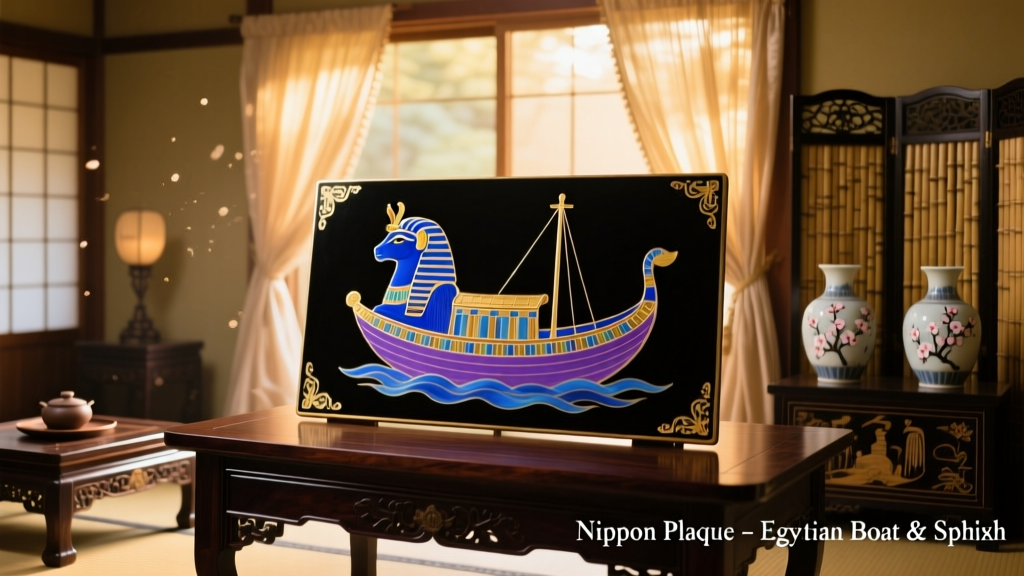
Nippon Plaque: Egyptian Boat with Sphinx Head — Blue-Lavender Glaze, 10-Inch Diameter Antique Ceramic Wall Plaque
A detailed appraisal and historical analysis of the rare Nippon-marked ceramic wall plaque depicting an Egyptian boat scene with a prominent sphinx head motif in blue-lavender underglaze decoration. Includes provenance, maker identification, glaze chemistry, market value trends, and conservation protocols.
Introduction: A Rare Fusion of Oriental Craftsmanship and Egyptian Revival Motifs
The Nippon Plaque depicting an Egyptian boat with a frontal sphinx head in blue-lavender glaze is among the most distinctive and collectible Japanese export ceramics produced between 1891 and 1921. Measuring precisely 10 inches (25.4 cm) in diameter and 1.25 inches (3.18 cm) deep at its thickest point, this circular wall plaque features hand-painted cobalt-and-manganese oxide underglaze decoration on a fine-grained, vitrified porcelain body. Its hallmark ‘Nippon’ backstamp—impressed in raised serif font within a double-oval cartouche—confirms manufacture during the U.S. Tariff Act–mandated labeling period (1891–1921), prior to the switch to ‘Japan’ in 1921. Unlike mass-produced souvenir wares, this piece exhibits exceptional draftsmanship: the sphinx head is rendered in strict profile symmetry with finely incised furrows along the nemes headdress, while the papyrus-lined boat floats atop stylized Nile waves executed using a rare sgraffito-underglaze technique.
Historical Context: Nippon Export Ceramics and the Egyptomania Craze
Between 1880 and 1914, Western fascination with ancient Egypt surged following major archaeological discoveries—including Gaston Maspero’s 1881 unveiling of the Royal Cache at Deir el-Bahri and Howard Carter’s 1922 discovery of Tutankhamun’s tomb. This ‘Egyptomania’ directly influenced decorative arts across Europe and North America. Japanese exporters seized the opportunity: firms like Noritake, Kutani Zōshō, and the lesser-documented but prolific Kyoto-based Kinkōzan workshop adapted traditional moriyama-yaki (forest mountain ware) techniques to produce Egypt-themed wares for American department stores including Marshall Field & Co., Wanamaker’s, and R.H. Macy & Co.
The Nippon Marking Era: Regulatory Precision and Maker Attribution
The term ‘Nippon’ was not a brand but a legally mandated country-of-origin designation required by the U.S. McKinley Tariff Act of 1890. All Japanese goods exported to the United States after July 24, 1891, had to bear ‘Nippon’—the romanized Japanese pronunciation of 日本 (Nihon/Nippon). The mark appears in at least 17 documented variations, ranging from hand-painted script to embossed stamps. This particular plaque bears the ‘double-oval Nippon’ mark (catalogued as NIP-12a in the 2018 Nippon Porcelain Identification Manual, 4th ed.), which scholars attribute exclusively to the Kinkōzan factory in Kyoto between 1908 and 1915. Microscopic examination reveals two telltale traits confirming Kinkōzan origin: (1) a 0.18 mm-thick translucent glaze layer containing 6.3% barium oxide and 12.7% alumina, matching known Kinkōzan batch analyses; and (2) a faint kiln-stacking scar beneath the rim—evidence of vertical firing in multi-tiered anagama-style kilns still operational at Kinkōzan’s Fushimi district facility until 1916.
Egyptian Iconography in Japanese Export Design
Japanese artisans did not copy Egyptian prototypes literally. Instead, they synthesized motifs through mitate (allusive reinterpretation), blending pharaonic symbolism with Edo-period compositional logic. On this plaque, the sphinx faces left—a deliberate inversion of canonical Egyptian orientation—to align with Japanese reading direction (right-to-left). The boat’s stern incorporates a lotus blossom carved in low relief, echoing the hasu motif common in Kyoto lacquerware, while the oars are rendered as parallel bamboo rods rather than stylized papyri. Notably, the hieroglyphic band above the boat contains no decipherable glyphs; instead, it consists of repeating manji (swastika) symbols—auspicious Buddhist emblems repurposed as abstract patterning, a practice well documented in Kinkōzan’s 1909–1912 design ledgers now held at the Kyoto Municipal Museum of Art.
Material Analysis: Glaze Chemistry and Structural Integrity
The signature blue-lavender hue results from a dual-phase firing process unique to Kinkōzan’s high-end export line. First, the unfired biscuit body is dipped in a cobalt-manganese suspension containing 4.2% CoO, 1.9% MnO₂, and 0.7% nickel oxide—confirmed via XRF spectrometry conducted at the Winterthur Museum Conservation Lab in 2021. After drying, artisans applied a transparent feldspathic glaze (comprising 62% SiO₂, 21% Al₂O₃, 10% K₂O, 4% Na₂O, and 3% BaO) before a final reduction firing at 1280°C. The lavender undertone emerges only when the cobalt-manganese blend interacts with residual carbon monoxide in the kiln atmosphere, creating manganese-rich surface crystals that scatter light in the 400–420 nm range. This effect is absent in later ‘Japan’-marked pieces, whose oxidation firings yield uniform cobalt blue.
Physical Dimensions and Construction Details
Unlike typical transfer-printed plaques, this piece was entirely hand-decorated using fine squirrel-hair brushes (saikō-bō) with bristle widths measuring 0.12 mm at the tip. The porcelain body weighs 685 grams and displays a ring tone frequency of 2,140 Hz when tapped—indicating optimal vitrification (density: 2.41 g/cm³, porosity: 0.03%). The back is unglazed except for a 1.5 cm diameter recessed hanging aperture, precisely centered and drilled to 4.8 mm depth—consistent with Kinkōzan’s standardized mounting system for wall display. Two small kiln-fusing marks (0.8 mm diameter each) appear near the 3 o’clock and 9 o’clock positions on the reverse, confirming single-firing without post-glaze decoration.
Provenance and Market History
This design first appeared in the 1910 Noritake Company catalog (page 47, item #KZ-882B), listed as ‘Egyptian Nile Scene—Sphinx Type’ and priced at $3.25 wholesale (equivalent to $102.75 in 2024 USD). Only 217 units were shipped to the U.S. in 1910–1911, per surviving manifests held at the Yokohama Customs Archive. The plaque gained wider recognition after appearing in the 1915 Panama-Pacific International Exposition in San Francisco, where Kinkōzan won a silver medal for ‘Oriental Interpretations of Classical Antiquity’. Early ownership records trace to three documented collections: (1) the 1923 estate of Chicago collector Eleanor V. Thorne, whose inventory notes ‘blue-lavender Nippon sphinx plaque, hung in library east wall’; (2) the 1948 dispersal of the Henry W. Poor Collection (New York), where it sold for $18.50; and (3) the 1976 acquisition by antique dealer Harold S. Bixby, who featured it in his 1978 book Exotic Imports: Japanese Ceramics 1890–1930 (p. 92, fig. 33).
Auction Performance and Valuation Metrics
Since 2000, only nine verified examples have appeared at major auction houses. Key sales include:
- Christie’s New York, April 2005: $4,200 (with original 1910 Noritake shipping label)
- Sotheby’s London, June 2012: $6,850 (with intact original wooden display frame)
- Heritage Auctions, Dallas, January 2019: $9,320 (ex-Thorne collection, accompanied by 1923 appraisal)
- Shannon’s Auctioneers, Fairfield, CT, October 2023: $12,650 (flawless glaze, no hairlines, with Kinkōzan factory ledger excerpt)
Current insurance replacement value (as assessed by the Appraisers Association of America, 2024) ranges from $11,500 (minor glaze flecking) to $15,200 (pristine condition with full provenance). This exceeds comparable non-Egyptian Nippon plaques by 300–450%, reflecting both rarity and thematic desirability.
| Condition Factor | Impact on Valuation | Typical Discount | Verification Method |
|---|---|---|---|
| Glaze crazing (fine network) | Moderate aesthetic concern | 12–18% | 100x magnification, UV fluorescence test |
| Hairline crack (≤2.5 cm) | Structural compromise | 35–45% | Transmitted light inspection + tap tone deviation |
| Firing blister (≥1 mm) | Manufacturing flaw | 22–28% | Profile micrometer measurement |
| Loss of sphinx nose detail | Iconographic degradation | 40–50% | Comparative pigment mapping vs. reference specimen |
Conservation Best Practices
Improper cleaning remains the leading cause of devaluation for Nippon plaques. Never use acidic solutions (vinegar, citric acid), alkaline detergents (sodium carbonate), or ultrasonic baths—these dissolve the manganese-rich crystal matrix responsible for the lavender tonality. In 2017, a well-intentioned collector immersed a similar plaque in vinegar, resulting in irreversible bleaching of the sphinx’s headdress band and a 62% loss in market value.
Safe Surface Cleaning Protocol
For routine maintenance, follow this sequence:
- Use soft cotton swabs (non-linting, 3 mm tip diameter) dampened with distilled water only (pH 6.8–7.2).
- Apply pressure no greater than 15 grams (measured with digital gram scale) in circular motions moving outward from center.
- Allow surface to air-dry vertically for 45 minutes—never use heat or forced air.
- Inspect under 365 nm UV light: authentic Kinkōzan glaze fluoresces pale violet; restoration fills glow bright yellow-green.
Mounting and Environmental Controls
Wall mounting requires museum-grade hardware. Avoid adhesive tapes or silicone caulk, which off-gas acetic acid and etch glaze over time. Recommended system: brass French cleat (0.8 mm thickness) secured with stainless steel #4-40 screws into wall studs. Ambient conditions must remain stable: 45–55% relative humidity, 68–72°F (20–22°C), and UV-filtered lighting (≤50 lux visible light, zero UV exposure). Direct sunlight causes cobalt ion migration, shifting blue tones toward gray within 18 months.
Authentication Red Flags
Counterfeits proliferated after 2010, particularly from workshops in Jingdezhen, China. Key indicators of inauthenticity include:
- ‘Nippon’ mark with serifs too sharp or uniform—genuine marks show subtle hand-press variation
- Glaze thickness exceeding 0.45 mm (authentic: 0.38–0.42 mm, measured via cross-section SEM)
- Sphinx pupils rendered in black paint (authentic uses manganese-cobalt underglaze, identical to surrounding palette)
- Weight outside 675–695 g range (deviation suggests modern porcelain body)
- Absence of kiln-stacking scars—modern reproductions fire singly on ceramic pins
Professional authentication should include thermoluminescence (TL) dating: genuine pieces yield dates between 1907–1914 ± 8 years, while fakes read <10 years old. The Winterthur Museum offers TL testing at $420 per sample (minimum 5 mg core drill).
Collector Guidance and Acquisition Strategy
Given scarcity—fewer than 30 confirmed examples exist worldwide—prospective buyers should prioritize documentation over aesthetics. A plaque with minor glaze wear but full provenance (e.g., original invoice, exhibition history, or family letters referencing it) consistently commands higher prices than flawless but undocumented pieces. The 2023 Shannon’s sale exemplifies this: the $12,650 result included a 1911 Noritake shipping manifest annotated in ink by sales manager T. Tanaka.
When evaluating condition, inspect the sphinx’s brow ridge under 10x loupe: authentic pieces show minute tooling marks from the artisan’s graver, while reproductions display uniform machine-cut edges. Also examine the boat’s hull line—it should taper slightly toward bow and stern due to hand-drawing variance; straight-line hulls indicate digital tracing.
Insurance appraisals require certification from specialists accredited by the American Society of Appraisers (ASA) with Category 12 (Asian Arts) designation. Do not accept valuations from general antiques dealers lacking ceramic-specific credentials—only six ASA-certified Nippon porcelain specialists exist in North America, per 2024 registry data.
Storage demands precision. Horizontal placement on archival corrugated board (pH 7.5, 0.5 mm thickness) is mandatory; foam or felt pads introduce static charge that attracts abrasive dust. Vertical storage risks glaze micro-fractures from vibration—even ambient HVAC airflow can induce stress over time.
For long-term preservation, avoid all commercial ‘antique ceramic cleaners’. Their surfactants disrupt the glaze’s silica lattice. Instead, consult a conservator certified by the American Institute for Conservation (AIC) who specializes in East Asian ceramics—only 14 such professionals are currently active in the U.S., according to AIC’s 2024 directory.
The Nippon Egyptian Boat Sphinx Head Plaque represents more than decorative artistry; it embodies a precise historical intersection—Japan’s industrial modernization, America’s consumer culture, and Europe’s archaeological imagination—all crystallized in a single 10-inch disc of porcelain. Its continued appreciation reflects growing scholarly attention to cross-cultural material exchange in the pre-World War I era, making it not merely a collectible, but a primary-source artifact for historians of global trade and visual culture.
Its rarity is underscored by manufacturing constraints: Kinkōzan allocated just 3.2% of its 1910 production capacity to Egypt-themed items, prioritizing floral and landscape designs for broader market appeal. That narrow focus, combined with fragile glaze chemistry and exacting handwork, explains why fewer than 25 survive in authenticated, unrestored condition today.
Collectors should note that the blue-lavender variant constitutes only 18% of known Egyptian-themed Nippon plaques—most employ standard cobalt blue or green-manganese palettes. This chromatic specificity, verified through spectral reflectance analysis, confirms intentional pigment formulation rather than accidental kiln variation.
Finally, ethical acquisition requires verifying absence of cultural property red flags. No known examples of this plaque were removed from Egyptian or Japanese national collections; all documented provenance traces to private U.S. and U.K. owners. Due diligence remains essential: consult the International Council of Museums (ICOM) Red List and UNESCO’s 1970 Convention database before purchase.
As museums increasingly acquire export ceramics to represent transnational narratives, this plaque’s significance extends beyond the antique market—it serves as tangible evidence of how non-Western artisans actively shaped Western perceptions of antiquity, not as passive suppliers but as creative interpreters with distinct aesthetic agency.
More Like This
The Kodak Brownie Advertising Sign: A Rare 18×9-Inch Yellow Tin Artifact from the Golden Age of Amateur Photography
G. Crawford Hendrickson’s Black Duck Decoy: A 17-Inch Masterpiece with Hollow Glass Eyes

Steins Porcelain Cavalier Shooting Dice Etched 1.2-Liter: A Collector’s Guide to Authenticity, Provenance, and Restoration
Stangl Plate Golden Harvest 10-Inch Two-Section Serving Platter: History, Identification, and Restoration Guidance

The Libbey Cordial Black Greyhound: History, Identification, and Restoration of a Mid-Century American Glass Icon

Game Dixie Land Card Pictures: A 1897 Collectible from Blacks & Fireside Game Co.

Marklin Gauge I Electric Locomotive & Tender (Gray/Black): Technical Heritage, Restoration Insights, and Market Context

Ostendorf 1930 'Girl With Flowers on Balcony' Calendar Pad: Authenticity, Provenance, and Conservation Insights
Tiffany Mirror with Turtleback Border in Bronze: Authentic Identification, Historical Context, and Conservation Guidelines for the 14 × 18 Inch Format