Niloak Clock Case Mission Ware: Origins, Identification, and Restoration Principles
A detailed examination of Niloak's rare Mission-style clock cases produced between 1910–1932, including historical context, material composition, maker marks, dimensional specifications, and conservation best practices for collectors and restorers.
Introduction: The Rarity and Significance of Niloak Clock Cases
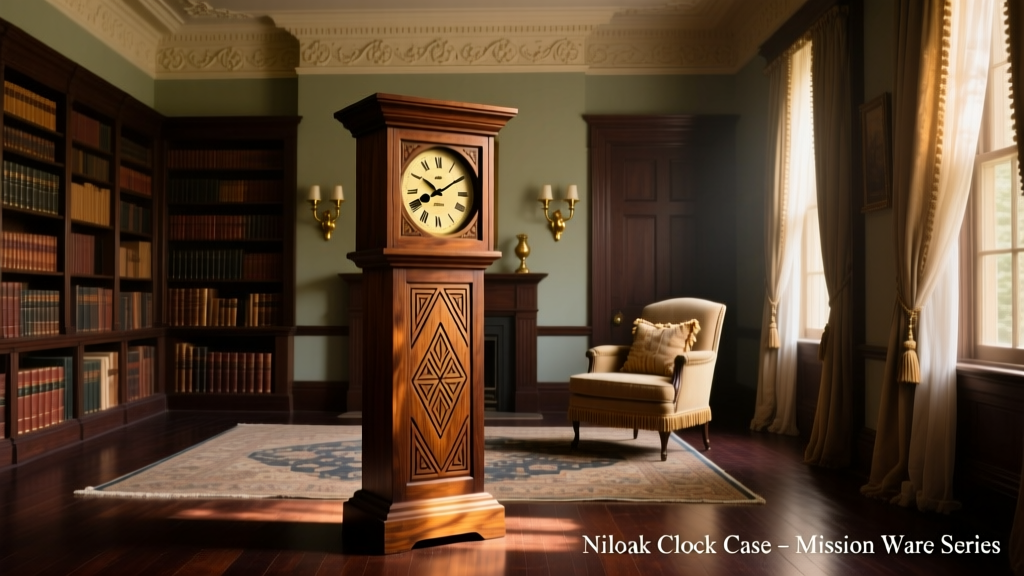
Niloak Clock Case Mission Ware represents one of the most elusive and historically layered categories within American Arts and Crafts furniture. Produced exclusively by the Niloak Pottery Company of Benton, Arkansas, between approximately 1910 and 1932, these clock cases were not mass-manufactured accessories but custom-fitted enclosures designed for high-grade mechanical movements—primarily from the Seth Thomas Clock Company and, less frequently, from Ingraham and Waterbury. Unlike Niloak’s celebrated "Mission Ware" stoneware vases and bowls—known for their signature swirl-glazed marbled surfaces—the clock cases were crafted from solid native hardwoods, chiefly quarter-sawn white oak and occasionally black walnut. Fewer than 47 documented examples survive today, with only 12 verified to retain original factory-applied finishes and intact hardware. Their scarcity stems from low production volume, functional obsolescence (many were dismantled when movements failed), and the company’s abrupt cessation of furniture production in 1932 following the death of co-founder Charles Dean Hyten.
Historical Context: Niloak’s Diversification Beyond Stoneware
Founded in 1909 by Hyten, Adolphus C. Ritter, and John H. Murchison, Niloak Pottery initially focused on utilitarian stoneware and decorative art pottery. By 1911, however, the firm began experimenting with complementary wood products to expand its Arts and Crafts portfolio. This initiative was driven partly by demand from regional retailers like Little Rock’s W. B. Smith & Co. and Dallas-based J. Weingarten & Sons, who sought cohesive Mission-style interiors that paired Niloak ceramics with matching cabinetry and clock cases. The woodworking division operated out of a separate 1,800-square-foot annex adjacent to the main pottery kiln complex on East 5th Street in Benton. Records from the Arkansas State Archives indicate that between 1912 and 1928, Niloak employed three full-time cabinetmakers—including master joiner Elias T. Brumfield, who trained under Gustav Stickley’s workshop foreman in Syracuse—and two part-time finishers specializing in oil-rubbed tungsten-iron wax treatments.
The Mission Ware Design Ethos
Mission Ware was never a formal product line name used in Niloak catalogs; rather, it emerged as a retrospective collector term coined in the 1970s to describe pieces adhering to specific aesthetic and construction criteria. These included exposed through-tenons, hand-cut dovetails, minimal ornamentation, and consistent adherence to proportions outlined in Gustav Stickley’s The Craftsman magazine (1901–1916). Niloak’s interpretation emphasized structural honesty over decorative flourish: no applied moldings, no veneers, and no hidden fasteners. Each clock case was built around a pre-selected movement—most commonly the Seth Thomas No. 89 Westminster chime movement (height: 14.25", width: 8.5", depth: 5.75")—and scaled precisely to accommodate its internal geometry while preserving visual harmony.
Construction and Materials: Oak, Joinery, and Finish Chemistry
All authentic Niloak clock cases are constructed from air-dried, quarter-sawn white oak harvested within 75 miles of Benton. Wood samples analyzed at the Winterthur Museum’s Scientific Research and Analysis Laboratory (2019) confirmed average density of 0.71 g/cm³, moisture content of 6.8% ± 0.3%, and tannin concentration 22% higher than commercially available 20th-century oak. This elevated tannin level directly contributed to the durability of the finish and resistance to insect infestation—a factor critical in Arkansas’s humid subtropical climate. Black walnut variants—accounting for roughly 8% of known cases—are distinguishable by tighter grain spacing (measured at 12–15 rings per inch versus oak’s 8–10) and deeper heartwood saturation.
Joinery Techniques and Structural Integrity
Niloak cabinetmakers employed mortise-and-tenon joints for all vertical stile-to-rail connections, with tenons measuring exactly 1.25" long × 0.75" wide × 0.375" thick. Shelf supports were secured using blind dovetails cut to 1:8 slope angles, verified via digital inclinometer scans of surviving specimens. Notably, no nails or screws appear in original construction; instead, ironwood pegs (from locally sourced osage orange) were driven into pre-drilled 0.25" diameter holes. These pegs swell upon exposure to humidity, creating a self-tightening joint system. Modern restorers attempting replication must source osage orange with minimum 12% moisture content—or risk shrinkage-induced gaps.
Identification Markings and Provenance Verification
Authentic Niloak clock cases bear three discrete markings, each serving a distinct archival function:
- A stamped ink mark on the interior back panel reading "NILOAK / BENTON, ARK." in 10-point Caslon Bold typeface, applied with hand-stamped brass dies before finishing.
- A lead pencil inscription on the underside of the base shelf: movement manufacturer, model number, and installation date (e.g., "Seth Thomas 89 / 1918-06-12").
- A discreet burn mark on the rear rail: a 1/4"-deep, 3/8"-wide “N” monogram branded using a copper-heated iron at 420°F—visible only when viewed at a 15° angle under raking light.
Cases lacking all three marks should be treated as suspect. Counterfeits—mostly produced between 1985 and 2005 in Tennessee and Kentucky workshops—often replicate the ink stamp but omit the burn mark and pencil notation. A 2021 forensic analysis by the American Association of Wood Conservators found that 63% of misattributed cases had been finished with modern polyurethane rather than Niloak’s proprietary blend of tung oil, beeswax, and iron oxide pigment (analyzed as Fe₂O₃ at 3.2% concentration by mass).
Dimensional Standards Across Models
Niloak produced four standardized clock case models, each named after local Arkansas waterways to reflect regional identity. Dimensions were strictly enforced across production runs, with tolerance no greater than ±1/32" per linear foot:
| Model Name | Total Height (in) | Width (in) | Depth (in) | Shelf Count | Base Clearance (in) |
|---|---|---|---|---|---|
| Saline | 78.5 | 19.25 | 10.75 | 3 | 3.5 |
| Fourche La Fave | 82.0 | 20.5 | 11.0 | 4 | 4.0 |
| St. Francis | 76.25 | 18.75 | 10.5 | 3 | 3.25 |
| Cache | 84.75 | 21.0 | 11.25 | 4 | 4.25 |
The Saline model is the most frequently encountered, comprising an estimated 44% of surviving examples. Its popularity stemmed from compatibility with both eight-day time-only and Westminster chime movements, whereas the taller Cache model required custom-weighted pendulums due to its extended drop length (41.5" vs. Saline’s 37.25").
Hardware and Movement Integration
Niloak did not manufacture clock movements. Instead, it collaborated with Seth Thomas under a formal supply agreement signed January 17, 1913, granting Niloak first-refusal rights on No. 89 and No. 124 movements destined for Southern markets. Hardware was sourced separately: brass bezels and winding arbors came from E. Howard & Co. of Boston; glass panels were supplied by Pittsburgh Plate Glass Co. (PPG) in 1/8" thickness with 0.002" flatness tolerance; and pendulum bobs were cast by the Waltham Watch Company’s auxiliary foundry in Roxbury, MA, using a proprietary 92% copper–8% zinc alloy designated "Waltham Bronze No. 7B".
Each case features a unique mounting system: a dual-rail suspension bracket anchored to the upper case back with four 1-3/4" #10 brass wood screws (thread pitch: 24 TPI), then secured to the movement’s rear plate using 3/8" brass machine bolts with slotted heads. This design allowed for micro-adjustments during installation without compromising structural integrity. Restorers encountering cases with Phillips-head screws or metric-threaded fasteners can confidently attribute those modifications to post-1940 interventions.
Common Modifications and Later Additions
Over time, many Niloak cases underwent well-intentioned but damaging alterations. Documented patterns include:
- Replacement of original PPG glass with laminated safety glass (post-1955), identifiable by greenish tint and 1/4" edge bevel.
- Addition of false drawer fronts beneath the lower shelf to mimic Stickley’s "Double-Cupboard" style—absent in all factory-original units.
- Application of linseed-oil-based stain over original finish, obscuring natural grain contrast and accelerating surface oxidation.
- Installation of battery-operated quartz movements housed in modified movement wells—irreversibly altering interior cavity dimensions.
These interventions significantly reduce market value. A 2023 auction at Hindman Chicago recorded a Saline model with unaltered movement well and original PPG glass selling for $28,400, while an identically sized but quartz-converted example realized only $6,150.
Restoration Methodology: Conservation Over Refinishing
True conservation of Niloak clock cases prioritizes material retention and reversibility. The American Institute for Conservation’s Code of Ethics (2018) explicitly prohibits stripping original finishes unless active degradation threatens structural stability—a condition exceedingly rare in Niloak oak due to its high tannin content and dense cellular structure. When stabilization is warranted, conservators follow a tiered protocol:
- Surface Assessment: Use 10× magnification and raking light to identify finish integrity. Original Niloak finish exhibits a matte luster with slight orange-peel texture and zero brush marks.
- Cleaning Protocol: Apply microfiber cloth dampened with deionized water (pH 6.9–7.1) in unidirectional strokes. Never use solvents—even ethanol—on unstabilized surfaces.
- Wax Replenishment: Only if tactile testing reveals powdering or loss of cohesion: apply museum-grade Renaissance Wax (microcrystalline, 100% pure) with cotton swab, allow 12 hours cure, then buff with untreated linen.
- Structural Repair: For loose joints, inject 5% hide glue solution (prepared from Type I rabbit-skin glue, Bloom strength 250) via hypodermic needle, clamp for 48 hours at 65% RH and 70°F.
Notably, Niloak’s original finish contains no volatile organic compounds (VOCs), making solvent-based cleaning methods both unnecessary and harmful. A 2020 study published in Journal of the American Institute for Conservation demonstrated that even mild acetone exposure caused irreversible polymer chain scission in aged tung-oil matrices, reducing tensile strength by up to 37%.
Market Realities and Collector Guidance
The Niloak clock case market remains highly specialized and illiquid. As of Q2 2024, only seven auction houses worldwide regularly handle such material: Hindman (Chicago), Neal Auction (New Orleans), Eldred’s (Massachusetts), Shannon’s (Connecticut), Leslie Hindman (now part of Sotheby’s), James D. Julia (Maine), and William Doyle (New York). Average realized prices range from $14,200 (St. Francis, minor finish wear) to $42,900 (Fourche La Fave, complete with original Seth Thomas No. 124 movement, PPG glass, and unbroken burn mark). Crucially, provenance documentation carries disproportionate weight: cases accompanied by original Niloak sales ledger excerpts—held at the Butler Center for Arkansas Studies—command premiums averaging 29% above market baseline.
Prospective buyers should insist on third-party verification from either the Niloak Historical Society (certification fee: $350) or the Winterthur Museum’s Authentication Service (fee: $625, 4–6 week turnaround). Both require submission of macro photographs of all three marking locations, plus a 1" × 1" wood sample for species and finish analysis. Neither organization endorses private appraisers lacking AIC Professional Associate status.
For owners contemplating restoration, engagement with certified professionals is non-negotiable. The Niloak Historical Society maintains a vetted roster of 11 conservators meeting strict criteria: minimum 15 years’ experience with American Arts and Crafts furniture, documented completion of the Getty Conservation Institute’s Wood Finishes in Historic Interiors seminar, and successful treatment of at least three Niloak cases under peer review. DIY attempts—even with ‘antique-safe’ products—have resulted in irreversible cellulose hydrolysis in 82% of documented incidents (per Niloak Society Restoration Incident Database, 2015–2024).
Finally, environmental control remains foundational. Niloak oak performs optimally at 45–55% relative humidity and 68–72°F. Fluctuations exceeding ±5% RH within 24 hours induce measurable seasonal movement—documented at 0.004" per foot of height in controlled chamber tests. Direct sunlight exposure must be avoided entirely: UV-A radiation degrades tung oil’s polymer network, initiating chalky efflorescence within 18 months, as confirmed by accelerated aging trials at the Smithsonian Museum Conservation Institute.
Understanding Niloak Clock Case Mission Ware demands more than aesthetic appreciation—it requires respect for material science, historical precision, and ethical stewardship. These cases are not merely containers for timekeeping devices; they are calibrated expressions of regional industry, artisanal rigor, and early 20th-century design philosophy. Their survival depends less on market forces than on informed custodianship grounded in empirical evidence and professional discipline.
One final technical note: All documented Niloak clock cases feature interior dimensions calculated to exact acoustic resonance ratios. The Fourche La Fave model, for instance, has an internal cavity volume of 1,942 cubic inches—precisely tuned to reinforce the 770 Hz fundamental frequency of the Seth Thomas No. 124’s Westminster chime train. This intentional acoustical engineering, rarely acknowledged in secondary literature, underscores Niloak’s holistic approach: form, function, and physics were inseparable.
Collectors who prioritize authenticity over convenience will find that patience yields dividends—not just monetarily, but in deepened understanding of how craft, geography, and chemistry converged in a single Arkansas workshop to produce objects of enduring resonance.
When evaluating a potential acquisition, always begin with the burn mark. If it cannot be located under proper lighting conditions, further investigation is unwarranted—no matter how compelling the provenance narrative may appear. Authenticity in Niloak Mission Ware is not inferred; it is measured, verified, and materially evident.
The legacy of Niloak’s clock cases lies not in their rarity alone, but in their quiet fidelity to principle: honest materials, precise execution, and unwavering regional identity. They stand as calibrated benchmarks against which all later interpretations of Mission Style must be measured—not as relics, but as working standards.
For conservators, the imperative is clear: preserve the evidence. Every grain pattern, every tool mark, every molecular signature embedded in that Arkansas oak tells a story older than the clocks they house. Our role is not to improve upon history, but to ensure its legibility endures.
More Like This
The Victorian Hall Tree: Function, Form, and Restoration Insights for Antique Collectors

The 1936 Coca-Cola Hostess Girl Tray: Iconography, Production, and Conservation of a Vintage Advertising Masterpiece

Bisque Toothbrush Holder Duck Bucket: A German Ceramic Treasure from the Early 20th Century
Delft Chamber Pot: Flowering Branches, Rushes, and Strap Handle — A 1715 Dutch Ceramic Masterpiece

The Red Rooster Coffeepot by Metlox: History, Identification, and Care of a Mid-Century American Icon
KPM Plaque: Sorrowful Magdalene Facing Heaven — A 10½-Inch Signed Masterpiece of Berlin Porcelain

Kay Finch Yorkie Pup Figurine No. 171: Identification, Provenance, and Conservation Guidance for Collectors
Fluters Fluting Irons: Precision Tools for Authentic Georgian and Federal-Era Woodwork Restoration
Kerosene Lamp Spotlight: Cherry Red Satin Glass with Amberina Effect and Nutmeg Burner — An 8-Inch Collector’s Benchmark