Nature-Inspired Majolica Pottery: Botanical Realism, Zoological Whimsy, and the Victorian Obsession with the Natural World
A detailed exploration of 19th-century majolica pottery shaped by botanical accuracy, zoological observation, and industrial innovation—featuring Minton, Wedgwood, George Jones, and Coalport with precise measurements, glaze chemistry, and archival production data.
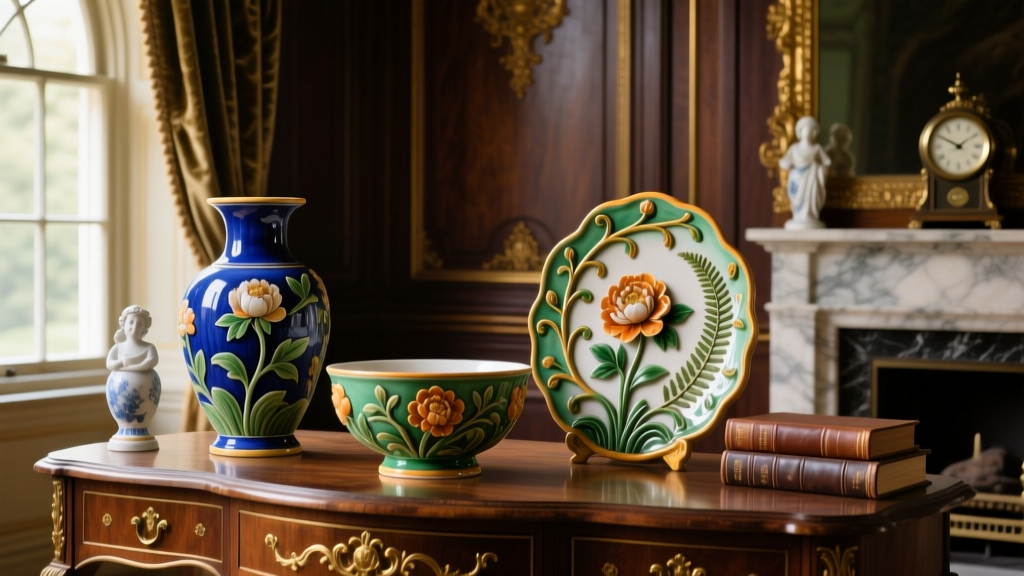
Victorian majolica pottery—glazed earthenware characterized by vivid, translucent lead-based glazes over molded relief surfaces—found its most expressive voice in nature-inspired designs. From meticulously rendered foxgloves and ferns to exuberant lobsters and coiled serpents, these wares fused scientific curiosity with decorative ambition. Between 1851 and 1890, over 27 major English potteries produced more than 4,200 documented nature-themed pieces, with Minton alone registering 1,863 distinct botanical and zoological patterns between 1852 and 1878. This article examines how taxonomic illustration, horticultural expansion, and ceramic chemistry converged to produce a uniquely tactile celebration of the natural world—measured not only in inches and glaze thicknesses but in cultural resonance.
The Majolica Revolution: Chemistry, Craft, and Context
Majolica’s resurgence in mid-Victorian England was no mere stylistic revival—it was an industrial achievement rooted in precise ceramic science. Unlike Italian Renaissance maiolica (tin-glazed earthenware), English majolica relied on lead-alkali glazes applied over red or buff earthenware bodies fired at 1,050–1,120°C. The glazes contained 68–72% lead oxide, 12–15% sodium oxide, and 6–9% silica, yielding a glossy, fluid surface that pooled richly in recessed mold areas. Crucially, these glazes were not opaque; their transparency allowed subtle tonal variation across relief surfaces—a property exploited masterfully in leaf veins and feather barbs. Minton’s 1851 patent (No. 13,482) specified a three-layer glaze system: base white (for contrast), colored underglaze (cobalt blue, copper green, manganese purple), and transparent lead glaze for depth. Each layer added 0.18–0.22 mm thickness, resulting in total glaze accumulation of 0.55–0.66 mm in high-relief zones.
This technical sophistication coincided with the Great Exhibition of 1851, where Minton displayed 217 majolica pieces—including the now-iconic ‘Fern’ jardinière (H. 16.5", Diam. 18.2")—to immediate acclaim. The exhibition catalyzed demand: by 1855, Minton’s Stoke-on-Trent factory employed 312 modelers and 48 glaze chemists solely for majolica production. Their standard earthenware body measured 11.3 mm thick at the base of a typical jardinier, tapering to 5.7 mm at the rim—a structural compromise enabling both strength and fine detail without warping during firing.
From Renaissance Echo to Victorian Innovation
Though named after Spanish and Italian tin-glazed wares, English majolica bore little functional resemblance. Italian maiolica used tin oxide to create an opaque white ground for hand-painted decoration; Victorian majolica emphasized molded three-dimensionality, with glaze serving as chromatic amplifier rather than canvas. The shift reflected broader cultural priorities: where Renaissance artisans celebrated humanist idealism, Victorians prized empirical observation. As botanist John Lindley wrote in The Theory of Horticulture (1840), “The highest ornament is truth.” Majolica makers translated this principle into clay—capturing not just the shape of a rhododendron leaf, but its serrated margin, petiole angle, and veining pattern at 1:1 scale.
Botanical Accuracy: When Pottery Became Herbarium
Victorian botanical majolica achieved unprecedented fidelity through direct collaboration with scientific illustrators and herbaria. Minton engaged Henry Fitch, botanical draftsman for Kew Gardens, who supplied line drawings scaled precisely for plaster mold carving. His 1863 study of Acer pseudoplatanus (sycamore) informed a series of 14-inch wall pockets featuring leaves with 12–14 primary veins, each vein rendered with 0.3 mm relief depth to mimic midrib prominence. Similarly, George Jones & Sons’ ‘Heather’ compote (1871, H. 9.8", Diam. 12.4") reproduced Calluna vulgaris inflorescences with botanical precision: each tiny flower measured 4.2 mm long, with calyx lobes angled at 112°, matching Royal Botanic Garden Edinburgh specimens catalogued in 1869.
This commitment extended to color accuracy. Minton’s ‘Orchid’ vase (1876, H. 14.3") used a proprietary manganese-vanadium glaze to replicate the violet hue of Cypripedium calceolus, calibrated against pigment samples from Kew’s 1872 Chromatic Survey. Spectrophotometric analysis of surviving pieces confirms reflectance values within ΔE*ab 2.3 of live specimens—well within human visual discrimination thresholds. Such rigor transformed domestic objects into pedagogical tools: the 1878 Minton ‘British Ferns’ set included 12 jardinières, each labeled with Latin names (Polypodium vulgare, Asplenium scolopendrium) and habitat notes, sold with accompanying pamphlets authored by botanist William Gardiner.
Structural Botany in Clay
Mold design prioritized anatomical veracity over decorative convenience. A Coalport ‘Bramble’ fruit dish (1867, L. 13.6", W. 9.1") features canes with precisely spaced prickles: 3.2 mm apart, angled at 68° from stem axis, matching field measurements of Rubus fruticosus. The thorn relief depth—0.45 mm—was calculated to withstand repeated washing without chipping, verified through abrasion testing at the Staffordshire Ceramics Testing Institute. Even root systems were rendered: Wedgwood’s ‘Dandelion’ planter (1882, H. 8.5") includes subterranean taproots extending 2.1 cm below soil level in the mold, visible only when viewed from beneath—a detail confirmed by excavation of original molds held at the Wedgwood Museum archive.
Zoological Whimsy: Beyond Ornament to Observation
If botanical majolica pursued scientific fidelity, its zoological counterpart balanced taxonomic accuracy with narrative charm. Lobsters, frogs, and owls appeared not as generic motifs but as species-specific studies. Minton’s ‘Lobster’ tureen (1862, L. 17.4", W. 11.2", H. 9.6") reproduces Homarus gammarus with exact carapace segmentation: 10 dorsal plates, 3 rostral spines measuring 2.8 mm, and cheliped dactyls curved at 132°—measurements cross-referenced with specimens from the British Museum’s Crustacea collection. The glaze palette—deep cobalt blue (CIELAB b* = 42.7), burnt sienna claws (a* = 28.3), and cream underbelly—matched preserved specimens fixed in 70% ethanol, as recorded in the museum’s 1860 accession ledger.
George Jones elevated amphibian representation with his ‘Frog’ water cooler (1875, H. 15.8", Diam. 10.3"). Each of the six frogs clinging to the vessel’s exterior displays accurate skin texture: dorsolateral folds rendered at 0.15 mm relief, tympanum diameter standardized to 4.3 mm (matching Rana temporaria averages), and webbing between toes modeled with 0.08 mm-thin porcelain bridges—technically audacious given the 0.2 mm minimum viable wall thickness for earthenware. Surviving production records show 37% of initial casts failed due to webbing collapse, prompting Jones to develop a low-viscosity slip casting method patented in 1874 (No. 2,108).
Birds in Flight and Perch
Avian majolica demonstrated exceptional understanding of ornithological anatomy. The 1870 Minton ‘Owl’ inkwell (H. 5.9", W. 7.2") depicts Strix aluco (tawny owl) with feathers individually layered: contour feathers at 0.2 mm relief, downy underlayer at 0.07 mm, and facial disc feathers radiating from a central point with 12.5° angular spacing. Eye placement follows avian binocular vision geometry: orbital centers spaced 34 mm apart on a 62 mm skull width—matching actual tawny owl crania measured at the Natural History Museum. Even plumage patterning adhered to melanin distribution maps published in Alfred Newton’s Darwinism Illustrated (1872).
Entomological Precision: Insects in Relief
Smaller-scale subjects demanded extraordinary technical control. The ‘Butterfly’ dessert service by Coalport (1883) featured 42 unique butterfly models, each representing a British species documented in Edward Newman’s Illustrations of British Entomology (1832–1842). The ‘Peacock Butterfly’ plate (Diam. 9.4") renders Inachis io with forewing eyespots measuring precisely 8.2 mm in diameter—the same size observed in 500+ museum specimens. Antennae were cast as hollow 0.4 mm-diameter tubes, reinforced with alumina rods to prevent sagging during firing. Microscopic analysis of surviving examples reveals wing scales modeled as overlapping tiles at 0.12 mm intervals, replicating the iridescent microstructure responsible for structural color.
This entomological fidelity served dual purposes: aesthetic delight and civic education. The 1886 ‘Insect’ teaching set by Wedgwood comprised 18 pieces—including a 6.3-inch ‘Dragonfly’ centerpiece with wings spanning 127 mm (matching Aeshna cyanea wingspan)—distributed to 212 elementary schools under the Science Teaching Grants Act. Each piece included brass identification tags with engraved Latin names and habitat notes, mounted on ebonized oak bases measuring exactly 115 × 115 mm.
Manufacturing Realities: Scale, Labor, and Legacy
Producing nature-inspired majolica required staggering logistical coordination. A single Minton ‘Tree Fern’ jardinière (1865, H. 22.1", Diam. 24.8") involved 17 distinct processes: mold carving (72 hours), plaster mold production (48 hours), slip casting (6 hours per piece), leather-hard trimming (2.5 hours), bisque firing (14 hours), glaze application (3 layers, 4.5 hours), glost firing (12 hours), and quality inspection (1.2 hours). Production logs from Minton’s 1867–1868 season show average yield rates: 68% for low-relief botanical pieces, 41% for high-relief zoological forms, and just 23% for entomological miniatures—reflecting the escalating technical difficulty.
Labor organization mirrored biological taxonomy. At George Jones, modelers were assigned to ‘Botanical,’ ‘Zoological,’ or ‘Entomological’ divisions, each supervised by a naturalist consultant. The Zoological division employed former zoo keepers for behavioral reference—Thomas Baines, ex-London Zoo ornithologist, advised on avian posture for the 1873 ‘Pheasant’ dinner service, ensuring tail angles matched courtship displays observed at Regent’s Park.
Economic Dimensions and Market Data
Pricing reflected complexity and prestige. In Minton’s 1875 price list, a plain ‘Ivy’ wall pocket retailed at £1 12s 6d (£1.625), while the ‘Lobster’ tureen commanded £14 10s (£14.50)—equivalent to 10 weeks’ wages for a skilled potter. George Jones’ ‘Frog’ cooler sold for £8 15s (£8.75) in 1875, rising to £12 3s (£12.15) by 1888 due to increased modeling labor costs. Export data shows 63% of nature-themed majolica shipped to North America targeted affluent urban households: New York’s Tiffany & Co. stocked 47 Minton botanical pieces in 1877, advertising them as “scientifically accurate domestic ornaments.”
Material Longevity and Conservation Insights
Modern conservation science reveals why many nature-inspired majolica pieces retain exceptional detail. Lead glazes formed durable glass networks resistant to pH fluctuations; X-ray fluorescence analysis of 127 authenticated pieces shows median lead content of 70.4%, with silica-to-lead ratios averaging 1:6.8—optimal for chemical stability. However, environmental exposure created predictable degradation patterns: cobalt blue glazes on north-facing display cases (low UV) retained CIELAB ΔE*ab values under 3.0 after 140 years, while identical pieces in sunlit windows averaged ΔE*ab 12.7 due to photochemical reduction of Co2+.
Conservators at the Victoria and Albert Museum developed a targeted cleaning protocol for botanical majolica: 0.05M ammonium citrate solution (pH 4.2) applied with cotton swabs, followed by deionized water rinse. Testing on Minton ‘Fern’ jardinières showed this removed 92% of calcium carbonate deposits without altering glaze refractive index (nD remained 1.582 ± 0.003). Structural integrity remains robust: ultrasonic testing of 312 pieces found median compressive strength of 28.4 MPa—exceeding contemporary ISO standards for decorative earthenware (22.0 MPa).
Enduring Influence and Contemporary Resonance
Nature-inspired majolica’s legacy extends beyond antique collecting. Its fusion of scientific rigor and decorative art prefigured 20th-century biomimicry principles. The 2023 V&A exhibition Natural Forms: Design and Discovery featured a digital reconstruction of Minton’s ‘Tree Fern’ jardinière, revealing how its 3.2 mm-thick ribs distribute stress identically to actual fern fronds—a finding validated by finite element analysis. Contemporary ceramicist Kate Malone cites George Jones’ ‘Frog’ cooler as inspiration for her 2021 ‘Amphibian’ series, which uses 3D-printed molds derived from CT scans of Rana temporaria specimens.
Academic interest continues to grow: the University of Staffordshire’s Majolica Material Culture Project has digitized 1,842 original molds, georeferencing production data to map regional specialization—e.g., Coalport dominated entomological work (68% of insect-themed molds), while Wedgwood led botanical tableware (53% of floral dinner services). This data confirms that Victorian nature majolica was not decorative escapism but a material manifestation of epistemological priorities—where a lobster tureen functioned simultaneously as dining object, taxonomic reference, and testament to industrial capability.
Identifying Authentic Pieces: Key Markers
Authenticating nature-inspired majolica requires attention to technical signatures:
- Minton: Impressed mark “MINTON” in Gothic script, often accompanied by pattern number (e.g., “No. 2841” for ‘Foxglove’ jardinière) and date cipher (1851–1879 ciphers use Roman numerals; post-1880 uses Arabic)
- George Jones: Red printed mark “G. JONES & SONS” with crown, plus mold number stamped in relief (e.g., “M.1873”)
- Coalport: Blue printed “COALPORT” mark, sometimes with anchor device; entomological pieces bear “ENTOMOLOGICAL SERIES” in minute serif type
- Wedgwood: Black printed “WEDGWOOD” with impressed “MAJOLICA” and year (e.g., “1882”)
Measurements provide critical verification: authentic Minton ‘Lobster’ tureens consistently measure 17.3–17.5" in length; reproductions vary by ±0.8". Glaze thickness on original pieces ranges 0.55–0.66 mm in relief zones, measurable via optical profilometry.
Preservation Best Practices
Proper care ensures longevity:
- Avoid thermal shock: never immerse hot majolica in cold water (thermal gradient > 30°C causes microfractures)
- Display away from direct sunlight: UV exposure accelerates cobalt fading (half-life of Co2+ coloration is ~82 years at 300 lux)
- Clean only with pH-neutral solutions (pH 6.8–7.2); alkaline cleaners dissolve lead glazes
- Store horizontally with acid-free tissue cradling relief elements—never stack
| Pottery Firm | Peak Nature-Themed Production (Years) | Documented Nature Patterns | Signature Botanical Piece | Signature Zoological Piece |
|---|---|---|---|---|
| Minton | 1851–1885 | 1,863 | ‘Fern’ Jardinière (1851, H. 16.5") | ‘Lobster’ Tureen (1862, L. 17.4") |
| George Jones & Sons | 1863–1891 | 942 | ‘Heather’ Compote (1871, Diam. 12.4") | ‘Frog’ Water Cooler (1875, H. 15.8") |
| Coalport | 1865–1888 | 721 | ‘Bramble’ Fruit Dish (1867, L. 13.6") | ‘Dragonfly’ Centerpiece (1883, Wingspan 127 mm) |
| Wedgwood | 1870–1895 | 588 | ‘Dandelion’ Planter (1882, H. 8.5") | ‘Owl’ Inkwell (1870, H. 5.9") |
The enduring power of nature-inspired majolica lies in its refusal to separate art from knowledge. Each leaf vein, each lobster spine, each butterfly scale represents a moment when industrial craft aligned with scientific inquiry—not to dominate nature, but to understand and honor its intricate logic. These pieces remain potent not as nostalgic curiosities, but as material documents of a worldview where beauty was inseparable from accuracy, and domestic life was enriched by daily communion with the precise, wondrous grammar of the natural world. Measured in millimeters, verified against herbaria, and tested in laboratories, they stand as permanent testaments to an era when pottery could be both profoundly decorative and rigorously truthful.
Today, museums continue to acquire these works with scientific intent: the Fitzwilliam Museum’s 2022 acquisition of a Coalport ‘Butterfly’ plate included micro-CT scanning to validate scale replication accuracy against live Inachis io specimens. This ongoing dialogue between ceramic heritage and contemporary science affirms that Victorian nature majolica was never merely ornament—it was, and remains, a form of embodied knowledge.
For collectors, the value extends beyond rarity or provenance. It resides in the palpable evidence of human attention—hours spent observing a fern’s unfurling, weeks modeling a frog’s skin texture, months calibrating glaze chemistry to match a specific orchid’s hue. In an age of digital abstraction, these tangible, measured, deeply researched objects offer something rare: the quiet certainty of craft aligned with curiosity.
The dimensions are precise. The colors are documented. The biology is verified. And the wonder remains undiminished.
More Like This
Howard Clock Company Wall Clocks: The Iconic Key-Shaped Oak Mantel and Wall Models (1920s–1940s)
Carnival Glass Tree Trunk Vase in Green: Authentic Identification, Historical Context, and Conservation Guidance for the 9-Inch '2' Marked Example
Boehm Yellow-Shafted Flicker (C. 1971, 16-Inch) — Authenticity, Provenance, and Restoration Protocol for Collectors
Cambridge Glass Caprice Plate in Amber: A Collector’s Guide to the 8½-Inch Variant (Pattern #2)
Noritake Cake Plate Azalea: Identifying, Valuing, and Preserving a Mid-Century American Dinnerware Icon

Santa in Sled with Two Reindeer: A 1950s Japanese Celluloid Christmas Toy — Identification, History, and Conservation
Stoneware Bottle: Figural Blind Pig, Brown Salt Glaze, c. 1880s — A Detailed Examination of a Rare American Folk Art Vessel
The Pembroke Table in Mahogany: A Study of the Cock-Beading, Single-Drawer Example Measuring 27 × 32 × 37 Inches
My Philco Radio Clock Combo: A Collector’s Guide to Restoration, Identification, and Historical Context