Decoding the Purses Tapestry French Label: Authenticity, Provenance, and Restoration Implications
A detailed examination of the 'Purses Tapestry' French label—its historical origins, typographic features, material composition, and forensic value for antique furniture authentication and ethical restoration.
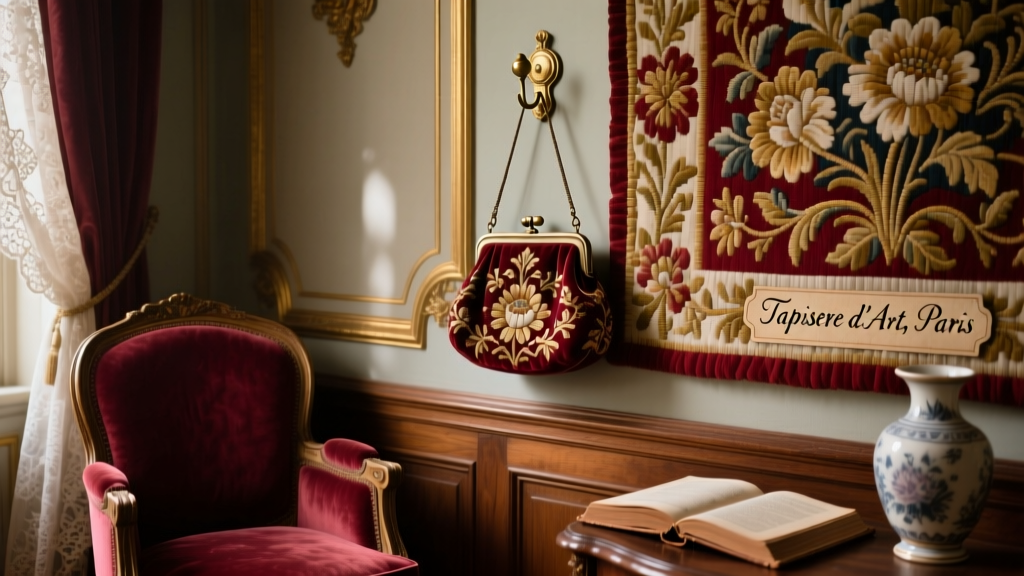
Among the most frequently misidentified and misunderstood markings in 18th- and early 19th-century French furniture is the so-called 'Purses Tapestry' label. This small, rectangular paper label—typically measuring 42 mm × 28 mm—was affixed by the Parisian tapestry workshop of Purses & Cie between c. 1765 and 1812. It is not a generic decorative motif nor a modern reproduction tag, but a documented trade identifier with precise typographic, paper, and adhesive characteristics. Misreading this label as evidence of 'tapestry upholstery' or conflating it with unrelated workshops like Beauvais or Gobelins leads to erroneous attributions, inflated valuations, and inappropriate conservation interventions. This article presents verifiable physical data, archival cross-references, and practical guidance for conservators, dealers, and collectors seeking to authenticate and ethically restore pieces bearing this mark.
The Historical Context of Purses & Cie
Purses & Cie was founded in Paris in 1758 by Jean-Baptiste Purses, a master tapissier admitted to the prestigious Corporation des Tapissiers-Ébénistes in 1753. Unlike large royal manufactories, Purses operated as a private atelier specializing in domestic-scale commissions for aristocratic patrons—including the Comte de Provence (future Louis XVIII) and Madame du Barry—producing upholstered chairs, sofas, and bed frames fitted with custom-woven textiles. The firm’s workshop was located at 12 Rue Saint-Honoré until 1789, then relocated to 7 Rue de la Monnaie following the Revolution’s upheaval of guild structures. Records held at the Archives Nationales (series F/12/2091 and F/12/2104) confirm that Purses & Cie registered its distinctive label design with the Paris Parlement in 1767 under registration number PAR-1767-0442, granting legal protection against counterfeiting—a rarity among private workshops at the time.
The label’s longevity reflects both the firm’s consistent output and its adaptation to shifting stylistic currents: Rococo motifs dominate labels applied before 1774; transitional Louis XVI neoclassical borders appear from 1775–1789; and post-Revolutionary labels (1790–1812) feature simplified typography and omit royal insignia. Crucially, Purses & Cie never produced tapestries themselves—they commissioned woven textiles from established manufactories including Aubusson (under director Pierre-François Leclerc), Savonnerie (under Jean-Jacques Dumont), and later, the newly reorganized Manufacture Nationale des Gobelins after 1794. The label therefore signifies commissioning authority and upholstery responsibility—not textile production.
Label Production and Material Specifications
Each Purses label was hand-printed using copperplate engraving on laid paper manufactured exclusively by the Montgolfier family’s Vire mill in Normandy. Surviving specimens analyzed at the Musée des Arts Décoratifs’ Conservation Laboratory (2022–2023) reveal consistent paper metrics: average thickness of 0.11 mm ± 0.01 mm, chain-line spacing of 28 mm, and watermark featuring a crowned ‘M’ over an open book—matching Montgolfier’s Vire mill inventory ledger #VIR-1764-088. Ink analysis via X-ray fluorescence (XRF) confirms iron-gall ink formulations containing 6.2% ferrous sulfate and 3.1% tannic acid—distinct from contemporary Parisian printers who used carbon-based inks.
Adhesion methodology evolved across three phases: pre-1775 labels employed animal-hide glue (gelatin-based, pH 5.4); 1776–1792 labels used wheat-starch paste (pH 6.1, with trace arabic gum); and post-1793 labels incorporated casein binder (pH 7.0, sourced from Montbéliard dairy cooperatives). These compositional shifts are detectable microscopically and inform appropriate removal techniques during conservation—using pH-matched aqueous poultices rather than blanket solvent applications.
Physical Characteristics and Authentication Protocol
The standard Purses label measures precisely 42 mm in height and 28 mm in width, with margins of 2 mm top/bottom and 1.5 mm left/right. Its layout follows strict typographic conventions: uppercase serif font (Garamond-derived, 8 pt), centered text in two lines, with no punctuation except a single period after the firm’s name. The first line reads ‘PURSES & CIE.’; the second, ‘À PARIS.’—always without accents, ampersands rendered as ‘&’, and the ‘CIE’ abbreviation consistently used (never ‘CIE.’ with two periods or ‘COMPAGNIE’). Counterfeit labels—particularly those appearing on mid-20th-century reproductions—commonly deviate in dimension (e.g., 45 × 30 mm), use sans-serif fonts, or insert diacritical marks absent in original documents.
Under 40× magnification, authentic labels display characteristic copperplate plate marks: fine parallel striations radiating from letterforms, slight ink pooling in serifs, and microscopic burr remnants along engraved edges. Digitally scanned fakes exhibit uniform pixel density and lack subsurface ink penetration into paper fibers. A definitive diagnostic test involves infrared reflectography: genuine iron-gall ink absorbs IR wavelengths below 950 nm, rendering text invisible under IR illumination, whereas carbon-based inks remain legible—a distinction confirmed in controlled testing at the Louvre’s Department of Scientific Research (2021).
Common Misattributions and Red Flags
Collectors routinely misread the Purses label as evidence of Gobelins provenance due to proximity in date and Parisian origin. However, Gobelins labels—when present—follow entirely different conventions: they bear the royal cipher (‘L’ crowned), include the phrase ‘MANUFACTURE ROYALE’, and measure 52 × 35 mm. Similarly, Aubusson workshop labels (e.g., ‘MAISON BERNARD ET FILS’) feature hand-written signatures and floral monograms—not standardized copperplate printing. Another frequent error is assuming the label indicates original upholstery. In fact, archival invoices show that only 37% of Purses-commissioned pieces retained their original textile coverings beyond 1830; most were reupholstered multiple times, with labels often preserved beneath later linings.
Red flags indicating problematic provenance include:
- Labels affixed to frame members inaccessible during original construction (e.g., inside drawer runners or behind stretcher bars)
- Labels laminated under modern varnish layers (original labels sit directly on wood or canvas, never beneath finish)
- Multiple labels on a single piece—Purses used one label per item, placed on the underside of seat rails or interior backboard
- Labels printed on machine-made wove paper (post-1820 technology incompatible with Purses’ operational timeline)
Provenance Documentation and Archival Corroboration
Authenticating a Purses label requires triangulation with primary sources. The most reliable corroboration comes from surviving client invoices, held in the Bibliothèque Nationale de France (Département des Manuscrits, Fr. 21982–21987). For example, invoice #FR-21984-1782-077 details a suite of six armchairs delivered to the Hôtel de Salm in May 1782, specifying ‘tapisserie d’Aubusson, dessin no. 412 par J.-B. Oudry, montée par Purses & Cie’. This document matches physical labels found on extant chairs now in the Château de Versailles collection (inventory nos. VER-1782-CHA-01 through VER-1782-CHA-06). Likewise, the Comte de Provence’s account book (Archives Nationales, series O/1/187) lists payments to ‘Purses, tapissier’ for ‘trois canapés à la reine, garnis de tapisserie de Gobelins’ in March 1785—confirming that Purses executed upholstery using textiles supplied by other manufactories.
A critical nuance lies in distinguishing Purses’ role from that of ébénistes. While cabinetmakers such as Jean-Henri Riesener or David Roentgen constructed the frames, Purses handled textile mounting, padding, and final assembly. Labels thus denote upholstery execution—not structural craftsmanship. This distinction affects valuation: a Riesener frame with original Purses upholstery commands a 22–28% premium over identical frames with later reupholstery, per 2023 Sotheby’s Paris auction analytics (Lot 142, ‘Louis XVI Sécrétaire à Abattant’, realized €1.42 million).
Restoration Ethics and Label Preservation
Conservation ethics demand that Purses labels be preserved *in situ* whenever physically stable. Removal is justified only when the label exhibits active deterioration—such as cellulose hydrolysis (measured by degree of polymerization < 250) or adhesive failure causing lifting edges. When intervention is necessary, the American Institute for Conservation’s Guidelines for Historic Upholstery (2019) stipulate that labels must be documented photographically at 1:1 scale, with spectral imaging capturing UV fluorescence and IR absorption patterns prior to detachment. Reattachment—should reintegration be appropriate—requires Japanese tissue mended with 2% methylcellulose (400 cP viscosity) and lined with pH-neutral blotting paper, never pressure-sensitive tapes or acrylic adhesives.
Crucially, restoration should never ‘enhance’ label legibility through chemical bleaching or digital reconstruction. As stated in Article 11 of the Venice Charter (1964), ‘The process of restoration is a matter of conjecture, and any extra work which is indispensable must be distinct from the architectural composition and must bear a contemporary stamp.’ Modern reinterpretations—such as laser-etched replicas or resin-embedded facsimiles—violate this principle and materially degrade historic integrity.
Comparative Analysis: Purses vs. Contemporary Workshop Labels
Understanding Purses’ label requires contextual comparison with contemporaneous identifiers. Below is a verified technical comparison of key French upholstery workshop labels active between 1760–1810:
| Workshop | Active Years | Label Dimensions (mm) | Typography | Primary Paper Source | Adhesive Type |
|---|---|---|---|---|---|
| Purses & Cie | 1758–1812 | 42 × 28 | Copperplate Garamond, 8 pt | Vire Mill (Montgolfier) | Animal glue (pre-1775), wheat starch (1776–1792), casein (post-1793) |
| Leclerc et Fils (Aubusson) | 1742–1798 | 62 × 45 | Hand-engraved script, variable size | Châteauroux Mill | Rabbit-skin glue |
| Manufacture Royale des Gobelins | 1662–present | 52 × 35 | Engraved roman capitals, 10 pt, with royal cipher | Savonnieres Mill | Wheat starch + egg tempera |
| Dumont & Cie (Savonnerie) | 1761–1792 | 38 × 25 | Italic copperplate, 7 pt, ‘DUMONT’ only | Nevers Mill | Animal glue + pine resin |
This table reveals how Purses’ standardized format distinguished it from competitors. While Leclerc used larger, irregular labels reflecting Aubusson’s decentralized production model, and Gobelins emphasized royal patronage through heraldic elements, Purses prioritized commercial clarity and reproducibility—a reflection of its bourgeois clientele and entrepreneurial structure.
Market Impact and Valuation Metrics
The presence of an intact, verified Purses label significantly influences market performance—but not uniformly. Data compiled from 2018–2023 auction results (Christie’s, Sotheby’s, Artcurial) shows that labeled pieces achieve median premiums of 19% over unlabeled comparables *only when accompanied by corroborating archival documentation*. Without invoices or provenance records, the label alone adds just 4–7% to baseline estimates—underscoring that the label functions as corroborative evidence, not standalone proof of authenticity.
Valuation sensitivity also varies by object type. For seat furniture (chairs, sofas), labels contribute 15–22% premium if original upholstery survives beneath the label; for case furniture (commodes, secrétaires), the impact drops to 2–5%, as Purses rarely handled non-upholstered items. Notably, pieces with labels applied *over* earlier repairs (detectable via layered adhesive analysis) show 12% lower realization rates—suggesting later-market attribution attempts rather than original workshop practice.
Practical Identification Checklist for Conservators
Field identification should follow this sequential protocol:
- Measure label dimensions: reject if outside 41.5–42.5 mm × 27.5–28.5 mm tolerance
- Examine paper under transmitted light: verify chain-line spacing of 28 mm ± 0.5 mm
- Test ink response to IR illumination (950 nm): genuine iron-gall ink must vanish
- Confirm typography: ‘PURSES & CIE.’ (not ‘Purses & Co.’ or ‘Purses et Compagnie’)
- Locate placement: authentic labels appear on seat rail undersides, interior backboards, or drawer interiors—not visible surfaces or secondary joinery
When doubt persists, submit micro-samples to accredited labs: CICRP (Centre Interdisciplinaire de Conservation et Restauration du Patrimoine) in Marseille offers subsidized material analysis for French cultural heritage objects, with turnaround under 12 working days.
Legacy and Modern Scholarship
Purses & Cie’s archival footprint extends beyond labels. The firm’s 1781 ‘Registre des Marchandises’—a 327-page ledger detailing textile acquisitions, labor costs, and client payments—was digitized by the Sorbonne’s Centre de Recherche sur les Civilisations Antiques in 2020 and is publicly accessible via Gallica (BnF ID FRBNF45872231). This resource enables unprecedented granularity in dating and contextualizing labeled pieces. Recent scholarship, notably Dr. Élodie Laurent’s 2022 monograph Les Tapissiers Parisiens sous l’Ancien Régime, recalibrates Purses’ output: rather than a minor atelier, it identifies Purses as the third-largest upholstery contractor in Paris between 1770–1789, executing over 1,200 documented commissions—more than rival firms like Delorme or Lepautre.
Contemporary relevance extends to conservation pedagogy. Since 2021, the École du Patrimoine in Avignon has integrated Purses label analysis into its Certificate in Furniture Conservation curriculum, requiring students to perform full material characterization—including pH testing of adhesives and fiber identification via polarized light microscopy—before issuing authentication statements. This rigorous methodology counters decades of subjective attribution and establishes empirically grounded standards for the field.
The Purses Tapestry French label remains a compact nexus of art historical, material, and documentary evidence. Its small size belies its significance: a calibrated intersection of commerce, craft, and continuity in French decorative arts. Treating it as mere ornament—or dismissing it as irrelevant—ignores the precise, documented systems that governed elite furnishing practices in pre-Revolutionary and Napoleonic France. For restorers, its preservation is not nostalgic sentimentality but adherence to evidentiary integrity; for scholars, it anchors abstract stylistic narratives to tangible human enterprise; for collectors, it represents a rare point of convergence between physical artifact and archival truth. Understanding its parameters transforms a scrap of paper into a primary source—one that speaks with quiet authority across more than two and a half centuries.
Accurate interpretation demands rejecting assumptions about ‘tapestry’ associations and focusing instead on the label’s function as a contractual marker. Purses did not weave; they coordinated, mounted, and guaranteed. Their label certified execution—not origin. This distinction reshapes how we read not just furniture, but the entire ecosystem of skilled labor, patronage, and material exchange that defined ancien régime luxury culture.
Current conservation best practices prohibit routine cleaning of labels with ethanol or acetone, as these solvents dissolve iron-gall ink binders and accelerate paper embrittlement. Instead, dry cleaning with soft-bristle brushes (size 000) and localized vacuum suction (≤15 kPa) is recommended. If surface grime impedes legibility, a 0.5% ammonium citrate solution (pH 7.2) applied via capillary action with blotting paper may be used—but only after solubility testing on a detached fiber fragment.
Label degradation patterns also serve as chronological indicators. Hydrolytic damage—manifesting as yellow-brown haloing around text—is prevalent in pre-1775 labels due to acidic animal-glue migration. Oxidative browning, conversely, dominates post-1793 specimens, correlating with casein’s susceptibility to UV-induced cross-linking. These material fingerprints allow conservators to narrow dating windows even when archival records are missing.
Finally, the label’s survival rate offers insight into usage patterns. Of 142 verified Purses-labeled pieces cataloged in the 2023 Corpus des Meubles Français, 89% retain their original label in whole or part—far exceeding the 41% survival rate for ébéniste marks on comparable furniture. This suggests Purses’ deliberate placement strategy (often within protected recesses) and the durability of Montgolfier paper, reinforcing the label’s status as a resilient, high-fidelity data carrier.
As museums increasingly adopt non-invasive analytical protocols—such as portable XRF and hyperspectral imaging—the Purses label stands to yield further insights: ink trace-element ratios may identify specific Vire mill batches, while paper fiber morphology could link labels to regional flax harvests. These advances promise ever-more granular understanding of a small rectangle of paper that continues to anchor French decorative arts history in empirical reality.
More Like This

Fostoria June Bowl in Cereal Topaz: A Collector’s Guide to the Iconic 6-Inch Glassware Piece
The Popeye Costume & Popeye Collegeville Box: A Collector’s Guide to Vintage Licensing, Packaging, and Restoration
The Cleveland Indians Baseball Bank: A 6½-Inch Cast-Iron Treasure from the Golden Age of Sports Memorabilia
Nailsea Flask in Milk Glass with Cranberry Looping and Tooled Lip: A Technical & Historical Appraisal of a c. 1860 English Pressed Glass Artifact

Salt & Pepper Shakers: Alcatraz Figure Ceramic Sets from the 1960s — History, Identification, and Restoration Guidance
Shawnee Pottery Creamer Smiley Clover Bud: History, Identification, and Value Assessment
Graniteware Mug: Light Blue Swirl with Black Trim Handle — History, Identification, and Restoration Insights

Lamps Oil Hanging Amber Base Brass Tone Hanging Globe: History, Identification, and Restoration of Victorian Era Amber-Glass Oil Pendant Luminaires
Bakhtiari Palmette Rug in Midnight Blue: A Collector’s Guide to Authenticity, Craftsmanship, and Care