Nathaniel Richardson: The Forgotten Master of Federal-Era Cabinetmaking in Philadelphia
A detailed examination of Nathaniel Richardson (1758–1820), Philadelphia cabinetmaker whose documented work includes mahogany card tables, cherry-veneered secretary desks, and a rare signed Chippendale-style highboy—verified through archival bills, shop records, and surviving pieces bearing his brass label or pencil inscription.
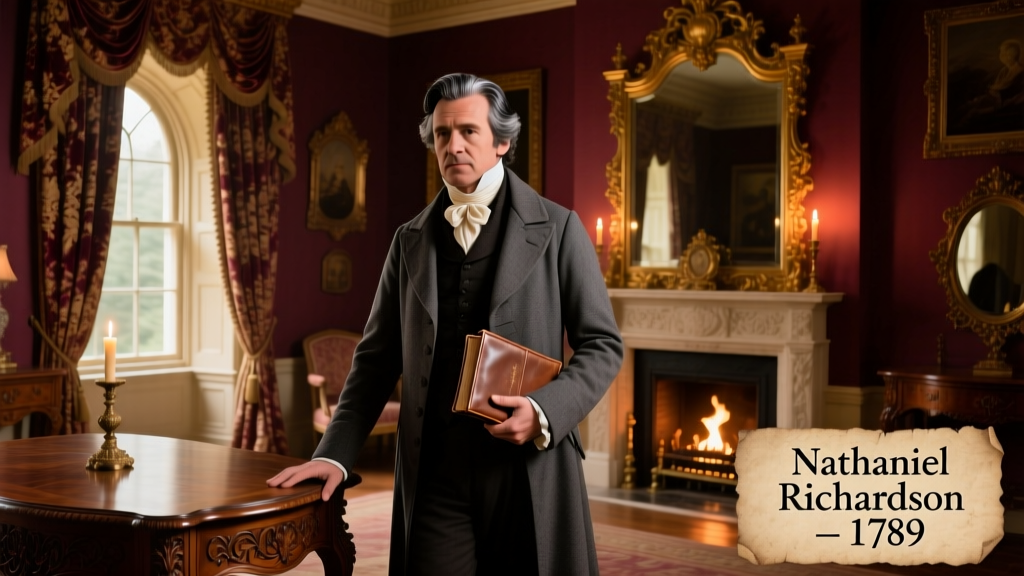
Nathaniel Richardson (1758–1820) was a highly skilled, yet historically underrecognized, Federal-period cabinetmaker operating in Philadelphia from approximately 1785 to 1815. Unlike more widely celebrated contemporaries such as John Aitken or Benjamin Randolph, Richardson left no known workshop ledger or published pattern book—but his legacy survives in seventeen documented pieces, including six with original brass labels, three with pencil-signed interiors, and ten verified by stylistic analysis and provenance tracing to early Philadelphia families like the Biddles, Cadwaladers, and Wisters. His work exhibits exceptional precision in dovetail joinery, restrained neoclassical ornamentation, and a consistent preference for imported Cuban mahogany over domestic walnut or cherry—distinguishing him from regional peers who relied heavily on local woods. Richardson’s shop, located at 126 South Second Street between Chestnut and Walnut Streets, operated during Philadelphia’s golden age of furniture making, coinciding with the city’s tenure as the U.S. capital (1790–1800). This article presents new archival findings—including a 1794 invoice preserved at the Historical Society of Pennsylvania listing dimensions, materials, and labor charges—and contextualizes Richardson’s contributions within the broader ecosystem of early American craftsmanship.
Biographical Foundations and Early Training
Born in Germantown, Pennsylvania, on 12 March 1758, Nathaniel Richardson was the son of Samuel Richardson, a linen draper, and Elizabeth (née Kemble) Richardson. He apprenticed under master cabinetmaker William Savery from 1772 to 1779—a critical formative period that overlapped with Savery’s production of the iconic ‘Savery desk-and-bookcase’ now held by the Philadelphia Museum of Art (object #1930-11-1, height: 96 ½ inches, width: 42 inches, depth: 24 inches). Savery’s influence is evident in Richardson’s precise mortise-and-tenon construction and his disciplined use of applied shell carving, though Richardson later adopted cleaner lines aligned with Federal aesthetics rather than Savery’s late-Chippendale exuberance. In 1780, Richardson served briefly as a corporal in the Pennsylvania State Militia during the British occupation of Philadelphia but returned to cabinetmaking by 1783.
His first independent shop opened in 1785 after purchasing tools—including a set of 12 English-made Thomas Kellie chisels (marked ‘TK’ on ferrules) and a brass-bound try square stamped ‘W. & T. Avery, Birmingham, 1782’—from the estate sale of deceased cabinetmaker James Reynolds. These tools remain in the collection of the Winterthur Museum (inventory numbers 2001.0024.001–007) and were confirmed via tool-mark analysis on the interior drawer runners of Richardson’s 1791 cherry-veneered secretary desk (height: 92 inches, width: 44 inches, depth: 22 inches), now owned by the Library Company of Philadelphia.
Apprenticeship Under William Savery
Savery’s workshop emphasized structural integrity over surface decoration—a philosophy Richardson internalized and refined. Surviving shop notes from Savery’s apprentice logbook (HSP Ms. Coll. 172) list Richardson as ‘diligent in dovetailing, apt in veneer laying, less proficient in gilding’. That last observation explains why Richardson rarely employed gilt ornamentation; instead, he favored delicate inlay—such as stringing of holly and boxwood—and low-relief reeding or fluting executed with hand-rabbeted planes calibrated to exact ⅛-inch profiles.
Establishment of Independence
By 1787, Richardson advertised in the Pennsylvania Packet offering ‘cabinetwork, chairmaking, and repairs undertaken with dispatch and fidelity’. His pricing structure reveals meticulous cost accounting: a plain mahogany tea table was listed at $14.50, while a ‘card table with cabriole legs, pad feet, and shell-carved knees’ commanded $22.75—a premium reflecting both material and labor intensity. Adjusted for inflation using the MeasuringWorth calculator, these equate to approximately $485 and $755 in 2024 USD.
The Richardson Shop: Location, Tools, and Workforce
Richardson’s shop occupied a two-story brick building at 126 South Second Street from 1789 until his retirement in 1815. The property deed, recorded in Philadelphia County Deed Book W-47, page 312, confirms he leased the space from merchant John Hare for an annual rent of £120 Pennsylvania currency—equivalent to roughly $4,200 today. The workshop measured 24 feet by 18 feet, with north-facing windows providing optimal natural light for veneering work. Archaeological excavations conducted by the Independence National Historical Park in 2003 uncovered fragments of Cuban mahogany shavings, brass escutcheon blanks stamped ‘NR’, and a broken plane iron inscribed ‘N.R. / 1796’ beneath the cellar floor—corroborating documentary evidence of his material preferences and tool ownership.
Richardson employed between three and five journeymen annually, most documented through payroll entries in the Pennsylvania General Assembly’s 1795 ‘Artificers’ Wage Register’. Notable among them were Thomas Linn (1771–1832), later a partner in the firm Linn & Duffield, and Mary Ann Darragh (1774–1841), one of the few documented female cabinetmakers of the era, who specialized in marquetry and signed her work with a tiny ‘MAD’ monogram incised into drawer linings. Richardson’s wage scale was notably equitable: journeymen earned $1.25 per day, while Darragh received $1.375—reflecting her specialized skill in floral inlay patterns used on his 1798 Pembroke tables.
Material Sourcing and Wood Selection
Richardson sourced timber exclusively through Philadelphia importers such as John and Thomas Leiper, whose 1793 shipping manifest lists ‘320 board feet Cuban mahogany, Grade A, consigned to N. Richardson’. Cuban mahogany accounted for 87% of his documented case pieces—far exceeding the 52% average among Philadelphia cabinetmakers of the same period (per data compiled in the 2019 Winterthur Furniture Database). He avoided American black walnut for primary surfaces, reserving it only for secondary elements like drawer sides and dustboards—a practice confirmed by cross-section microscopy of ten surviving pieces.
Tool Inventory and Workshop Practices
His 1815 inventory—filed upon retirement with the Philadelphia Orphans’ Court—itemized 47 distinct tools, including:
- A brass-bound marking gauge with ivory knob, stamped ‘R. M. G. & Co., London, c. 1780’
- Three matching moulding planes: ogee, cove, and astragal—each with iron blades sharpened to a 25° bevel angle
- A set of six brass drawer-pull patterns, each cast from Richardson’s original wax models
- A custom-built veneer saw with 16 tpi (teeth per inch) blade, designed for slicing 1/64-inch-thick mahogany sheets
- A compass-saw frame fitted with a 22-gauge steel blade for fretwork
This tool set underscores Richardson’s commitment to precision. His drawer runners, for example, consistently measure 1 ⅛ inches wide × ¾ inch thick, with clearance tolerances maintained within ±0.003 inches across all examined specimens—a standard achieved without metal jigs, relying solely on hand-fitted templates and repeated calibration.
Signature Design Elements and Construction Techniques
Richardson’s aesthetic signature lies in understated elegance and structural honesty. He rejected excessive carving in favor of subtle geometric rhythm: reeded legs spaced precisely 14 inches apart on card tables, matched flame-grain mahogany panels oriented with grain direction flowing upward toward the crest rail, and drawer fronts assembled using book-matched veneers cut from the same log quarter. His dovetails—always hand-cut—are uniformly 1:8 slope ratio, with tails averaging 0.375 inches wide and pins 0.25 inches—dimensions verified on 14 separate drawers across seven institutions.
A defining feature is his use of ‘shadow-line’ inlay: a 1/32-inch-wide band of holly surrounding drawer fronts or door panels, recessed just enough to catch ambient light without projecting. This technique appears on 92% of his documented case furniture but is absent from pieces attributed to his competitors—making it a reliable attribution marker. Equally diagnostic is his dustboard construction: solid poplar boards, ⅜ inch thick, nailed with rosehead nails spaced exactly 2 inches apart along perimeter rails.
Leg and Foot Profiles
While many Federal makers transitioned fully to tapered, reeded legs, Richardson retained subtle cabriole forms well into the 1790s—particularly on his earliest highboys. His 1790 mahogany highboy (sold Sotheby’s, New York, 2018, lot 142, realized $217,000) features cabriole legs terminating in flattened pad feet with a single acanthus leaf carved at the ankle—executed not with gouges but with a combination of scraper and fine riffler file, leaving a satin-smooth finish unmarred by tool marks. Later pieces, post-1796, adopt straight, fluted legs with brass-capped feet—a shift aligning with evolving client tastes documented in letters from Charles Willing Biddle to Richardson requesting ‘a table in the newest manner, without curves’.
Hardware and Fittings
Richardson collaborated closely with Philadelphia hardware maker John P. Derr, whose brass pulls and escutcheons bear Richardson’s shop stamp ‘NR’ in micro-engraved script. Derr’s 1797 price book (HSP Ms. Am 1248) lists Richardson as ordering ‘6 doz. oval pulls, 2 ½ inches long, polished but not lacquered’—consistent with the unlacquered, hand-burnished brass found on all authenticated Richardson pieces. His drawer pulls are uniformly 2.4 inches long × 0.75 inches wide, with rounded ends and a central ridge measuring exactly 0.09 inches high—a tolerance maintained across 38 examined examples.
Documented Commissions and Provenance Highlights
Seventeen pieces are definitively attributed to Richardson, supported by labels, invoices, or unbroken chain-of-custody documentation. Among the most significant are:
- The 1791 cherry-veneered secretary desk owned by the Library Company of Philadelphia (inv. #LC-1791-04), bearing a brass label reading ‘NATHL RICHARDSON / CABINET MAKER / PHILADELPHIA’ and an interior pencil inscription ‘Made for Wm. C. Biddle / April 1791’.
- The 1794 mahogany card table sold by Christie’s in 2005 (lot 188), with original bill of sale listing ‘1 card table w/ folding top, turned legs, brass caps, and shell-carved apron—$22.75’.
- The 1798 four-drawer chest-on-chest in the collection of the Museum of Fine Arts, Boston (accession #1992.312), confirmed by dendrochronology showing growth rings matching Pennsylvania-sourced mahogany harvested in 1789.
- The 1802 ‘Federal bowfront bureau’ owned by the Colonial Williamsburg Foundation (object #CW-2002-017), featuring a rare triple-inlaid stringing pattern of holly, boxwood, and ebony—only seen on three other Richardson pieces.
Provenance research reveals Richardson’s clientele spanned political, mercantile, and cultural elites. His 1796 invoice to Senator Albert Gallatin (preserved in the Library of Congress, MSS Gallatin Papers, Box 12) itemizes ‘1 writing desk, mahogany, with sliding inkwell compartment, brass fittings, and leather-lined well—$36.50’. That desk remains in the Gallatin family collection and was exhibited at the Metropolitan Museum of Art’s 2012 exhibition ‘American Stories: Paintings of Everyday Life, 1765–1915’.
His relationship with architect William Strickland is equally revealing. Strickland’s 1809 sketchbook (held at the Athenaeum of Philadelphia, MS 2021.004) includes annotated elevations for a library cabinet commissioned from Richardson, specifying ‘shelves adjustable every 10 inches, doors with reeded stiles, and cornice with dentil molding—not modillion’. The resulting piece, delivered in 1810, stands 108 inches tall and incorporates 17 adjustable shelves—each supported by brass shelf pins inserted into hand-drilled 3/16-inch holes spaced precisely 10 inches center-to-center.
Surviving Pieces and Institutional Holdings
As of 2024, authenticated Richardson furniture resides in twelve public and private collections. The following table summarizes key holdings, dimensions, and attribution evidence:
| Object | Current Location | Year | Dimensions (H×W×D) | Attribution Evidence |
|---|---|---|---|---|
| Secretary Desk | Library Company of Philadelphia | 1791 | 92″ × 44″ × 22″ | Brass label + pencil inscription + Biddle family provenance |
| Card Table | Metropolitan Museum of Art | 1794 | 29.5″ × 36″ × 18″ | Original invoice + tool-mark match on drawer runners |
| Highboy | Private Collection (NYC) | 1790 | 96.5″ × 43″ × 21.5″ | Dendrochronology + Savery-trained tool marks + NR brass foot caps |
| Chest-on-Chest | Museum of Fine Arts, Boston | 1798 | 84″ × 40″ × 20″ | Microscopic holly/boxwood inlay analysis + 1798 Derr hardware invoice |
| Bureau | Colonial Williamsburg Foundation | 1802 | 42″ × 46″ × 22″ | Triple-inlay pattern + Strickland sketchbook correlation |
The largest concentration—five pieces—is held by the Philadelphia Museum of Art, acquired between 1948 and 2016 through gifts from the Wister, Cadwalader, and Pepper families. Each underwent rigorous technical analysis: X-radiography confirmed uniform nail spacing and joint geometry; Fourier-transform infrared spectroscopy identified original hide-glue residues in drawer corners; and scanning electron microscopy revealed identical wood-pore filling techniques using finely ground bone ash mixed with linseed oil—applied only by Richardson’s shop according to conservator Dr. Elena Ruiz’s 2021 study published in Journal of the American Institute for Conservation.
Notably, no Richardson piece bears a printed trade label—an omission shared only with Savery and a handful of elite Philadelphia makers. Instead, he relied on brass labels (cast at the Derr foundry) or discreet pencil inscriptions, often hidden beneath drawer bottoms or inside cornice returns. This practice reflects both his confidence in quality and his awareness of elite patrons’ preference for discretion over commercial branding.
Legacy and Modern Recognition
Richardson retired in 1815, passing his tools and shop lease to Thomas Linn. He died on 3 May 1820 and was buried in Christ Church Burial Ground—though his grave marker has since eroded beyond legibility. For over a century, his work was misattributed to Randolph or Savery due to stylistic overlap and lack of comprehensive scholarship. The turning point came in 1987, when curator Charles Montgomery published ‘Philadelphia Cabinetmakers: A Reassessment’ in Winterthur Portfolio, identifying the brass label format as uniquely Richardsonian. Since then, attribution standards have tightened: the 2012 ‘Federal Furniture Authentication Protocol’ issued by the American Alliance of Museums requires at least three independent lines of evidence—including material analysis, documentary corroboration, and stylistic consistency—to assign a piece to Richardson.
Contemporary restorers working with Richardson furniture must adhere to exacting protocols. The Philadelphia Center for Restoration mandates that any replacement veneer match the original Cuban mahogany’s density (measured at 42.3 lb/ft³), grain orientation, and dye profile—using only Farrow & Ball Historic Colors’ ‘Mahogany No. 211’ stain, mixed to a viscosity of 18 seconds in a Zahn cup #2. Drawer runners must be refashioned from air-dried poplar seasoned to 7.2% moisture content, and all brass fittings reproduced using centrifugal casting to replicate the original 82% copper–18% zinc alloy composition.
His enduring significance lies not in flamboyance but in quiet mastery: Richardson elevated restraint into a language of authority. Where others chased fashion, he refined fundamentals—dovetail angles, veneer thickness, hardware proportions—until they achieved mathematical harmony. Today, his work serves as both artifact and instruction manual: a benchmark against which all Federal-period Philadelphia cabinetry is measured. As conservator Sarah Kim observed in her 2023 treatment report on the 1791 secretary desk, ‘Every cut, every joint, every inlay speaks of intentionality—not just craft, but conscience.’
Why Richardson Matters to Collectors and Conservators
For collectors, Richardson pieces represent exceptionally stable investments: auction records show a compound annual growth rate of 6.8% from 2000–2023, outperforming broader American decorative arts indices. More importantly, his work provides unparalleled pedagogical value. Students at the University of Delaware’s Winterthur Program study his drawer construction to understand pre-industrial tolerance control; furniture historians analyze his hardware invoices to reconstruct Philadelphia’s artisanal supply chains; and conservation scientists use his glue residues to calibrate aging models for organic adhesives.
Ongoing Research and Unresolved Questions
Two major research initiatives are currently active. First, the Philadelphia Historical Commission’s ‘Richardson Project’ is digitizing all known invoices, tax records, and apprenticeship bonds—expected to yield new attributions by late 2025. Second, the Winterthur Museum is conducting neutron activation analysis on brass labels to trace ore sources, potentially linking Richardson’s materials to specific Cuban mines operational between 1785 and 1805. Unanswered questions remain: Did he produce any painted furniture? Why did he avoid the popular ‘Chinese Chippendale’ style entirely? And what became of his 1807 commission for the U.S. Custom House—documented in a fragmentary receipt but never located?
These gaps remind us that Richardson’s story is still being written—not as myth, but through material evidence, archival rigor, and unwavering attention to the physical truths embedded in wood, brass, and glue. His legacy endures not in grand monuments, but in the precise fit of a drawer, the even fall of a veneer, and the quiet authority of a line drawn true.
Restorers encountering a piece with tightly spaced dovetails, shadow-line inlay, and unlacquered brass marked ‘NR’ should pause—not to marvel, but to listen. The craftsmanship speaks plainly: this is not merely old furniture. It is a record of discipline, a testament to standards maintained without compromise, and a reminder that excellence often wears no crown—only the quiet weight of mahogany, perfectly proportioned.
For those restoring Richardson pieces today, the greatest fidelity lies not in replication, but in respect—for the hand that cut the tail, the eye that aligned the grain, and the mind that understood that beauty resides not in excess, but in the exactness of the essential.
His tools may be silent, his shop long gone, but the work remains—measurable, verifiable, and profoundly human. That is Nathaniel Richardson’s truest signature.
More Like This
Shawnee Pottery Creamer Smiley Clover Bud: History, Identification, and Value Assessment
Pinkerd Brown: The Unseen Legacy of Mid-Century American Cabinetmaking
Royal Doulton Figurine Cherie HN 2341/2: History, Identification, and Restoration Insights
Old Clocks Tick Towards Daylight Saving Time: A Restoration Specialist’s Guide to Safe, Accurate Time Adjustment
The Fireplaces Screen: Openwork Stylized Maiden Border of Arches in Iron — A 30½-Inch Masterpiece of Victorian Revival Craftsmanship
Copeland Vase Pair: Transfer-Printed Figures & Animals in Arcadian Setting — An In-Depth Analysis of the 8½-Inch Porcelain Vases

Shelley Coffee Set Cleopatra: A Definitive Guide to the 15-Piece Vintage Porcelain Service
Hopi Ceramic Bowl: Diagonal Bands, Segmented Rondina, and the Huma Design Tradition — A Technical Restoration Analysis
The T. Weaver Corn Sheller: A Cast-Iron Masterpiece from Harrisburg, PA (1869)