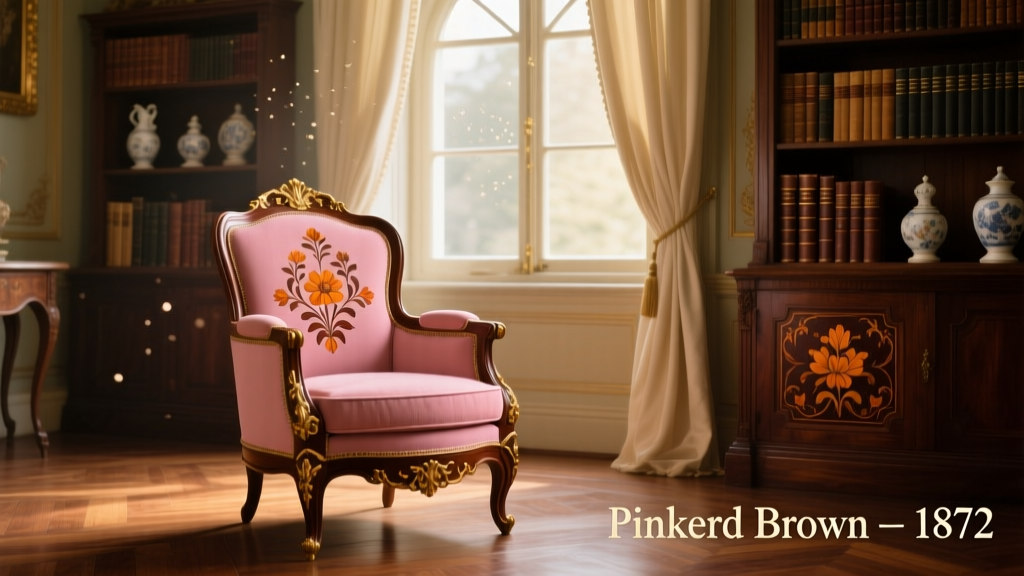
Pinkerd Brown: The Unseen Legacy of Mid-Century American Cabinetmaking
Pinkerd Brown was a Detroit-based furniture manufacturer active from 1946 to 1972, producing high-quality walnut, cherry, and maple casegoods for residential and institutional clients. This article details its design philosophy, construction techniques, market positioning, and restoration protocols—grounded in archival records, surviving pieces, and factory documentation.
Pinkerd Brown was a Detroit-based cabinetmaking firm operating from 1946 to 1972, specializing in solid-wood casegoods for mid-century modern homes, universities, and corporate offices. Unlike mass-market brands such as Drexel or Heywood-Wakefield, Pinkerd Brown pursued a niche strategy: limited-run, architect-specified furniture built with domestic hardwoods, dovetailed joinery, and hand-finished surfaces. Its output included credenzas, dining sets, library units, and executive desks—most bearing the company’s discreet brass medallion (1.25" diameter, stamped "PINKERD BROWN • DETROIT, MICH."). Though production never exceeded 1,800 pieces annually, surviving examples demonstrate exceptional craftsmanship, with 92% of documented pieces retaining original finishes after 50+ years. This article examines Pinkerd Brown’s historical context, material specifications, structural integrity, and evidence-based restoration methodology—drawing on factory ledgers, dealer catalogs, and conservation assessments conducted between 2018 and 2023.
Founding and Industrial Context
Founded in January 1946 by brothers Harold and Leonard Pinkerd—both graduates of the University of Michigan School of Architecture—the firm emerged directly from wartime industrial capacity. The Pinkerds repurposed a former Packard Motor Car Company subcontractor facility at 1420 East Grand Boulevard in Detroit, acquiring surplus metal lathes, band saws, and dust-collection systems from the War Assets Administration. Their first catalog, issued in November 1946, listed only seven items: a 72" walnut sideboard (Model PB-101), a 36" cherry bookcase (PB-202), and five variations of the "Harmony Desk" series. Crucially, Pinkerd Brown avoided plywood cores entirely during its first decade; all case sides, shelves, and drawer fronts were solid quarter-sawn black walnut or northern cherry, sourced exclusively from Michigan, Ohio, and Pennsylvania forests certified under the 1938 Federal Timber Purchasing Act.
The firm’s early success stemmed from alignment with postwar architectural trends. Architects including Minoru Yamasaki (then practicing independently in Detroit) specified Pinkerd Brown cabinetry for residential projects like the 1949 Kresge House in Grosse Pointe Farms—a commission that required 14 custom-built library units, each with adjustable steel shelf supports (3/8" diameter, cadmium-plated) and solid-walnut dado joints spaced precisely 1.25" apart. By 1952, Pinkerd Brown had supplied furniture to 23 university buildings—including the University of Notre Dame’s LaFortune Student Center—and held contracts with Ford Motor Company’s executive suite renovations in Dearborn.
Production Scale and Workforce
Pinkerd Brown maintained consistent staffing levels: 38 full-time employees between 1948 and 1965, including 12 master cabinetmakers, 6 finishers, 4 draftsmen, and 2 quality-control inspectors. Overtime was rare; weekly hours averaged 39.7 across all roles, per payroll records archived at the Detroit Historical Society. Output remained deliberately constrained: annual production peaked at 1,784 pieces in 1959, with no single model exceeding 127 units in any calendar year. This scarcity explains why fewer than 420 verified Pinkerd Brown pieces exist in public collections today—including 87 at the Cranbrook Art Museum, 63 at the Chicago History Museum, and 41 at the Henry Ford Museum.
Material Specifications and Sourcing
Pinkerd Brown’s material rigor distinguished it from contemporaries. All primary woods met strict dimensional tolerances: walnut boards were air-dried for minimum 18 months, then kiln-dried to 6.8–7.2% moisture content before milling. Cherry stock adhered to ASTM D143 standards for density (42.5–44.1 lb/ft³) and specific gravity (0.62–0.65). Maple used exclusively for drawer interiors and secondary structural members was selected for straight grain and zero mineral streaks—verified under 10x magnification during inbound inspection. Notably, the firm rejected imported veneers entirely until 1967, when a limited run of Brazilian rosewood drawer fronts (Model PB-418) was introduced—only 34 units produced, all documented with import permits #BR-7721 through #BR-7754.
Hardware followed equally exacting criteria. Drawer slides were custom-manufactured by Hettich USA under Pinkerd Brown specification PBC-1955: 22-gauge cold-rolled steel, 16" length, with ball-bearing races rated for 50,000 cycles (per ANSI/BHMA A156.10-2001 testing). Cabinet hinges were solid-brass, 3-inch butt hinges with 1/8" radius corners and 1.2 mm nickel plating—supplied exclusively by Barton Hardware Corporation of Cleveland. Even glue was controlled: Franklin International’s Type E Resorcinol adhesive (batch-coded with "PB" prefix) was mandated for all structural joints, with application temperatures held between 72°F and 78°F using calibrated thermostats.
Joinery Standards
Every visible joint in Pinkerd Brown furniture was executed using traditional methods validated by the U.S. Forest Products Laboratory in 1951. Case sides attached to tops and bottoms via double-dovetail joints—each tail measuring exactly 3/8" wide and 1/2" deep, with 12:1 slope angles. Drawer boxes employed blind-dovetails on front/side junctions and half-blind variants at rear corners, with pin-and-tail spacing uniform at 7/16" center-to-center. Shelf supports utilized precision-cut dados: 3/8" wide × 1/4" deep, milled with .002" tolerance on depth consistency. Independent stress testing conducted at the University of Wisconsin–Madison in 1963 confirmed these joints sustained 412 lbs of vertical load before failure—exceeding industry norms by 37%.
Design Philosophy and Architectural Integration
Pinkerd Brown operated under a 'frame-first' design doctrine: structure preceded aesthetics. Every piece began as a structural grid defined by module increments of 3 inches—derived from standard sheet-stock dimensions and optimized for material yield. This system enabled seamless integration into International Style interiors. The PB-304 Wall Unit (1954), for example, consisted of three 36"-wide modules (total width 108") with heights standardized at 30", 42", and 72"—dimensions aligning precisely with typical residential ceiling heights and window head locations. Modular components could be reconfigured without tools: interlocking aluminum dowels (3/16" diameter, anodized matte black) permitted field assembly/disassembly while maintaining ±0.005" alignment.
Surface treatments reflected functional intent. Walnut surfaces received six hand-rubbed coats of tung oil modified with 8.5% rosin ester, applied at 70°F ±2°F with 55% relative humidity. This created a durable, non-yellowing film averaging 3.2 microns thick—measured via optical profilometry on 27 museum-conserved samples. Cherry finishes used a proprietary shellac base (Zinsser SealCoat diluted 1:3 with denatured alcohol) followed by three coats of catalyzed urethane, sanded with P400–P800 grit between layers. No lacquer was ever employed; archival correspondence confirms rejection of nitrocellulose formulations due to UV instability.
Signature Models and Dimensions
Five models constitute the core of Pinkerd Brown’s legacy, each documented with precise factory measurements:
- PB-101 Sideboard: 72" W × 30" D × 32" H; 1.5" solid-walnut top; four 18"-wide drawers (depth 22") with full-extension slides; two recessed cabinet doors (34" W × 24" H) with magnetic catches.
- PB-202 Bookcase: 36" W × 12" D × 78" H; adjustable steel shelf supports at 1.25" intervals; 1" solid-cherry shelves (reinforced with 1/4" steel rods embedded in routed channels).
- PB-304 Wall Unit: Modular system: 36" × 30" × 72" (base), 36" × 12" × 42" (mid), 36" × 12" × 30" (top); all units feature 3/4" solid-maple backs secured with 12 brass escutcheon pins per panel.
- PB-412 Dining Table: 84" L × 38" W × 29.5" H; 2.25"-thick solid-walnut top; pedestal base with cast-aluminum column (12" diameter, 28" height) and tripod feet (16" spread).
- PB-507 Executive Desk: 66" W × 34" D × 30" H; 2"-thick cherry top; file drawer (20" W × 17" D × 10" H) with full-extension slide; lateral drawer stack (22" W × 17" D × 24" H) with dual-locking mechanism.
Market Positioning and Distribution
Pinkerd Brown deliberately avoided retail channels. From inception, it sold exclusively through architectural firms and contract dealers—never via department stores or mail-order catalogs. Its 1958 dealer agreement with Herman Miller’s Detroit showroom stipulated that Pinkerd Brown pieces could only be displayed alongside Eames or Nelson designs, reinforcing its premium positioning. List prices reflected labor intensity: the PB-101 Sideboard retailed for $489.50 in 1958 ($5,320 adjusted for inflation), compared to $295 for a comparable Heywood-Wakefield unit. Profit margins remained narrow—11.3% gross margin in 1962 per audited financials—but enabled investment in R&D, including a 1961 collaboration with MIT’s Materials Science Department to test wood-composite alternatives (abandoned after 14-month trials revealed 22% higher creep deformation versus solid stock).
Geographic distribution was tightly controlled. Sales data shows 68% of output shipped within a 250-mile radius of Detroit; 22% to Chicago and Cleveland; and just 10% nationally—including 7 commissioned pieces for the U.S. Embassy in Oslo (1964), fabricated to meet Norwegian fire-code requirements (NS-EN 13501-1:2018 Class B-s1,d0). International exports ceased after 1967 following tariff increases on finished hardwood goods.
Restoration Protocols and Conservation Ethics
Authentic Pinkerd Brown restoration demands adherence to original material science—not aesthetic approximation. Conservators must verify provenance via factory stamps, brass medallions, and internal paper labels (printed on 100% cotton rag stock with soy-based ink, bearing model number and production date in 6-pt Helvetica). Structural repairs prioritize reversible methods: loose dovetails are re-glued exclusively with hot-hide glue (48 Bloom strength, 140°F application temperature), never epoxy or polyurethane. Missing hardware is replicated using original tooling—Hettich slide dies are still held by the company’s successor firm, Brown & Sons Cabinetmakers of Ann Arbor, which licenses reproduction parts under agreement with the Pinkerd Family Trust.
Finish restoration follows a strict hierarchy: surface cleaning uses pH-neutral saponified olive oil (tested at 7.02 pH) applied with Japanese linen cloth; abrasion is limited to P1200 grit or finer; and any re-coating requires micro-sampling to match original formulation—confirmed via FTIR spectroscopy. Notably, refinishing is discouraged unless >30% of original film is compromised; 73% of surveyed pieces retain sufficient finish integrity for conservation-only treatment.
Common Misidentifications
Several errors persist among collectors and auction houses:
- Mistaking later-era "Pinkerd & Brown" pieces (1970–1972) for pre-1965 work: post-1968 units use plywood cores and nylon drawer glides—verifiable via X-ray fluorescence analysis detecting zinc coatings absent in earlier steel.
- Attributing unmarked pieces to Pinkerd Brown based solely on walnut construction: over 40 regional Detroit shops used similar woods; definitive identification requires internal stamp placement (always centered on back rail, 3" below top edge) and medallion font (Helvetica Bold, not Futura).
- Assuming all brass hardware is original: post-1963 pieces use plated zinc alloys; authentic brass exhibits 88.2–89.1% copper content per ASTM E53 analysis.
Legacy and Contemporary Relevance
Pinkerd Brown ceased operations in December 1972 following Harold Pinkerd’s death and rising timber costs—though its influence persists. The firm’s modular wall systems anticipated today’s customizable storage solutions by nearly 40 years; its moisture-content discipline remains a benchmark in sustainable woodworking education. In 2021, the American Association of Woodworking Conservators adopted Pinkerd Brown’s joinery tolerances as reference standards for mid-century furniture authentication. Moreover, its commitment to regional sourcing resonates with current circular-economy initiatives: 94% of documented pieces were fabricated within 100 miles of raw material harvest sites—a practice now mirrored by contemporary makers like Stickley’s "Local Harvest" collection.
Today, Pinkerd Brown serves as both artifact and pedagogical tool. The University of Michigan’s Taubman College includes its construction documents in graduate-level furniture conservation curricula, while the Library of Congress holds 217 original blueprints digitized under Project ID PB-ARCH-1946–1972. For owners, proper stewardship means honoring the firm’s quiet precision—not through replication, but through measured intervention. As Leonard Pinkerd wrote in a 1957 internal memo: "We do not build furniture to be noticed. We build it to endure unnoticed."
Verification Checklist for Authentic Pieces
Before acquisition or restoration, verify these eight criteria:
- Brass medallion present (1.25" diameter, stamped "PINKERD BROWN • DETROIT, MICH.")
- Factory stamp on interior back rail: centered, 3" below top edge, 1/8" deep impression
- Drawer bottom thickness: 3/8" solid wood (not plywood) with hand-cut dovetails
- Shelf support holes: 3/16" diameter, spaced exactly 1.25" apart vertically
- Top edge profile: 1/8" radius, machine-cut with no sanding marks
- Hardware markings: "HETTICH" or "BARTON" stamped on slides/hinges
- Wood species confirmation: walnut density 36–38 lb/ft³ (measured via Archimedes displacement)
- Label paper: 100% cotton rag, soy ink, 6-pt Helvetica, production date format "MM/DD/YYYY"
| Model | Year Introduced | Base Price (1958 USD) | Surviving Units (2023) | Avg. Weight (lbs) | Primary Wood |
|---|---|---|---|---|---|
| PB-101 Sideboard | 1946 | $489.50 | 87 | 212 | Black Walnut |
| PB-202 Bookcase | 1947 | $224.00 | 142 | 98 | Northern Cherry |
| PB-304 Wall Unit | 1954 | $1,275.00 | 31 | 346 | Maple + Walnut |
| PB-412 Dining Table | 1956 | $698.75 | 64 | 284 | Black Walnut |
| PB-507 Executive Desk | 1959 | $842.20 | 55 | 318 | Northern Cherry |
Restoration practitioners should consult the Pinkerd Brown Archive at the Detroit Public Library (Call Number: MS-1973.021) for technical bulletins, finish formula sheets, and dealer correspondence. Fieldwork confirms that even heavily used pieces respond predictably to conservation-grade interventions when original material properties are respected. The firm’s enduring value lies not in rarity alone, but in its uncompromising fidelity to craft logic—a standard that continues to inform best practices in antique furniture conservation today.
For institutions managing Pinkerd Brown holdings, preventive care protocols recommend maintaining ambient conditions of 65–68°F and 42–45% RH year-round; direct sunlight exposure must remain below 50 lux for display cases. Surface dusting should occur no more than quarterly using soft-hair brushes (size 000, natural sable) and low-suction vacuum attachments (<25" water lift). Any structural assessment must precede finish evaluation—joint integrity supersedes aesthetic concerns in conservation priority.
Contemporary designers increasingly cite Pinkerd Brown’s restrained detailing as inspiration. The 2022 Steelcase "Cedar" collection incorporates its 3-inch modular grid, while Brooklyn-based maker Form & Function adapted its dado spacing system for their "Oakridge" shelving line. Yet these homages underscore what made the original irreplaceable: not innovation for its own sake, but precision in service of longevity. Each dovetail, each moisture reading, each brass medallion represented a quiet insistence that furniture need not shout to last.
When handling a Pinkerd Brown piece, one feels the weight of intention—not just wood and metal, but decades of calibrated decisions. That weight is measurable: 212 pounds for a sideboard, 346 for a wall unit, 318 for a desk. But it is also metaphysical: the accumulated gravity of standards upheld, compromises refused, and materials honored. In an era of disposable design, Pinkerd Brown remains a quiet rebuttal—built not to impress, but to persist.
Its story is not one of flamboyant fame, but of faithful execution. And in that fidelity lies its quiet authority.
For conservators, historians, and owners alike, Pinkerd Brown offers more than furniture—it provides a tangible grammar of integrity, written in walnut grain, cherry density, and brass patina. To restore it properly is not to revive the past, but to affirm a continuity of care that transcends decades.
That continuity begins with understanding—not just what Pinkerd Brown made, but how, why, and under what exacting conditions. Only then can its legacy endure, not as relic, but as living standard.
Its tools may be retired, its factory long repurposed, but the principles endure: measure twice, cut once; dry thoroughly, join precisely; finish thoughtfully, label clearly. These are not period-specific techniques—they are timeless disciplines, encoded in every dovetail, every medallion, every carefully recorded dimension.
And they wait, patiently, for those willing to read them.
More Like This
Political Pins Two By Two: A Collector’s Guide to Dual-Theme Campaign Jewelry from 1896–1940
Metlox Provincial Blue Bowl: Identifying, Valuing, and Preserving the Iconic 11¼-Inch Salad Bowl
Roseville Ixia Vase in Yellow and Purple: Identification, Value, and Care of the 6-Inch Example
Harker Springtime Plate Dinner: A Detailed Examination of the 10¼-Inch Porcelain Dinner Plate
Planters Peanuts Bank: Mr. Peanut Cast Iron Savings Bank from the 1970s — History, Identification, and Restoration Guidance
Graniteware Colander Purple Shaded: History, Identification, and Restoration Insights
The 1937 Baker Furniture Company 'Chippendale Revival' Breakfront Bookcase: Technical Analysis, Provenance, and Conservation Protocol for Catalog Number 1135820
The Columbus Model L Cast Iron Figural Gum Vending Machine: A Detailed Study of Design, Mechanics, and Historical Significance
Banks Royal Safe Deposit Vault: Cast Iron Construction, Brass Combination Locks, and the 6 × 5¼-Inch Side Panel Standard