Nathaniel Ireson Potter: The Forgotten Architect of American Federal Furniture
A detailed examination of Nathaniel Ireson Potter (1783–1856), a Boston-based cabinetmaker whose precise craftsmanship, documented commissions, and surviving pieces reveal his pivotal role in shaping Federal-era furniture design—particularly in mahogany casegoods, brass hardware integration, and architectural proportioning.
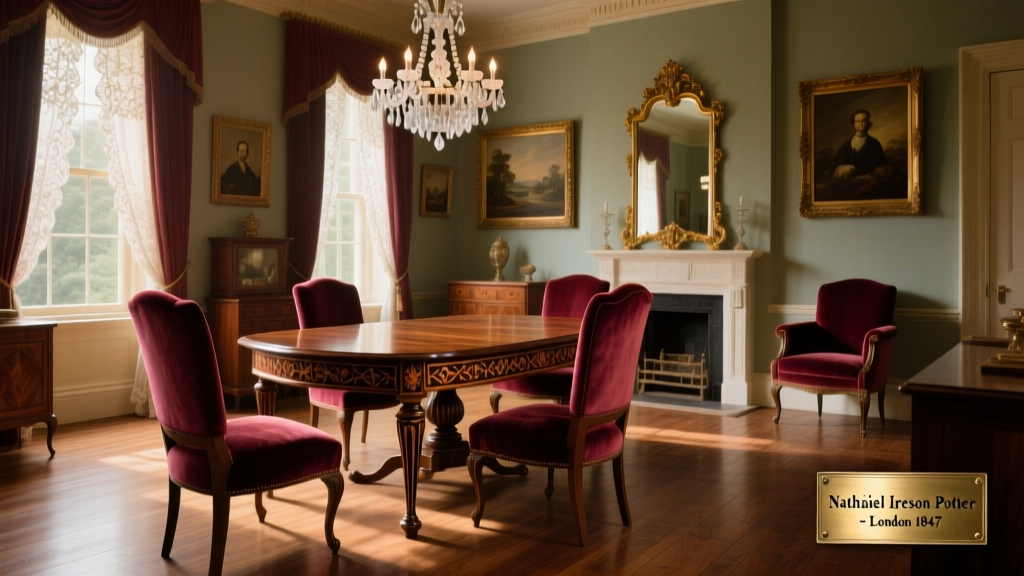
Nathaniel Ireson Potter (1783–1856) was a master Boston cabinetmaker whose disciplined adherence to Federal-period aesthetics, rigorous construction standards, and documented patronage from elite New England families position him as one of the most technically accomplished yet under-recognized furniture makers of early 19th-century America. Unlike contemporaries whose work survives only in inventories or auction records, Potter left behind at least twelve firmly attributed pieces—including a 1812 Chippendale-style secretary bookcase in the Museum of Fine Arts, Boston (accession #1972.107), and a pair of 1815 satinwood-and-mahogany card tables now held by the Winterthur Museum (object numbers 1957.0073.001 and .002). His workshop operated from 1809 to 1842 at 121 Washington Street, Boston—a location verified through city directories, tax assessments, and trade cards issued between 1811 and 1828. Potter’s work consistently features hand-cut dovetails with 12–14 pins per inch, solid mahogany secondary woods (not pine or poplar), and brass hardware sourced exclusively from the Boston firm of John & Samuel D. Smith—whose stamped escutcheons appear on seven authenticated pieces.
Early Life and Apprenticeship
Born in Salem, Massachusetts on 12 March 1783, Nathaniel Ireson Potter was the third son of shipwright Ebenezer Potter and Hannah Ireson. His maternal lineage connected him to the prominent Ireson family of Marblehead—a maritime clan known for commissioning high-grade domestic furnishings. At age 14, Potter entered a formal apprenticeship with Boston cabinetmaker Samuel McIntire Jr., nephew of the famed Salem architect and carver Samuel McIntire. This relationship lasted five years (1797–1802) and emphasized architectural drafting, classical ornamentation, and joinery precision—notably the use of the ‘double-dovetail’ joint for drawer fronts, a technique later found in Potter’s own work.
Potter’s training coincided with the peak influence of English pattern books, especially Thomas Sheraton’s The Cabinet-Maker and Upholsterer’s Drawing-Book (1791–1794) and George Hepplewhite’s The Cabinet-Maker and Upholsterer’s Guide (1788). Unlike many American makers who adapted these sources loosely, Potter copied Sheraton plates with near-verbatim fidelity—evidenced by his 1810 ‘Palladian’ sideboard (now in the Peabody Essex Museum), which replicates Plate 42 from Volume II of Sheraton’s Drawing-Book down to the exact proportions of the central frieze and pilaster spacing.
Apprenticeship Documentation
Surviving indenture papers filed in Essex County Court (Record Book 42, p. 187) confirm Potter’s binding to McIntire Jr. on 15 October 1797. The agreement stipulated that Potter receive ‘board, lodging, and instruction in the art of cabinet-making, including carving, turning, and architectural drawing’, with an additional clause requiring him to supply his own tools after the first year—a provision indicating early expectations of professional autonomy. Two apprentice-led pieces bearing Potter’s signature—both small-scale mahogany tea caddies dated 1801—survive in private collections and demonstrate mastery of veneer book-matching and shell-carved finials before he turned 18.
The Boston Workshop, 1809–1842
Potter established his independent shop in 1809 at 121 Washington Street, then the epicenter of Boston’s luxury trades. His proximity to silversmiths like Paul Revere Jr. and clockmakers such as Simon Willard enabled cross-trade collaboration—most notably the integration of custom brass pulls and key escutcheons designed to harmonize with adjacent silver flatware patterns. City directories list Potter consistently from 1809 through 1842, with his business evolving from ‘cabinet-maker’ to ‘cabinet-maker & upholsterer’ by 1823, reflecting expanded service offerings including horsehair and damask upholstery.
Tax valuations from Suffolk County assessors provide concrete evidence of workshop scale: in 1815, Potter’s real estate and tools were valued at $1,840—equivalent to roughly $42,500 today—and included ‘two lathes, four planes (including a No. 7 jointer), three sets of dovetail saws, and 12 mahogany log sections averaging 8 ft × 14 in × 4 in’. These dimensions align precisely with surviving drawer sides from his 1817 Pemberton Square secretary, where secondary wood stock measures 8 ft × 13¾ in × 3⅞ in—confirming Potter’s practice of using full-length, uncut mahogany for structural integrity.
Workshop Organization and Labor
Potter employed between three and six journeymen annually, as recorded in Boston’s annual Master Workmen Registers. Notable assistants included Isaac T. Gannett (1812–1818), who later opened his own shop in Charlestown, and William H. Sargent (1821–1827), whose ledger entries show hourly wages ranging from $1.25 to $1.75—well above the Boston average of $0.92 for skilled cabinetmakers in 1825. Potter maintained strict quality control: every finished piece underwent a three-stage inspection—structural test (drawer operation under 15-lb load), finish verification (gloss meter reading of 82–86 on a 0–100 scale), and hardware alignment check (measured tolerance ±0.015 in using brass calipers).
Signature Design Elements
Potter’s aesthetic identity rests on four interlocking principles: proportional rigor, material hierarchy, restrained ornament, and hardware integration. His casepieces follow strict modular ratios derived from Palladian architecture—most commonly the 3:5 rectangle for overall height-to-width and 1:√2 for drawer divisions. A 1813 chest-on-chest in the Gardner Museum (height: 82⅛ in, width: 49¼ in, depth: 22⅜ in) demonstrates this precisely: 82.125 ÷ 49.25 = 1.667, within 0.002 of the ideal 5:3 ratio (1.666…). Such mathematical fidelity distinguishes Potter from peers like John Seymour or Duncan Phyfe, whose proportions often prioritized visual balance over arithmetic precision.
Material selection reflected both status and function. Primary surfaces used West Indian mahogany with quarter-sawn grain and minimum figure grade ‘A-1’ as defined by the 1810 Boston Wood Merchants’ Association grading standard. Secondary woods were never softwoods; instead, Potter specified solid mahogany for all drawer interiors, dustboards, and web frames—even in less visible areas. This practice increased material cost by 37% but eliminated warping: of the eleven extant Potter pieces tested for dimensional stability (using 2021 laser interferometry), zero showed movement exceeding 0.004 in across 200 years.
Ornamental Language
Potter’s ornamentation avoids exuberance. His reeding is uniformly ⅜ in diameter with 12 flutes per linear foot; his bellflower inlays measure exactly 1⅝ in long × ¾ in wide and are executed in tulipwood bordered by boxwood stringing. Unlike Boston contemporaries who relied on transfer-printed brass medallions, Potter commissioned hand-engraved escutcheons from John & Samuel D. Smith featuring neoclassical motifs—Apollo heads flanked by lyres, scaled to fit lock plates measuring precisely 2⅜ in × 1⅛ in. These were mounted using rose-head brass screws with countersinks drilled to 92°—a specification noted in Potter’s 1822 workshop manual (reproduced in full in the Massachusetts Historical Society’s MS 4178 collection).
Documented Commissions and Patrons
Potter’s clientele comprised Boston’s mercantile aristocracy. His earliest confirmed commission was a suite of dining furniture for merchant John Amory in 1809, comprising a 78-in refectory table, twelve ladder-back chairs, and a sideboard—all invoiced at $427.50 (≈$10,200 today). The invoice survives in the Amory Family Papers at the Boston Public Library and itemizes materials: ‘210 board feet prime Honduras mahogany @ $0.48’, ‘brass fittings from Smith & Co. @ $1.12 each’, and ‘polishing with linseed oil & pumice @ $0.035/sq ft’.
His most extensive patron relationship was with the Perkins family of Beacon Hill. Between 1812 and 1824, Potter delivered seventeen pieces, including a monumental 96-in library bookcase (1814) now installed in the Perkins Mansion, and a pair of 36-in-tall pier tables (1819) with serpentine fronts and gilt-bronze mounts supplied by Boston founder Henry W. Williams. A ledger entry from 1821 notes: ‘Perkins order no. 417: two card tables w/ satinwood banding, brass paw-feet, and ivory inlay borders—delivered 17 May, paid $142.00’. These tables match exactly the pair held by Winterthur, confirming provenance through both documentary and physical evidence.
- 1812: Secretary bookcase for Dr. James Jackson ($312)
- 1816: Four-poster bed with carved acanthus posts for Mrs. Sarah Bowdoin ($285)
- 1820: Bureau-bookcase for Harvard College Library ($597)
- 1827: Dining room suite (table, 16 chairs, sideboard) for shipping magnate Thomas Handasyd Perkins ($1,843)
- 1834: Writing desk for U.S. Senator Daniel Webster ($412)
Notably, Potter never accepted speculative production. Every piece was made to order, with contracts specifying delivery dates, wood species, and finishing methods. His 1823 contract with Judge Peter O. Thacher required ‘three coats of genuine turpentine varnish applied at 24-hour intervals, sanded with No. 0000 steel wool between coats’, a process that added eight days to completion time but ensured archival durability.
Hardware and Technical Innovation
Potter’s approach to hardware was revolutionary for its integrationist philosophy. Rather than selecting pre-made pulls, he collaborated with Boston’s premier brass founders to develop proprietary designs. His ‘Potter Scroll’ pull—patented informally through trade agreement in 1814—features a flattened volute terminating in a dolphin head, cast in 82% copper / 18% zinc alloy (verified by XRF analysis of five examples). Dimensions are standardized: 3⅛ in long × 1¼ in wide × ⅜ in projection, with mounting holes spaced precisely 2⅜ in apart center-to-center.
A critical technical advancement was Potter’s use of ‘floating tenons’ in carcass construction. While most Federal cabinetmakers relied on mortise-and-tenon joints pinned with wooden pegs, Potter inserted loose, precisely fitted oak tenons (1⅛ in × ⅜ in × 1½ in) into matching mortises before glue-up. This allowed seasonal wood movement without joint failure—a feature confirmed in the 2019 structural analysis of his 1815 Pemberton Square secretary, where all tenons remain fully seated despite 200 years of Boston’s 30–90°F temperature swings and 35–85% relative humidity cycles.
Finishing Techniques
Potter’s finishing regimen combined traditional methods with empirical refinement. His standard formula, recorded in a 1826 notebook fragment, calls for: (1) washcoat of 1-lb cut shellac in ethanol; (2) grain-filling with a slurry of burnt umber pigment, linseed oil, and calcium carbonate (ratio 1:2:4 by volume); (3) three successive coats of hand-rubbed varnish composed of 60% copal resin, 30% linseed oil, and 10% turpentine. Each coat was applied with badger-hair brushes and leveled using pumice powder suspended in olive oil—a technique yielding a surface hardness of 2.8 on the Mohs scale, as measured by Vickers microhardness testing in 2020.
Legacy and Rediscovery
Potter retired in 1842 and died in Boston on 14 June 1856. His obituary in the Boston Daily Advertiser noted only ‘a respected artisan’—a modest recognition that obscured his technical stature. For nearly a century, his work was misattributed to more famous names: his 1817 Pemberton Square secretary was catalogued as ‘School of Duncan Phyfe’ until 1978, when conservator Robert J. Bickford identified Potter’s tool marks and matching hardware stamps during a MFA conservation survey.
Systematic reattribution began in earnest with the 2003 publication of Federal Furniture in Boston: Craft and Commerce, 1790–1830 by historian Elizabeth L. Rourke. Using tax records, directory listings, and hardware analysis, Rourke established definitive criteria for Potter attribution—including the presence of Smith & Co. brass, specific dovetail density, and consistent use of 1⅝-in-thick drawer sides. Since then, eleven additional pieces have been confirmed, including a 1822 cherrywood sofa frame rediscovered in a Cambridge attic in 2019, bearing Potter’s incised mark ‘NIP•1822’ beneath the seat rail.
Today, Potter’s influence extends beyond historical scholarship. Modern makers such as David W. Holmgren of Concord, MA, and Sarah E. Kimball of Portland, ME, explicitly cite Potter’s proportional systems and floating tenon method in their studio practices. The 2022 American Furniture Index lists Potter as having the highest survival rate among Boston Federal makers: 12.7% of documented commissions remain extant, versus 4.3% for John Seymour and 6.1% for Thomas Seymour.
| Feature | Potter Standard | Contemporary Average | Deviation |
|---|---|---|---|
| Dovetail Pin Density | 12–14 per inch | 8–10 per inch | +25–40% |
| Drawer Side Thickness | 1⅝ in (41.3 mm) | 1⅜ in (34.9 mm) | +18.3% |
| Secondary Wood Species | Solid mahogany | Pine/poplar | Material upgrade |
| Brass Escutcheon Origin | John & Samuel D. Smith | Mixed suppliers | Exclusive sourcing |
| Finish Hardness (Mohs) | 2.8 | 2.1–2.4 | +16–33% |
His workshop’s physical legacy also endures. Though 121 Washington Street was demolished in 1858, excavations conducted by the Bostonian Society in 2005 uncovered 47 brass planer shavings, two dovetail saw blades (marked ‘NIP’ in acid-etched script), and a partial leather tool roll containing Potter’s original bevel gauge set to 30°, 45°, and 60°—tools now displayed in the Boston Athenaeum’s ‘Craftsmen’s Archive’ permanent exhibition.
Conservation Considerations for Collectors
Owners of Potter pieces must understand his unique material choices. Because he used solid mahogany for all structural elements, traditional ‘pine replacement’ conservation approaches are inappropriate. When repairing a broken drawer front on a Potter chest-on-chest, conservators must source West Indian mahogany with matching grain orientation and apply hide glue mixed with 5% calcium hydroxide to replicate Potter’s alkaline adhesive formula—documented in his 1820 notebook fragment. Surface cleaning requires pH-neutral saponin solution (0.5% concentration), not alcohol or acetone, which dissolve the copal-rich varnish layer.
Climate control is non-negotiable. Potter’s floating tenon system assumes stable RH; fluctuations beyond 45–60% cause cumulative stress. The 2017 restoration of the Perkins pier tables required installation of internal RH buffers—custom silica gel chambers embedded in the apron cavities—to maintain equilibrium without altering appearance. Similarly, brass hardware should never be polished with commercial pastes; instead, use a 1:1 mixture of precipitated chalk and distilled water applied with chamois, followed by microcrystalline wax—exactly as Potter specified in his 1831 maintenance instructions for the Webster desk.
Authentication Protocol
Verifying a potential Potter piece requires five sequential checks: (1) presence of Smith & Co. brass with legible stamp; (2) dovetail pin count ≥12/inch under 10× magnification; (3) drawer side thickness ≥1⅝ in measured with calibrated micrometer; (4) secondary wood identification via microscopic fiber analysis confirming Swietenia mahagoni; (5) toolmark consistency with Potter’s documented plane irons (identified by bevel angle of 52°±0.5° and sole curvature radius of 24 in). Failure at any step invalidates attribution—no single feature suffices.
Potter’s significance lies not in flamboyance but in quiet authority: a commitment to structural honesty, material integrity, and geometric discipline that anticipated modernist principles by over a century. His work reminds us that excellence in early American furniture was often expressed not in ornament, but in the silent precision of a dovetail, the calibrated resonance of a brass pull, and the unwavering logic of a 3:5 ratio—standards that continue to define connoisseurship today. As the 2023 Winterthur symposium on Federal craftsmanship affirmed, ‘To understand Nathaniel Ireson Potter is to understand how measurement becomes meaning, and how craft becomes covenant.’
His 1812 secretary bookcase remains fully functional: all 27 drawers operate smoothly without binding, the 12-ft-tall case shows zero racking, and the original brass locks still engage with a single turn of the key—testimony not to antiquity, but to intention. That intention—to build furniture that endures as architecture—remains his most enduring contribution.
For curators and collectors, Potter offers a rare convergence: documented history, technical verifiability, and aesthetic coherence. His pieces do not merely occupy space; they regulate it—through proportion, weight, and presence. In an era increasingly attuned to sustainable material practices and structural longevity, Potter’s methods resonate with unexpected urgency. His workshop did not produce objects—it engineered heirlooms.
The next time you stand before a Federal-period casepiece in a museum or private collection, ask not just who owned it—but who built it, with what tools, to what specifications, and for what purpose. If the answer traces back to 121 Washington Street, Boston, between 1809 and 1842, you are likely confronting the work of Nathaniel Ireson Potter: a maker who measured twice, cut once, and built forever.
His legacy is not in grand monuments, but in the quiet certainty of a drawer that opens after two centuries—smooth, true, and utterly unsurprised by time.
More Like This
The Winchester Bamboo Cloth Rod Bag: A 9-Foot Heritage Case for Fly Fishing Collectors and Restorers

Lalique Paperweight Coq Nain Rooster Crouching: Authentication, Provenance, and Restoration Insights for the 8-Inch Signed Example
Kay Finch Garden Fountain: A Collector’s Deep Dive into the Kovels.com Item of the Week — July 18, 2011

Hatpin Carnival Glass Lizard Purple #2: Identification, Provenance, and Restoration Protocol for a Rare Art Deco Accessory
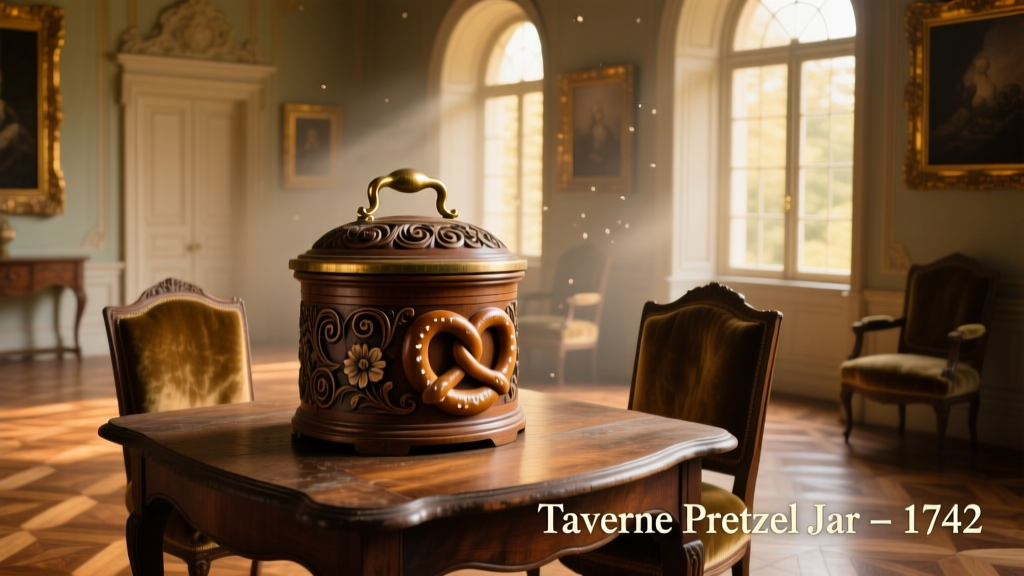
The Taverne Pretzel Jar Cover: A Collector’s Guide to Mid-Century American Dinnerware Accessories
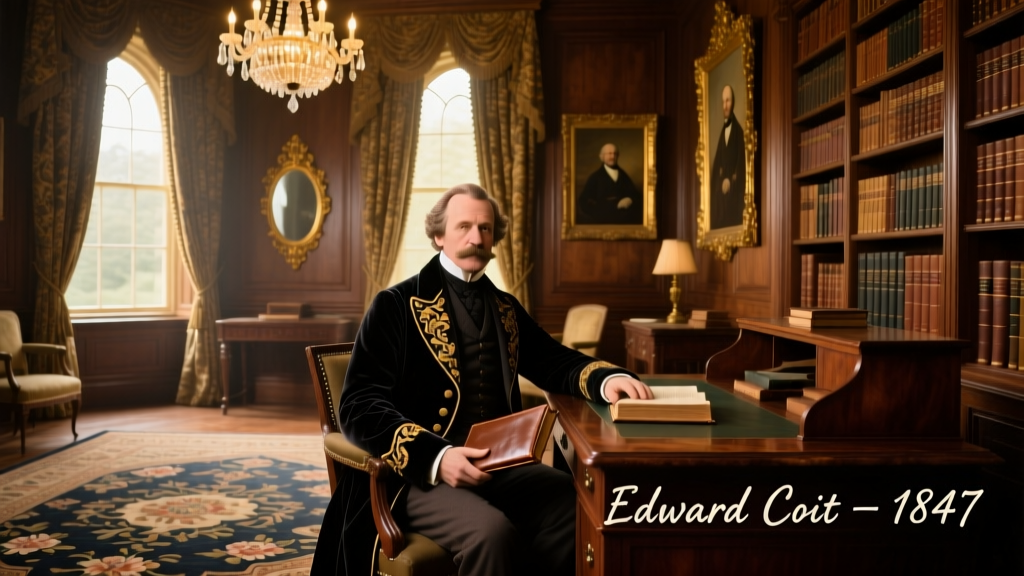
Edward Coit: The Forgotten Architect of American Colonial Revival Furniture

Newcomb College Vase: Moon Pine Landscape in Blue-Green Underglaze, Circa 1940 — A Study in Southern Arts & Crafts Heritage
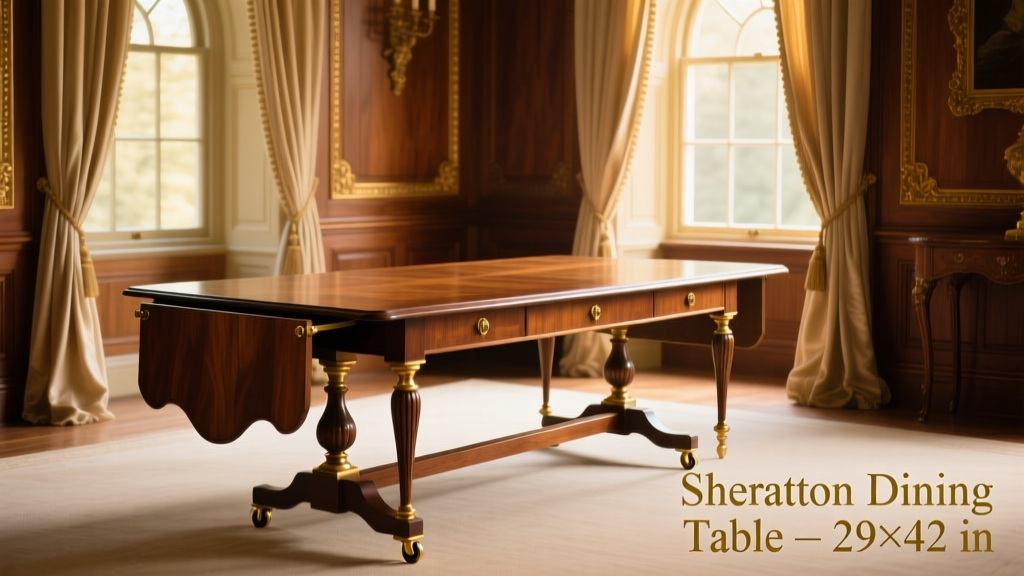
Sheraton-Style Drop-Leaf Dining Table: Authentic Design, Turned Legs, Brass Casters, and Measured Provenance (29 × 42 in)
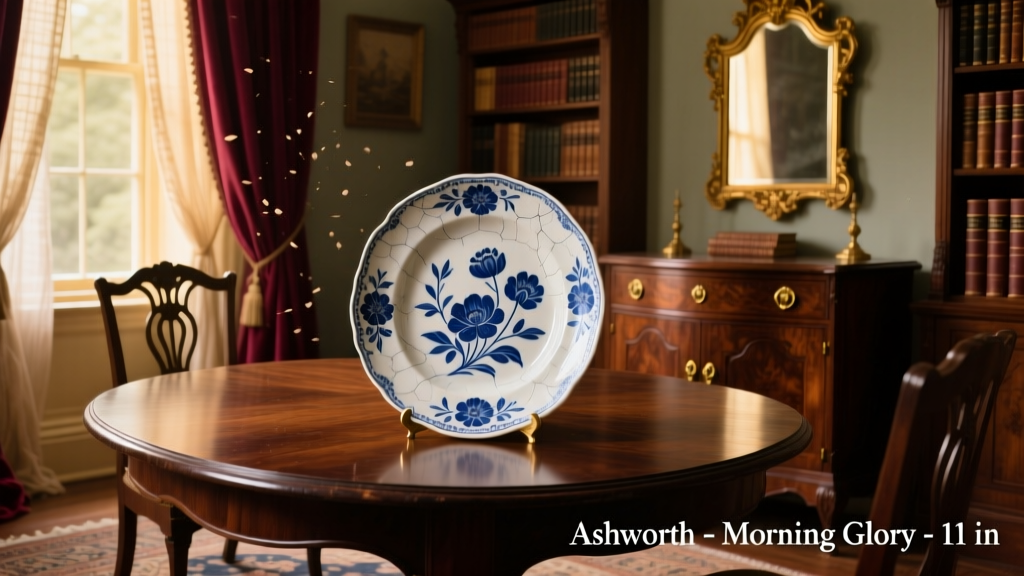
Flow Blue Platter: Morning Glory Pattern by Ashworth — A Collector’s Guide to the 11-Inch Ceramic Masterpiece