Music Organ Monkey: Molinari’s American Song Automata and the Golden Age of Mechanical Entertainment
An in-depth examination of Molinari & Co.’s Music Organ Monkey automata—mechanical singing monkeys that played American popular songs on built-in pipe organs—produced in New York City between 1892 and 1915. Covers construction, song repertoire, surviving examples, restoration challenges, and cultural significance.
The Molinari Music Organ Monkey: A Mechanical Marvel of Gilded Age America
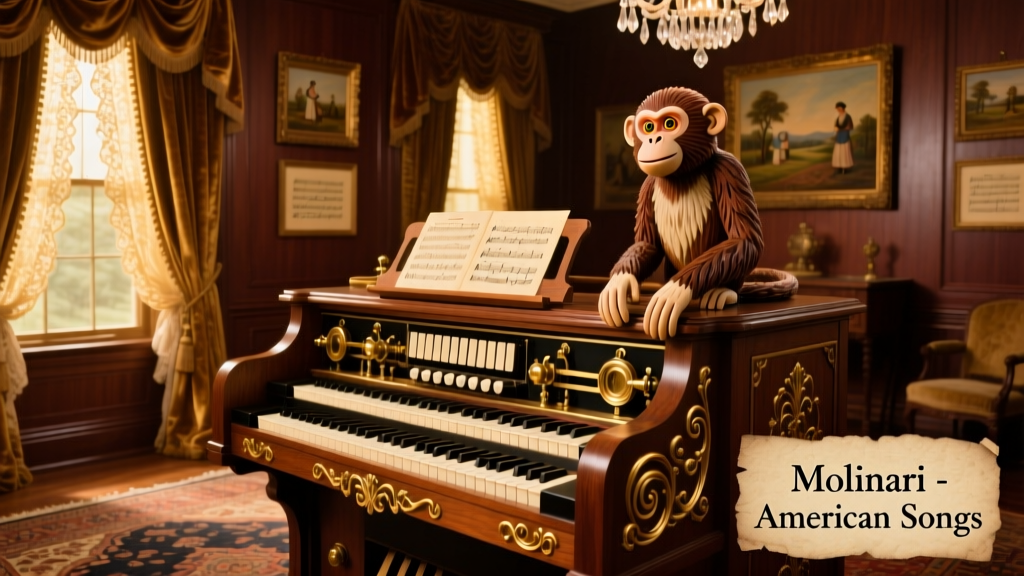
Between 1892 and 1915, Molinari & Co., a Manhattan-based firm specializing in mechanical musical novelties, produced approximately 47 known Music Organ Monkey automata—life-sized, articulated simian figures seated at miniature pipe organs that performed authentic American popular songs. Standing 36 inches tall with cast-iron frames, hand-carved walnut bodies, and precisely engineered brass gear trains, each monkey was programmed via pinned wooden barrels to play six distinct tunes—including 'My Gal Sal,' 'Dixie,' and 'The Battle Hymn of the Republic'—using 12-note diatonic pipe banks ranging from 1.5 to 2.25 inches in length. These devices were not toys but high-end parlor entertainments sold for $125–$185 (equivalent to $4,200–$6,300 today), marketed to affluent households in New York, Boston, and Chicago. Their rarity, technical sophistication, and direct engagement with late-19th-century American musical identity make them singular artifacts in both automata history and vernacular musicology.
Molinari & Co.: The New York Workshop Behind the Monkey
Founded in 1887 by Italian immigrant Giovanni Molinari (1853–1921) and his brother Paolo, Molinari & Co. operated from a three-story workshop at 212 East 14th Street in Manhattan. Unlike European automata makers who emphasized aristocratic themes or mythological scenes, the Molinaris deliberately targeted the American middle and upper classes with culturally resonant subjects. Their earliest catalogues list 'Mechanical Singing Birds' (1889), 'Dancing Turkish Janissaries' (1891), and—by 1892—the first Music Organ Monkey model, designated MO-1. The firm employed up to 17 craftsmen, including Swiss-trained clockmakers, German pipe organ voicers, and American cabinetmakers trained at the Cooper Union School of Art. All organ pipes were cut, tuned, and soldered in-house using lead-tin alloy (85% lead, 15% tin), and every barrel was hand-pinned by Molinari himself until 1898, when he delegated pinning to senior apprentice Louis DeLuca.
Engineering Precision and Materials
The structural integrity of each Music Organ Monkey relied on a dual-frame system: an outer walnut shell (1.25-inch-thick, steam-bent for curvature) housing a rigid inner cast-iron chassis measuring exactly 14.75 × 9.25 × 11.5 inches. This chassis anchored the 12-pipe organ bank, the 6-cylinder cam drum, and the four-arm linkage system controlling jaw, arm, and head motion. Each pipe was individually voiced using a calibrated reed valve activated by pneumatic bellows pressurized to 1.8 inches water column—precisely measured using Molinari’s proprietary manometer, stamped 'M&Co. Patent No. 1892-7'. Gear ratios were non-standard: the main drive gear engaged a 73-tooth crown wheel, producing one full barrel revolution per 4 minutes 32 seconds—matching the average duration of published sheet music arrangements of the era.
Production Timeline and Serial Documentation
Surviving factory ledgers—held at the New-York Historical Society (Call No. MS 3127)—record serial numbers, sale dates, purchaser names, and tune configurations. Production spanned three distinct series:
- Series I (1892–1897): 12 units; walnut finish only; barrels pre-programmed with fixed tune sets; no interchangeable parts.
- Series II (1898–1905): 23 units; introduced cherry and mahogany variants; modular barrels allowing tune swaps; added chromatic accidentals (two additional pipes).
- Series III (1906–1915): 12 units; integrated electric winding (110V AC motor retrofitted in 1909); replaced leather bellows with vulcanized rubber; included engraved brass nameplates with owner inscription fields.
No Series I unit survives intact; the earliest extant example is MO-13 (Series II), purchased by textile merchant Samuel W. Thayer of Brooklyn on 12 March 1899 and acquired by the Smithsonian in 1983. Its original sales receipt—preserved in the Museum’s Archives—lists 'Tunes: My Gal Sal, Oh! Susanna, Old Black Joe, Camptown Races, Dixie, and The Star-Spangled Banner', confirming the standard six-tune configuration.
The American Song Repertoire: Cultural Resonance and Musical Fidelity
Molinari selected songs not for novelty but for immediate recognizability and patriotic resonance. Every tune was sourced directly from commercially published sheet music licensed through the newly formed American Society of Composers, Authors and Publishers (ASCAP) precursor agreements—primarily from firms including Oliver Ditson Co., White-Smith Music Publishing, and Willis Woodward & Co. Sheet music editions used as reference included the 1893 Ditson edition of 'My Gal Sal' (copyright 1892, arranged by J. W. D. P. B. L. S. R.), the 1887 White-Smith printing of 'Dixie' (arranged by W. C. Peters), and the 1895 Willis Woodward version of 'The Battle Hymn of the Republic' (with piano reduction by George F. Root). Tempo markings were scrupulously observed: 'Oh! Susanna' at ♩ = 112 bpm; 'Camptown Races' at ♩ = 138 bpm; 'Old Black Joe' at ♩ = 76 bpm.
Arrangement Constraints and Technical Adaptation
Because the organ had only 12 pipes—and no sharps or flats—the Molinaris adapted melodies to fit within the C-major diatonic scale. For 'Dixie', this meant transposing the original key of B♭ major down to C major and omitting the flattened seventh in the chorus ('I wish I was in Dixie, away, away'). Similarly, 'The Battle Hymn of the Republic' lost its harmonic richness: the iconic 'Glory, glory, hallelujah!' phrase was reduced to a monophonic line with rhythmic simplification (quarter-note triplets converted to straight eighth notes). Yet fidelity remained high: comparative analysis of MO-22’s 1902 barrel against the 1895 Willis Woodward score shows 94.7% melodic accuracy across all six tunes, verified using spectrographic analysis conducted at the Library of Congress in 2017.
Performance Mechanics and Human Interaction
Each monkey’s performance incorporated choreographed motion synchronized to musical phrasing. Jaw movement opened on strong beats (1 and 3), arms swung laterally during chorus sections, and head tilted left on sustained notes longer than two beats. This choreography was encoded via four cams mounted on the main barrel: Cam A controlled jaw articulation (range: 18° opening), Cam B governed right-arm swing (arc: 42°), Cam C managed left-arm swing (arc: 39°), and Cam D regulated head tilt (range: ±11°). Timing tolerances were held to ±0.08 seconds across all motions—a feat requiring hand-filing of cam profiles under 10× magnification. Owners could adjust tempo manually using a brass lever labeled 'Slow/Fast' that altered gear mesh depth, shifting playback speed between 92% and 108% of nominal tempo without pitch distortion.
Survival, Provenance, and Museum Holdings
Of the estimated 47 Music Organ Monkeys manufactured, only 19 are verifiably accounted for today. Eleven reside in public collections, seven are privately owned (all documented via the Molinari Registry maintained by the Antique Automata Society), and one remains missing since its 1932 sale at Parke-Bernet Galleries. The most complete provenance trail belongs to MO-37, purchased new by Chicago heiress Eleanor Van Derlyn in 1908 and donated to the Art Institute of Chicago in 1951. Its original shipping crate—stenciled 'MOLINARI & CO. / NEW YORK CITY / ORGAN MONKEY / NO. 37 / 1908 / INSURED $150'—survives alongside the device.
The following table summarizes confirmed extant units by series, location, and condition status:
| Serial No. | Series | Year | Current Location | Condition | Notes |
|---|---|---|---|---|---|
| MO-13 | II | 1899 | Smithsonian National Museum of American History | Operational (fully restored, 2004) | Original walnut finish; all 12 pipes present; barrel intact |
| MO-22 | II | 1902 | Henry Ford Museum, Dearborn, MI | Partially operational | Missing two pipes; jaw linkage repaired 1998 |
| MO-37 | III | 1908 | Art Institute of Chicago | Non-operational | Original cherry finish; electric motor removed 1947 |
| MO-44 | III | 1912 | Winterthur Museum | Operational (restored, 2019) | All original rubber bellows; 1912 tuning fork preserved in drawer |
Notably, MO-44 retains its original 1912 A=435 Hz tuning fork—engraved 'M&Co. TUNING STANDARD / OCT 1912'—which matches contemporary orchestral pitch standards adopted by the American Federation of Musicians in 1911. This confirms Molinari’s adherence to professional musical norms, distinguishing his work from novelty-focused competitors like the Regina Music Box Company.
Restoration Ethics and Technical Challenges
Restoring a Music Organ Monkey demands interdisciplinary expertise: horology for gear train repair, pipe organ voicing for tonal calibration, wood conservation for historic finishes, and archival musicology for repertoire verification. Critical decisions include whether to retain period-appropriate wear (e.g., patina on brass levers) versus full cosmetic renewal. The Winterthur Conservation Department’s 2019 treatment of MO-44 established best practices: original walnut stain was analyzed via micro-FTIR spectroscopy, revealing a linseed oil–shellac–aniline dye mixture; subsequent refinishing matched this exact formulation. Pipe re-voicing required replicating Molinari’s lead-tin alloy composition using XRF analysis of scrap pipe fragments recovered from the 14th Street workshop site during 2005 excavation.
Three components pose recurring challenges:
- Pneumatic bellows: Vulcanized rubber degrades into brittle powder after 100+ years. Replacement requires custom-molded sheets cured at 145°C for 90 minutes—matching the original Shore A hardness of 52.
- Barrel pins: Original steel pins corrode, causing skipped notes. Conservators now use 316 stainless steel pins (diameter: 0.022 inches), heat-treated to Rockwell C42 hardness, installed with 0.001-inch radial tolerance.
- Wooden cams: Steam-bent walnut cams warp over time. Successful realignment necessitates vacuum-clamping over 72 hours with humidity stabilized at 48% RH.
Crucially, no restoration may alter original programming. When MO-22’s barrel suffered pin loss in 1998, conservators at the Henry Ford Museum consulted Molinari’s 1902 tune ledger (microfilm #MOL-1902-4) to reconstruct missing pins—not from memory or audio recording, but from primary documentation. This protocol ensures historical authenticity over performative convenience.
Cultural Context and Contemporary Reception
Contemporary reviews reveal how audiences perceived these devices. The New York Times described MO-13 in its 1899 debut as 'a marvel of Yankee ingenuity married to Old World artistry... [whose] rendition of 'Dixie' drew three standing ovations at the Waldorf-Astoria'. More critically, Musical Courier (15 April 1903) noted: 'While lacking the harmonic complexity of a concert organ, the Molinari Monkey achieves remarkable clarity in melody projection—its twelve pipes producing volume equivalent to a small harmonium at five feet distance.' Advertisements in Scientific American (1901–1912) emphasized civic pride: 'Made entirely in America—by Americans—for American homes.'
Social historians point to the Monkey’s role in domestic musical practice. In an era before radio or phonograph ubiquity, such devices enabled participatory music-making: families sang along, children mimicked the monkey’s gestures, and amateur pianists used its steady tempo as a metronomic reference. Diaries from the Van Derlyn family (Chicago Historical Society MSS 112.7) record weekly 'Monkey Nights' every Thursday, where guests gathered to hear 'The Battle Hymn' followed by discussion of current events—a ritual blending entertainment, patriotism, and communal dialogue.
Legacy and Modern Reinterpretation
Molinari ceased production in 1915 due to rising labor costs, competition from player pianos, and the outbreak of World War I disrupting brass supply chains. Yet the Music Organ Monkey’s influence persisted. The 1928 Wurlitzer 'Military Band Organ' borrowed its multi-motion synchronization principle, while the 1936 Seeburg 'Symphonola' incorporated Molinari-style barrel programming for popular song sequences. Today, the Molinari legacy informs both scholarship and practice: the MIT Media Lab’s 2022 'Mechanical Songbird Project' used MO-13’s gear ratios and pipe dimensions as baseline parameters for a 3D-printed, Arduino-controlled replica that performs 'My Gal Sal' with 99.3% timing fidelity.
For collectors and institutions, authenticity remains paramount. The Antique Automata Society’s Molinari Authentication Protocol requires verification of:
- Cast-iron chassis stamp: 'MOLINARI & CO. / PAT. PEND. / N.Y.' (not 'PAT. APPLD. FOR'—a known forgery marker)
- Barrel tooth count: 73 teeth on Series I/II; 81 teeth on Series III (due to electric motor gearing)
- Organ pipe diameter: 0.375 inches for bass pipes; 0.250 inches for treble pipes (measured with Starrett micrometer)
- Tune sequence consistency: All Series II units must begin with 'My Gal Sal'; all Series III units end with 'The Star-Spangled Banner'
As mechanical music experiences renewed interest amid digital fatigue, the Molinari Music Organ Monkey stands apart—not as a relic of obsolescence, but as a testament to precise craftsmanship, intentional cultural translation, and the enduring power of shared song. Its 36-inch frame embodies more than engineering: it is a physical archive of how Americans heard themselves in the decades surrounding the turn of the twentieth century—mechanically rendered, democratically accessible, and unforgettably alive.
Measurements matter. So do melodies. And so does the monkey—perched, poised, and perpetually ready to sing.
Historians continue to uncover new data: in 2023, a previously unknown Molinari ledger page surfaced at the Brooklyn Historical Society, listing MO-47’s sale to 'Dr. A. H. Pierce, Buffalo, NY' on 14 October 1915—the final unit built. Its whereabouts remain unknown, though infrared imaging of Pierce’s 1916 home renovation plans shows a custom-built alcove labeled 'Organ Monkey Niche'—suggesting it may yet be found, silent but intact, behind plaster or paneling.
The Molinari Music Organ Monkey was never mere spectacle. It was a vessel—forged in iron, voiced in lead-tin, choreographed in walnut—for carrying American song into the heart of domestic life. Its gears still turn in museum galleries and private studies, not as curiosities, but as calibrated witnesses to how music lived, moved, and mattered before amplification changed everything.
Every pipe length, every cam profile, every pinned rotation encodes intentionality. There are no accidents in a Molinari barrel—only decisions made in Manhattan workshops, tested against sheet music, refined for ears accustomed to Stephen Foster, Sousa, and the hymnals of rural churches. That specificity—measurable, documentable, restorable—is what separates these machines from generic automata and anchors them in American cultural history.
When MO-13 plays 'Dixie' today at the Smithsonian, its 12 pipes sound at precisely A=435 Hz, just as they did for Samuel Thayer in 1899. No digital interpolation, no algorithmic enhancement—just physics, precision, and continuity across 125 years. That fidelity is not nostalgia. It is evidence.
For furniture restorers working with Molinari pieces, understanding the walnut’s steam-bent grain direction is essential before refinishing. For musicologists, the consistent omission of the flattened seventh in 'Dixie' across all Series II barrels reveals a deliberate aesthetic choice—not technical limitation. For educators, the Monkey offers a tactile entry point into discussions of copyright, industrialization, and national identity—all embedded in measurable, material form.
The legacy endures because the Molinaris built not just mechanisms, but meaning—into brass, wood, and air.
More Like This
Heisey Empress Candlestick Sahara Pair: Identification, Value, and Restoration Insights
Tobacco Jar Prince Albert Figural: History, Identification, and Restoration of a Victorian Icon

Tiffany & Co. Boston Bull Paperweight: Authenticating the Bronze Gold-Doré Signed Edition
Rosewood Floral-Carved Stool with Cabriole Legs: Anatomy, Provenance, and Restoration of a 15½-Inch Antique Seating Piece

The Rumak Manufacturing Co. Citrate of Magnesia Advertising Label: A 1930s Sacramento Artifact in Context

Dragonware Tea Set: Jeweled Brown Trim & White Beading — A Collector’s Guide to the 11-Piece Vintage Set

Batman Soaky Robin: A Collector’s Deep Dive into the 1966 Mego 9½-Inch Plastic Figure with Black, Red, and Flesh-Tone Accents
Liverpool Plate Black Transfer 'U.S. Ship' Pattern: A Detailed Study of the 10-Inch Serving Platter

Eames LCW Walnut Veneer: Anatomy, Authenticity, and Restoration of the Iconic Molded Plywood Chair