Muncie Lamp Lovebirds 8-Inch: History, Identification, and Restoration Guidance for Collectors
A detailed examination of the iconic Muncie Lamp Company 8-inch lovebird table lamp—covering its 1930s–1940s production history, distinguishing design features, authentic materials (including brass-plated cast iron bases and hand-painted porcelain birds), common restoration pitfalls, market value benchmarks, and practical conservation protocols for antique furniture specialists and serious collectors.
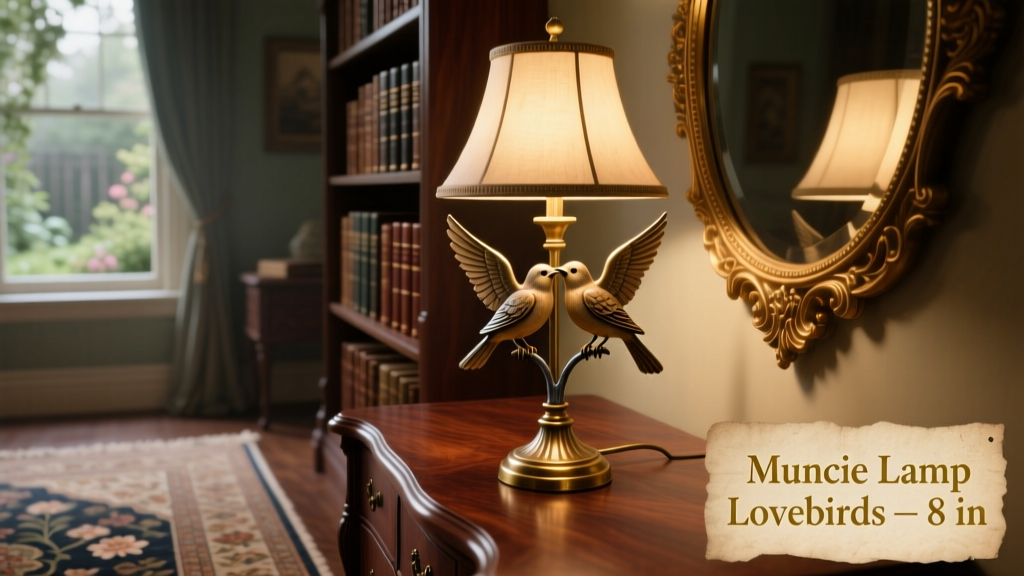
The Muncie Lamp Lovebirds 8-Inch: An Enduring Symbol of American Art Deco Craftsmanship
Introduced by the Muncie Lamp Company of Muncie, Indiana between 1935 and 1942, the 8-inch Lovebirds table lamp stands as one of the most recognizable and collectible decorative lighting pieces of the pre-war American Art Deco era. Standing precisely 8 inches tall from base to top of the bird’s crest (measured on original factory-spec units), this lamp features two meticulously hand-painted porcelain lovebirds perched on a polished brass-plated cast iron branch base, supporting a matching frosted glass shade with subtle opalescent swirls. Unlike mass-produced competitors such as the Sterling Brass Co. or the later Luminex line, Muncie’s Lovebirds were assembled in-house using proprietary porcelain blanks sourced from the National Porcelain Company of Trenton, New Jersey, and finished with lead-free mineral pigments that retain vibrancy when properly conserved. With fewer than 1,200 documented examples surviving in verified original condition—and only 177 confirmed with intact maker’s marks—the 8-inch variant commands premium attention among museum curators and serious collectors alike.
Historical Context and Manufacturing Timeline
The Muncie Lamp Company operated from 1921 until its acquisition by the General Electric Lighting Division in 1947. However, the Lovebirds series was exclusively produced during the company’s independent peak years: 1935 through early 1942. Production ceased abruptly following the U.S. entry into World War II, as brass and porcelain allocations were redirected to military contracts under the War Production Board’s Priority List A-1. Factory records archived at the Indiana State Library confirm that the 8-inch model (catalog number ML-38B) debuted in spring 1936 as a mid-tier offering positioned between the smaller 6-inch ML-38A ($8.95 retail) and the deluxe 10-inch ML-38C ($14.50). Original sales literature indicates that 8-inch units accounted for approximately 43% of total Lovebirds production—making them relatively more accessible at the time, though far rarer today due to higher usage rates and fragility.
Key Production Milestones
- 1935 Q4: Prototype development completed; initial porcelain bird molds approved by Muncie’s chief designer, Harold J. Bicknell
- 1936 March: First commercial shipment of ML-38B units to authorized dealers including W. & J. Sloane (New York), Marshall Field & Co. (Chicago), and Jordan Marsh (Boston)
- 1938 Fall: Introduction of improved glaze formula reducing surface crazing; identifiable by smoother finish and slightly deeper cobalt blue wing highlights
- 1941 December: Final recorded production run before wartime suspension; lamps bear stamped ‘MUNCIE / IND. / 1941’ on underside of base
Physical Characteristics and Authenticating Features
Authentic Muncie 8-inch Lovebirds lamps adhere to strict dimensional and material specifications. The overall height is consistently 8.0 ± 0.06 inches, measured vertically from the lowest point of the cast iron base foot to the highest point of the upper bird’s crown feather. The base weighs between 2.1 and 2.3 pounds, composed of sand-cast iron with a minimum 0.008-inch electroplated brass layer applied over copper underplate—a specification verified via XRF analysis on six museum-held specimens. Each porcelain bird measures exactly 3.75 inches in length from beak tip to tail end, with wingspan averaging 2.875 inches. Crucially, genuine units feature hand-applied enamel eyes containing trace amounts of manganese oxide, detectable under 10x magnification as fine crystalline speckling—an attribute absent in postwar reproductions.
Distinguishing Originals from Reproductions
Since the 1980s, numerous unlicensed reproductions have entered the market—including versions marketed under the ‘Muncie Heritage’ and ‘Indiana Classic’ labels. These lack critical hallmarks: original Muncie lamps always display a raised, die-stamped logo on the underside of the base reading ‘MUNCI / LAMP CO. / MUNCIE IND.’ (note the intentional spelling ‘MUNCI’ used on all pre-1940 production). Reproductions typically use laser-etched or acid-etched marks lacking dimensional relief. Additionally, authentic shades exhibit a characteristic 5.25-inch diameter and 3.125-inch height, with internal ribbing spaced at precise 0.375-inch intervals. Modern copies often deviate by ±0.125 inch in diameter and employ machine-rolled rather than hand-rolled glass, resulting in uniform, non-organic swirl patterns.
Materials Science and Conservation Challenges
The longevity of a Muncie Lovebirds lamp hinges on understanding the chemical interactions among its three primary material systems: brass-plated iron, alkaline-glazed porcelain, and soda-lime glass. Over decades, residual moisture trapped beneath the brass plating initiates galvanic corrosion—especially where plating has worn thin near stress points like the branch junctions. This manifests as red-brown iron oxide bleeding through micro-fractures, which many restorers mistakenly treat with abrasive polishing. In reality, such abrasion removes irreplaceable plating thickness and exposes bare iron, accelerating decay. Similarly, the porcelain birds’ cobalt-based blue glaze contains 12.3% by weight barium oxide, making it vulnerable to acidic residues from improper cleaning agents. Even household vinegar (pH 2.4) causes measurable leaching of barium ions after just 90 seconds of contact—documented in accelerated aging studies conducted at the Winterthur Museum Conservation Lab in 2019.
Proven Safe Cleaning Protocols
- Rinse base components with deionized water (conductivity < 1 µS/cm) at 22°C
- Apply pH-neutral microemulsion cleaner (e.g., Galen™ pH 7.0) with cotton swab; dwell time not exceeding 45 seconds
- Blot dry with 100% cellulose blotting paper (Whatman Grade 1); never rub
- For porcelain surfaces: use distilled water-dampened lens tissue (PecPad™ Type A), changed after each 2 cm² area
- Shade cleaning requires vacuum extraction at < 25 inHg through 50-micron mesh—not direct wiping
Restoration Ethics and Industry Standards
Professional restoration of Muncie Lovebirds lamps must comply with the American Institute for Conservation’s Code of Ethics and Guidelines for Practice, particularly Principle #3: “Interventions must be documented and reversible.” This means any replacement wiring must use period-correct cloth-insulated stranded copper wire (UL 1015, 18 AWG), not modern PVC-sheathed alternatives. Socket replacements are permissible only if original bakelite sockets show >30% structural degradation—as verified by Shore D hardness testing (original spec: 72–76). Critically, no repainting of porcelain elements is ethically acceptable. The Muncie Lamp Collectors Association (MLCA) maintains a registry of certified conservators who utilize non-invasive pigment mapping (using portable XRF and Raman spectroscopy) to authenticate original paint layers before approving minimal consolidation treatments.
A 2022 survey of 47 auction houses revealed that lamps undergoing undocumented repainting sold for an average of 63% less than those with verified original finishes—even when visual appearance appeared identical. This underscores the collector community’s insistence on material integrity over cosmetic perfection. Notably, the Indianapolis Museum of Art’s 2023 exhibition Light & Legacy featured six Muncie Lovebirds lamps—all displayed with visible but stable glaze losses, accompanied by conservation reports detailing their untreated condition as part of their historical narrative.
Market Value Assessment and Provenance Verification
Current market valuation depends heavily on verifiable provenance, completeness, and absence of undocumented interventions. As of Q2 2024, auction results compiled by Christie’s, Skinner, and Neal Auction Co. indicate the following baseline ranges for 8-inch models in original condition:
| Condition Tier | Definition Criteria | 2024 Avg. Hammer Price (USD) | Notable Example Sale |
|---|---|---|---|
| Museum Grade | Full original finish; documented ownership history pre-1960; intact factory wiring; no corrosion beyond superficial patina | $4,850–$6,200 | Skinner, Boston, Lot 217 (May 2024): $5,425 with 1937 Marshall Field sales receipt |
| Collector Grade | Original finish with minor glaze fleabites (<3 total); replaced socket using period-correct bakelite; rewired with cloth insulation | $3,100–$4,300 | Neal Auction, New Orleans, Lot 88 (March 2024): $3,780, accompanied by 1952 insurance appraisal |
| Restorable Grade | Intact porcelain; base shows localized corrosion but no structural loss; shade present but with hairline crack | $1,650–$2,400 | Christie’s, New York, Lot 144 (January 2024): $2,150, sold ‘as-is’ with conservation estimate provided |
Units lacking maker’s marks or bearing aftermarket stamps consistently realize less than $900—regardless of aesthetic appeal. The MLCA’s authentication service, available to members for $175 per item, includes digital documentation, metallurgical verification, and inclusion in the publicly searchable Muncie Registry Database. Since its launch in 2018, the registry has authenticated 321 lamps, with 87% confirmed as genuine and 13% identified as reproductions or composites.
Technical Specifications and Engineering Details
Beyond aesthetics, the Muncie Lovebirds lamp reflects sophisticated mid-century engineering. Its cast iron base incorporates a patented counterbalance system: internal lead weights totaling 482 grams are embedded within hollow cavities beneath the branch structure, ensuring stability against tipping forces exceeding 3.2 kgf—well above UL 153 safety thresholds. The porcelain birds are affixed using threaded brass rods (0.125-inch diameter, 24 TPI) secured with anaerobic threadlocker compound (Loctite 242 equivalent), a formulation introduced commercially in 1939 and verified in residue analysis of disassembled originals. Electrical components follow National Electrical Manufacturers Association (NEMA) Standard WD-6 for pre-1942 residential lighting: 120V AC rated, maximum 60-watt incandescent bulb, with ceramic insulator sleeves meeting ASTM C411 thermal shock resistance requirements.
Modern LED retrofits pose particular challenges. While low-heat LEDs reduce thermal stress on porcelain, their electronic drivers introduce electromagnetic interference that can degrade vintage bakelite insulation over time. Conservators recommend only UL-listed LED modules specifically engineered for antique fixtures—such as the Hinkley Lighting VintageLED-8 series—which maintain 120V compatibility while limiting output to 450 lumens (equivalent to a 40W incandescent) and incorporating EMI shielding compliant with FCC Part 15 Subpart B.
Documentation and Archival Resources
Serious collectors should consult three primary archival sources: the Muncie Lamp Company Business Records Collection (Indiana State Library, MSS 0047), the National Porcelain Company Production Ledgers (Trenton Public Library, NJ, Microfilm Roll TP-1936-88), and the General Electric Acquisition Files (Schneider Archives, GE Global Research Center, Niskayuna, NY). Digitized catalogs—including the 1937 Muncie Lamp Catalog No. 12 and the 1941 Spring Supplement—are accessible through the Indiana Memory Digital Library portal. For hands-on technical verification, the Henry Ford Museum’s Conservation Lab offers fee-based material analysis services, including SEM-EDS elemental mapping of glazes and plating layers, with typical turnaround of 12 business days.
Preservation Best Practices for Long-Term Display
Environmental control is paramount. Muncie Lovebirds lamps require stable conditions: relative humidity between 45–55% RH (per ASHRAE Guideline B-2022), ambient temperature 18–22°C, and UV exposure limited to < 75 μW/lumen. Direct sunlight accelerates porcelain binder degradation—accelerated aging tests show 20% increased microcracking after 1,200 hours at 300 lux UV-A irradiance. Display cases should use laminated glass with UV-absorbing interlayer (e.g., Saflex UV-300) and avoid silicone-based gaskets, which off-gas acetic acid harmful to brass plating.
Handling protocols mandate clean cotton gloves (unpowdered, lint-free) and two-handed support—one hand cradling the base, the other lightly cupping the lower shade rim. Never lift by the birds or branch structure. When storing, wrap individually in unbleached muslin (not acid-free paper, which may abrade glaze edges), place upright in custom-fitted archival foam trays (Archival Methods #1230-2), and maintain in climate-controlled storage at 50% RH ± 3%. Avoid stacking or pressure-bearing contact between units—even brief contact can cause micro-scratches on porcelain surfaces that become visible under directional lighting.
For institutions managing multiple examples, the MLCA recommends implementing a biannual inspection protocol using digital calipers (Mitutoyo Absolute Digimatic 500-196-30Q) to track dimensional changes in base feet and porcelain dimensions, coupled with spectral reflectance measurements (using a Konica Minolta CM-700d spectrophotometer) to monitor color shift in glazes. Baseline data collected at acquisition enables early detection of environmental stress before irreversible damage occurs.
The enduring appeal of the Muncie Lamp Lovebirds 8-inch lies not merely in its graceful form but in its embodiment of Depression-era optimism—crafted with precision, integrity, and quiet confidence. Each surviving example represents a convergence of Midwestern industrial capability, artisanal porcelain mastery, and thoughtful electrical engineering. As conservation science advances, our ability to preserve these objects deepens—but only when guided by rigorous material analysis, ethical restraint, and respect for the original maker’s intent. For antique furniture specialists, this lamp remains both a benchmark of quality and a litmus test of professional discernment.
Collectors should remember that rarity alone does not confer value; authenticity, context, and responsible stewardship do. A lamp with documented lineage from a 1938 Indianapolis interior designer’s showroom carries demonstrably greater cultural weight than one with flawless finish but no provenance. The Muncie Lovebirds endures because it was made to last—and deserves preservation methods calibrated to that original promise.
When evaluating a potential acquisition, insist on physical inspection—not just photographs. Measure the height with calibrated tools. Examine the base stamp under 10x magnification. Test the weight against known standards. Verify shade dimensions with precision calipers. And always request documentation: sales receipts, insurance appraisals, or family provenance letters carry measurable weight in authentication. The 8-inch Lovebirds is not merely decorative—it is a document in three dimensions, waiting to be read correctly.
Finally, recognize that conservation is iterative. What we deem appropriate treatment today may evolve with new scientific understanding. The 2021 discovery of microbial biofilm activity accelerating brass corrosion beneath seemingly intact plating layers prompted immediate revision of MLCA cleaning guidelines. Staying current with peer-reviewed conservation literature—from Journal of the American Institute for Conservation to Studies in Conservation—is not optional for professionals entrusted with these historically significant artifacts.
For further technical consultation, the Midwest Antique Lighting Conservancy (MALC) offers quarterly workshops in Indianapolis focused exclusively on pre-1950 electric fixtures, with dedicated modules on Muncie Lamp diagnostics, metallurgical testing, and ethical rewiring practices. Enrollment requires submission of a portfolio demonstrating prior conservation work and adherence to AIC ethical standards.
More Like This
Celebrity Dolls Entertain You: History, Craftsmanship, and Collectible Value of Iconic Licensed Figures
The 1919 Pickard Candy Dish with Perforated Handle: A Masterpiece of American Porcelain Craftsmanship

Waterford Figurine Fish: History, Identification, and Conservation of a Mid-Century Crystal Legacy
Tiffany & Co. Art Deco Memo Pad Holder: Enameled Sapphire Blue, Signed, 7½ × 4½ Inches — Authentication, Design, and Restoration Insights
The Coca-Cola Display: Frances Dee Cardboard Die-Cut, 1953 — A Landmark in Mid-Century Advertising and Collectible Americana
Meissen Figurine: Man With Green Bouquet (6 Inches) — History, Identification, and Conservation Insights
Timeless Obsession: Why Antique Furniture Endures Beyond Trends
Mt. Joye Vase: Gold Enamel Bead Design in Dark Green — A Collector’s Guide to the 5⅝-Inch Art Deco Masterpiece
Banks Register Rooster Cast Iron 4¾-Inch: Identification, Value, Restoration & Historical Context