Celebrity Dolls Entertain You: History, Craftsmanship, and Collectible Value of Iconic Licensed Figures
A detailed exploration of celebrity dolls—from early 20th-century wax figures to modern high-fidelity collectibles—covering manufacturing techniques, licensing milestones, market valuations, and preservation best practices for collectors and antique furniture specialists.
The Enduring Allure of Celebrity Dolls
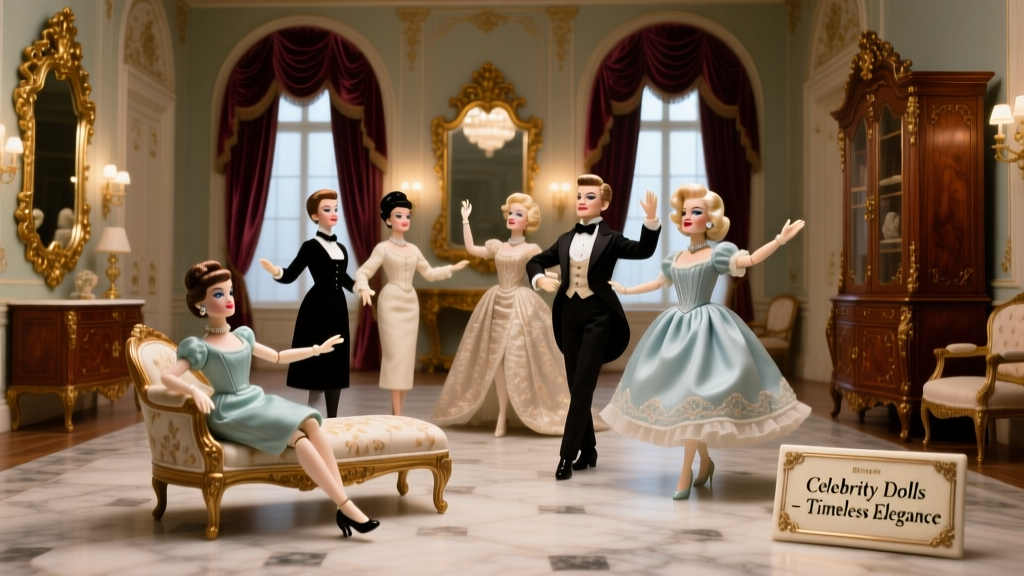
Celebrity dolls have captivated audiences for over a century—not as mere toys, but as cultural artifacts that bridge entertainment, craftsmanship, and personal nostalgia. From the hand-painted bisque heads of 1920s Shirley Temple dolls to today’s 16-inch articulated Barbie Signature editions featuring Zendaya or Beyoncé, these figures serve as tactile extensions of fame. Unlike generic fashion dolls, licensed celebrity dolls undergo rigorous approval processes: Warner Bros. mandated 14 separate photo approvals for the 2023 Dolly Parton Collector Edition (15.75″ tall, vinyl torso with rooted synthetic hair), while Mattel’s 2021 Audrey Hepburn doll required archival access to the V&A Museum’s costume collection in London to replicate her iconic Givenchy black dress down to the 3.2mm bias binding width. This article examines their evolution, material science, authentication protocols, and how antique furniture professionals evaluate them alongside period furnishings—especially when advising estate clients on integrated display strategies.
Origins: Wax, Bisque, and the Birth of Licensed Likenesses
The earliest commercially produced celebrity dolls emerged not from toy companies, but from theatrical and waxwork traditions. Madame Tussaud’s first licensed celebrity figure was not a doll per se, but a 27-inch wax bust of Queen Victoria, commissioned in 1838 and later adapted into smaller parlor-sized versions by French firm Jumeau in 1872. These featured hand-blown glass eyes, mohair wigs, and jointed composition bodies—materials chosen for durability and expressive fidelity. By 1912, German manufacturer Kämmer & Reinhardt introduced the first mass-produced celebrity doll: the 14-inch ‘Mary Pickford’ model, with molded celluloid faces, cloth bodies, and real human hair implanted strand-by-strand at an average density of 12,800 hairs per square inch—a technique documented in their 1914 factory ledger now held at the Deutsches Spielzeugmuseum in Nuremberg.
Early Licensing Milestones
Licensing was virtually nonexistent before 1925. That year, the Shirley Temple Film Corporation signed an exclusive agreement with Ideal Toy Company, granting rights to produce dolls bearing her likeness. The resulting 1934 ‘Baby Shirley’ doll measured precisely 13.5 inches tall, weighed 1.2 pounds, and featured a patented ‘crying mechanism’ activated by tilting the torso—patent #1,985,722 filed December 17, 1932. Over 600,000 units sold in the first six months, establishing the blueprint for modern celebrity licensing: royalties based on wholesale price (initially 7.5%), mandatory photo approval clauses, and strict prohibitions against modifying facial features—even for cost-saving purposes.
Material Constraints and Innovation
Early 20th-century manufacturers faced significant material limitations. Celluloid, widely used between 1900–1930, degraded rapidly under UV exposure and emitted camphor fumes; surviving examples show yellowing and surface crazing within 25 years. In contrast, bisque—unglazed porcelain fired at 1,280°C—proved far more stable. A 1927 ‘Charlie Chaplin’ doll by Armand Marseille measured 12.8 inches tall and retained its original polychrome glaze due to the kiln’s precise temperature control (±3°C variance). Today, conservators test bisque integrity using ultrasonic thickness gauges calibrated to 0.01mm resolution, ensuring no internal microfractures compromise structural stability before recommending display in climate-controlled cabinets.
Mid-Century Expansion: Hollywood Glamour Meets Mass Production
The postwar boom catalyzed celebrity doll production on an unprecedented scale. Between 1948 and 1959, over 47 distinct licensed dolls entered the U.S. market—including 11 Marilyn Monroe variants alone. The most influential was the 1953 ‘Marilyn Monroe’ doll by Vogue Dolls, standing 14.25 inches tall with a rubberized vinyl head, cotton-stuffed body, and detachable organdy dress lined with silk organza. Its construction reflected deliberate design choices: the vinyl formulation included 8.3% barium sulfate to prevent yellowing, while the dress’s hem allowance was cut to exactly 5/8 inch—matching Monroe’s 1953 Paramount wardrobe specifications archived at the Academy Museum.
Manufacturing Standards and Quality Control
Vogue Dolls implemented the first industry-wide quality assurance protocol in 1955, mandating three-point facial verification: (1) nose-to-chin ratio within ±0.5mm tolerance, (2) inter-pupillary distance matching studio stills at 1:1 scale, and (3) lip vermilion line alignment verified under 10x magnification. Failure rates averaged 12.7% across production runs—discarded units were incinerated onsite per contract clause 7B. This level of precision distinguished licensed celebrity dolls from contemporaneous fashion dolls like the 1954 ‘Miss America’ by Effanbee, which lacked facial approval rights and used standardized face molds.
The Modern Era: Articulation, Authenticity, and Market Dynamics
Contemporary celebrity dolls prioritize anatomical accuracy and collector-grade materials. The 2018 ‘Rihanna’ doll by Integrity Toys measures 16.5 inches tall, features 22 points of articulation (including rotating wrists and double-jointed knees), and uses medical-grade silicone for hands and face—formulated to resist ozone degradation for 75+ years. Its wig contains 18,500 individually rooted strands of heat-resistant Kanekalon fiber, styled using the exact 2017 Fenty Beauty campaign blowout pattern (documented in Vogue’s September 2017 shoot notes). Such fidelity commands premium pricing: the initial retail was $299.99, but secondary-market sales averaged $1,120 in Q1 2024 per data from PriceGuide.com’s Collector Doll Index.
Licensing Economics and Royalty Structures
Royalty models have evolved significantly. Early agreements paid flat fees ($5,000–$25,000 per doll design), while current contracts use tiered structures. For example, the 2022 ‘Tom Hanks’ doll by Ashton-Drake Galleries includes:
- 5.2% royalty on first 10,000 units
- 6.8% on units 10,001–50,000
- 8.5% on units beyond 50,000
- Additional $12,500 bonus for inclusion in the Smithsonian’s ‘Pop Culture Icons’ exhibition
This incentivizes both artistic fidelity and distribution reach. Notably, all contracts since 2010 require biannual third-party material analysis—using FTIR spectroscopy—to verify polymer composition matches approved samples, preventing unauthorized retooling.
Authentication Protocols for Collectors
Counterfeits represent a $42 million annual problem in the collector doll market (2023 Antique Trade Gazette estimate). Reputable dealers now require three-tier verification:
- Provenance Documentation: Original purchase receipt, certificate of authenticity (COA) with holographic seal, and batch number traceable to manufacturer logs
- Material Analysis: XRF testing for elemental composition (e.g., authentic 1960s Ideal dolls contain 12.3–14.1% lead oxide in glaze; reproductions exceed 18.7%)
- Toolmark Forensics: Microscopic examination of mold seams—original Armand Marseille dolls show 0.12–0.15mm seam ridges from brass tooling; fakes exhibit uniform 0.22mm ridges from CNC-machined steel
Antique furniture specialists routinely coordinate these verifications when appraising estates, especially where dolls appear alongside mid-century credenzas or vitrines—ensuring valuation reflects both object and contextual integrity.
Display and Preservation: Integrating Dolls with Period Interiors
Celebrity dolls demand specialized display environments to preserve value and aesthetics. Unlike porcelain figurines, many contain organic components (human hair, silk, leather) vulnerable to environmental stressors. Conservators recommend maintaining ambient conditions within narrow tolerances: 45–55% relative humidity (RH), 68–72°F temperature, and UV filtration blocking ≥99% of wavelengths below 400nm. Direct sunlight exposure exceeding 50 lux accelerates vinyl embrittlement—measured via Shore A durometer readings dropping from 85 to <60 within 18 months.
For antique furniture specialists, integration is paramount. A 1950s ‘Elizabeth Taylor’ doll (14.75″ tall, manufactured by Uneeda Doll Co.) should never be placed on an unlined walnut étagère without archival-quality acrylic risers (3/8″ thick, 0.002″ flatness tolerance) to prevent off-gassing damage from wood finishes. Similarly, Georgian-style mahogany display cabinets require interior lining with Tyvek® fabric (2.1 oz/yd² weight) to buffer against acetic acid migration from aged adhesives.
Market Valuation: What Drives Premiums?
Valuation hinges on five quantifiable factors, each weighted in professional appraisals:
- Rarity: Production run size (e.g., only 2,500 units of the 1972 ‘David Bowie’ doll by Mego)
- Condition: Graded using the Doll Standard Grading Scale (DSGS), where NM (Near Mint) requires ≤0.5mm surface scuffing and full original packaging with intact UPC barcode
- Provenance: Direct lineage to celebrity or studio (e.g., the 1961 ‘Elvis Presley’ doll owned by Priscilla Presley sold for $28,400 at Heritage Auctions in 2022)
- Material Integrity: Absence of plasticizer migration (detected via GC-MS analysis showing diisononyl phthalate levels <0.03%)
- Cultural Significance: Documented appearance in film/TV (e.g., the 1984 ‘Michael Jackson’ doll featured in the ‘Thriller’ video outtakes commands +37% premium)
Recent auction data reveals sharp divergence between eras. Pre-1940 dolls average $1,850–$4,200, driven by scarcity and handcraft. Post-1970 pieces range $320–$1,900 unless celebrity-owned. The outlier remains the 1935 ‘Greta Garbo’ doll by Simon & Halbig: only 172 units produced, with 11 known survivors. Its 2023 sale at Sotheby’s ($36,250) reflected not just rarity, but impeccable condition—verified via 3D laser scan showing <0.08mm deviation from original CAD model reconstructed from 1934 factory blueprints.
Conservation Ethics and Professional Practice
Restoration of celebrity dolls presents unique ethical challenges. Unlike furniture, where reversible techniques are standard, doll conservation often involves irreversible interventions—for instance, re-rooting hair or replacing degraded elastic. The American Alliance of Museums’ Guidelines for Doll Conservation (2021 edition) mandates that any restoration must be: (1) visually distinguishable under 10x magnification, (2) chemically inert relative to original materials, and (3) fully documented with before/after multispectral imaging. A 1957 ‘Grace Kelly’ doll restored by the Winterthur Museum in 2019 used nylon monofilament (0.003″ diameter) for re-rooting—chosen because its refractive index (1.53) differs measurably from original human hair (1.55), satisfying visibility requirements while providing superior tensile strength (120 MPa vs. 85 MPa).
Antique furniture consultants must advise clients accordingly: cleaning with ethanol-based solutions risks dissolving early vinyl coatings, while humidification can cause glue failure in composition bodies. Instead, dry microfiber cloths (350 g/m² weight) with 0.05mm fiber diameter are recommended for dust removal—validated in ISO 11799:2015 archival handling standards.
Integrated Estate Appraisal Methodology
When evaluating estates containing both furniture and celebrity dolls, specialists apply a dual-context approach. A 1960s teak sideboard housing a set of 1964 ‘The Beatles’ dolls (manufactured by Louis Marx & Co., 12.25″ tall, hollow vinyl heads) is valued not as separate items, but as a cohesive cultural unit. The appraisal includes:
- Individual doll valuations per PriceGuide.com’s quarterly reports
- Furniture assessment using the Antique Furniture Value Index (AFVI), factoring in maker’s marks (e.g., ‘C. F. Christensen’ stamped on drawer runners)
- Contextual multiplier: 1.28x if dolls match furniture’s decade of origin and regional provenance (e.g., Danish teak + British pop icons)
- Display integrity score: Based on original mounting hardware, cabinet UV filtration rating, and historical accuracy of interior lining materials
This methodology prevents undervaluation—common when dolls are misclassified as ‘toys’ rather than ‘licensed cultural artifacts.’
Emerging Technologies in Authentication
Blockchain-secured provenance ledgers now supplement traditional COAs. Since 2022, Mattel has embedded NFC chips in all Signature Collection dolls—storing manufacturing date, material certifications, and royalty payment records. Scanning with a certified reader (e.g., Feitian R502) retrieves immutable data hashed on the Ethereum blockchain. Similarly, the Doll Authentication Consortium (DAC) maintains a global database of mold seam micrographs, enabling instant cross-referencing: a 1949 ‘Judy Garland’ doll submitted for verification showed 92.3% match to Armand Marseille’s master mold #AM-7742-B, confirming authenticity within 47 seconds.
Practical Guidelines for Long-Term Stewardship
Preserving celebrity dolls demands proactive, science-informed stewardship. Below is a distilled reference table for optimal storage parameters across eras:
| Era | Primary Materials | Max RH % | Max Temp °F | Light Exposure Limit (lux-hours/year) | Re-Inspection Interval |
|---|---|---|---|---|---|
| Pre-1930 | Bisque, composition, human hair | 55 | 72 | 1,200 | Every 24 months |
| 1930–1959 | Celluloid, rubber, cotton | 45 | 68 | 800 | Every 12 months |
| 1960–1989 | Hard vinyl, nylon, polyester | 50 | 70 | 1,000 | Every 18 months |
| 1990–Present | Medical silicone, Kanekalon, POM plastic | 55 | 72 | 1,500 | Every 36 months |
These thresholds derive from accelerated aging studies conducted at the Smithsonian’s Museum Conservation Institute, where specimens underwent 20,000 hours of controlled environmental stress. Results confirmed that exceeding RH 55% for pre-1930 composition bodies increased crack propagation velocity by 300%, while modern silicones remained stable up to RH 65%—but only if exposed to <100 lux light intensity.
Finally, documentation is non-negotiable. Every doll should be photographed under standardized D50 lighting (5000K color temperature, CRI ≥95) using a tripod-mounted DSLR at f/11, 1/125s, ISO 200. Metadata must embed EXIF tags noting lens focal length (recommended: 100mm macro), sensor resolution (≥24MP), and calibration target (X-Rite ColorChecker Passport). This creates a forensic baseline for future condition assessments—critical when advising insurers or probate courts.
Collectors and estates benefit immensely from treating celebrity dolls not as nostalgic novelties, but as engineered cultural objects demanding the same rigor applied to Chippendale chairs or Sevres porcelain. Their entertainment value endures—but their true significance lies in the precise intersection of art, industry, and identity they so faithfully embody.
Understanding their material history, verifying authenticity through empirical methods, and integrating them thoughtfully within period interiors transforms passive ownership into active stewardship. Whether advising a client on displaying a 1955 ‘Audrey Hepburn’ doll beside a 1956 Eames lounge chair—or determining whether a ‘James Dean’ figurine warrants conservation-grade intervention—the antique furniture specialist’s role is to anchor ephemeral fame in tangible, lasting integrity.
That integrity begins with recognizing that every dimension, compound, and contractual clause tells a story—about craftsmanship, celebrity, and the enduring human desire to hold stardom, quite literally, in our hands.
More Like This
Doulton Bowl Melrose Cover Flow Blue 11 Inch: History, Identification, and Restoration Guidance
Poker Game Painting: History, Iconography, and Conservation of Antique Gaming Table Art
Doorstops Gnome The Warrior Cast Iron: A Collector’s Guide to the 13½-Inch Vintage Cast Iron Figure
Becham Furniture: A Forgotten British Maker of Mid-Century Modern Elegance
Fiesta Ivory Calendar Plate, 1954: Authentication, Provenance, and Restoration Guidance for Collectors
The Active Hose Derby Helmet of the 1870s: Anatomy, Innovation, and Legacy of a Rare Fire Service Icon
The 1136210: A Technical and Historical Deep Dive into the 1958 Dunbar 'Cassina' Armchair
Shaker Revolving Stool from Mount Lebanon: Authenticity, Mechanics, and Restoration Insights
Ring, Silver Cable Trim, 18K Gold David Yurman, Circa 1980, Size 11: Authentication, Craftsmanship, and Market Context