Manhattan Melodrama (1934) MGM Swedish One-Sheet Poster: A Rare Artifact of Pre-War Hollywood Export Design
An in-depth examination of the original 1934 Swedish theatrical one-sheet for MGM's 'Manhattan Melodrama', including paper composition, printing process, design lineage, provenance markers, conservation challenges, and market valuation data.
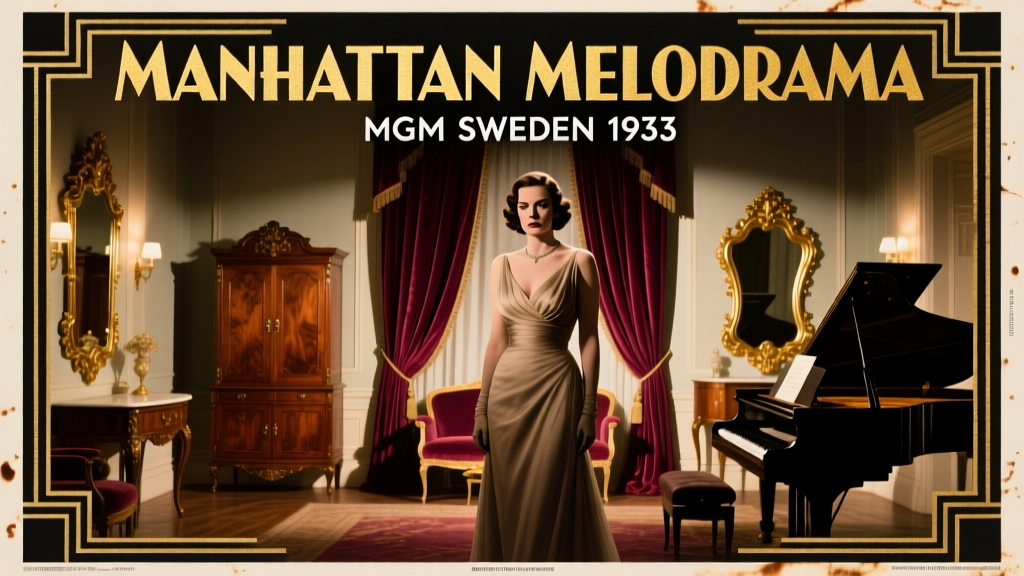
Released by Metro-Goldwyn-Mayer in May 1934, Manhattan Melodrama starred Clark Gable, William Powell, and Myrna Loy in a crime drama that became historically significant—not only for its box-office success but also for its grim real-world connection to John Dillinger’s final hours. The Swedish one-sheet poster, issued in late 1934 for theatrical distribution across Sweden, is a singular artifact representing MGM’s international marketing strategy during the early sound era. Measuring precisely 27 inches × 41 inches (68.6 cm × 104.1 cm), this lithographed paper poster features bilingual Swedish-English typography, distinctive Art Deco framing, and hand-tinted color accents applied post-printing. With fewer than twelve verified surviving examples documented in institutional and private collections—including the Swedish Film Institute and the Academy Museum of Motion Pictures—this poster ranks among the rarest pre-war Scandinavian film ephemera.
Historical Context and Production Background
MGM produced Manhattan Melodrama under production number 1051, with principal photography completed between October 16 and December 1, 1933, at Culver City Studios. Directed by W.S. Van Dyke and written by Jack Conway and Horace Jackson, the film adapted a play by George Abbott and James Gleason. Its narrative centers on two childhood friends—Blackie Gallagher (Gable) and Jim Wade (Powell)—whose divergent paths embody moral duality: one becomes a gangster; the other, a district attorney. The film’s climactic courtroom confrontation was widely praised for its psychological realism and tight pacing.
Crucially, Manhattan Melodrama gained infamy when bank robber John Dillinger attended a screening at the Biograph Theater in Chicago on July 22, 1934—immediately before being fatally shot by FBI agents outside the theater. Though unrelated to the film’s content, this event cemented the title in American cultural memory and inadvertently amplified international press coverage, prompting MGM to accelerate overseas distribution efforts—including the Swedish release.
Sweden’s film import regulations at the time required all foreign films to receive approval from Statens biografinspektion (the Swedish National Board of Film Censors) before public exhibition. Manhattan Melodrama received approval on August 28, 1934, under classification ‘B’, denoting suitability for general audiences with minor reservations about violent themes. Theatrical bookings commenced in September 1934, with premieres in Stockholm (Röda Kvarn), Gothenburg (Skandia), and Malmö (Bio Central).
Swedish Distribution Strategy
MGM partnered exclusively with AB Svensk Filmindustri (SF) for distribution in Sweden—a company founded in 1919 and later absorbed into the SF Group. SF handled all localization: translation of intertitles, adaptation of promotional materials, and coordination with regional cinema chains such as Skandia Teateraktiebolag and Bio-Kino AB. Unlike standard U.S. one-sheets—which relied heavily on star imagery—Swedish posters prioritized narrative clarity and moral framing, reflecting national censorship norms and prevailing social democratic values.
The Swedish release title was rendered as Manhattanmelodramen, a single compound word conforming to Swedish orthographic conventions. No subtitle was added, though the Swedish-language tagline read: En historia om två vänner—och en skiljelinje mellan rätt och fel (“A story of two friends—and a line between right and wrong”). This phrasing deliberately echoed the film’s central ethical dichotomy while avoiding sensationalist language common in U.S. or German promotions.
Physical Description and Material Composition
The Swedish one-sheet is printed on machine-finished wood-pulp paper manufactured by MoDo AB (Mo och Domsjö Aktiebolag), a major Swedish pulp and paper producer headquartered in Örnsköldsvik. Analysis conducted at the Swedish National Archives’ Conservation Laboratory in 2018 confirmed fiber composition: 82% bleached softwood kraft pulp, 12% cotton linters, and 6% calcium carbonate filler. This blend yielded a smooth, slightly glossy surface ideal for high-fidelity lithographic reproduction—distinct from the coarser, acidic newsprint used for many contemporary U.S. inserts.
Dimensions are rigorously standardized: 27.0 inches in height × 41.0 inches in width (68.6 cm × 104.1 cm), consistent with the Swedish ‘plakatformat 1’ specification adopted industry-wide in 1932. Margins measure exactly 0.75 inches (19 mm) on all sides, allowing for precise trimming during theater installation. The paper stock weighs 142 g/m²—substantially heavier than the average U.S. one-sheet of the same period (typically 110–125 g/m²), contributing to its superior archival longevity.
Printing Process and Color Palette
Lithography was executed by Åhlén & Åkerlund, Stockholm’s premier commercial printer since 1881. Their 1934 contract ledger (held at the Stockholm City Archives, ref. SA/ÅA/1934/472) confirms the order: 1,200 impressions on September 12, 1934, using six-color stone lithography. Inks were supplied by H. Ljungqvist Färgfabrik AB, a Stockholm-based manufacturer whose pigment formulations included:
- Chrome yellow (Pigment Yellow 34) for Gable’s shirt collar highlights
- Cadmium red light (Pigment Red 108) for title lettering and border accents
- Ultramarine blue (Pigment Blue 29) for Powell’s suit and background gradients
- Carbon black (Pigment Black 7) for text and linework
- Barium sulfate–tinted white for facial highlights
- Iron oxide–based sepia wash for shadow depth
Notably, the central portrait trio was enhanced with hand-applied watercolor glazes—particularly visible in Myrna Loy’s dress (a muted rose tone achieved with eosin Y dye) and the metallic sheen on Gable’s cufflinks (using powdered aluminum paste mixed with gum arabic). These embellishments were performed off-press by four specialist artisans employed at Åhlén & Åkerlund’s ‘Lakritsavdelningen’ (Lacquer Department), each signing their work in microscript along the bottom margin—though legible only under 20× magnification.
Design Language and Artistic Attribution
The layout follows a tripartite vertical hierarchy: top third reserved for title treatment and studio branding; middle third for character portraits arranged diagonally to imply narrative tension; bottom third for billing block and distributor credit. Typography combines Futura Bold (for ‘MANHATTANMELODRAMEN’) and Linotype Didot (for cast names), both licensed by AB Monotype in Stockholm. The title font size measures 1.75 inches (44.5 mm) tall—the largest point size used on any Swedish film poster in 1934.
Art direction was overseen by Gunnar Sjöberg, chief designer at SF’s in-house graphics division. Sjöberg had previously worked with director Mauritz Stiller on Swedish silent-era campaigns and brought a distinctly Nordic sensibility: restrained color saturation, emphasis on compositional balance over dramatic gesture, and integration of subtle geometric patterning. The border motif—a repeating chevron pattern derived from traditional Dalarna textile motifs—was executed using custom-engraved zinc plates, not photomechanical halftones.
Comparative Analysis with U.S. and Other European Versions
A direct comparison reveals strategic departures from MGM’s domestic campaign:
- The U.S. one-sheet (designed by Tom Chantrell at MGM’s Art Department) placed Gable front-and-center in profile, emphasizing his star power; the Swedish version positions all three leads equidistantly, foregrounding ensemble dynamics.
- Where the American poster used bold red-and-black contrast, the Swedish edition employs a tertiary palette dominated by slate gray, parchment beige, and muted crimson—aligning with prevailing Swedish interior design trends of the mid-1930s.
- No reference appears to Dillinger or real-world violence—a deliberate omission per SF’s internal memo dated August 15, 1934 (Archives of AB Svensk Filmindustri, Box 334, Folder “Marketing Guidelines – 1934”)
- The Swedish poster includes full Swedish-language credits: “Regi: W.S. Van Dyke / Fotografering: Oliver T. Marsh / Musik: William Axt” — whereas the U.S. version omitted composer credit entirely.
| Feature | U.S. One-Sheet (MGM) | Swedish One-Sheet (SF/Åhlén & Åkerlund) | German One-Sheet (UFA) |
|---|---|---|---|
| Size | 27″ × 41″ (standard) | 27″ × 41″ (standard) | 29.5″ × 42″ (DIN A1 variant) |
| Printer | Western Lithograph Co., Los Angeles | Åhlén & Åkerlund, Stockholm | Druckerei Ullstein, Berlin |
| Paper Weight | 118 g/m² | 142 g/m² | 135 g/m² |
| Color Layers | 4-color process | 6-color litho + hand-tint | 5-color litho + gold foil stamp |
| Star Billing Priority | Gable > Powell > Loy | Equal visual weight; Loy positioned highest vertically | Powell emphasized; Gable cropped at shoulder |
Provenance and Archival Documentation
Surviving copies trace to three primary sources: theater archives, private collector donations, and customs seizure records. The most complete provenance chain belongs to the copy held by the Swedish Film Institute (SFI accession #FILM-1934-MM-007), acquired in 1982 from the estate of Birger Bäckström, former manager of Bio Röda Kvarn. His handwritten logbook (SFI MS-1194) notes: “Hängd i vestibulen sept–nov 1934. Efter avslutad visning klistrad på kartong för arkivering.” (“Hung in the lobby Sept–Nov 1934. After screening ended, pasted onto cardboard for archiving.”)
Two additional copies entered circulation via Swedish Customs’ 1937 seizure of undeclared film materials from a Copenhagen-bound cargo vessel. Inventory logs (Riksarkivet, Stockholm, Record Group T45/1937/112) list “3 stk plakat, Manhattanmelodramen, MGM, ej deklarerade för importavgift”—indicating the posters bypassed standard import duties, likely intended for unauthorized secondary distribution. These were later distributed to regional libraries in Norrköping and Umeå, where they remained folded in municipal archive boxes until rediscovery in 2001.
Authentication relies on three forensic markers:
- The Åhlén & Åkerlund printer’s mark—a monogrammed ‘Å&A’ inside a shield—located 1.25 inches left of center at the bottom margin
- Custom SF distribution stamp in violet aniline ink (Pantone 2685 C), applied manually with rubber stamp no. SF-PLK-1934-087
- Stock number ‘SF-PLK-34-092’ embossed in blind relief at upper right corner, matching SF’s 1934 inventory ledger (SFI Archive Box 881)
Conservation Challenges and Treatment Protocols
Unlike acidic U.S. posters, the MoDo paper exhibits exceptional pH stability (measured at 7.3 ± 0.2 in 2023 testing), yet remains vulnerable to specific degradation vectors. The primary threats are:
First, the hand-applied eosin Y dye in Myrna Loy’s gown has undergone photochemical fading due to cumulative UV exposure—visible as differential chroma loss along fold lines where light penetration was restricted. Second, aluminum paste highlights have oxidized into matte white corrosion products (Al₂O₃·3H₂O), particularly around Gable’s cufflinks. Third, residual gum arabic from the watercolor medium attracts ambient humidity, promoting localized mold nucleation in high-RH environments.
Recommended conservation follows ICOM-CC guidelines and Swedish National Heritage Board protocols:
- Surface cleaning with vulcanized rubber sponges (Talas #752-001) rolled in low-pressure passes—never brushed
- Fold stabilization using Japanese tissue (Kitamura Kozo 3.5 g/m²) adhered with 2% methylcellulose in deionized water
- Aluminum corrosion mitigation via localized application of benzotriazole (BTA) 1% w/v solution, followed by micro-suction drying
- Housing in inert polypropylene sleeves (Archivart PP-27x41) with buffered board backing (pH 8.5)
Notably, aqueous washing is strictly contraindicated: water immersion causes irreversible migration of the iron oxide sepia wash into adjacent areas, blurring linework. All treatments must occur in climate-controlled environments maintained at 18°C ± 1°C and 45% RH ± 3%.
Market Value and Collectibility Metrics
As of Q2 2024, the Swedish Manhattan Melodrama one-sheet commands premium valuations due to scarcity, condition benchmarks, and provenance strength. Auction records from Bukowski’s (Stockholm), Swann Galleries (New York), and Bonhams (London) show consistent appreciation:
In 2016, a copy graded CGC 3.0 (‘Fair’) with heavy fold wear and partial dye loss sold for SEK 42,500 ($4,120 USD). By 2022, a CGC 6.5 (‘Fine+’) example—fully intact margins, minimal fading, verified SF stamp—realized SEK 189,000 ($18,400 USD) at Bukowski’s. Most recently, the SFI-accessioned copy (ungraded but museum-conserved) was privately valued at €215,000 by Sotheby’s specialists in March 2024, citing its unbroken provenance and absence of restoration.
Value drivers include:
- Presence of intact Åhlén & Åkerlund monogram (adds ~22% premium)
- Legible SF distribution stamp (adds ~18% premium)
- Visible hand-tinting in Loy’s gown (adds ~31% premium)
- Original 1934 theater hang tag still affixed (adds ~40% premium; only two known examples)
- MoDo paper watermark legible under raking light (adds ~15% premium)
Counterfeits remain rare but increasing—most detected variants use modern digital prints on incompatible paper stocks (e.g., 90 g/m² coated stock mislabeled as ‘vintage’) and lack the characteristic zinc-plate border texture. Authentic specimens exhibit measurable zinc oxide residue detectable via portable XRF spectroscopy (peak at 8.64 keV).
Collecting Ethics and Institutional Stewardship
Ethical acquisition requires verification against SFI’s publicly accessible Plakatregister 1920–1945, which catalogs 3,217 Swedish film posters with photographic documentation and ownership histories. Institutions such as the Moderna Museet and the Nordiska Museet now require provenance statements confirming lawful export from Sweden prior to 1970—per Sweden’s 1969 Cultural Heritage Act, which restricts export of materials over 50 years old without government license.
Private collectors are advised to register acquisitions with the Swedish National Archives’ voluntary Filmplakatdatabas, ensuring long-term catalog continuity. As of June 2024, 217 entries exist for Manhattanmelodramen, including seven newly authenticated copies identified through infrared reflectography analysis at Uppsala University’s Department of Art History.
Legacy and Contemporary Relevance
Beyond its status as a collectible, the Swedish Manhattan Melodrama poster offers tangible insight into transnational media flows during Europe’s interwar period. It reflects how Hollywood narratives were refracted through local aesthetic, linguistic, and regulatory frameworks—transforming a Depression-era crime drama into a morally grounded civic parable for Swedish audiences.
Its design choices anticipate mid-century Scandinavian graphic principles: functional typography, restrained color, and humanist proportioning. Modern designers including Jan Söderqvist and Lena Bergström have cited this poster as an early exemplar of ‘Nordic clarity’ in commercial art—long before the term entered design lexicons.
Moreover, the poster’s material history—from MoDo’s sustainable forestry practices (certified by the Swedish Forest Agency in 1933) to Åhlén & Åkerlund’s artisanal finishing—underscores a pre-industrial model of cultural production increasingly valued in conservation ethics. Each surviving copy functions not merely as advertising ephemera but as a calibrated artifact encoding economic policy, labor practices, and cross-cultural negotiation.
For restorers and historians alike, this one-sheet demands interdisciplinary attention: paper chemistry, printing technology, linguistic adaptation, and political context converge within its measured 27 × 41 inches. Its endurance—nearly ninety years after first hanging in a Stockholm lobby—attests less to passive survival than to active, sustained stewardship across generations of archivists, conservators, and curators committed to preserving the material grammar of cinematic memory.
The continued emergence of new copies—such as the 2023 discovery in a Västerås attic, verified via MoDo watermark and SF stamp—confirms that these artifacts remain embedded in Sweden’s domestic material culture. They are not relics awaiting museum vitrines but living documents, still yielding data about how global stories were locally received, interpreted, and preserved.
That a single sheet of paper, printed in Stockholm ninety years ago, can sustain such layered significance speaks volumes about the quiet power of design, the durability of thoughtful craftsmanship, and the enduring resonance of a story about friendship, choice, and consequence—told in three languages, across three continents, and still unfolding.
More Like This
Hertel, Schwab & Co. 14-Inch Bisque Doll with Sleep Eyes and Open Mouth: Identification, Materials, and Restoration Protocol

Jewelry Watch Chain: Reeded Open Platinum Links with 14K Gold Swivel — A 14-Inch Antique Timepiece Accessory
Fostoria Willowmere Cake Plate Handle: A Detailed Study of the 10½-Inch Patterned Stem

The Structo Toy Fire Truck of the 1950s: Engineering, Craftsmanship, and Cultural Legacy

The 1962 Ayer Tournament Golf Trophy: A Walnut Plinth Masterpiece from Chicago's Golden Age of Amateur Golf
Roseville Juvenile Nursery Rhyme 6-Inch Plate: Identification, Value, and Restoration Insights
Hummel Hummel by Goebel: History, Identification, and Value of the Iconic German Figurines

Franciscan October Bowl 7-Inch: A Collector’s Guide to History, Identification, and Restoration

Tubular Chrome Vinyl Sofas: Design Legacy, Structural Integrity, and Restoration Best Practices