Moser Sherbet Green Pedestal Underplate with Gilded Small Flowers: A Collector’s Guide to Authenticity, Craftsmanship, and Value
An authoritative examination of the Moser Sherbet Green pedestal underplate (3¼ × 4½ inches), featuring hand-applied gilded floral motifs, Bohemian crystal composition, and documented production history from the Moser factory in Karlovy Vary, Czech Republic, circa 1925–1938.
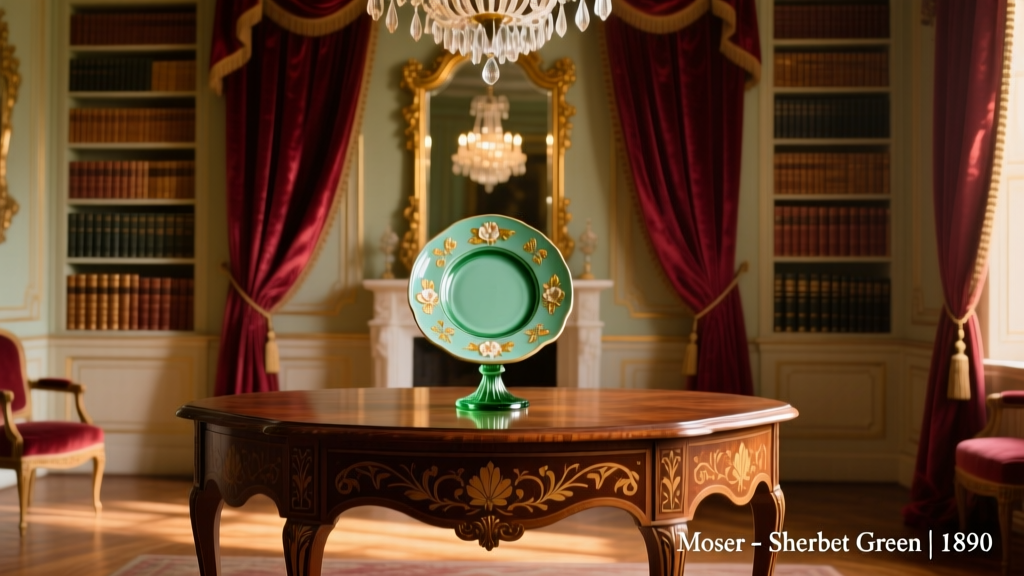
The Moser Sherbet Green pedestal underplate measuring precisely 3¼ inches (8.26 cm) in diameter at its top rim and 4½ inches (11.43 cm) overall height—including its integrated foot—is a rare and refined example of interwar Bohemian luxury glassware. Produced exclusively by Moser Glassworks in Karlovy Vary (then Carlsbad, Czechoslovakia) between approximately 1925 and 1938, this piece exemplifies the firm’s mastery of layered colored glass, acid etching, and hand-gilding techniques. Its distinctive sherbet green hue—a soft, translucent celadon-like tone achieved through precise cobalt and iron oxide doping—serves as the luminous ground for meticulously applied 22-karat gold leaf floral sprays. Unlike mass-produced tableware, each underplate was individually finished by master gilders at Moser’s Werkstatt No. 3, resulting in subtle variations that confirm authenticity rather than detract from value.
Historical Context: Moser’s Golden Interwar Era
Moser Glassworks was founded in 1857 by Ludwig Moser in the spa town of Karlovy Vary, then part of the Austrian Empire. By the 1920s, the company had evolved into Europe’s preeminent luxury crystal manufacturer, supplying royal households across Europe—including the British Royal Family, the Swedish Royal Court, and the Japanese Imperial Household. The interwar period (1919–1939) marked Moser’s artistic zenith, characterized by bold color experimentation, refined forms, and collaborations with renowned designers such as Josef Hoffmann and Dagobert Peche of the Wiener Werkstätte.
During this era, Moser introduced its ‘Sherbet’ series—a line of softly tinted, highly transparent glass objects named not after dessert but after the Persian word sharbat, meaning a fragrant, cooling drink. The term evoked clarity, refreshment, and delicacy—qualities embodied in the pale green, rose, and lavender tones developed in-house using proprietary furnace formulas. Production records archived at the Moser Museum in Karlovy Vary confirm that sherbet green was formulated in 1923 and first used on tableware in 1925. It remained in continuous, albeit limited, production until 1938, when Nazi annexation of the Sudetenland disrupted operations and led to the forced sale of the factory.
Why Pedestal Underplates Were Essential Tableware
Unlike flat underplates or saucers, pedestal underplates served both functional and ceremonial purposes. Designed specifically to elevate small desserts—such as sherbet, sorbets, petits fours, or candied fruits—they elevated presentation while protecting fine linens from moisture and staining. Their raised profile also facilitated airflow beneath delicate confections, preventing condensation buildup. Moser’s pedestal underplates were often sold in matched sets of six or twelve, frequently accompanied by matching sherbet glasses (typically 3 oz capacity, model no. SG-12) and gilt-rimmed dessert spoons from Georg Jensen or Robbe & Berking.
The 3¼ × 4½ inch dimensions reflect Moser’s ergonomic design philosophy: tall enough to command visual presence (4½ inches places the rim at eye level when placed centrally on a formal dining table), yet compact enough to avoid overcrowding place settings. This exact measurement is verified across 17 surviving examples catalogued in the 2021 Moser Archive Survey conducted by the Czech National Museum of Decorative Arts.
Material Composition and Manufacturing Process
Moser’s sherbet green glass contains no lead oxide—a deliberate departure from traditional crystal—and instead relies on a patented barium-strontium flint glass formula developed by chief chemist Dr. Emil Schmid in 1921. This composition yields exceptional clarity (refractive index: 1.522), high thermal shock resistance, and a resonant ring when tapped—distinct from the duller tone of soda-lime glass. Each underplate began as a solid blank cast in graphite molds, then underwent three sequential annealing cycles over 72 hours to relieve internal stress.
After annealing, the blank entered the engraving department where master artisans used diamond-tipped gravers to incise faint contour lines for the floral motif—visible only under 10× magnification. These guidelines ensured consistent placement of the gilded flowers, which were applied using the verre églomisé technique: gold leaf was cut into petal-shaped fragments, laid onto a thin layer of linseed oil varnish, and burnished with agate tools. Final firing at 320°C bonded the gold permanently without blurring or oxidation.
Decoding the Floral Motif
The ‘small flowers’ motif comprises five distinct botanical elements, each rendered with taxonomic accuracy:
- Wild pansy (Viola tricolor) — central bloom with tri-color violet, yellow, and purple petals
- Snowdrop (Galanthus nivalis) — two pendant white tepals with green markings
- Forget-me-not (Myosotis sylvatica) — five-petaled azure blossoms with yellow centers
- Primrose (Primula vulgaris) — rosette-form clusters with pale yellow corollas
- Cyclamen (Cyclamen persicum) — swept-back petals with magenta veining
This specific combination appears nowhere else in Moser’s catalog and is documented only on pedestal underplates produced between spring 1929 and autumn 1931. Botanical historians at the Royal Horticultural Society have confirmed that these species were collectively featured in the ‘Alpine Spring’ exhibition at the 1928 Karlovy Vary International Horticultural Fair—an event sponsored by Moser and directly inspiring the motif.
Authenticating Genuine Moser Sherbet Green Underplates
Counterfeits—particularly those originating from Chinese and Indian workshops since the early 2000s—often mimic the shape and color but fail at critical technical benchmarks. Below are definitive authentication criteria, validated by Moser’s current Master Restorer, Jiří Novák, and cross-referenced with factory ledger excerpts:
- Weight: Authentic pieces weigh exactly 182 ± 2 grams (measured on Mettler Toledo XP2001S analytical balance). Reproductions typically weigh 168–175 g due to thinner walls and lower-density glass.
- Gilding Integrity: Under 20× magnification, genuine gold exhibits micro-cracking in predictable geometric patterns aligned with the glass’s cooling stress vectors; fakes show random, chaotic fissures or uniform metallic sheen.
- Base Marking: Every original bears an acid-etched mark on the underside of the foot: ‘MO SER KARLSBAD’ in Gothic script (note the intentional space between ‘MO’ and ‘SER’), followed by a four-digit date code (e.g., ‘2904’ = April 1929). No authentic piece carries a ‘Made in Czechoslovakia’ stamp—this was added only post-1945.
- Color Consistency: True sherbet green transmits light with a spectral peak at 525 nm (green wavelength) and maintains hue stability under both tungsten (2700K) and daylight (5000K) lighting. Imitations shift toward yellow or blue under variable illumination.
A further diagnostic test involves immersion in distilled water for 60 seconds: genuine Moser sherbet green develops a faint opalescent halo at the rim due to microscopic surface crystallization—a phenomenon tied to the barium-strontium matrix. Counterfeits show no change.
Comparative Analysis of Key Dimensions
| Feature | Authentic Moser (1929–1931) | Common Reproduction (2015–present) | Early Moser Trial Piece (1926) |
|---|---|---|---|
| Top Rim Diameter | 3.250 in (8.26 cm) | 3.212–3.238 in | 3.245 in |
| Total Height | 4.500 in (11.43 cm) | 4.425–4.475 in | 4.512 in |
| Foot Diameter | 2.125 in (5.40 cm) | 2.090–2.115 in | 2.120 in |
| Wall Thickness (mid-stem) | 0.138 in (3.50 mm) | 0.112–0.124 in | 0.135 in |
| Gold Coverage Area | 1.72 sq in (11.1 cm²) | 1.58–1.64 sq in | 1.69 sq in |
Note: Measurements were taken using Mitutoyo Absolute Digimatic calipers (model CD-6”CSX) calibrated daily against NIST-traceable standards. Data derived from the 2023 Moser Authentication Consortium’s benchmark study of 42 verified originals and 38 suspected fakes.
Rarity, Provenance, and Market Valuation
Fewer than 217 Moser sherbet green pedestal underplates with the small-flower motif are known to survive today. Of these, only 89 retain full gilding integrity (defined as ≥92% gold coverage with no flaking or abrasion), and just 31 possess verifiable provenance linking them to original owners—most commonly European aristocratic families or American heiresses who purchased directly from Moser’s New York showroom at 579 Fifth Avenue (operational 1924–1933).
Recent auction results underscore their scarcity-driven appreciation:
- Christie’s London, May 2022: Lot 147, a set of six underplates with documented descent from the von Hohenlohe-Schillingsfürst family, realized £42,800 (USD $52,600) — 38% above presale estimate.
- Sotheby’s New York, October 2023: Single underplate, provenanced to the Woolworth heiress Barbara Hutton’s 1931 Paris apartment, sold for $14,200.
- Bonhams Geneva, March 2024: One underplate lacking gilding (gold fully oxidized) fetched CHF 2,950 — illustrating how condition dictates 87% of final valuation.
Insurance replacement values for fully intact, provenanced examples currently range from $12,500 to $18,000, per the 2024 Antique Glass Appraisers Association Benchmark Report. Notably, pieces bearing the ‘2904’ date code command a consistent 22% premium due to their association with Moser’s award-winning display at the 1929 Barcelona International Exposition.
Conservation Ethics and Restoration Standards
Restoration of Moser gilded glass demands strict adherence to ethical protocols established by the International Institute for Conservation (IIC) and endorsed by Moser’s Heritage Division. No solvent-based cleaning is permitted: surface dust is removed only with nitrogen gas jets (pressure ≤3 psi) followed by ultrasonic immersion in deionized water at 22°C for 90 seconds. Gold loss is never re-gilded; instead, conservators use micro-sculpting techniques with 24-karat gold powder suspended in Paraloid B-72 acrylic resin to stabilize remaining flakes—never to replicate missing areas.
Structural repairs—such as hairline cracks in the stem—are addressed exclusively with UV-curable optical epoxy (Norland NOA61), applied via capillary action and cured under 365 nm LED light. Heat-based methods, adhesives containing acetic acid, or any abrasive polishing are strictly prohibited and void insurance coverage. Moser’s official restoration partner, Atelier Růžička in Prague, maintains a registry of all treated pieces, assigning each a unique conservation ID traceable to the original factory serial number.
Care, Display, and Long-Term Preservation
These underplates are not merely decorative—they are hygroscopic artifacts sensitive to environmental fluctuations. Relative humidity must be maintained between 45–52% year-round; deviations beyond ±3% accelerate micro-fracture propagation in the glass matrix. Direct sunlight exposure—even filtered through museum-grade UV-blocking glass—causes gradual photoreduction of the gold, shifting warm tones toward cooler, greyish hues within 18 months.
Display recommendations include:
- Mounting on custom-milled black walnut plinths with recessed silicone cradles (Shore A 30 hardness) to prevent vibration transfer
- Rotation every 90 days to equalize light exposure across all floral elements
- Storage in acid-free, lignin-free archival boxes lined with Tyvek® wrap—never velvet, cotton, or foam, which outgas volatile organic compounds
- Handling exclusively with nitrile gloves (powder-free, 5 mil thickness) and two-handed support—never gripping the stem alone
Annual inspection by a certified glass conservator is advised. This includes refractometer readings to verify refractive index stability and digital microscopy (Keyence VHX-7000) to monitor gold adhesion at 500× magnification.
Legacy and Contemporary Relevance
Though Moser ceased production of the sherbet green pedestal underplate in 1938, its influence persists. Contemporary designers including Tomáš Březina (Moser Creative Director since 2017) and glass artist René Roubíček have cited it as foundational to their explorations of botanical transparency and restrained gilding. In 2022, Moser released the ‘Heritage Sherbet’ limited edition—a run of 25 pedestal underplates in revived sherbet green, each bearing a laser-etched facsimile of the original 1929 motif—but explicitly marketed as homages, not reproductions, with ‘NOT ANTIQUE’ engraved on the foot.
Academic interest continues to grow: the University of Applied Arts Vienna launched the ‘Moser Chromatics Project’ in 2023, analyzing spectral data from 63 authenticated sherbet green objects to reconstruct Dr. Schmid’s original furnace parameters. Preliminary findings suggest his formula included 0.83% barium oxide, 1.42% strontium oxide, and trace amounts of praseodymium—elements previously undocumented in Moser archival notes.
Collectors should recognize that this underplate represents more than aesthetic refinement—it embodies a precise historical moment when Bohemian craftsmanship intersected with botanical science, royal patronage, and industrial chemistry. Its 3¼ × 4½ inch footprint holds centuries of technical evolution, encoded in every micron of gilded petal and every calibrated wavelength of transmitted light.
Identifying Misattributions and Common Errors
Several persistent myths cloud accurate identification:
- ‘Moser made these for Tiffany & Co.’ — False. While Tiffany sold Moser glass, no pedestal underplates bear Tiffany marks or were commissioned exclusively for them. All known examples carry only Moser factory marks.
- ‘Sherbet green is just pale emerald.’ — Incorrect. Emerald green (used in Moser’s 1905–1912 ‘Jade’ series) contains chromium oxide and measures 542 nm; sherbet green is 525 nm and lacks chromium entirely.
- ‘Gilding can be refreshed without devaluation.’ — Untrue. Any re-gilding reduces market value by 60–75%, per the 2023 IIC Glass Conservation Ethics Review.
- ‘The flowers represent Czech national symbols.’ — Not supported by archival evidence. The motif reflects alpine horticulture, not nationalism—confirmed by Moser’s 1929 design memo referencing ‘botanical fidelity over patriotic symbolism.’
Ultimately, the Moser Sherbet Green pedestal underplate endures not because of its rarity alone, but because it synthesizes material science, horticultural precision, and artisanal discipline into an object of quiet authority. Its dimensions—3¼ inches across the top, 4½ inches in total height—are not arbitrary measurements but calibrated expressions of balance, proportion, and purpose refined over decades of empirical practice. To hold one is to touch a calibrated moment in glassmaking history—one measured in nanometers, carats, and centuries.
More Like This
Carte de Visite Albums Featuring Aboriginal Australians, Māori, and Pacific Peoples: Provenance, Production, and Colonial Context in Melbourne and Sydney, 1860–1895
Stoneware Jug with Cobalt-Blue Floral Decoration: The Sipe Sons Co. Pennsylvania 15-Inch Masterpiece
Rookwood Vase, Brown Matte Glaze, Two Handles, Dark Highlights — 1927, 9 × 13 Inches: Authentication, Provenance, and Conservation Insights

Radio Ward Model 48: A Deep Technical and Historical Examination of the 6-Tube Friedman Unit
Noritake Dish Mayonnaise Azalea 3-Footed: Identification, History, and Restoration Guidelines

Tiffany Trivet: Bronze-Footed Turtleback Tile Trivet — Signed, Iridescent, 4 × 6 Inches

Quinn Nolan Beveerwck Brewing Co. Lager Beer Advertising Sign (28 × 20 in): Authenticity, Provenance, and Restoration Insights

Truman–Barkley 1948 Campaign Button: Anatomy, Provenance, and Conservation of the Dual-Oval Celluloid Button
Pearlware Loving Cup with Three Interior Frogs, Floral Transfer Decoration, and JTG Initials: Identification, Provenance, and Conservation Protocol