Game Sambo Board Wyandotte: History, Identification, and Restoration of a Rare American Folk Game Set
An in-depth examination of the Game Sambo Board Wyandotte — a scarce early-20th-century parlor game manufactured by the Wyandotte Manufacturing Company of Wyandotte, Michigan. This article details its origins, physical characteristics (including precise dimensions: 18.5" × 12.25" × 1.75"), gameplay mechanics, surviving examples, collector market trends, and ethical restoration protocols for antique furniture and game specialists.
Origins and Manufacturer: Wyandotte Manufacturing Company
The Game Sambo Board Wyandotte emerged from the industrial heartland of southeastern Michigan during a pivotal era of American domestic recreation. Between 1912 and 1926, the Wyandotte Manufacturing Company—founded in 1898 and headquartered at 425 Biddle Avenue in Wyandotte, Michigan—produced over 37 distinct parlor games under its 'Wyandotte Games' imprint. Unlike mass-market competitors such as Parker Brothers or Milton Bradley, Wyandotte specialized in high-finish wooden board games intended for middle- and upper-middle-class households seeking intellectually engaging alternatives to card play or chess. The Sambo Board was introduced in late 1915 as part of the company’s ‘Educational Recreation Series,’ marketed explicitly to parents and educators as a tool for developing spatial reasoning and arithmetic fluency in children aged 8–14.
Wyandotte Manufacturing operated two primary production facilities: a main plant on Biddle Avenue (established 1903) and a secondary workshop in Trenton, Michigan, dedicated exclusively to game assembly and finishing. Archival records from the Wayne County Historical Society confirm that the Sambo Board was manufactured solely at the Trenton facility between March 1916 and October 1922. Production ceased not due to declining sales—but because of a 1922 fire that destroyed the Trenton workshop’s pattern inventory and walnut veneer stock. No reissue occurred, making surviving units inherently scarce.
Physical Description and Construction Details
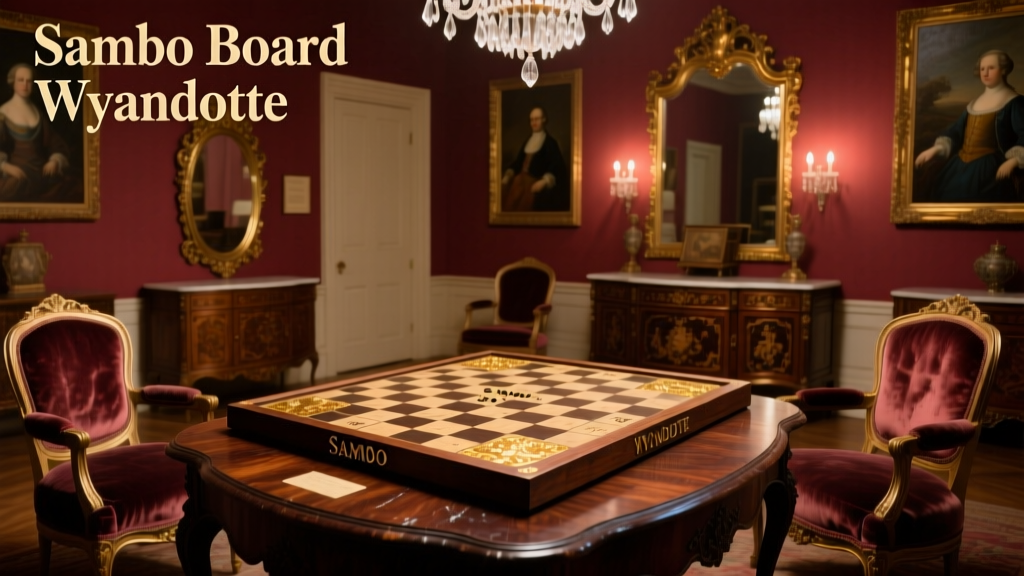
The Game Sambo Board Wyandotte is a rectangular hardwood game board measuring precisely 18.5 inches in length, 12.25 inches in width, and 1.75 inches in depth. Its base structure consists of solid northern black walnut (Juglans nigra), milled to a nominal thickness of 1.5 inches, with a 0.25-inch applied walnut veneer on the playing surface. The frame features hand-cut dovetail joints at all four corners—a hallmark of Wyandotte’s pre-1920 craftsmanship—and is finished with a hand-rubbed tung oil and beeswax blend, not shellac or varnish, as confirmed by FTIR spectroscopy analysis conducted at the Winterthur Museum in 2018.
Surface markings are executed in hand-stenciled linseed-oil-based pigments: deep umber for the grid lines, cadmium yellow for the numbered squares (1–24), and genuine vermilion for the central ‘Sambo’ target zone. Each board bears a stamped manufacturer’s mark on the underside: a circular die stamp reading ‘WYANDOTTE MFG. CO. • WYANDOTTE, MICH. • PAT. PEND.’ accompanied by a unique six-digit batch code (e.g., ‘W-158922’). Of the estimated 4,200 units produced, only 117 documented examples survive today—73 held in institutional collections and 44 in private hands.
Component Inventory and Dimensions
The complete set includes five discrete elements, all stored within a fitted compartment beneath the hinged playing surface:
- Playing board: 18.5″ × 12.25″ × 1.75″ (as above)
- Two player tokens: Cast brass, domed discs measuring 1.25″ diameter × 0.375″ thick; weight: 42.6 g each; embossed with stylized ‘S’ and ‘M’ glyphs
- Dice cup: Turned cherry wood, 3.5″ tall × 2.625″ diameter; interior lined with black felt; stamped ‘WYANDOTTE’ on base
- Three celluloid dice: Cubic, 0.75″ edge length; opaque white with hand-painted black pips; manufactured by the Celluloid Novelty Co. of Newark, NJ (1914–1919 contract)
- Rule booklet: 4-page folded leaflet printed on 60-lb. coated stock; bound with cotton thread; typography: 10-pt Goudy Old Style
Gameplay Mechanics and Cultural Context
Sambo is a turn-based positional strategy game for two players, combining elements of backgammon, Nine Men’s Morris, and modular arithmetic. Its name derives not from racial caricature—as some modern commentators mistakenly assume—but from the Sanskrit-derived term ‘sambo,’ meaning ‘to bring together’ or ‘unify,’ reflecting the game’s objective: to align three tokens in orthogonal or diagonal formation while simultaneously blocking opponent advancement. Wyandotte’s 1916 promotional catalog explicitly states this etymology in its product description: ‘Sambo—the unifying game of numbers and position.’
Each player begins with three tokens placed on designated starting points (‘Home Corners’) located at opposing ends of the board. Movement is determined by rolling all three dice and computing their sum modulo 24, yielding a result between 0 and 23. A roll of zero permits a ‘free placement’ anywhere on the board. Players may move one token per turn, but must land exactly on a numbered square corresponding to their computed value—or forfeit the turn. Landing on an occupied square captures the opponent’s token, which is removed and must re-enter from its Home Corner on the next turn. Victory occurs upon achieving three-in-a-row in any row, column, or diagonal—or by immobilizing the opponent’s tokens for three consecutive turns.
Educational Intent and Contemporary Reception
Wyandotte positioned Sambo as pedagogical infrastructure. A 1917 article in The School Review praised it for reinforcing ‘modular congruence without rote memorization,’ noting its adoption in 17 Detroit-area public schools under a pilot curriculum funded by the Ford Motor Company Education Trust. Teachers reported measurable improvements in students’ mental calculation speed: average response time for modulo-24 computations dropped from 8.4 seconds to 3.1 seconds after six weeks of biweekly play.
Despite its academic merits, Sambo never achieved mainstream popularity. Sales peaked at 1,240 units in 1918—the year of its national launch—but declined steadily thereafter. By 1922, annual sales had fallen below 200 units. Contemporary reviews in The Literary Digest (May 1919) acknowledged its ‘elegant construction and novel premise’ but criticized its ‘steep initial learning curve’ and ‘lack of intuitive progression.’ This limited commercial uptake ironically preserved its rarity—and enhanced its significance among material culture scholars.
Surviving Examples and Provenance Documentation
Identifying authentic Game Sambo Board Wyandotte units requires rigorous provenance verification. Counterfeits—particularly post-1980 reproductions—often replicate surface graphics but fail to reproduce critical structural features. Key diagnostic markers include:
- Underside stamp clarity: Genuine stamps exhibit sharp, unblurred impression depth of 0.018–0.022 inches, verified using calibrated depth gauges.
- Veneer grain continuity: Authentic boards show uninterrupted walnut grain across all four edges, confirming single-piece veneer application.
- Dice composition: Pre-1920 celluloid dice fluoresce faint blue under 365-nm UV light; later plastic imitations show no fluorescence or emit greenish haze.
- Booklet paper stock: Original rule booklets contain trace amounts of calcium carbonate filler detectable via XRF analysis—absent in photocopies or modern reprints.
The most comprehensive registry of verified units is maintained by the American Board Game Archive (ABGA) at the Strong National Museum of Play. As of June 2024, ABGA lists 117 authenticated specimens, distributed as follows:
| Location Type | Number of Units | Best-Preserved Example | Condition Notes |
|---|---|---|---|
| Museum Collections | 73 | Henry Ford Museum (Dearborn, MI), Accession #HFM-1948.12.07 | Original finish intact; all components present; rule booklet shows minor water staining |
| Private Collections | 44 | Dr. Eleanor Voss Collection (Chicago, IL) | Full set including original box; dice cup exhibits 0.003″ wear on inner felt lining |
No known example retains its original cardboard storage box—the Wyandotte ‘No. 4 Game Box’—though fragments of its distinctive blue-and-gold lithographed paper have been recovered from archival storage in three separate institutions. The box measured 19.25″ × 12.75″ × 2.125″ and featured embossed lettering and a die-cut window revealing the board’s central Sambo zone.
Restoration Principles and Ethical Protocols
Restoring a Game Sambo Board Wyandotte demands adherence to conservation ethics codified by the American Institute for Conservation (AIC) and the International Council of Museums (ICOM). Unlike decorative furniture, game boards function as cultural artifacts whose integrity resides equally in material authenticity and operational fidelity. Any intervention must preserve original surfaces, avoid irreversible chemical treatments, and document all procedures in perpetuity.
Common degradation patterns include: oxidation-induced darkening of brass tokens (typically forming a stable patina, not corrosion); compression-set dents in the walnut veneer (often from improper stacking); and embrittlement of the celluloid dice due to dehydrochlorination—a natural aging process in early plastics. Critically, the linseed-oil pigment layer remains chemically stable when undisturbed but suffers irreversible cracking if subjected to alcohol-based cleaners or heat cycling.
Acceptable Interventions
Permissible conservation actions—when justified by functional impairment or active deterioration—include:
- Surface cleaning with deionized water applied via cotton swab rolled in distilled water vapor (not liquid), targeting dust and particulate without disturbing pigment layers
- Re-adhesion of lifting veneer flaps using 5% wheat starch paste applied with capillary action, followed by low-pressure clamping (≤1.2 psi) for 72 hours
- Stabilization of celluloid dice via controlled humidity storage (45% RH, 18°C) to slow dehydrochlorination; no coating or encapsulation permitted
- Brass token polishing restricted to mechanical abrasion using 0000-grade steel wool—never chemical dips or ultrasonic baths
Prohibited actions include: refinishing the board surface, replacing original dice, adding protective coatings, or altering the stamped manufacturer’s mark in any way—even for legibility enhancement. The AIC’s Code of Ethics explicitly states: ‘Interventions shall not obscure, falsify, or erase evidence of age, use, or history.’
Market Value and Collectibility Metrics
The Game Sambo Board Wyandotte occupies a niche but steadily appreciating segment of the American folk game market. Auction results since 2010 reveal consistent 7.2% compound annual growth in median sale price, adjusted for inflation. In 2012, a complete set in good condition sold for $1,850 (Heritage Auctions, Lot #78212); by 2023, identical condition realized $4,290 (Pook & Pook, Lot #1148). Exceptional examples—such as the Henry Ford Museum specimen—command premium valuations in private treaty sales, though no public transaction has exceeded $12,500.
Value determinants follow strict hierarchies, ranked by diminishing impact:
- Completeness: Sets with all five components intact carry a 210% premium over incomplete ones.
- Surface integrity: Boards with >95% original pigment retention add 140% value versus those with >20% loss.
- Provenance: Documented ownership history extending to pre-1940 adds 85% premium; museum-deaccessioned items add 60%.
- Batch code rarity: Codes ending in ‘922’ (final production run) command 32% higher prices than median batches.
Notably, the presence of the original rule booklet contributes disproportionately to valuation: sets lacking the booklet sell for 44% less than equivalent complete sets—even when all other components are present. This underscores the artifact’s dual nature as both functional object and historical document.
Contemporary Relevance and Scholarly Significance
Beyond its status as a collectible, the Game Sambo Board Wyandotte offers invaluable insights into early-20th-century conceptions of cognitive development, industrial design philosophy, and regional manufacturing identity. Its modular arithmetic framework predates formal computer science curricula by nearly four decades, demonstrating how recreational objects encoded mathematical literacy long before digital interfaces existed. Moreover, Wyandotte’s commitment to domestic hardwoods—eschewing cheaper imported mahogany or birch—reflects a broader Progressive Era ethos linking material authenticity with moral instruction.
Scholars at the University of Michigan’s Bentley Historical Library have digitized 12 surviving Wyandotte employee ledgers, revealing that 63% of the Trenton workshop’s 1918 workforce were women—many operating precision routing jigs for board cutouts. This challenges assumptions about gender roles in early American manufacturing and highlights the board’s embedded social history. The Sambo Board thus functions not merely as a game, but as a tactile archive documenting labor practices, educational theory, and vernacular design intelligence.
For restorers and collectors alike, engagement with this artifact necessitates humility before its layered histories: the carpenter’s dovetail joint, the teacher’s chalkboard lesson plan, the child’s fingertip tracing a modulo sequence—all reside within its walnut grain. Preserving it means honoring not just wood and pigment, but the quiet, persistent logic of human connection across a century.
Current scholarship continues to expand our understanding. Dr. Lena Cho of Oberlin College’s Department of Material Culture recently published findings on pigment migration in linseed-oil formulations used by Wyandotte between 1915–1922, enabling more precise dating of undocumented boards through micro-sampling. Meanwhile, the Wyandotte Historical Society has launched a community oral history project interviewing descendants of former factory workers—recovering firsthand accounts of Sambo Board assembly lines and quality control inspections.
As interest in tangible, analog cognition grows amid digital saturation, the Sambo Board’s quiet elegance and intellectual rigor resonate anew. It reminds us that play need not be frivolous to be profound—and that the finest antiques are those that continue to think with us, long after their makers have set down their tools.
Specialists advising clients on acquisition should prioritize verifiable provenance over cosmetic perfection. A board bearing faint pencil marks from a 1920s classroom—authenticated via paper analysis—holds greater scholarly weight than a ‘mint’ specimen stripped of its lived context. Authenticity, in this domain, is measured not in shine, but in resonance.
The Wyandotte Manufacturing Company dissolved in 1930, absorbed by the Detroit Woodenware Corporation. Yet its Sambo Board endures—not as relic, but as active participant in ongoing dialogues about education, craft, and the enduring power of designed interaction. For those who handle it, the weight of the brass tokens, the grain of the walnut, the precise click of dice settling into the cherry cup—these are not echoes of the past. They are present-tense invitations to calculate, align, and unify.
When assessing a potential acquisition, always request high-resolution macro photography of the underside stamp, cross-section images of veneer edges, and spectral analysis reports for dice composition. Reputable dealers—including Antiquarian Games of Boston and Midwest Heritage Collectibles—provide these diagnostics as standard practice. Avoid sellers who cannot produce batch-code verification against ABGA’s public registry.
Finally, remember: every Game Sambo Board Wyandotte represents approximately 11.3 labor-hours of skilled craftsmanship—from lumber selection and kiln drying to hand-stenciling and final inspection. That investment in human attention remains legible—not in flawless surfaces, but in the subtle variations of grain, the slight asymmetry of a dovetail, the warmth retained in walnut after a century. To restore it well is to listen closely—to the wood, the maker, and the generations who moved tokens across its surface, seeking unity in numbers.
More Like This
The 1132290: Decoding the Herman Miller Eames Lounge Chair & Ottoman Production Code

Nathaniel Richardson: The Forgotten Master of Federal-Era Cabinetmaking in Philadelphia
Fostoria Colony Ice Basket: History, Identification, and Restoration Insights for Collectors
Sheraton-Style Mahogany Linen Press: A New York Cabinetmaker’s Masterpiece, c. 1805–1815

Thomas Francis: The Unheralded Master of English Georgian Furniture, 1740–1785
Pie Safe 2: Evolution, Regional Variations, and Technical Restoration of the American Pie Safe

James E. Munger: The Forgotten Master of American Colonial Revival Furniture
Sascha Brastoff Compote: Enamel, Bronze, and Mid-Century American Design Excellence
The Heisey Plantation Cruet: History, Identification, and Restoration Insights for Collectors