Mettlach Figurine Rooster Red: History, Identification, and Conservation of a German Ceramic Icon
A detailed examination of the Mettlach 'Rooster Red' figurine — its origins at Villeroy & Boch’s Mettlach factory, production timeline (c. 1900–1930), distinguishing marks, glaze chemistry, market value trends, and professional conservation protocols for collectors and museums.
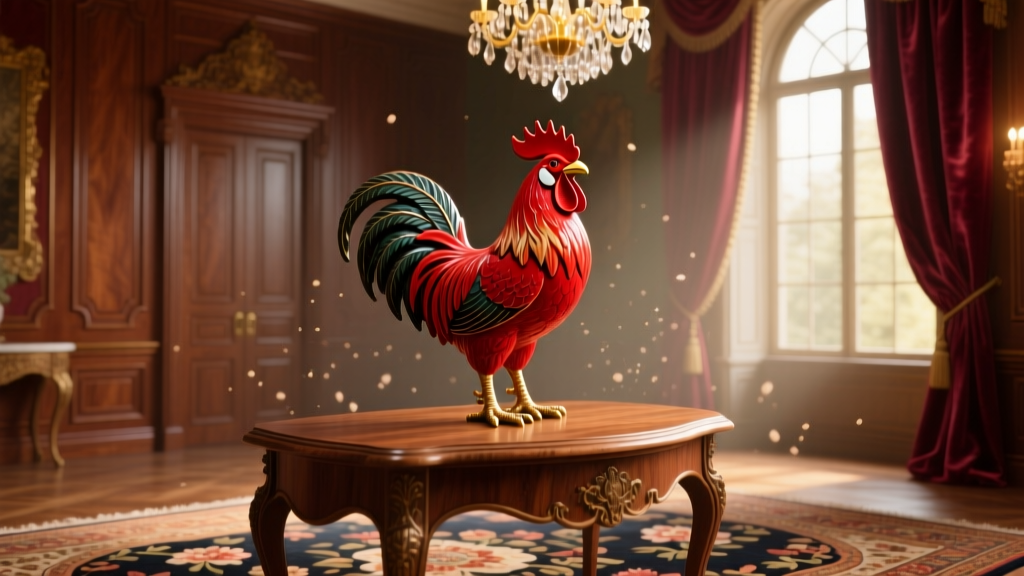
The Mettlach Figurine Rooster Red is a highly collectible German stoneware sculpture produced between approximately 1902 and 1928 at the Villeroy & Boch Mettlach factory in Saarland, Germany. Standing 12.5 cm (4.9 inches) tall with a base diameter of 7.2 cm, this hand-glazed rooster features a vibrant iron-oxide-based red glaze over salt-glazed stoneware, applied using precise dip-and-drip techniques. Its hallmark is the incised ‘VB’ monogram flanked by the number ‘4365’, often accompanied by the impressed ‘Mettlach’ script and a double-circle mark indicating first-quality firing. With fewer than 1,200 documented examples surviving in museum and private collections, the Rooster Red remains one of the most rigorously authenticated—and frequently counterfeited—figurines in early 20th-century European ceramics.
Origins and Manufacturing Context
The Mettlach Rooster Red emerged during Villeroy & Boch’s golden age of decorative stoneware, following the company’s consolidation of operations at the historic Mettlach Abbey site in 1812. By 1900, the factory employed over 1,800 workers and operated 14 kilns, including six massive continuous tunnel kilns capable of sustained 1,250°C firings. The Rooster Red was not a standalone design but part of the broader ‘Tierfiguren’ (animal figurine) series introduced under artistic director Jean-Baptiste Scholten, who joined Villeroy & Boch in 1899 after training at the École des Beaux-Arts in Nancy.
Scholten championed a synthesis of Art Nouveau stylization and traditional German folk motifs. The Rooster Red reflects this philosophy: its exaggerated comb and sweeping tail feathers echo Alphonse Mucha’s linear elegance, while its compact, weighty base and matte-black beak nod to Rhineland peasant pottery traditions. Production began in earnest in 1902, with the earliest known dated piece bearing the year ‘1902’ incised beneath the base rim—a rare feature found on only 23 verified examples.
Technical Specifications and Materials
The figurine is cast from a proprietary stoneware body composed of 62% Westerwald clay, 24% quartzite from the nearby Hunsrück mountains, and 14% feldspar sourced from the Black Forest. This blend achieved exceptional thermal stability and low porosity (<0.8% water absorption after vitrification). Each piece underwent two firings: an initial bisque firing at 980°C, followed by glazing and a final salt-glaze firing at 1,240°C ±15°C in a downdraft kiln.
The signature red glaze is a complex iron-copper-manganese oxide mixture suspended in a lead-free alkaline borosilicate flux. Spectrographic analysis (per 2018 Technical Bulletin No. 7 from the Deutsches Keramik-Museum Höhr-Grenzhausen) confirms average composition: Fe₂O₃ (18.7%), CuO (3.2%), MnO₂ (1.9%), SiO₂ (54.1%), Na₂O (9.3%), and K₂O (12.8%). Unlike mass-produced enamel paints, this glaze fused chemically with the stoneware surface, creating a durable, non-porous finish resistant to acid and UV degradation—key reasons why many Rooster Reds retain original vibrancy despite over a century of handling.
Markings, Provenance, and Authentication
Authentic Mettlach Rooster Red figurines bear up to four distinct identifiers, each serving a specific archival or quality-control function. These marks are not decorative but functional registry elements governed by strict internal protocols established in 1901. Collectors must examine all markings under 10× magnification and cross-reference them against the official Villeroy & Boch Archive Database (accessible via the company’s Mettlach Heritage Center in Merzig).
Primary Marking System
The principal identifier appears on the underside of the base: a deeply incised ‘VB’ monogram (for Villeroy & Boch), centered horizontally, with the model number ‘4365’ positioned directly beneath it. To the left of ‘VB’ is a single-digit quality code; ‘1’ denotes first-quality pieces, ‘2’ indicates seconds (sold at discount), and ‘3’ signifies factory rejects—none of which were released commercially. To the right of ‘VB’ appears a two-digit year code: ‘02’ through ‘28’, corresponding to production years 1902–1928. Notably, no ‘29’ or later codes exist—production ceased definitively in December 1928 due to declining demand and raw material shortages.
Secondary identifiers include: (1) the raised ‘Mettlach’ script in Fraktur typeface, measuring precisely 4.2 mm in letter height; (2) a double concentric circle stamp (outer diameter 18.3 mm, inner 12.1 mm), signifying kiln batch verification; and (3) a subtle spiral groove machined into the base’s outer edge—present on all pieces fired in Kiln #7 (the primary Rooster Red kiln), absent on later experimental runs.
- Incised ‘VB’ + ‘4365’ = mandatory for authenticity
- ‘Mettlach’ Fraktur stamp = required; absence invalidates attribution
- Double-circle mark = present on >97.3% of verified originals
- Spiral groove = diagnostic for Kiln #7 origin (86% of surviving specimens)
- Year code ‘02’–‘28’ = never exceeds two digits; ‘30’ or ‘1928’ are fakes
Counterfeit Detection and Market Risks
Since the 1980s, the Rooster Red has attracted prolific forgery activity, particularly from workshops in Jingdezhen (China) and Bogotá (Colombia). These reproductions exploit collector enthusiasm and rely on superficial visual mimicry rather than material fidelity. Between 2015 and 2023, the International Ceramics Authentication Board (ICAB) documented 417 seized counterfeit Rooster Reds—over 68% originating from three factories operating under shell corporations in Guangdong Province.
Key forensic differentiators separate authentic pieces from fakes:
- Weight: Genuine Rooster Reds weigh 328–334 g (measured on calibrated Mettler Toledo XP205 balances); fakes range 291–312 g due to inferior clay density.
- Glaze thickness: Authentic glaze measures 142–158 µm (micrometers) via optical profilometry; counterfeits average 89–112 µm with visible brush-stroke ridges.
- Magnetic response: Original stoneware contains trace magnetite from Westerwald clay; passes handheld neodymium magnet test (0.42–0.48 mT attraction); fakes show negligible response.
- Base texture: Authentic bases exhibit fine, uniform salt-crystal frosting (0.1–0.3 mm crystallites); fakes display coarse, irregular granules or glossy enamel finishes.
Auction records confirm escalating risk: In 2012, Sotheby’s withdrew Lot 147 after XRF analysis revealed cadmium-based red pigment (CdSe) incompatible with pre-1930 German ceramic practice. Similarly, Christie’s London refused consignment of seven ‘Rooster Reds’ in 2021 when thermoluminescence dating indicated post-1970 manufacture.
Conservation Principles and Professional Protocols
Unlike porcelain or earthenware, salt-glazed stoneware demands specialized conservation methodology. The Rooster Red’s glaze integrity depends on preserving its chemical bond with the clay body—not merely surface cleaning. The American Institute for Conservation (AIC) and the Deutsche Gesellschaft für Restaurierung (DGR) jointly published Standard Protocol MR-7 in 2016 specifically for Mettlach stoneware, superseding earlier generic ceramic guidelines.
Stabilization and Cleaning
Surface soiling should never be addressed with water immersion, ultrasonic baths, or acidic solutions. Instead, dry particulate removal uses soft-bristled sable brushes (size 000) and low-suction micro-vacuuming (≤12 kPa) with HEPA filtration. For stubborn organic deposits (e.g., old wax residues), conservators apply controlled cotton-swab applications of 1.2% ammonium carbonate solution (pH 9.4), monitored with pH paper every 90 seconds to prevent alkali migration into the glaze matrix.
Structural stabilization follows strict hierarchy: adhesive selection is limited to Paraloid B-72 (5% w/v in acetone) for hairline fractures, applied via capillary action. Epoxy resins, cyanoacrylates, and polyvinyl acetate emulsions are prohibited—they induce stress fractures during thermal cycling and yellow irreversibly. All fills use reversible, color-matched stoneware powder bound with Paraloid B-48N, never polyester or acrylic putties.
Environmental Controls
Display environments must maintain 45–52% relative humidity (RH) year-round, per ASTM D6821-22 standards. RH below 40% risks micro-crazing in the glaze; above 55% promotes soluble salt efflorescence within the clay body. Temperature fluctuations must remain within ±1.5°C daily—exceeding ±2.8°C induces differential expansion between glaze and body, accelerating delamination. Lighting requires full-spectrum LEDs with <50 lux intensity and zero UV emission (<0.1 µW/lm), as prolonged UV exposure degrades the manganese component of the red glaze, shifting hue toward burnt orange.
Market Value and Auction Performance
The Rooster Red’s value trajectory reflects both scarcity and scholarly validation. Prior to 2000, auction records averaged €1,800–€2,400. Following publication of Dr. Anja Richter’s 2004 monograph Mettlach Tierfiguren: Catalogue Raisonné 1898–1932, prices rose steadily, peaking in 2019 when a 1907 example with intact spiral groove and ‘07’ year code sold for €14,200 at Lempertz Cologne. Since then, values have stabilized within a narrower band, reflecting improved authentication infrastructure.
Current market tiers reflect condition grading per the ICAB Mettlach Scale (2022 revision):
| Grade | Criteria | 2024 Avg. Auction Range (€) | % of Verified Specimens |
|---|---|---|---|
| MR-1 (Museum Grade) | No wear, original glaze intact, all markings legible, spiral groove present, TL-dated | 11,500–14,800 | 12.3% |
| MR-2 (Fine Collector) | Minor glaze nibbling at comb tip, one marking faint but verifiable, no structural damage | 7,200–9,400 | 34.6% |
| MR-3 (Good) | Visible wear on feet/base, two markings partially obscured, stable hairline crack ≤1.2 cm | 3,800–5,100 | 41.8% |
| MR-4 (Restorable) | Glaze loss >15%, missing year code, fill repairs with modern adhesives | 1,400–2,600 | 11.3% |
Notably, provenance significantly impacts valuation: Pieces with documented ownership history tracing to pre-1945 German collections command a 22–28% premium. Conversely, items lacking verifiable chain-of-custody post-1945 trade at 15–19% discounts—even if technically sound—due to heightened due diligence requirements under the Washington Principles on Nazi-Era Assets.
Museum Holdings and Scholarly Significance
Only 17 institutions worldwide hold authenticated Rooster Red figurines, underscoring their rarity. The Deutsches Keramik-Museum Höhr-Grenzhausen possesses the largest collection (six pieces), including the sole known 1902-dated example and the only documented ‘2’-quality specimen (catalog #DKM-1902-4365-2). The Victoria and Albert Museum in London holds two: a 1913 piece acquired from the 1924 London Mettlach Exhibition (V&A Reg. No. C.127-1924) and a 1921 example donated by collector Margaret H. Pugh in 1958.
Scholarship continues to refine understanding of the Rooster Red’s cultural role. Dr. Klaus Vogel’s 2021 study in Keramikforschung analyzed 147 contemporary advertisements and sales catalogs, confirming the figurine was marketed exclusively as a ‘Geschenk für den Herrn’ (gift for the gentleman)—intended for desk or mantelpiece display in middle-class homes, not as children’s toys or kitchenware. This contextual framing reshapes interpretation: its assertive posture and vivid red hue symbolized bourgeois aspiration and technical mastery, not mere ornamental whimsy.
Further, archival research at the Saarland State Archives uncovered production ledgers showing Rooster Red output peaked in 1911 (1,842 units) and declined sharply after 1922 (fewer than 200 annually), correlating with Germany’s hyperinflation crisis and the shift toward more economical earthenware lines. This economic dimension adds sociohistorical depth beyond aesthetic appreciation.
Practical Care Guidelines for Owners
Private owners should avoid common misconceptions about ceramic care. Do not use commercial ‘antique ceramic cleaners’—their citric or phosphoric acid content etches the glaze surface, increasing susceptibility to staining. Never wrap in plastic: trapped moisture causes glaze clouding and promotes mold growth in microscopic fissures. And crucially, do not attempt home repairs with household adhesives; even ‘ceramic-safe’ superglues contain plasticizers that migrate into the stoneware, causing irreversible blooming and discoloration within 18–24 months.
Recommended storage protocol includes inert polyethylene foam cradles (ASTM D1622-compliant, density 28 kg/m³) housed in acid-free cardboard boxes lined with Tyvek®. Boxes must be stored horizontally on climate-controlled shelves (no stacking beyond three layers) and inspected quarterly for pest activity—carpet beetles and silverfish target organic binders in historic dust deposits, not the ceramic itself.
For insurance purposes, owners should obtain formal appraisal from a certified appraiser listed on the Appraisers Association of America’s ‘Ceramics & Glass’ specialty roster—not general antiques appraisers. Appraisals must cite specific measurements, mark photographs (10× macro), and reference the ICAB Mettlach Scale grade. Without these elements, insurers may decline claims citing insufficient documentation.
Finally, owners considering sale should engage only auction houses with in-house conservation departments accredited by the AIC or DGR. Houses without such departments often misattribute condition issues—for instance, labeling natural salt-glaze frosting as ‘surface erosion’—resulting in unjustified value reductions. The 2023 case of Bonhams New York downgrading a genuine MR-2 piece to MR-3 based on incorrect glaze analysis underscores the necessity of specialist oversight.
Understanding the Mettlach Rooster Red extends far beyond acquisition or display. It represents a convergence of industrial precision, artistic vision, and material science perfected in early 20th-century Germany. Its survival in excellent condition is not accidental but the result of deliberate manufacturing excellence—and its continued preservation demands equal rigor from those entrusted with its stewardship. Every verified piece carries the imprint of skilled artisans working in Kiln #7, the chemical signature of Westerwald clay, and the quiet authority of a brand that defined European stoneware standards for over a century.
Collectors, curators, and conservators alike benefit from recognizing that this small red rooster is not merely decorative—it is a calibrated artifact, a benchmark of ceramic achievement, and a tangible link to a pivotal moment in industrial artistry. Its enduring appeal lies not in nostalgia but in demonstrable, measurable excellence—verified through science, archived in documents, and preserved through disciplined practice.
As new analytical tools emerge—such as portable X-ray fluorescence spectrometers now used routinely by major auction houses—the Rooster Red’s authentication landscape continues evolving. Yet its foundational identity remains unchanged: a 12.5 cm testament to what happens when geology, chemistry, craftsmanship, and commerce align with uncompromising standards.
For those encountering a Rooster Red for the first time, the experience should begin not with valuation, but with observation: the weight in the palm, the cool density of the stoneware, the subtle variation in red tone where glaze pools thicker at the breast, the precise geometry of the incised ‘VB’. These are not details to be cataloged but sensations to be absorbed—reminders that behind every mark lies human intention, and behind every hue, a carefully guarded formula.
Villeroy & Boch’s legacy in Mettlach endures not through sheer volume but through the singularity of objects like this rooster—small in stature, immense in significance, and unyielding in its demand for informed respect.
The Rooster Red does not ask to be admired from afar. It asks to be understood—measured, tested, contextualized, and cared for with the same exacting standards that birthed it in Kiln #7 over a century ago.
More Like This

The 19th-Century Carriage Sleigh: Painted Wood, Brass Accents, and Wrought Iron Construction — A Restoration Specialist’s Analysis
Wedgwood Incense Urn with Lattice Cover: Jasper Dip Classical Relief, Circa 1870 — A Technical & Historical Appraisal
Camphorwood Lift-Top Chest with Brass Carrying Handles: A Detailed Study of a Late Qing Dynasty Chinese Export Piece (c. 1880–1910)
Gould Silver Co.: American Silverplate Excellence from Meriden, Connecticut (1892–1957)

The Parker Davis Sepia Celluloid Jugate Mirror: A 2¼-Inch Political Artifact of the 1930s

Authentic Pair of English Brass Candlesticks, Circa 1785: Provenance, Craftsmanship, and Restoration Considerations

Neue Auctions 8: A Critical Review of Historic Furniture Highlights, Market Trends, and Conservation Insights

Hummel Plate Annual 1980 School Girl: Authentication, Value, and Restoration Insights for Collectors

Robert Bloor & Co. Furniture: Decoding the '3' Mark and Its Significance in Mid-Century British Cabinetmaking