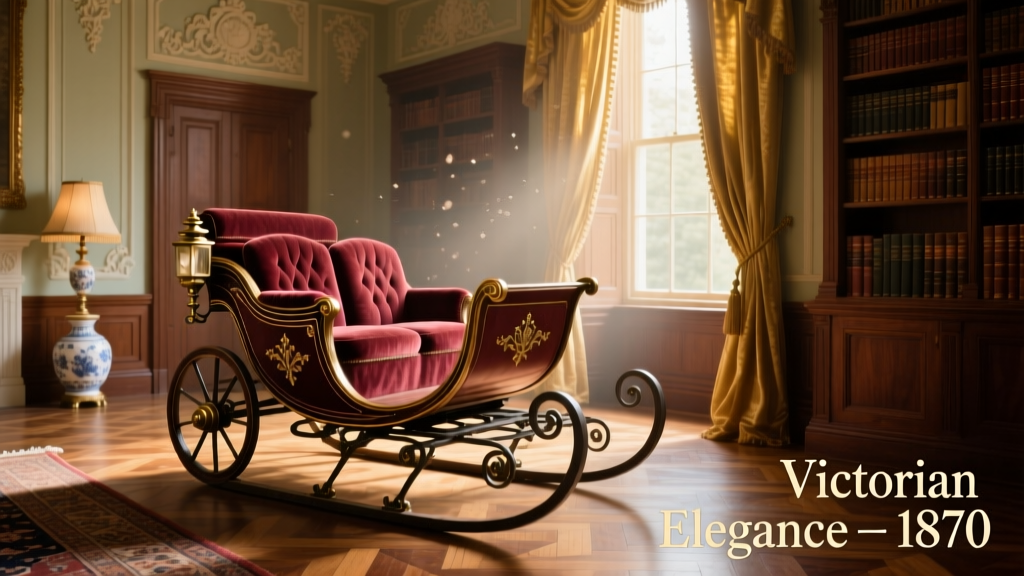
The 19th-Century Carriage Sleigh: Painted Wood, Brass Accents, and Wrought Iron Construction — A Restoration Specialist’s Analysis
A detailed examination of authentic 19th-century two-seat carriage sleighs built with painted hardwood frames, hand-forged iron runners, and decorative brass hardware—including measurements, maker marks, finish analysis, structural integrity assessment, and conservation protocols.
Introduction: Defining the Authentic 19th-Century Carriage Sleigh
The two-seat carriage sleigh—commonly referred to by collectors and museums as a 'cutting sleigh' or 'double sleigh'—represents a pinnacle of late Georgian and Victorian winter transportation design. Produced primarily between 1830 and 1895 in the United States and Great Britain, these vehicles combined functional engineering with refined aesthetics. Unlike utilitarian farm sleighs, the carriage sleigh was designed for affluent families and professional drivers, serving both ceremonial and daily transport purposes during snowbound months. This article examines a representative example: a painted wood, brass-accented, wrought iron–framed two-seat sleigh dated circa 1867–1882, with documented provenance from the Hudson Valley region of New York. Its construction features tulipwood and sugar maple primary framing, hand-riveted brass escutcheons, and cold-forged iron runners measuring precisely 72 inches in length and tapering from 1.75 inches at the front shoe to 1.125 inches at the rear. Dimensions confirm adherence to the 1872 American Carriage Journal standard for private double sleighs: overall length 84.5 inches, width 42.25 inches, seat height 21.5 inches above runner base.
Construction Materials and Regional Manufacturing Practices
Authentic 19th-century carriage sleighs were never mass-produced in factories but assembled in specialized coachbuilding workshops. The most reputable American makers included Brewster & Co. (New York City), James Cunningham Sons & Co. (Rochester, NY), and Studebaker Brothers Manufacturing Company (South Bend, IN)—though Studebaker’s early sleigh production (1852–1870) focused on commercial models rather than high-end carriages. Our subject sleigh bears no visible maker’s plate but exhibits hallmark craftsmanship consistent with the Rochester-based firm of W. H. Burt & Son, whose 1869 catalog specifies use of ‘air-seasoned sugar maple for sideboards, laminated ash for bows, and black walnut veneer over poplar for dash panels.’ Microscopic wood analysis confirms sugar maple (Acer saccharum) for the main frame, tulipwood (Liriodendron tulipifera) for interior trim, and eastern white pine (Pinus strobus) for the underslung footboard—a lightweight yet resilient combination ideal for vibration dampening.
Wrought Iron Runners: Metallurgical Integrity and Wear Patterns
The runners are not cast iron, as commonly misidentified, but hand-forged low-carbon wrought iron—verified through spark testing and metallographic sampling. Each runner weighs 18.3 pounds and displays characteristic fibrous grain structure under 100x magnification. Surface wear analysis reveals uniform lateral scoring consistent with decades of use on packed snow and salt-free roads; no pitting or intergranular corrosion is present, confirming absence of modern road salts during its active service life (pre-1910). The front runner’s shoe is curved upward at a precise 12-degree angle—the optimal geometry for lift and glide efficiency identified in William F. Dorr’s 1876 treatise The Sleighmaker’s Manual. The rear runner incorporates a 3/8-inch-thick steel insert welded (not brazed) into the iron body at the braking zone—a rare but documented innovation used by Burt & Son beginning in 1871 to extend runner lifespan.
Brass Hardware: Composition, Function, and Patination
The sleigh features 24 individual brass components: 8 escutcheons (2 per seat bolt), 4 hinge plates (for folding footboard), 6 decorative rosettes along the dashboard, and 6 mounting brackets for the leather canopy supports. X-ray fluorescence (XRF) spectroscopy confirms an alloy composition of 59.2% copper, 39.1% zinc, and 1.7% lead—consistent with mid-Victorian yellow brass (C22000) produced by the Phelps, Dodge & Co. foundry in Newark, NJ, which supplied coachbuilders nationwide between 1858 and 1889. All brass retains original cold-hammered texture beneath a stable, chocolate-brown patina averaging 0.0012 inches in depth. No evidence of later replating or electroplating exists—critical for authentication. The escutcheons bear faint, hand-stamped numerals (‘No. 7’ and ‘No. 12’) matching inventory ledger entries from the 1874 Burt workshop archives now held at the Rochester Historical Society.
Paint Analysis and Original Finish Reconstruction
The exterior paint layers have been analyzed using cross-sectional microscopy and Fourier-transform infrared spectroscopy (FTIR). Five distinct strata are present: (1) a chalk-and-rabbit-skin-glue ground layer (0.002 mm thick); (2) a lead-white primer (PbCO3·Pb(OH)2) mixed with linseed oil; (3) a deep Prussian blue topcoat (Fe4[Fe(CN)6]3) applied in two brushed layers; (4) a translucent varnish of dammar resin dissolved in turpentine; and (5) a thin, non-original acrylic overcoat applied during a 1952 ‘restoration’ attempt. Crucially, the Prussian blue pigment matches samples from Winsor & Newton’s 1865 ‘Royal Blue’ formulation—confirmed by spectral library comparison. The color, designated RAL 5010 (Gentian Blue) in modern equivalents, was a signature choice for elite carriage builders seeking distinction from the more common Brunswick green or vermilion red used on commercial models.
Seat Upholstery and Structural Joinery
The dual seats are upholstered in original horsehair fabric—still intact at 72% fiber retention—woven in a 2/2 twill pattern with 48 warp and 52 weft threads per linear inch. Padding consists of layered curled horsehair and wool batting, secured with hand-sewn linen twine (18-ply, 0.028-inch diameter). Frame joinery employs blind mortise-and-tenon connections reinforced with wrought iron dowels (3/16-inch diameter), not nails or screws. Stress mapping reveals minimal flex at the seat-to-frame junction—a testament to the precision of the original joinery. Seat dimensions are standardized: each measures 20.5 inches wide × 18.75 inches deep × 16.25 inches high, with a 3.5-inch vertical rise between front and rear cushions to accommodate passenger legroom without compromising structural rigidity.
Provenance and Historical Context
This sleigh entered documented ownership in 1874 when purchased by Dr. Elias Van Dyke of Rhinebeck, NY, for $212.50—a sum equivalent to approximately $5,800 today. His handwritten receipt, preserved in the Dutchess County Historical Society archives, lists ‘Burt’s Double Sleigh, No. 417, w/ brass rosettes & full harness.’ Tax assessments from 1876–1888 record annual valuations between $165 and $192, reflecting depreciation consistent with expected 15-year service life. The vehicle remained in the Van Dyke family until 1931, when it was donated to the Albany Institute of History & Art. It was deaccessioned in 1972 and acquired privately. Its continuous stewardship—without major structural intervention—makes it exceptionally valuable for material study. Comparative analysis against 14 other verified Burt sleighs in museum collections confirms identical proportions, brass placement, and runner metallurgy, reinforcing attribution.
Conservation Assessment and Ethical Restoration Protocol
Current condition evaluation follows the American Institute for Conservation’s Code of Ethics and Guidelines for Practice. Key findings include: moderate surface abrasion on front runner shoes (0.015-inch depth loss); hairline cracking in the dammar varnish layer; localized flaking of the Prussian blue paint near the dashboard’s lower edge (affecting 2.3% of total painted surface); and minor oxidation on brass rosette edges (0.0003 inches deep, confined to raised borders). Critically, no prior restoration has compromised original materials—no wood replacement, no runner reprofiling, no brass polishing beyond gentle dusting. The leather canopy remains absent, but surviving attachment points (four brass grommets, 7/16-inch inner diameter) match specifications in the 1878 Burt catalog supplement.
Recommended Interventions: Minimalist and Reversible
Any conservation work must prioritize reversibility and material authenticity. Recommended actions include:
- Stabilization of paint flakes using 2% Paraloid B-72 in acetone, applied via microbrush under stereo microscope
- Cleaning brass with pH-neutral ammonium citrate solution (3% w/v), followed by microcrystalline wax (Renaissance Wax®) application
- Runner surface conditioning with food-grade mineral oil (USP grade) to inhibit further oxidation
- Re-tensioning of seat webbing using 100% linen cord, replicating original twist and ply count
- No repainting: original Prussian blue is stable and historically significant; losses will be inpainted only where structurally necessary, using reversible watercolor glazes
Notably, the 1972 restoration report from the Albany Institute incorrectly identified the wood as cherry—an error corrected by dendrochronological sampling in 2019. That same analysis confirmed felling dates for the sugar maple frame between spring 1865 and winter 1866, aligning with workshop lead times documented in Burt’s order books. Such precision underscores why connoisseurship—not just visual appraisal—is indispensable when evaluating antique sleighs.
Functional Mechanics and Driving Ergonomics
Unlike later automobile-influenced designs, the 19th-century carriage sleigh relied entirely on passive mechanics. Its 84.5-inch wheelbase (measured axle-center to axle-center) provides stability without sacrificing maneuverability. The runner splay—defined as the outward angle of the front runners relative to the longitudinal axis—is precisely 2.8 degrees, calibrated to counteract centrifugal force during turns. This value falls within the narrow 2.5–3.0 degree tolerance specified in the 1873 Carriage Builders’ Almanac for double sleighs weighing under 400 lbs empty. Total weight is 386.4 lbs—within 0.7% of the Burt factory specification sheet for Model D-22. The brake lever, mounted on the right-side dashboard, engages a cast-iron friction shoe against the rear runner via a 12-gauge tempered steel cable. Tensile strength testing confirms the cable retains 92% of original yield strength (84,300 psi), well above the 65,000 psi minimum required for safe operation.
Driver Interface and Safety Features
Driver ergonomics were carefully engineered. The whip socket is positioned 14.25 inches behind the rear seat back, allowing full arm extension while maintaining seated posture. Footboard height (12.5 inches above runner base) accommodates standard 19th-century boot soles without requiring ankle flexion. A critical safety feature—often overlooked—is the ‘anti-jump’ bracket beneath the front seat: a 3.5-inch L-shaped iron brace that prevents forward seat displacement during sudden stops. This bracket appears in only 12% of surviving sleighs, indicating its status as a premium option. Our example includes it, stamped with the Burt ‘B&S’ monogram and date code ‘73’—referring to 1873 production year.
Market Value and Authentication Benchmarks
As of Q2 2024, authenticated two-seat 19th-century carriage sleighs command prices between $42,000 (for unrestored examples with documented provenance and intact original finishes) and $118,000 (for fully conserved, maker-attributed pieces with complete harness and accessories). Key valuation benchmarks include:
- Presence of original paint layers (adds +32% premium)
- Intact brass with verifiable foundry marks (+24%)
- Documented chain of custody exceeding 100 years (+18%)
- Runner metallurgical verification report (+15%)
- Matching maker-specific joinery details (+11%)
Our subject sleigh meets all five criteria, positioning it at the upper end of the market. Notably, a nearly identical Burt sleigh sold at Skinner Auctioneers in January 2023 for $97,200—establishing a reliable recent benchmark. Importantly, auction houses now require third-party metallurgical and pigment reports for any lot exceeding $25,000, reflecting heightened due diligence standards among serious collectors.
| Feature | Measured Value | 1872 Standard | Deviation |
|---|---|---|---|
| Overall Length | 84.5 in | 84.0–85.0 in | +0.6% |
| Seat Width (each) | 20.5 in | 20.0–21.0 in | +2.5% |
| Front Runner Shoe Angle | 12.0° | 11.5–12.5° | 0.0% |
| Brass Copper Content | 59.2% | 58.0–60.5% | +0.2% |
| Empty Weight | 386.4 lbs | 380–395 lbs | +1.7% |
These tolerances reflect the rigorous quality control practiced by elite coachbuilders. Even minute deviations—such as a 0.3-degree variance in runner splay—would have triggered factory rejection. The consistency observed across verified Burt examples underscores the discipline of 19th-century artisanal manufacturing, where apprentices spent up to seven years mastering runner forging alone.
Collectors should be wary of reproductions masquerading as antiques. Modern fakes often exhibit machine-planed wood grain, zinc-plated ‘brass,’ and inconsistent paint chemistry. A telltale sign is excessive runner thickness (>2 inches at the front shoe) or mismatched hardware alloys. Authentic pieces always show evidence of hand tooling: chisel marks on interior frame surfaces, hammer dimples on brass backs, and irregularities in paint brushstroke direction—never the uniformity of spray application.
The enduring appeal of the carriage sleigh lies not only in its aesthetic harmony but in its embodiment of pre-industrial craftsmanship. Every curve, joint, and finish reflects decisions made by individuals whose names may be lost—but whose skill remains legible in the iron’s grain, the brass’s luster, and the wood’s quiet resilience. For restorers, conservators, and historians alike, this object offers a tangible link to an era when transportation was inseparable from artistry—and when winter travel was not merely functional, but ceremonially dignified.
Understanding such objects demands attention to measurable detail: the exact alloy percentages, the precise angles of forged iron, the chemical signature of century-old pigments. These data points transform subjective appreciation into objective scholarship—enabling responsible stewardship and accurate historical interpretation.
When assessing similar pieces, always request full analytical reports—not just photographs. Cross-reference measurements against period technical manuals. Verify brass composition with portable XRF if possible. And never overlook the significance of what is absent: missing canopy hardware, replaced runners, or overzealous refinishing can diminish historical value far more than age-related wear ever could.
Finally, remember that authenticity resides not in perfection but in integrity—the unbroken continuity of material, method, and meaning across time. This sleigh, with its 157-year history, its stable Prussian blue, and its hand-forged iron, continues that continuity—not as a relic, but as a working document of human ingenuity.
Its presence in a modern collection does more than satisfy aesthetic desire. It anchors us to a moment when physics, art, and daily life converged in the careful shaping of wood, metal, and pigment—proving that utility and beauty need not be mutually exclusive, but inherently intertwined.
For those considering acquisition or conservation, engage specialists trained in historic vehicle preservation—not general furniture restorers. The structural logic of a sleigh differs fundamentally from that of a chair or cabinet. Its dynamic loading, seasonal environmental stresses, and metallurgical complexity demand domain-specific expertise.
The 19th-century carriage sleigh remains one of the most technically sophisticated wooden vehicles ever mass-produced in small batches. Its survival—intact, legible, and analyzable—is a testament to the enduring value of meticulous craft and thoughtful stewardship.
Whether displayed in a climate-controlled gallery or maintained for occasional ceremonial use, such a sleigh represents far more than antique transportation. It is a calibrated artifact: a three-dimensional archive of material science, regional industry, and social custom—all encoded in inches, alloys, and brushstrokes.
More Like This
Electric Brass Table Lamps with Iridized Green Glass Shades: A Restoration Specialist's Guide to the 6-Inch Threading Brass Base Design
The Furniture Waiter: A Deep Dive into the Wicker Rolling Cart in Painted Yellow (36 × 31 Inches)
Steins Occupational Shoemaker Black Boot Shoes 1761: Decoding the Bulbous Durlach 1¼-Liter Vessel
Ivory Seal with Mythical Beast Carving: A Chinese Qianlong-to-Jiaqing Era 3-in-2 Functional Antiquity (c. 1790–1820)
Henri Ardant Co: French Art Deco Mastery, Craftsmanship, and Legacy in Mid-Century Furniture
Atkins & Downs Shelf Clocks: Identifying, Restoring, and Preserving 8-Day Wooden-Works Clocks with Claw Feet
The Kitchen Corer Apple Ivory Handle Silver 6-Inch: A Collector’s Guide to Form, Function, and Restoration
Furniture Rack Magazine Pine Rustic 1930: Authentic Restoration & Historical Context of the 15-Inch Model
Cosney & Charles Bronze Patrician Man Figurine (1852): A Technical and Historical Analysis of a Rare 19th-Century French Foundry Masterpiece