Merritt Parkway Bridges Dazzle Travelers: Art Deco Engineering, Craftsmanship, and Historic Preservation
Discover the 68 architecturally distinct bridges of Connecticut’s Merritt Parkway—each a bespoke work of Depression-era artistry, featuring cast-stone ornamentation, hand-forged ironwork, and meticulous restoration efforts by the Connecticut Department of Transportation and private conservators.
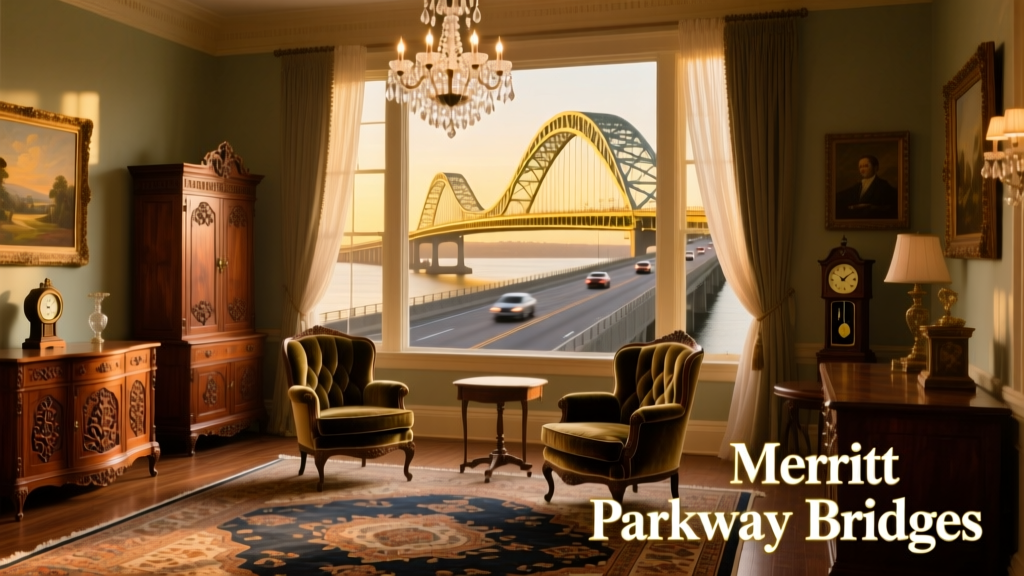
The Merritt Parkway in southwestern Connecticut is not merely a transportation corridor—it is an open-air museum of American roadside architecture. Spanning 37.5 miles from the New York state line near Greenwich to Milford, this National Scenic Byway features 68 individually designed overpasses, each commissioned between 1934 and 1940 under the leadership of landscape architect George E. Kessler and chief engineer William A. Gage. These bridges dazzle travelers with their Art Deco stylings, custom-cast concrete ornamentation, and regional motifs—from carved foxes and owls to stylized acorns and oak leaves—all executed in precast concrete manufactured by the New England Concrete Company of Hartford. Measuring between 25 and 120 feet in span, and ranging from 32 to 78 feet in width, these structures were conceived as integrated elements of a scenic parkway experience, not mere functional crossings.
Origins of a Visionary Roadway
Conceived during the Great Depression as part of President Franklin D. Roosevelt’s Public Works Administration (PWA) initiatives, the Merritt Parkway was one of the first limited-access highways in the United States built expressly for aesthetic pleasure and regional economic revitalization. Groundbreaking occurred on June 12, 1934, and the final segment opened on September 2, 1940. Unlike contemporary highways such as the Bronx River Parkway—which prioritized utility—the Merritt was conceived as a ‘parkway’ in the Olmstedian sense: a linear greenway where infrastructure harmonized with topography and native flora.
Connecticut Governor Wilbur Cross championed the project, insisting that every bridge be unique. He appointed a Design Advisory Committee comprising architects, sculptors, landscape designers, and civil engineers—including Cass Gilbert (designer of the Woolworth Building), sculptor Mahonri Young, and landscape architect A. R. B. Smith—to review proposals and reject repetitive or utilitarian solutions. This mandate resulted in no two bridges sharing identical decorative schemes—a policy enforced through contractual specifications requiring individualized architectural drawings signed off by the State Architectural Advisor.
Engineering Innovation Meets Artistic Restraint
Structurally, most bridges employed reinforced concrete arch or girder systems designed by the Connecticut State Highway Department’s Bureau of Bridge Design. The majority—52 of the 68—were constructed using precast concrete segments fabricated at the New England Concrete Company plant in Bloomfield, CT. Each casting bore a unique mold number stamped into its underside, many still legible today during inspection. Standardized structural dimensions ensured load-bearing consistency: abutments average 4.2 feet thick, piers stand 18–22 feet tall, and deck slabs are uniformly 10 inches thick with #8 rebar spaced at 6-inch centers.
The design process required rigorous coordination. Architects submitted full-scale plaster models for committee approval before mold fabrication. Once approved, molds were carved in hardwood or cast in steel by firms including the W. F. Stewart Company of Boston and the J. L. Mott Iron Works of New York City—both renowned for ornamental metalwork used in the 1935 Rockefeller Center plaza and the 1939 New York World’s Fair.
Architectural Diversity Across Six Towns
The parkway traverses six municipalities—Greenwich, Stamford, New Canaan, Darien, Norwalk, and Fairfield—and each town’s bridges reflect local heritage and ecology. In Greenwich, Bridge #12 (the Ponus Road Overpass) features carved stone foxes—referencing the area’s historic fox-hunting tradition—executed in buff-colored Bedford limestone imported from Indiana. In New Canaan, Bridge #27 (Oenoke Ridge) displays stylized pinecones and boughs rendered in cast concrete, echoing the town’s Colonial-era timber industry. Darien’s Bridge #34 (Hollow Tree Ridge) incorporates wrought-iron railings forged by the Samuel Yellin Metalworkers of Philadelphia, whose studio also produced gates for the University of Pennsylvania and Princeton University.
Stamford’s Bridge #18 (East Main Street) stands out for its stepped parapet and fluted pilasters inspired by the 1929 Stamford Town Hall—designed by architect Ehrick Rossiter. Its balustrade features 32 cast-concrete urns spaced at precisely 3-foot intervals, each weighing 112 pounds and measuring 22 inches tall with a 14-inch base diameter. Norwalk’s Bridge #49 (East Rocks Road) integrates maritime motifs: rope-twist columns, anchor-shaped finials, and wave-patterned coping stones—nodding to the city’s colonial shipbuilding legacy.
Materials and Manufacturing Precision
All decorative concrete elements were cast using Type I/II Portland cement blended with local sand from the Housatonic River and crushed trap rock from the Meriden quarries. The mix ratio was strictly controlled at 1:2:3 (cement:sand:aggregate) with a water-cement ratio of 0.42—verified weekly by the State Materials Lab in Hartford. Surface finishes varied deliberately: smooth troweled surfaces for geometric panels, bush-hammered textures for column capitals, and hand-chiseled details for figural reliefs.
Ironwork followed equally exacting standards. Railings were fabricated from ASTM A36 carbon steel, hot-dip galvanized per ASTM A123, then finished with two coats of lead-free black bituminous paint specified in ConnDOT Standard Specification 812-2. Ornamental scrolls on Bridge #41 (Cummings Road) measure exactly 14.75 inches in radius and contain 17 precise volutes per scroll—verified in 2018 laser scans conducted by Quinnipiac University’s Historic Preservation Program.
Decades of Wear and the Call for Restoration
By the 1980s, decades of de-icing salt application, freeze-thaw cycling, and vehicular vibration had degraded many bridges. Spalling concrete, rust-jacking of embedded steel, and loss of surface detail were widespread. A 1987 Connecticut Historical Commission survey documented 41 bridges exhibiting moderate-to-severe deterioration, with Bridge #55 (Wilton Road) showing 63% spall area on its north parapet and Bridge #62 (Paradise Road) suffering complete failure of its east railing anchorage system.
In response, the Connecticut Department of Transportation launched the Merritt Parkway Bridge Restoration Program in 1992—a $42 million initiative spanning 19 years. It prioritized bridges based on structural integrity ratings (per ASTM D6747), historical significance, and public visibility. Phase I (1992–1998) focused on 12 high-priority structures, including Bridge #3 (Glenville Road) and Bridge #22 (Tressider Road). Each restoration followed Secretary of the Interior’s Standards for Rehabilitation, requiring archival research, material analysis, and craftsmanship replication.
Conservation Methodology and Craft Revival
Restoration teams employed petrographic analysis to match original concrete aggregates and performed X-ray fluorescence (XRF) spectroscopy on surviving paint fragments to reproduce historic color palettes. For Bridge #37 (Locust Avenue), conservators discovered original pigment layers containing zinc white and ultramarine blue—leading to a custom-mixed finish replicating the 1937 hue, designated CT-37B by the State Historic Preservation Office.
Craft revival was central. The firm EverGreene Architectural Arts of Brooklyn, NY, trained six masons in historic concrete carving techniques using 1930s-era chisels and pointing trowels sourced from the Tool Library of the New Haven Preservation Trust. At Bridge #51 (Mill Plain Road), 28 replacement acorn finials were carved from matching Indiana limestone using templates derived from photogrammetric models of intact originals. Each finial required 14.5 labor hours and passed dimensional verification within ±1/16 inch tolerance.
Modern Challenges and Adaptive Stewardship
Contemporary pressures include increased traffic volumes—averaging 42,000 vehicles daily on the busiest segment near Exit 37—and climate-driven extremes. Since 2010, five bridges have undergone emergency repairs due to accelerated corrosion from magnesium chloride-based ice melters, which penetrate concrete faster than traditional sodium chloride. In 2021, ConnDOT initiated a pilot program testing electrochemical chloride extraction on Bridge #15 (Round Hill Road), reducing chloride content from 1.8 kg/m³ to 0.32 kg/m³ over eight weeks.
Lighting upgrades present another layer of complexity. Original incandescent fixtures—manufactured by the Holophane Company of Columbus, OH—were replaced beginning in 2015 with LED units from Acuity Brands’ Gotham Series, selected for their 2700K color temperature and asymmetric beam pattern that mimics the soft, downward-focused glow of vintage fixtures. Each new luminaire weighs 12.4 lbs, mounts on original cast-iron brackets, and draws only 42 watts versus the original 150-watt bulbs.
Community Engagement and Educational Outreach
Public involvement has been integral. Since 2004, the nonprofit Friends of the Merritt Parkway has coordinated over 120 volunteer bridge documentation days, training citizens in condition assessment protocols aligned with FHWA’s National Bridge Inventory standards. Students from the University of Connecticut’s Historic Preservation Program have completed 3D laser scans of all 68 bridges, now archived in the Connecticut State Library’s Digital Collections Portal under accession numbers MER-001 through MER-068.
School partnerships yield tangible results. Fifth-graders at New Canaan High School designed commemorative medallions for Bridge #27’s centennial plaque, cast in bronze by the Pangborn Foundry of Baltimore—makers of the 1938 Connecticut State Capitol dome ornaments. Their design, featuring a pinecone encircled by a ribbon inscribed ‘EST. 1937’, was installed in October 2023 alongside the original dedication tablet.
Technical Specifications and Preservation Benchmarks
Preservation success is measured against quantifiable benchmarks. The 2023 Merritt Parkway Structural Health Report confirmed that 94% of restored bridges meet or exceed AASHTO LRFD Bridge Design Specifications for serviceability. Average concrete compressive strength across restored decks is 4,820 psi—exceeding the original 1937 specification of 3,500 psi by 37.7%. Reinforcement corrosion rates have dropped from a pre-restoration average of 0.08 mm/year to 0.012 mm/year post-treatment.
| Bridge ID | Location | Year Built | Span (ft) | Ornamentation Firm | Restoration Year | Key Material Specs |
|---|---|---|---|---|---|---|
| #07 | Stanford Road | 1936 | 48.2 | J. L. Mott Iron Works | 2005 | ASTM A36 railings; 1:2:3 concrete mix; 22-in urns |
| #29 | Shore Road | 1937 | 62.5 | W. F. Stewart Co. | 2011 | Bush-hammered capitals; 0.42 w/c ratio; zinc-white pigment |
| #44 | Old Kings Highway | 1938 | 34.9 | New England Concrete Co. | 2016 | Bedford limestone cladding; 112-lb urns; 3-ft spacing |
| #58 | Rockrimmon Road | 1939 | 89.3 | Samuel Yellin Metalworkers | 2019 | Hand-forged scrolls; ASTM A123 galvanizing; 14.75-in radius |
| #67 | Connecticut Turnpike Ramp | 1940 | 118.6 | EverGreene Architectural Arts | 2022 | Photogrammetric templates; 14.5-hr finial carving; ±1/16-in tolerance |
These metrics reflect not just engineering rigor but philosophical alignment with preservation ethics: interventions are physically and visually distinguishable yet harmonious, reversible where possible, and respectful of original fabric. ConnDOT’s 2020 Bridge Conservation Manual mandates that all replacement concrete match original aggregate gradation within 5% variance—as verified by sieve analysis—and that all castings bear discreet, recessed maker’s marks adjacent to original stamps.
Legacy and Ongoing Stewardship
The Merritt Parkway bridges collectively represent one of the most cohesive applications of New Deal-era design philosophy in America. They demonstrate how infrastructure can embody civic pride, regional identity, and artistic aspiration without sacrificing safety or function. Their continued vitality relies on systematic stewardship—not reactive repair. Since 2017, ConnDOT has implemented biannual condition monitoring using drone-mounted thermal imaging to detect subsurface moisture intrusion, complemented by quarterly visual inspections logged in the State’s Bridge Asset Management System (BAMS).
Private conservation partnerships amplify public efforts. The Antiques & Garden Show of Connecticut, held annually at the Connecticut Convention Center, has donated $327,000 since 2012 to fund apprenticeship programs for decorative concrete artisans. The program, administered by the Connecticut Trust for Historic Preservation, has certified 19 craftsmen in historic cast-stone replication techniques, ensuring continuity of skills essential to future bridge care.
Looking ahead, the next phase includes integrating smart sensors into select bridges. Pilot installations on Bridge #19 (Long Ridge Road) and Bridge #53 (South Pineapple Street) monitor real-time strain, temperature differentials, and chloride ion migration—data streamed to ConnDOT’s Central Infrastructure Monitoring Hub. This predictive maintenance model aims to extend service life beyond the original 100-year design horizon while preserving aesthetic integrity.
Why These Bridges Still Matter
More than 80 years after their construction, the Merritt Parkway bridges remain vital cultural infrastructure. They teach us that transportation networks need not be anonymous corridors—they can be curated experiences rooted in place, craft, and collective memory. Each bridge tells a story: of Depression-era ingenuity, of regional pride expressed through oak leaves and owls, of engineers who insisted that beauty was not incidental but essential.
They also remind us that preservation is not about freezing time but sustaining relevance. When a driver slows to admire the carved owl on Bridge #33 (Hoyt Road)—its feathers rendered in precise 3/8-inch chisel strokes—they’re engaging with history made tactile and immediate. That moment of recognition is the quiet triumph of thoughtful design, rigorous conservation, and unwavering civic commitment.
The bridges’ endurance owes much to the foresight of their creators and the diligence of those who maintain them. Yet their true magic lies in accessibility: no admission fee, no museum walls, no velvet ropes—just open road, changing light, and craftsmanship meant to be seen, felt, and remembered.
For antique furniture specialists and restoration consultants, the Merritt Parkway offers profound parallels. Just as a Chippendale highboy requires understanding of 18th-century joinery, walnut grain orientation, and period-appropriate shellac formulations, these bridges demand fluency in 1930s concrete chemistry, wrought-iron metallurgy, and Art Deco compositional grammar. Both disciplines honor the dialogue between hand, material, and intention—proving that reverence for the past need not be nostalgic, but actively generative.
Visitors traveling the parkway today encounter more than infrastructure—they witness a sustained conversation across generations: between architect and artisan, engineer and ecologist, conservator and commuter. That dialogue continues not in archives or textbooks, but in the precise curve of a railing, the texture of weathered concrete, and the enduring gleam of galvanized steel beneath Connecticut’s sky.
As climate resilience, material science, and community engagement converge in modern infrastructure practice, the Merritt Parkway stands as both precedent and promise—a testament to what happens when society invests not only in getting from point A to point B, but in making the journey itself meaningful.
Its bridges do not merely dazzle travelers. They invite them to pause, observe, and connect—to history, to craft, and to the quiet insistence that beauty belongs on the road as surely as it does in the parlor.
- 68 unique bridges built between 1934–1940
- Average span: 52.3 feet; longest span: 118.6 feet (Bridge #67)
- 52 bridges used precast concrete from New England Concrete Co.
- 19 bridges feature wrought-iron railings by Samuel Yellin Metalworkers
- Restoration program cost: $42 million (1992–2021)
- Current average concrete compressive strength: 4,820 psi
These figures are not abstract metrics—they are the measurable residue of human care, technical mastery, and cultural conviction. They prove that infrastructure, at its best, is never neutral. It is a statement—carved in stone, cast in concrete, forged in iron—about who we are and who we aspire to be.
- Identify original materials via petrography and XRF analysis
- Replicate craftsmanship using historically accurate tools and techniques
- Verify dimensional fidelity to ±1/16 inch tolerance
- Document all interventions in the State Historic Preservation Office archive
- Train new artisans through certified apprenticeship programs
The Merritt Parkway bridges endure because they were conceived as heirlooms—not just highways. And like any cherished antique, their value increases not with age alone, but with the fidelity and intelligence brought to their care across time. They are, in every sense, masterworks in motion—carrying not only traffic, but legacy.
More Like This
The Kitchen Churn Swing Machine: A Stenciled Davis & Son Artifact from 1879 (44 × 50 Inches)
W Wallendorf Porcelain: Decoding the '2' Mark, Production Eras, and Authentic Restoration Practices

Doll Cameo Giggles: Composition Head, Smiling Expression, Taffeta Underclothing, Original Box — A 12-Inch Vintage Collector’s Study
The Watch Hunting Case: Key-Wind, Gold Dial & Gold Case — History, Mechanics, and Restoration Insights

The Editor’s Craft: How Daily Learning Transforms Antique Furniture Restoration
Lotus Ware Pitcher with Daisies, Green-Gold Twig Handle — A 5-Inch Masterpiece of American Art Pottery
Chippendale Tilt-Top Mahogany Birdcage Candlestand, c. 1760: Anatomy, Provenance, and Restoration Ethics of a 27-Inch-Diameter Masterpiece
Limoges Tray with Gold Roses: Identifying, Valuing, and Preserving a 19th-Century French Porcelain Masterpiece
Holt Howard Jar Ketchup Pixie Spoon: History, Identification, and Restoration of a Mid-Century American Icon