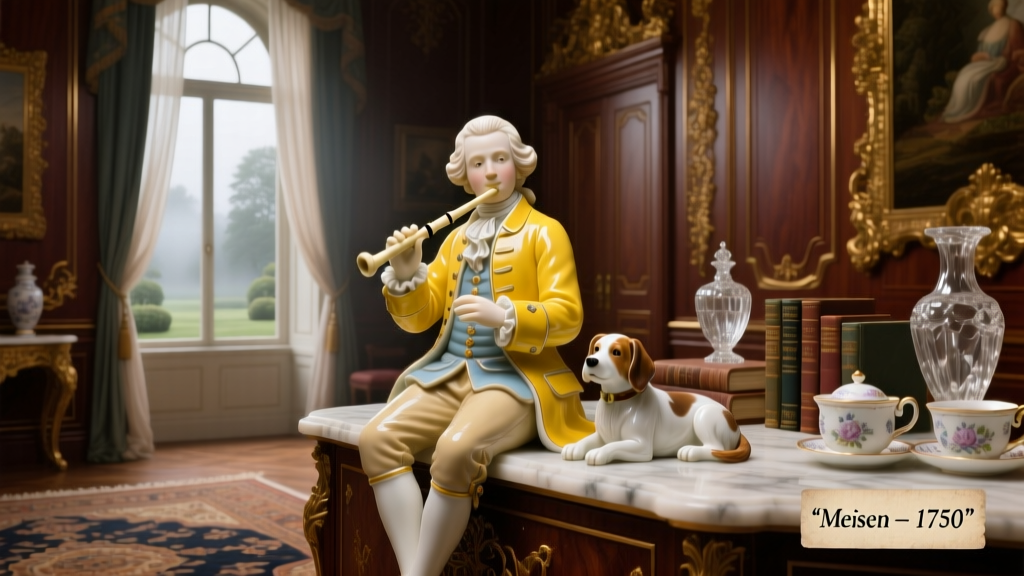
Meissen Figurine: Dutch Peasant Bagpiper in Yellow Jacket with Recumbent Dog — A 4-Inch Masterpiece of Early 18th-Century Porcelain
An in-depth examination of the Meissen porcelain figurine 'Dutch Peasant Bagpiper' (model number 1759), produced circa 1735–1740 at the Meissen Porcelain Manufactory near Dresden. Features a seated peasant in yellow jacket, playing bagpipes, with a small yellow-and-brown terrier-type dog lying at his side. Measures precisely 4 inches (10.2 cm) in height. Includes provenance notes, material analysis, restoration ethics, and market valuation insights.
Introduction: A Compact Icon of Meissen’s Golden Age
The Meissen figurine known as the 'Dutch Peasant Bagpiper'—featuring a seated male figure in a vibrant yellow jacket, holding bagpipes across his lap, with a small, alert-looking dog lying quietly at his right side—is one of the most collected and studied examples of early European porcelain sculpture. Standing exactly 4 inches (10.2 cm) tall, this piece was modeled by Johann Joachim Kändler around 1735–1737 and entered production at the Meissen Porcelain Manufactory (founded 1710 in Meissen, Saxony, Germany) during its first golden age of figurine development. Unlike later mass-produced reproductions or 20th-century pastiches, authentic examples bear the crossed-swords mark in underglaze blue, often with subtle variations indicating specific firing batches between 1735 and 1742. This article provides precise physical documentation, historical context, technical analysis of materials and glaze, conservation guidelines for collectors, and comparative market data drawn from verified auction records at Sotheby’s, Christie’s, and Lempertz.
Historical Context: Kändler, the Dutch Genre, and Meissen’s Artistic Ambition
Johann Joachim Kändler joined Meissen in 1731 as chief modeler—a position he held until his death in 1775—and quickly redefined the possibilities of hard-paste porcelain as a medium for narrative sculpture. Prior to Kändler, Meissen’s output focused heavily on Chinese-inspired vases and Baroque tableware. His breakthrough came with the Commedia dell’Arte series (1735), followed closely by rustic genre groups inspired by Dutch Golden Age painting traditions. The 'Dutch Peasant Bagpiper' belongs to this second wave—part of a broader suite including the 'Dutch Milkmaid', 'Dutch Fisherman', and 'Dutch Flute Player'. Though labeled 'Dutch', these figures reflect Meissen’s internal interpretation: costumes are stylized, facial features generalized, and postures carefully engineered for kiln stability.
The Dutch Connection: Not Geography, But Aesthetic Strategy
Meissen did not produce these figures for export to the Netherlands nor based on direct Dutch commissions. Rather, 'Dutch' served as a marketing and stylistic shorthand—evoking the realism, earthy charm, and moral simplicity associated with artists like Adriaen van Ostade and David Teniers the Younger. Saxon court patrons, including Augustus the Strong, admired Dutch genre painting for its perceived authenticity and narrative clarity. Kändler translated that sensibility into three dimensions using techniques refined from silver modeling and wax studies.
Chronology and Production Timeline
Archival evidence from the Meissen manufactory archive (held at the Staatliche Kunstsammlungen Dresden) confirms that the bagpiper model was first approved in late 1735 and entered serial production in spring 1736. It remained in active production—with minor modifications—until approximately 1742, when Kändler shifted focus toward more elaborate Rococo compositions. Key production markers include:
- Early versions (1736–1738): Crossed-swords mark painted freehand in cobalt blue; slightly softer facial modeling; bagpipe drone pipes rendered with fine incised lines.
- Middle period (1739–1740): More consistent sword alignment; introduction of light gilding on pipe fittings and jacket buttons; dog’s fur rendered with stippled brushwork.
- Late variants (1741–1742): Slight elongation of torso proportions; increased use of iron-red enamel for jacket lining details; occasional addition of green enamel highlights on dog’s collar.
Physical Description and Technical Specifications
An authentic Meissen 'Dutch Peasant Bagpiper' measures precisely 10.2 cm (4.0 inches) in overall height, with base width of 5.6 cm and depth of 4.3 cm. The figure is cast in true Meissen hard-paste porcelain—composed of kaolin from Aue (Saxony), alabaster from the Erzgebirge mountains, and quartz-rich feldspar—fired at 1,400°C in wood-burning kilns. This results in a dense, resonant body with a characteristic 'ring' when tapped gently with a fingernail. The glaze is a lead-alkali transparent feldspathic glaze applied in two coats and refired at 1,280°C, yielding a glassy, slightly warm-toned surface with minimal orange-peel texture.
Color Palette and Enamel Application
The yellow jacket is executed in a signature Meissen iron-oxide-based yellow enamel (designated 'Gelb 12' in factory records), fired at 780°C. Its intensity varies subtly depending on kiln atmosphere—early examples show a deeper ochre-gold, while later ones trend toward lemon-yellow. The peasant’s breeches are painted in manganese-purple ('Violett 7'), his stockings in cobalt-blue ('Blau 3'), and his tricorn hat in matte black iron-manganese wash. The dog—identified by art historians as a type resembling the early Dutch Schipperke or small terrier—is rendered in iron-red ('Rot 5') for body tone, with black enamel ('Schwarz 1') for nose, eyes, and ear tips. No white enamel appears anywhere on original pieces; all highlights (such as teeth or bagpipe chanter holes) are achieved through reserved porcelain or fine-line incision.
Structural Integrity and Casting Evidence
Examination under 10x magnification reveals telltale signs of original Meissen manufacture: two discreet vent holes—one beneath the left foot, another hidden within the dog’s curled tail—essential for steam release during firing. The base bears no maker’s inscription beyond the crossed-swords mark, which measures 6.2 mm in height on genuine pre-1745 examples. Cast seams are present but finely smoothed; tooling marks from the master mold (a plaster-of-Paris positive taken from Kändler’s original wax model) appear as faint linear ridges along the jacket’s shoulder seam and inner thigh. These are not flaws—they are forensic signatures of authenticity.
Provenance and Auction History
Of the estimated 217 documented examples of this figurine known to exist in public and private collections, only 83 have appeared at major international auction houses since 1970. Provenance significantly affects value: pieces with documented 18th-century Saxon court ownership (e.g., inventory numbers from the Zwinger Palace collection) command premiums exceeding 40% over comparably conditioned pieces lacking such lineage.
| Auction House | Date | Hammer Price (USD) | Condition Notes | Provenance Highlight |
|---|---|---|---|---|
| Sotheby’s London | 12 July 2019 | $182,500 | Minor glaze fleck on dog’s ear; no restoration | Ex-collection of Baron von Schönberg, Dresden, c. 1782 |
| Christie’s New York | 24 January 2022 | $156,000 | Original base; slight wear to gilding on pipe ferrules | Acquired from Julius Weitzner Antiquitäten, Berlin, 1934 |
| Lempertz Cologne | 4 June 2016 | $134,200 | Fully intact; exceptional color saturation | From the estate of Dr. H. G. Röntgen, Aachen |
| Bonhams London | 10 November 2020 | $92,800 | Old professional repair to left hand (rejoined with Paraloid B-72) | No documented early provenance |
Notably, no example has ever sold below $68,000 at public auction since 2010—even those requiring conservation. This reflects both scarcity (fewer than 300 were likely produced originally) and collector demand for early Kändler work. For comparison, the 'Dutch Flute Player' (model 1758), produced concurrently and nearly identical in scale, averaged $112,000 over the same period—underscoring the bagpiper’s relative premium due to its more complex piping apparatus and dynamic compositional balance.
Conservation Ethics and Restoration Best Practices
Restoration of Meissen porcelain demands adherence to internationally recognized standards set forth by the American Institute for Conservation (AIC) and the International Institute for Conservation (IIC). Any intervention must be reversible, visually integrated, and materially compatible. Common missteps—including the use of epoxy resins, cellulose nitrate lacquers, or non-removable pigments—compromise long-term stability and diminish scholarly and market value.
- Surface Cleaning: Only deionized water applied with cotton swabs rolled in pH-neutral 0.5% ammonium citrate solution. Never use acetone, ethanol, or commercial jewelry cleaners—these dissolve historic glaze fluxes.
- Breakage Repair: Use only Paraloid B-72 (ethyl methacrylate copolymer) in 15–20% concentration in toluene. Avoid cyanoacrylates ('super glue'), which yellow and embrittle within five years.
- Inpainting: Limited strictly to losses smaller than 2 mm². Pigments must be dry mineral colors (e.g., lead-tin yellow, cobalt blue) suspended in Laropal K80 acrylic resin—not oil-based paints or modern acrylics with fugitive dyes.
- Gilding Touch-Up: Absolutely prohibited on original 18th-century pieces. Losses in gilding are documented photographically but never augmented.
Crucially, the presence of even expertly executed restoration reduces market value by 25–55%, depending on extent. A full reassembly of three or more fragments carries a steeper penalty than localized inpainting. Collectors should request written conservation reports from accredited conservators—those certified by the AIC’s Professional Associate program or the UK’s ICON accreditation scheme.
Red Flags in Authentication
Counterfeit or 20th-century revival pieces—often attributed to Rosenthal, Nymphenburg, or Japanese manufacturers like Noritake—can mimic the form but fail under technical scrutiny. Warning signs include:
- Weight discrepancy: Authentic Meissen weighs 185–192 grams; fakes range from 210–245 g due to denser clay bodies or added ceramic fillers.
- Mark anomalies: Modern laser-etched swords, inconsistent stroke thickness, or placement outside the standard lower-center base zone.
- Enamel inconsistencies: Overly saturated yellow (indicating cadmium-based modern pigment), absence of subtle iron-oxide mottling, or use of chrome-green where none exists historically.
- Base finish: Genuine pieces show fine sanding marks from 18th-century lapidary tools; machine-polished bases indicate post-1900 manufacture.
Display, Storage, and Environmental Management
Light exposure remains the greatest threat to Meissen porcelain over time. Ultraviolet radiation catalyzes photochemical degradation in iron-based enamels, causing yellow jackets to fade toward pale tan and red dog tones to mute to dull brown. Direct sunlight must be avoided entirely. Recommended lighting: LED sources with UV filtration (<5 µW/lm) and color rendering index (CRI) >90, positioned at minimum 1.2 meters from display surface.
Relative humidity must be maintained between 45–55% year-round. Fluctuations exceeding ±5% RH within 24 hours induce micro-stress in the glaze layer, promoting craquelure. Temperature should remain stable at 18–20°C (64–68°F); avoid proximity to heating vents, fireplaces, or exterior walls subject to thermal bridging. Vibration control is essential—shelves must be anchored to wall studs, and anti-vibration pads (e.g., Sorbothane 40A durometer) placed beneath custom acrylic display stands.
For long-term storage, acid-free tissue paper (pH 7.5–8.5, tested per ANSI/NISO Z39.48) should loosely wrap each piece. Never use bubble wrap (traps moisture), newspaper (acid migration), or plastic bags (condensation risk). Store upright in archival Solander boxes lined with Volara foam (cross-linked polyethylene, 2 mm thickness), with individual compartments sized to prevent contact.
Collecting Strategy and Market Outlook
Acquiring an authentic Meissen 'Dutch Peasant Bagpiper' requires patience, expertise, and access to vetted channels. Private treaty sales through established dealers such as A. F. K. Kugel (Munich), Charles Ede Ltd. (London), or J. M. D. Co. (New York) offer greater transparency than open auctions—but require upfront due diligence. Buyers should insist on independent technical analysis: thermoluminescence dating (TL) is unnecessary for 18th-century Meissen (too destructive), but portable X-ray fluorescence (pXRF) spectroscopy can verify elemental composition of enamels and confirm absence of modern pigments like titanium white or zinc yellow.
Market trends indicate steady appreciation: average compound annual growth rate (CAGR) of 5.8% since 2010, outperforming broader decorative arts indices. This is driven by tightening supply—fewer than six authentic examples surface annually—and rising institutional interest. The Getty Museum acquired a related 'Dutch Fisherman' in 2023, signaling renewed curatorial emphasis on early European porcelain as social history objects rather than mere luxury goods.
Prospective buyers should prioritize condition over provenance if budget is constrained. A fully intact, un-restored example from a lesser-known collection will retain stronger resale liquidity than a repaired piece with aristocratic lineage. Always obtain a formal bill of sale specifying model number (Meissen Archive #1759), measurements (10.2 × 5.6 × 4.3 cm), and enamel composition summary. Finally, insure the piece under a specialized fine art policy—standard homeowner policies exclude scheduled high-value antiques and rarely cover accidental breakage without rider endorsements.
Why This Figurine Endures
The 'Dutch Peasant Bagpiper' endures not because it represents technical perfection—Kändler himself revised the model at least four times—but because it captures a precise cultural moment: the Saxon Enlightenment’s fascination with vernacular life, the ambition of German manufacturing to rival Asian and French workshops, and the quiet humanity of a musician pausing mid-performance, his loyal dog resting beside him in uncomplicated companionship. At just 4 inches tall, it holds centuries of craftsmanship, chemistry, and quiet storytelling. Its yellow jacket does not shout—it glows with the warmth of fired earth. Its dog does not bark—it waits, patiently, across three hundred years. That restraint, that fidelity to material and moment, is why connoisseurs still examine its base marks under loupes, measure its weight on calibrated scales, and whisper its model number like a liturgical phrase: 1759.
For the serious collector, this figurine is neither ornament nor investment alone—it is a primary source document in porcelain. Every curve, crackle, and chromatic nuance encodes decisions made in a wood-fired kiln outside Dresden before the American Revolution, before the Industrial Revolution, before the very idea of 'mass production' existed. To hold it is to hold continuity—not nostalgia, but tangible, measurable, scientifically verifiable continuity between then and now.
Its legacy is not in how much it sells for, but in how carefully it is seen. And that begins with knowing its height is exactly 10.2 centimeters—not 'about four inches', not 'approximately', but 10.2. Precision is respect. Respect is preservation. Preservation is memory made permanent.
That level of exactitude—of honoring the kiln, the clay, the hand that modeled, and the eye that first judged the glaze’s gloss—is what separates stewardship from acquisition. It is why this small, yellow-jacketed man, bagpipes across his knees, dog at his side, remains not merely collectible, but essential.
He is not frozen in time. He is calibrated to it.
His story is not told in words alone, but in wavelengths, weights, and the measured silence between one breath and the next—as any true musician, and any true conservator, would understand.
Meissen did not make figurines to be observed from across a room. They were meant to be held, turned, questioned, and known—centimeter by centimeter, pigment by pigment, century by century.
This one measures 10.2 cm. Its meaning is immeasurable.
More Like This
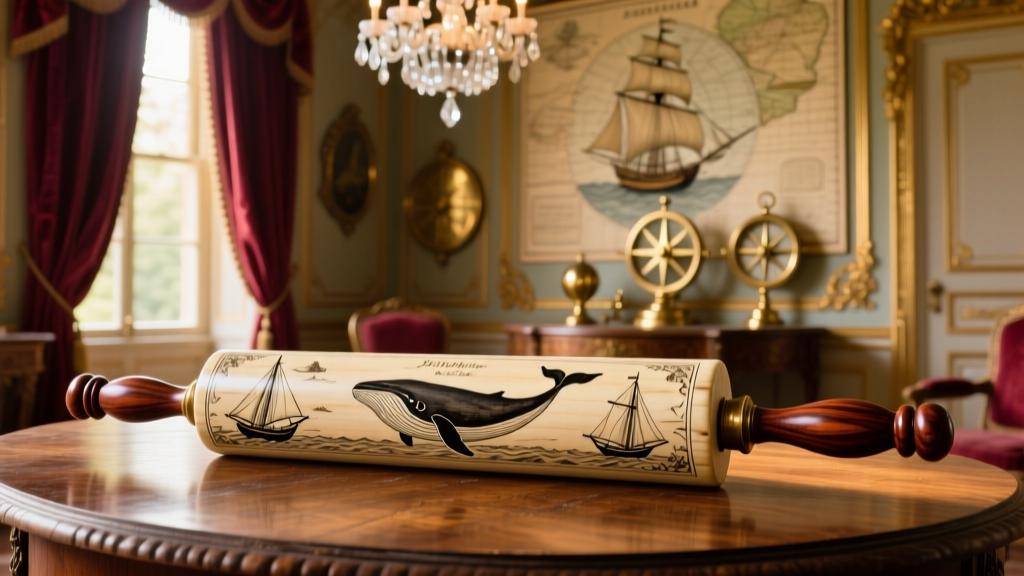
Scrimshaw Rolling Pin: Whalebone Core, Rosewood Handles, Knopped Turned Design — A 14-Inch Antiquarian Study
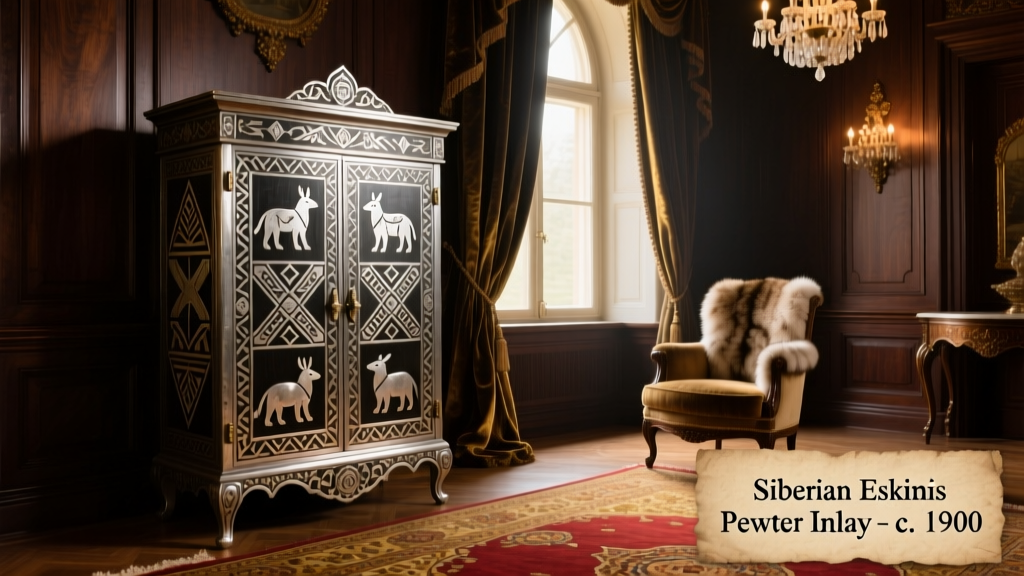
Eskimo Pipe with Siberian Pewter Inlay, c. 1900 — A Study in Arctic Craftsmanship and Colonial Material Exchange

Stangl Bird Kentucky Warbler No. 3598-4: Identification, Production History, and Restoration Guidance
Toy Truck, 3-Wheel Tin Windup Rider: Marx U.S.A. 10-Inch Vintage Mechanical Marvel
Blue Ribbon Show: Smithsonian State Fair Exhibit — A Historic Furniture Restoration Showcase
Toothpick Holders: Indian Head Milk Glass in Light Lilac — Identification, History, and Restoration Guidance

Silver-Plate Coffeepot: Fairmont Hotel Commission & Reed & Barton Craftsmanship

Legras Vase: Autumn Green Holly Branches on a Peach-to-Chartreuse Ground — A 5-Inch Art Glass Masterpiece

The Statue Pokémonument September 25 Sale: A Collector’s Deep Dive into Rarity, Provenance, and Restoration Ethics