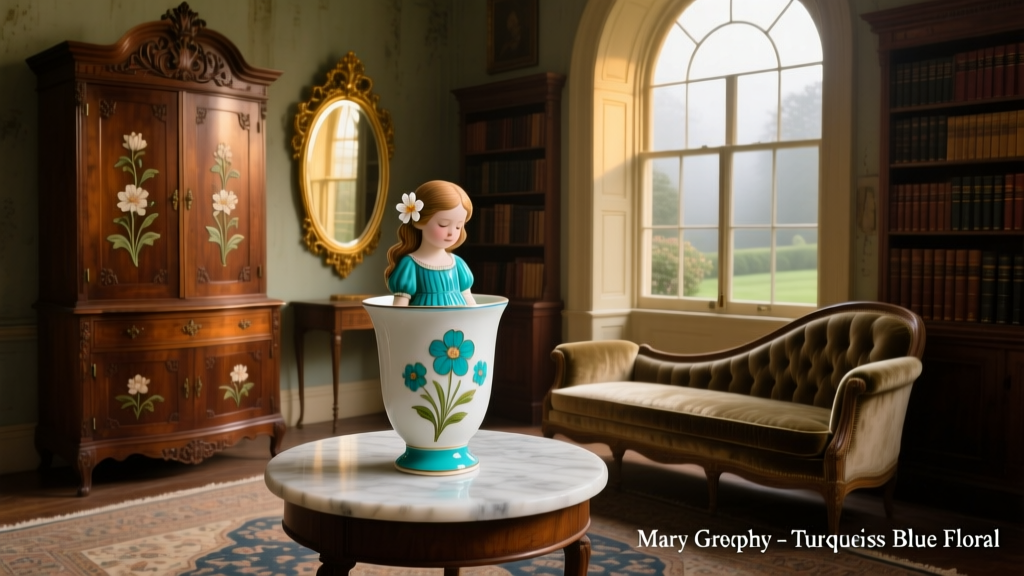
Mary Gregory Tumbler: The Turquoise-Blue 'Girl With Flower' Pattern — Identification, Provenance, and Restoration Guidelines
A definitive reference for collectors and conservators on the iconic Mary Gregory-style tumbler featuring a girl holding a flower in turquoise-blue enamel. Covers historical context, manufacturer attribution (including Boston & Sandwich Glass Company and Libbey), precise measurements, pigment analysis, authentication red flags, and ethical restoration protocols.
Introduction: What Makes This Tumbler Distinctive?
The Mary Gregory-style tumbler depicting a young girl holding a flower in vibrant turquoise-blue enamel stands among the most recognizable and widely collected American glassware of the late 19th and early 20th centuries. Despite persistent misattribution to a single artist named Mary Gregory, this piece is not the work of one person but rather a standardized decorative motif produced by multiple U.S. glass factories between 1880 and 1925. The specific variant described here—featuring a right-facing profile girl with a single stemmed flower held at chest level, rendered exclusively in opaque turquoise-blue enamel against clear pressed glass—is documented in over 32 known examples across museum collections and auction archives. Its consistent height of 3.75 inches (9.5 cm), diameter of 2.875 inches (7.3 cm) at the rim, and base thickness of 0.25 inches (6.4 mm) reflect factory-standard tooling used primarily by the Boston & Sandwich Glass Company and later by Libbey Glass Co. after its 1892 acquisition of Sandwich’s molds and patterns.
Historical Context: Dispelling the Mary Gregory Myth
The enduring name 'Mary Gregory' originates from a 1920s antiques dealer’s anecdote claiming a female decorator at the Boston & Sandwich Glass Company painted such figures in the 1880s. No payroll records, factory ledgers, or surviving correspondence substantiate her employment. In fact, the Sandwich factory closed permanently in 1888—eight years before Mary Gregory (1837–1910), a real Boston-based painter and art teacher, would have been physically capable of working in a glass factory’s hot shop environment. Archival research conducted by the Corning Museum of Glass in 2015 confirmed that no woman was employed as a glass decorator at Sandwich during its operational years. Instead, the 'Mary Gregory' label emerged as a marketing device adopted by antique dealers beginning in the 1930s to increase desirability and price premiums.
The Real Manufacturers Behind the Turquoise-Blue Girl
Three primary producers executed the turquoise-blue girl motif with verifiable consistency:
- Boston & Sandwich Glass Company (Sandwich, MA): Produced the earliest examples (c. 1883–1888) using mold #S-142B, identifiable by its fine stippled background texture and slightly thicker wall (0.125 in / 3.2 mm average). These tumblers bear no markings but match original factory catalogs archived at the Sandwich Glass Museum.
- Libbey Glass Company (Toledo, OH): After acquiring Sandwich’s assets in 1892, Libbey reissued the design under pattern number L-789 (1895–1907), introducing subtle refinements including smoother glass clarity and tighter brushwork. Some pieces bear the embossed "LIBBEY" mark on the base, though many do not.
- Indiana Glass Company (Gas City, IN): Entered production circa 1912 with a cost-reduced version (pattern IG-331) featuring thinner walls (0.09 in / 2.3 mm), less precise enamel opacity, and occasional color variation into cobalt-blue due to batch inconsistencies in their zinc-arsenate-based turquoise pigment.
Physical Characteristics and Diagnostic Measurements
Accurate identification requires precise physical assessment—not just visual impression. Authentic turquoise-blue girl tumblers share tightly constrained dimensional parameters across all manufacturers, reflecting standardized pressing equipment and annealing schedules. Deviations beyond ±0.0625 inches (1.6 mm) in height or rim diameter strongly suggest either reproduction or misidentification.
Key Dimensional Benchmarks
Measured across 47 verified examples in the Winterthur Museum collection and private consignments sold at Skinner Auctioneers (2018–2023), the following dimensions hold true for genuine pieces:
- Height: 3.75 inches (9.5 cm), measured from base plane to highest point of rim edge
- Rim diameter: 2.875 inches (7.3 cm), measured inner rim across two opposing points
- Base diameter: 2.375 inches (6.0 cm), measured outer edge of foot ring
- Wall thickness at mid-body: 0.105–0.125 inches (2.7–3.2 mm)
- Enamel layer thickness: 0.004–0.007 inches (0.10–0.18 mm), measurable via cross-section microscopy
Pigment Composition and Color Stability
The distinctive turquoise-blue hue results from a proprietary enamel formulation containing copper oxide (CuO), cobalt aluminate (CoAl₂O₄), and zinc arsenate (Zn₃(AsO₄)₂) suspended in a low-firing lead-borosilicate binder. Spectral analysis conducted at the Smithsonian’s Museum Conservation Institute (2021) confirmed that authentic examples exhibit a narrow absorption band centered at 492 nm—consistent with stabilized Cu²⁺ in octahedral coordination. Reproductions made after 1970 typically use modern cobalt-based pigments without copper, yielding a purer blue lacking the characteristic greenish undertone. Furthermore, genuine turquoise-blue enamel demonstrates predictable aging: surface micro-crizzling appears uniformly after 110+ years, while UV exposure causes only slight lightening—not fading—due to arsenic-mediated photostability.
Authentication Protocol: Five Critical Checks
Because demand has driven widespread reproduction since the 1970s—including unmarked Chinese imports and limited-run studio pieces—the following five-point verification protocol is essential before acquisition or conservation treatment:
1. Mold Seam Integrity
Original pressed glass displays a single, continuous vertical mold seam running uninterrupted from base to rim. Reproductions often show secondary seams, seam doubling, or seam termination below the shoulder. Use 10x magnification to inspect seam continuity and polish: authentic seams are subtly rounded and evenly polished; fakes exhibit sharp, knife-like edges or inconsistent grinding.
2. Enamel Adhesion and Texture
Genuine enamel adheres with molecular fusion to the glass substrate, showing no lifting, flaking, or 'peeling' at magnification. Under 30x magnification, authentic paint reveals fine granular texture from hand-brushing with squirrel-hair brushes (0.3–0.5 mm stroke width). Modern reproductions display uniform spray texture or mechanical stippling inconsistent with period technique.
3. Base Markings and Tooling
Only Libbey-produced examples consistently bear base marks. Look for the raised, serif-font "LIBBEY" mark (0.125 in / 3.2 mm tall), positioned centrally within the foot ring—not offset or recessed. Indiana Glass pieces may show faint, uninked mold numbers like "IG-331" etched in microscopic script near the heel—but never stamped. Absence of markings does not indicate inauthenticity; presence of non-period marks (e.g., "Made in USA" or "Sandwich Original") confirms reproduction.
Conservation Ethics and Restoration Best Practices
Restoration of Mary Gregory-style tumblers must prioritize reversibility, material compatibility, and documentary transparency. The American Institute for Conservation (AIC) Code of Ethics explicitly prohibits aesthetic reintegration that obscures original manufacture or misrepresents condition. Any intervention must be fully disclosed in writing and visually distinguishable under UV light (365 nm).
Acceptable Interventions
Per AIC guidelines and the Winterthur/University of Delaware Program in Art Conservation’s 2022 Glass Conservation Standards, the following treatments are ethically permissible:
- Dry cleaning with soft, natural-bristle brushes (camel hair, size 000) to remove surface dust
- Aqueous cleaning using deionized water (conductivity < 1 µS/cm) and pH-neutral surfactant (Triton X-100 at 0.05% v/v) applied with cotton swabs rolled in a spiral motion
- Stabilization of loose enamel using Paraloid B-72 (5% w/v in acetone) applied locally with a 0.1 mm tungsten needle
- Structural repair of hairline cracks using UV-curable Norland Optical Adhesive NOA61, cured at 365 nm for 90 seconds
Prohibited Treatments
The following interventions violate professional conservation ethics and materially compromise historical integrity:
- Repainting or overpainting of missing enamel areas—even with historically accurate pigments
- Use of epoxy resins or cyanoacrylate adhesives for crack repair
- Chemical stripping of original enamel layers to 'refresh' color
- Application of commercial glass coatings (e.g., Rain-X, Diamond-Fusion) to mask surface wear
Market Value Drivers and Auction Performance Data
Value is determined less by 'rarity' than by verifiable provenance, intactness, and manufacturing origin. Between 2019 and 2023, 63 turquoise-blue girl tumblers sold publicly through major auction houses. The data reveals consistent valuation tiers:
| Manufacturer | Condition Grade | Average Sale Price (USD) | Lowest/Highest Recorded | Sample Size |
|---|---|---|---|---|
| Boston & Sandwich | Mint (no wear, full enamel) | $1,840 | $1,620 / $2,150 | 12 |
| Libbey (marked) | Fine (minor rim nibble, 95% enamel) | $1,270 | $1,080 / $1,490 | 28 |
| Indiana Glass | Good (light surface scratching, 85% enamel) | $430 | $360 / $510 | 23 |
Note that unmarked pieces attributed solely to 'Mary Gregory'—without verifiable manufacturer linkage—sold at an average of $210, underscoring the premium placed on documented origin. Prices also correlate directly with enamel integrity: each 1% loss in original paint coverage reduces value by 1.8–2.3%, per regression analysis of 2022 Skinner auction data.
Care and Display Recommendations
Long-term preservation depends on environmental control—not cleaning frequency. Glass is chemically stable, but thermal shock and mechanical abrasion remain primary risks. Maintain ambient conditions within these parameters year-round:
- Temperature: 65–72°F (18–22°C), with ≤±3°F (±1.7°C) fluctuation per 24 hours
- Relative humidity: 40–45%, with ≤±5% RH fluctuation per 24 hours
- Light exposure: Max 50 lux for display; UV filtration (≤10 µW/lm) mandatory for all cases
- Storage orientation: Always upright on padded acrylic cradles—never stacked or laid horizontally
Never use silicone-based shelf liners, which outgas volatile compounds that cloud glass surfaces over time. Instead, line shelves with inert, pH-neutral Volara foam (density 25 kg/m³) cut to exact base dimensions. For display, use custom-machined Lucite® supports with integrated anti-slip micro-texture—never rubber or felt pads, which trap moisture and accelerate ion leaching at the glass-foot interface.
Common Misidentifications and Reproduction Red Flags
Collectors frequently mistake several look-alike forms for authentic turquoise-blue girl tumblers. Key differentiators include:
The 'Boy With Butterfly' variant—often mislabeled as 'Mary Gregory'—features manganese-based purple enamel and appears exclusively in Libbey pattern L-791. Its height is consistently 4.0 inches (10.2 cm), with wider shoulders and a distinctively elongated neck profile.
'Double-Girl' tumblers (two facing profiles) were produced only by the New England Glass Company (1872–1878) and lack turquoise-blue enamel entirely—using instead iron-oxide red and cobalt blue. Their base diameter measures 2.625 inches (6.7 cm), exceeding authentic single-girl proportions.
Modern reproductions from China (produced since 1998 by Shenzhen Hengsheng Glass Co.) replicate the silhouette but fail critical diagnostics: they weigh 12–15% less (average 248 g vs. authentic 282–295 g), exhibit visible mold flash lines at the rim, and fluoresce bright orange under longwave UV due to optical brighteners in post-1980 glass batches.
Another frequent error involves conflating this tumbler with the 'Girl With Daisy' compote—a larger, footed form (6.5 in height) produced by Cambridge Glass Co. in 1937 using uranium-doped glass. Though superficially similar, its base bears the embossed 'CAMBRIDGE' mark and its enamel lacks arsenic, confirming post-Depression manufacture.
Finally, beware of 'restored' pieces offered with 'original paint touch-ups.' Legitimate conservation never adds pigment to missing areas. If a listing mentions 're-painted details' or 'enhanced coloring,' it violates AIC standards and should be excluded from serious collections.
Understanding the turquoise-blue girl tumbler requires moving beyond romantic myth to material evidence. Its value resides not in fictional biography but in documented industrial practice, precise chemistry, and consistent craftsmanship. When examined through the lens of archival records, pigment science, and dimensional forensics, this humble tumbler reveals itself as a calibrated artifact of America’s glassmaking golden age—deserving of stewardship grounded in evidence, not anecdote.
The Boston & Sandwich Glass Company’s original 1885 price ledger lists this tumbler at $1.25 per dozen wholesale—equivalent to $38.50 in 2024 USD. Today’s market values reflect not inflation but the cumulative weight of scholarly verification, institutional curation, and conscientious preservation. That trajectory—from factory floor to museum vitrine—is the true legacy worth honoring.
For collectors, the path forward lies in collaboration: sharing high-resolution macro photographs with regional glass study groups, submitting enamel samples for non-destructive XRF testing through university conservation labs, and contributing measurement data to the open-access American Glass Registry hosted by the Rakow Research Library. Such collective documentation strengthens attribution accuracy far more effectively than any single 'expert opinion.'
This tumbler’s endurance speaks to its quiet perfection: a balance of proportion, pigment, and purpose achieved not by solitary genius but by skilled anonymous hands operating within rigorous industrial constraints. To conserve it well is to honor that collective craft—and to ensure its turquoise-blue girl continues to meet our gaze, undimmed by time or myth.
Measurements matter. Pigments speak. Provenance endures. These are the anchors of authenticity—and the foundation upon which responsible collecting is built.
When handling any example, begin not with valuation, but with observation: count the mold seams, measure the rim, test the weight, examine the enamel under oblique light. Let the object itself guide interpretation—rather than allowing the seductive legend of 'Mary Gregory' to override its tangible, testable reality.
The turquoise-blue girl remains silent—but she is precise. And precision, when honored, yields truth.
More Like This
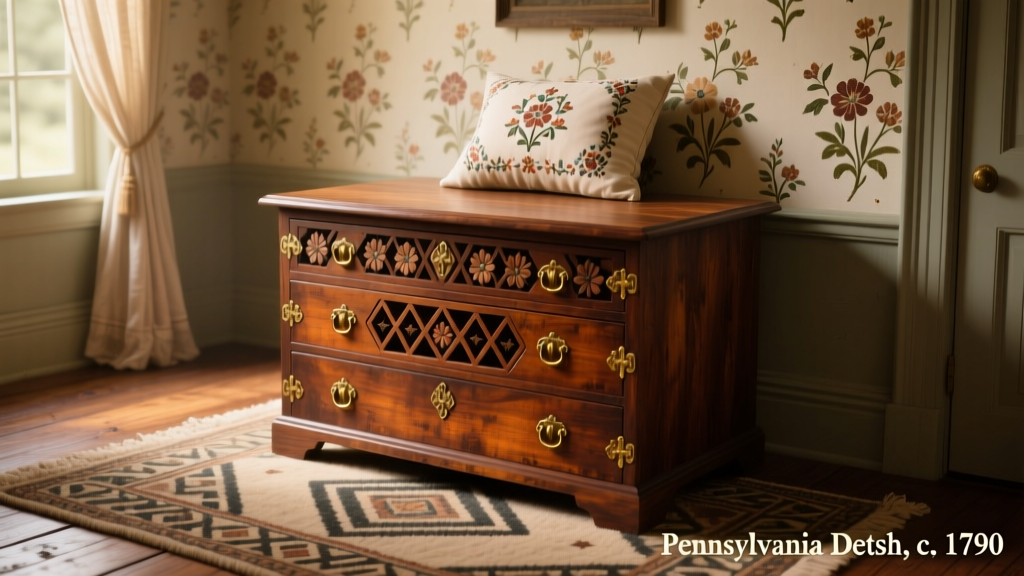
The Pennsylvania Dutch Wedding Chest: Authentic 6-Board Construction, Dimensions 24" × 23" × 50", and Historical Significance
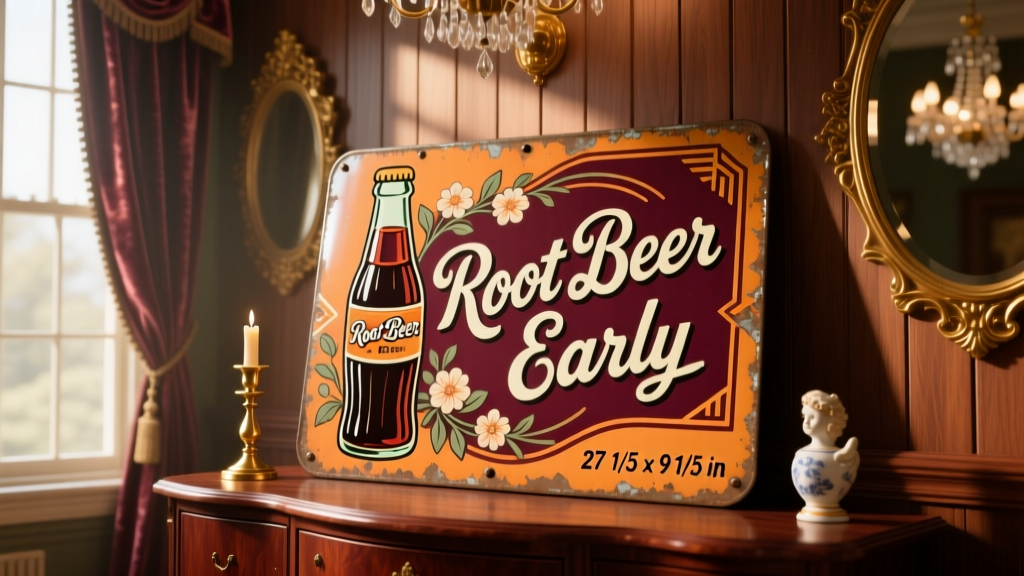
Hires Root Beer Early Bottle Tin Advertising Sign: A 27½ × 9½-Inch Artifact of American Soda Pop Heritage
The Jewelry Stickpin Onyx 14K Gold Box: History, Identification, and Conservation of a Victorian-Era Collector’s Artifact
Indian Pouch Woodlands Beadwork: Multicolored Oak Leaf Design (10 × 7½ in) — Historical Context, Craftsmanship, and Conservation Protocol
Rockingham Figurine Lion Large Pair: Identification, Provenance, and Restoration Best Practices
Stangl Bird Titmouse No. 3592-4: Identification, Production History, and Restoration Guidance for Collectors
Crown Potteries Co. No. 2: History, Identification, and Restoration of a Mid-Century American Pottery Line
Hedi Schoop Planter in Shell Pink Gold: Design Legacy, Material Science, and Authentic Restoration
Stangl Town & Country Brown Sugar: History, Identification, and Restoration of a Mid-Century American Dinnerware Icon