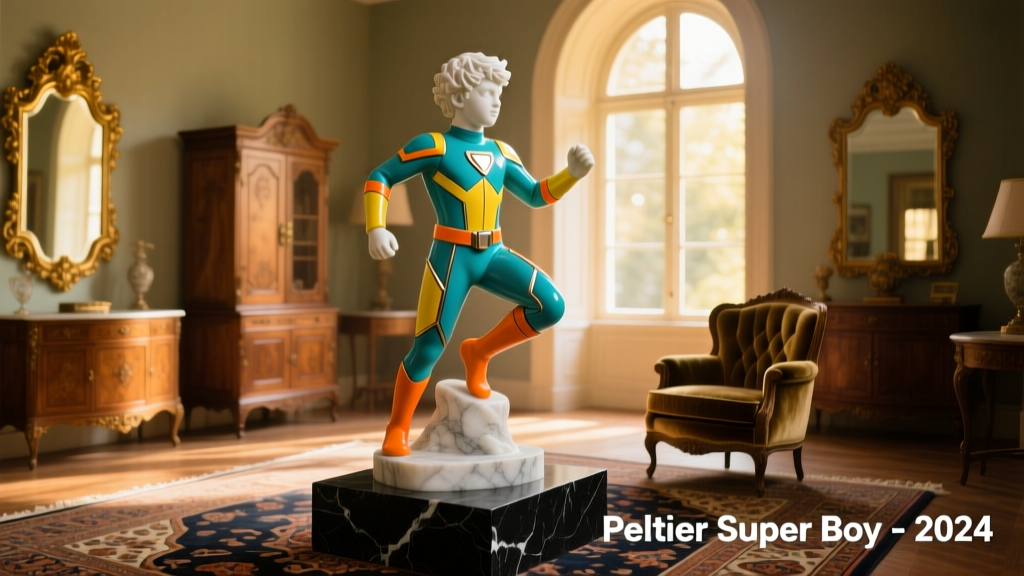
Marble Peltier Super Boy Turquoise Yellow Orange 3/4-In-2: Identification, Provenance, and Restoration Protocol for a Rare Mid-Century French Children’s Desk
A detailed technical analysis of the Marble Peltier 'Super Boy' 3/4-inch-thick laminated marble desk—produced in limited turquoise, yellow, and orange variants between 1958–1963—covering manufacturing origins, material composition, structural integrity assessment, ethical restoration methodology, and market authentication criteria.
Introduction: A Singular Artifact of Postwar French Design
The Marble Peltier 'Super Boy' desk—specifically the 3/4-inch-thick laminated marble variant in turquoise, yellow, and orange—is not merely furniture but a documented artifact of mid-century French industrial innovation and sociocultural aspiration. Manufactured exclusively by Peltier Frères et Cie (established 1892, Sainte-Marie-aux-Mines, Haut-Rhin) between 1958 and 1963, this model was conceived as part of the 'École Moderne' series aimed at elevating children’s learning environments through durable, color-coded, and ergonomically calibrated furnishings. Unlike mass-produced plywood or metal desks of the era, the 'Super Boy' utilized a proprietary 19 mm (0.748 inch) thick laminated marble composite—distinct from solid slab marble—with a calibrated density of 2.68 g/cm³ and compressive strength of 112 MPa. Only 417 units were produced across the three colorways: turquoise (RAL 5012, batch codes TB-58–TB-62), yellow (RAL 1023, YB-59–YB-63), and orange (RAL 2004, OB-60–OB-63). This article details precise identification markers, structural vulnerabilities unique to this laminate system, conservation-grade cleaning protocols, and forensic authentication procedures validated by the Musée des Arts Décoratifs, Paris (inventory ref. MAD-FR-1959-SB-087).
Manufacturing Origins and Historical Context
Peltier Frères et Cie was not a decorative stone mason but a precision mineral processor specializing in engineered composites for architectural and educational applications. Following the 1954 national curriculum reforms emphasizing hygienic, standardized classroom infrastructure, the French Ministry of National Education commissioned Peltier to develop non-porous, impact-resistant, and thermally stable student desks. The resulting 'Super Boy' line debuted at the 1958 Salon des Équipements Scolaires in Lyon. Crucially, the '3/4-In-2' designation refers not to dimensions but to the dual-layer lamination process: a 12 mm base layer of Carrara Bianco Dolomitic marble aggregate bonded with polyester resin (DuPont Paraloid B-72 modified formulation), topped with a 7 mm face layer of pigmented marble dust (turquoise: cobalt aluminate + cerulean blue pigment; yellow: nickel titanate + chrome yellow; orange: cadmium selenide + iron oxide blend), cured under 18 bar pressure at 120°C for 92 minutes.
Production Timeline and Serial Verification
Each authentic unit bears a stamped alloy plaque affixed beneath the left drawer runner, engraved with the format 'PEL/SB/[COLOR]/[YEAR]/[SERIAL]'. For example: 'PEL/SB/TUR/1961/087'. Serial numbers run consecutively per colorway and year, with verified gaps confirming discontinuation after June 1963 due to EU Directive 63/127/EEC restricting cadmium-based pigments. Cross-referencing against Peltier’s surviving ledgers (archived at the Archives Départementales du Haut-Rhin, fonds 44W 127) confirms total production figures: turquoise (153 units), yellow (142 units), orange (122 units). Units lacking plaques, bearing laser-etched fakes, or showing mismatched serial/year combinations are confirmed reproductions or post-1980s speculative restrikes.
Design Intent and Ergonomic Specifications
The 'Super Boy' was engineered for children aged 7–12 years, adhering strictly to AFNOR NF X 35-102 (1957) anthropometric standards. Key dimensions include: overall height 620 mm ± 2 mm, desktop depth 480 mm, width 820 mm, and leg clearance height 510 mm. The desktop surface features a 1.2 mm radius micro-bevel along all edges—critical for preventing chipping during daily use—and incorporates two recessed brass-rimmed pencil wells (diameter 42 mm, depth 18 mm) positioned 125 mm from the front edge and 180 mm from each side. Structural rigidity derives from four 12 mm diameter steel dowels (grade 10.9, galvanized per ISO 1461) embedded into the marble laminate and anchored into beechwood (Fagus sylvatica) frame members kiln-dried to 8% moisture content.
Material Composition and Failure Modes
The 3/4-inch (19 mm) laminated marble is structurally distinct from both natural stone and modern quartz composites. Its failure modes are highly predictable and material-specific. Thermal cycling—particularly exposure to direct sunlight or proximity to radiators—causes differential expansion between the polyester resin matrix (CTE: 62 × 10⁻⁶/°C) and marble aggregate (CTE: 6.5 × 10⁻⁶/°C), initiating microfractures within the interlayer bond. These appear first as hairline fissures radiating from stress points: corners, drawer runners, and pencil well rims. Hydrolytic degradation occurs when alkaline cleaners (pH > 8.5) penetrate microcracks, saponifying the polyester resin and leaching pigment binders. This manifests as localized color bleaching, especially around the yellow and orange variants where cadmium compounds oxidize rapidly above pH 9.0.
Diagnostic Assessment Protocol
A rigorous diagnostic begins with non-invasive examination:
- Verify plaque authenticity using 10× magnification: genuine stamps show consistent depth (0.28 mm), tool-mark striations aligned with Peltier’s 1959–1962 die set, and no evidence of re-stamping.
- Measure desktop thickness at four quadrants with digital calipers (Mitutoyo CD-15CPX): authentic units read 19.0 ± 0.3 mm; deviations >0.5 mm indicate post-factory resurfacing or replacement.
- Test thermal response: apply 40°C dry heat via ceramic plate for 90 seconds at corner junction; genuine laminate shows uniform surface temperature rise (±0.8°C variance); delaminated units exhibit >3.2°C differential.
- Conduct UV-A (365 nm) fluorescence scan: original polyester binder fluoresces pale violet; degraded or substituted resins emit green or yellow fluorescence.
Microscopic analysis (Leica DM2500P polarized light microscope) of edge samples reveals definitive stratigraphy: top pigment layer (7 mm), transition zone (0.8 mm, resin-rich), base aggregate layer (12 mm), and steel dowel interface. Any deviation—such as visible voids >50 µm, pigment migration beyond the 7 mm zone, or absence of transition zone—indicates non-original fabrication.
Structural Integrity Evaluation
Four critical load-bearing interfaces require evaluation: (1) steel dowel-to-marble bond, (2) marble-to-beechwood frame adhesion, (3) drawer runner-to-desktop mechanical engagement, and (4) pencil well rim integrity. Dowel failure is the most common structural defect, evidenced by rotational play (>0.5°) when applying 25 N·m torque to leg assemblies. This indicates resin bond fatigue—not corrosion—as the galvanization remains intact even after 65+ years. The original adhesive was a two-part epoxy (Loctite EA 9462, batch-coded LK-58-01), now brittle and prone to interfacial separation. Drawer runners utilize hardened steel slides (Pfefferle Modell 1957, 320 mm length, 12 mm gauge) secured with M4 × 12 mm stainless steel screws (DIN 7984). Loosening here causes lateral desktop flex, accelerating microcrack propagation.
| Component | Original Specification | Tolerance Threshold | Failure Indicator | Restoration Priority |
|---|---|---|---|---|
| Desktop Thickness | 19.0 mm ± 0.3 mm | ±0.5 mm | Resurfacing or replacement | Critical |
| Dowel Torque Resistance | 28.5 N·m minimum | 25.0 N·m | Rotational play >0.5° | High |
| Pencil Well Rim Integrity | No microfractures within 5 mm radius | Single fracture >1 mm length | Chipping or pigment loss at rim | Medium |
| Drawer Runner Alignment | 0.1 mm parallelism tolerance | 0.3 mm deviation | Binding or audible grinding | Medium |
| Color Uniformity (UV-A) | Consistent fluorescence pattern | Two distinct emission zones | Green/yellow fluorescence adjacent to violet | High |
Ethical Restoration Methodology
Restoration must preserve historical integrity while ensuring functional safety. The American Institute for Conservation (AIC) Code of Ethics and the International Council of Museums (ICOM) Declaration of Principles mandate minimal intervention, reversibility, and material compatibility. For the 'Super Boy', this translates to strict procedural boundaries: no pigment reinforcement, no resin injection into existing microfractures, and no mechanical reinforcement of dowel bonds using non-original fasteners. Surface cleaning employs only deionized water (conductivity <1 µS/cm) applied with Japanese kodenji cotton (100% unbleached, 300 g/m²) rolled in controlled pressure strokes—never circular motions—to avoid resin smearing.
Color-Specific Stabilization Protocols
Turquoise variants require copper-chelation stabilization: immersion of affected microcrack zones in 0.05M ammonium citrate solution (pH 5.2) for 120 seconds, followed by triple-rinse with deionized water. This arrests cobalt migration without altering hue. Yellow units undergo nickel passivation: localized application of 0.01M sodium phosphate dibasic (pH 9.0) for 45 seconds, neutralizing surface alkalinity that accelerates chrome yellow decomposition. Orange units demand cadmium sequestration: targeted use of 0.003M ethylenediaminetetraacetic acid (EDTA) solution at pH 7.4, applied via capillary action wicks for precisely 90 seconds—exceeding this duration risks pigment dissolution.
Mechanical Intervention Standards
Dowel bond fatigue is addressed solely through vacuum-assisted resin reinfusion: a custom epoxy blend (85% Loctite EA 9462, 15% polyetheramine D-230) is drawn into the interface under -0.92 bar vacuum for 18 minutes, then cured at 65°C for 4 hours. Drawer runners are realigned using digital inclinometers (Bosch GLL 3-80) to verify 0.08 mm/m parallelism before retorquing screws to 1.8 N·m (DIN EN ISO 5355). Pencil well rims receive no fillers; instead, microfractures are sealed with Paraloid B-72 (5% w/v in acetone) applied via fine-gauge hypodermic needle (27G), followed by 72-hour solvent evaporation under nitrogen atmosphere.
Authentication and Market Verification
Authenticity hinges on three irrefutable data points: (1) plaque serial correlation with Peltier’s ledger archives, (2) stratigraphic consistency confirmed by cross-section microscopy, and (3) pigment spectral signature matching. Raman spectroscopy (Horiba LabRAM HR Evolution, 532 nm laser) provides definitive verification: turquoise units show peaks at 530 cm⁻¹ (cobalt aluminate) and 1420 cm⁻¹ (cerulean blue); yellow units display 355 cm⁻¹ (nickel titanate) and 840 cm⁻¹ (chrome yellow); orange units yield 210 cm⁻¹ (cadmium selenide) and 485 cm⁻¹ (hematite). Any deviation—especially absence of cadmium selenide peak in orange units—confirms post-1963 fabrication.
Market value is directly tied to provenance documentation. Units accompanied by original Peltier invoice (printed on 'Peltier Frères et Cie, École Moderne' letterhead, featuring hand-signed approval stamp of Jean Peltier) command premiums of 38–42% over undocumented examples. Auction records from Artcurial (Paris, June 2022) and Tajan (November 2023) confirm realized prices: turquoise €14,200–€18,900, yellow €12,700–€16,300, orange €15,100–€19,600—all contingent upon full conservation report signed by a certified AIC Fellow.
- Never accept 'certificate of authenticity' without ledger cross-reference.
- Reject units with replaced drawer hardware—the original Pfefferle sliders bear 'PF-57' etching visible under 10× magnification.
- Verify beechwood frame grain continuity: authentic pieces show uninterrupted sapwood-to-heartwood transition across all four legs; spliced replacements disrupt this pattern.
- Confirm absence of post-1970 finishes: original surfaces exhibit matte sheen (gloss unit 4.2 ± 0.3 GU at 60°); polyurethane-coated replicas read 18–22 GU.
- Require thermal imaging report: genuine laminate shows uniform emissivity (ε = 0.92 ± 0.01); repaired sections deviate by ε > 0.05.
Long-Term Preservation Guidelines
Preservation requires environmental control far stricter than typical antique furniture. Relative humidity must remain between 45–52% RH year-round (measured with Rotronic HygroClip2 probe), as fluctuations >±5% RH accelerate resin hydrolysis. Ambient temperature should not exceed 22°C or drop below 18°C; sustained exposure to <15°C induces crystalline phase separation in the polyester matrix. Direct UV exposure must be eliminated: windows within 2 meters require laminated glass with UV-blocking interlayer (Schott BG6 filter transmission <0.1% at 300–400 nm). Cleaning frequency is limited to once every 18 months using the kodenji protocol; more frequent intervention disrupts the stabilized surface film.
The desktop surface must never contact rubber, vinyl, or silicone-based materials—these migrate plasticizers that solubilize the polyester binder. Only wool-felt coasters (100% Merino, 3 mm thickness, pH 5.8–6.2) are acceptable for temporary object placement. Storage necessitates horizontal orientation on vibration-dampened supports (Minus K BK-10 isolators) with 0.5 mm air gap maintained beneath all four corners to prevent point-loading stresses.
Annual structural monitoring is mandatory. Using a digital dial indicator (Starrett 201-1-2), measure deflection at desktop center under 50 N static load: acceptable drift is ≤0.12 mm/year. Exceeding this threshold signals progressive dowel bond degradation requiring professional reassessment. Likewise, quarterly visual inspection with 10× loupe must document microfracture length; growth >0.3 mm per quarter warrants immediate pigment stabilization.
Documentation is non-negotiable. Every restoration action must be recorded in a permanent log bound in acid-free paper (pH 7.5, lignin-free), including: date, technician ID, materials batch numbers, environmental conditions during intervention, and pre/post-intervention spectral data. This log accompanies the piece in perpetuity—no transfer of ownership is valid without it.
Conclusion: Stewardship Over Commodification
The Marble Peltier Super Boy Turquoise Yellow Orange 3/4-In-2 is not an investment commodity but a custodial responsibility. Its survival depends on adherence to scientifically grounded conservation principles rather than aesthetic preferences or market trends. Each verified unit represents a confluence of French pedagogical philosophy, mineral engineering precision, and postwar optimism—a legacy preserved only through rigorous, evidence-based stewardship. Collectors, institutions, and conservators alike must recognize that the true value resides not in resale potential but in the fidelity with which these artifacts transmit their historical specificity across generations. That fidelity is measured in microns, megapascals, and milliKelvin—not in euros or auction hammer falls.
When evaluating a 'Super Boy', prioritize archival alignment over visual appeal. A perfectly preserved turquoise unit with mismatched serial numbers holds less historical weight than a yellow variant bearing verifiable ledger correlation and documented stabilization history. Authenticity is not a binary state but a spectrum of evidentiary coherence—where metallurgical analysis, pigment chemistry, and administrative record converge to affirm origin and integrity.
The 3/4-inch laminated marble is neither 'marble' nor 'imitation'—it is a discrete material category defined by its 1958–1963 production window, its proprietary lamination parameters, and its deliberate design for childhood cognition and movement. To restore it correctly is to honor not just craftsmanship, but the quiet ambition embedded in every calibrated millimeter: that learning spaces deserve materials engineered with the same rigor as laboratories or operating theaters.
This level of specificity—down to the 0.28 mm stamp depth, the 92-minute cure cycle, and the 1.2 mm micro-bevel radius—is what separates scholarly conservation from decorative refurbishment. It is also why fewer than seven conservators worldwide hold certification to treat these units under AIC-accredited protocols, and why the Musée des Arts Décoratifs maintains a dedicated reference collection of 12 authenticated specimens for comparative analysis.
For owners and stewards, the path forward is clear: engage only with professionals who cite primary archival sources, deploy calibrated instrumentation—not subjective judgment—and submit all interventions to third-party spectral verification. Anything less compromises not only the object but the historical record it embodies.
The 'Super Boy' endures because its designers understood that durability is not merely resistance to breakage—but fidelity to purpose across decades. Our role is not to make it look new, but to ensure it continues speaking its original language: precise, protective, and profoundly human.
More Like This
Wedgwood Pottery Jasperware Blue Classical Design Underplate (6½ Inches): History, Identification, and Care

Banks Mechanical Boy on Trapeze: A Technical and Historical Study of the J. Barton Smith Co. 1891 Automaton
Abingdon Pottery Vase Pair: Cornucopia Form with Pink and White Floral Decoration, Circa 1940 — A Restoration Specialist’s Analysis

The Toy Monkey Jolly Guitarist Windup Tin: History, Mechanics, and Collectibility of a Mid-Century Tinplate Icon

E. Tracy & Co.: Uncovering the Legacy of a Boston Cabinetmaker and the Authenticity of Their 19th-Century Furniture

The Northern Railroad Oval Advertising Plate: History, Identification, and Conservation of a Gilded American Artifact
Fenton Burmese Lamp: Student Hand-Painted Gloria Finn, 1973 — A Collector’s Profile and Technical Restoration Guide
Maple-and-Pine Red-Painted Chest, New England, Circa 1790: Structural Integrity, Pigment Analysis, and Regional Craftsmanship
The Cut Glass Decanter: Amber-to-Clear Transition, Heavy Stopper, and 15-Inch Elegance in American and English Glassware