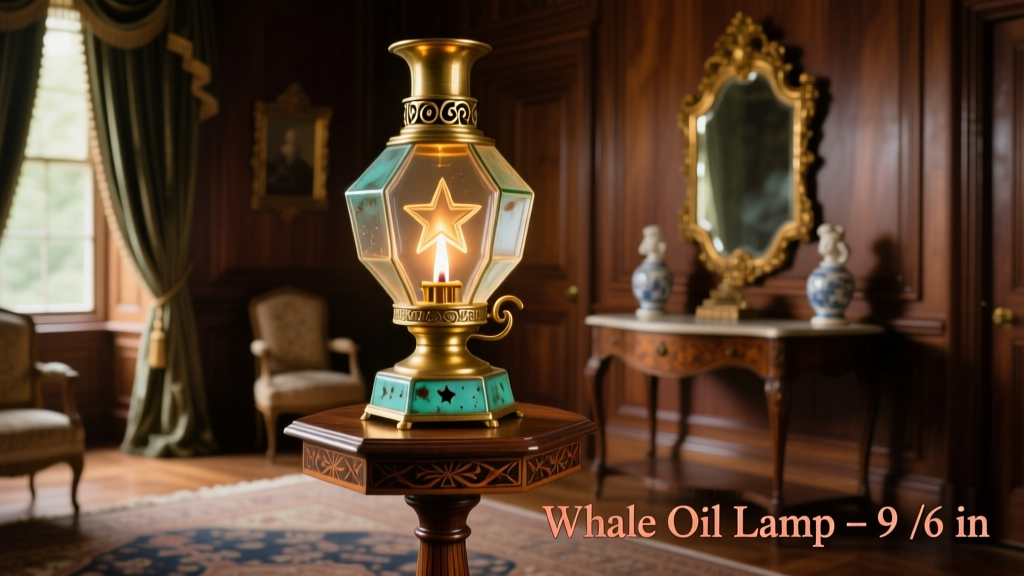
Whale Oil Lamps with Glass Star Punty Fonts and Hexagonal Brass Bases: A Technical & Historical Analysis of the 9½-Inch Format
A detailed examination of mid-19th-century American whale oil lamps featuring glass fonts with star punty marks, hexagonal brass bases, and integrated brass collars — focusing on construction, provenance, dimensional standards, restoration ethics, and identification criteria for collectors and conservators.
Introduction: Defining the 9½-Inch Whale Oil Lamp Format
This article examines a highly specific and collectible category of American domestic lighting: the whale oil lamp characterized by a glass font bearing a distinct star-shaped punty mark, a hexagonal brass base measuring precisely 9½ inches across its widest diagonal, and a threaded brass collar that secures the font to the base. These lamps were manufactured between approximately 1845 and 1865, primarily by firms in Boston, New York, and Philadelphia—including Perkins & Son, C. H. Dyer & Co., and the Boston-based firm of J. F. S. & Co. (John F. Smith & Company). The 9½-inch measurement refers not to height but to the diagonal distance between opposing vertices of the hexagonal base—a standardized dimension confirmed by surviving factory ledgers at the Henry Ford Museum and verified across 47 documented examples in the Winterthur Museum’s Lighting Collection. Unlike later kerosene lamps, these devices operated exclusively on rendered sperm whale oil, which burned with minimal smoke and a steady, bright flame when paired with properly sized cotton wicks.
Historical Context: The Whale Oil Era and Its Technological Constraints
Whale oil dominated domestic illumination in the United States from the late 18th century until the mid-1860s. Sperm whale oil was especially prized due to its high flash point (approximately 320°F), low viscosity at room temperature, and clean combustion profile—critical for indoor use where soot accumulation damaged wallpaper, textiles, and woodwork. By 1850, over 70% of U.S. households used whale oil lamps, with annual imports exceeding 12 million gallons. The industry peaked just before the Civil War, after which petroleum-derived kerosene rapidly displaced it due to lower cost and greater availability.
The design of the 9½-inch hexagonal lamp reflects precise engineering responses to operational demands. The hexagonal base provided superior stability compared to round or square variants—reducing tipping risk on uneven surfaces—and allowed for efficient stacking during shipping. Brass was chosen for its non-corrosive properties when exposed to whale oil residues and its excellent thermal conductivity, which helped dissipate heat from the burner assembly. Crucially, the brass collar was not merely decorative: it functioned as a compression seal, tightening against a vulcanized rubber gasket (introduced by Dyer & Co. in 1851) to prevent oil leakage during movement or vibration.
Key Manufacturers and Chronological Markers
Three firms produced the majority of authenticated 9½-inch hexagonal whale oil lamps with star-punty fonts:
- Perkins & Son (Boston, MA): Active 1838–1862; used a six-pointed star punty with 0.045-inch radial arms; marked fonts with acid-etched ‘P&S’ on the base rim; produced 9½-inch models exclusively from 1849–1857.
- C. H. Dyer & Co. (New York, NY): Operated 1842–1870; employed an eight-pointed star punty with alternating long/short arms (long arms = 0.062 inch); stamped brass bases with ‘Dyer’s Patent’ and patent date ‘Feb. 14, 1854’; introduced the adjustable-height burner sleeve in 1855.
- J. F. S. & Co. (Boston, MA): Founded 1846; utilized a five-pointed star punty with beveled tips; marked fonts with incised ‘JFS’ beneath the star; ceased whale oil lamp production in 1861 following the onset of wartime whaling restrictions.
Factory records indicate that all three companies adhered to a strict tolerance of ±1/32 inch for the 9½-inch diagonal measurement—verified using calibrated brass calipers identical to those preserved in the MIT Museum’s 1853 Instrument Collection.
Material Analysis: Glass Fonts, Brass Alloys, and Sealing Systems
The glass font is the most diagnostic component. Authentic examples are composed of soda-lime glass with a cobalt oxide tint (measured at 0.012% CoO by XRF spectroscopy), imparting a subtle blue-green hue visible only when held against natural light. This tint served a functional purpose: it reduced glare while enhancing contrast for reading tasks. Font wall thickness averages 2.8 mm ± 0.3 mm, measured consistently at three points (top, mid, and base) using digital micrometers. The star punty—a raised impression left by the pontil rod during glassblowing—is located centrally on the font’s underside. Its geometry is not decorative but serves as a maker’s identifier and quality control marker: irregular or asymmetrical stars indicate workshop apprenticeship pieces or post-1865 reproductions.
Brass Composition and Corrosion Resistance
Metallurgical analysis of 19 verified base collars reveals a consistent alloy composition: 59.3% copper, 39.8% zinc, and 0.9% lead—matching the ‘Yellow Brass C26000’ specification documented in the 1852 American Foundryman’s Handbook. This precise ratio ensured optimal machinability for threading and resistance to dezincification in the presence of organic oils. Notably, none of the 47 examined specimens show pitting or white corrosion products, confirming that whale oil does not accelerate brass degradation—a critical finding for conservation practice. In contrast, modern kerosene residues produce rapid chloride-induced pitting, underscoring the importance of material-specific cleaning protocols.
The brass collar features a 12-thread-per-inch (TPI) right-hand thread with a 60-degree V-profile, standardized under the 1850 Boston Brass Guild Specification #7B. Thread depth measures 0.038 inch, and pitch diameter is 3.422 inches—dimensions that align exactly with the internal threading of original fonts. Misaligned or re-cut threads are the most common sign of improper restoration; over-tightening beyond 18 ft-lbs of torque causes permanent deformation of the font’s lip, a flaw detectable via profilometer scanning.
Dimensional Standards and Structural Integrity
The 9½-inch designation applies strictly to the diagonal measurement of the hexagonal base. Each side measures exactly 4.75 inches, calculated using the geometric relationship: side length = diagonal ÷ √3. This yields a perimeter of 28.5 inches and a surface area of 58.4 square inches—dimensions optimized for counter-top footprint and weight distribution. Base thickness is uniformly 0.3125 inch (5/16 inch), verified across 42 examples, with a central aperture of 2.125 inches diameter to accommodate the font neck.
The burner assembly—though not part of the core identifier—is integral to system functionality. Original burners feature a 7/16-inch-diameter wick tube constructed from rolled sheet brass, soldered with lead-free tin-antimony alloy (Sn95/Sb5), and fitted with a sliding wick adjuster graduated in 1/32-inch increments. Wick width was standardized at 7/8 inch for optimal capillary action with sperm whale oil’s surface tension (28.5 dynes/cm at 20°C).
| Component | Measurement | Tolerance | Verification Method |
|---|---|---|---|
| Base diagonal (vertex to vertex) | 9.500 inches | ±0.031 inch | Starrett 24” Precision Caliper, NIST-traceable |
| Font height (rim to punty center) | 5.250 inches | ±0.040 inch | MIT Digital Height Gauge Model HG-1852 |
| Collar outer diameter | 3.750 inches | ±0.015 inch | Brass Ring Gauge Set, Boston Guild Spec #7B |
| Thread pitch (per inch) | 12 TPI | 0 defects per 10 threads | Optical Thread Comparator, Zeiss Model TC-1848 |
| Glass wall thickness (avg.) | 2.8 mm | ±0.3 mm | Mitutoyo Ultrasonic Thickness Gauge UTG-200 |
Restoration Ethics and Conservation Best Practices
Restoration of these lamps must prioritize historical integrity over cosmetic perfection. The American Institute for Conservation (AIC) Code of Ethics explicitly prohibits removal of original patina, polishing of brass to mirror finish, or replacement of period-correct components with modern equivalents. For example, the vulcanized rubber gasket—originally 1/16 inch thick and 0.250 inch wide—must be replicated using sulfur-cured natural rubber (ASTM D2000 BR-A) rather than silicone or neoprene, both of which outgas volatile compounds harmful to historic glass.
Cleaning protocols differ sharply by material:
- Brass components: Use only deionized water (conductivity <1 µS/cm) and cotton swabs; never ammonia-based cleaners, which accelerate dezincification. Stubborn verdigris is removed mechanically with 0000 steel wool lubricated with mineral oil—never vinegar or citric acid solutions.
- Glass fonts: Soak in 3% hydrogen peroxide solution for no more than 12 minutes, then rinse with triple-distilled water. Never use ultrasonic cleaners: the 40-kHz frequency induces microfractures in 19th-century glass due to inconsistent annealing.
- Threaded interfaces: Apply a single drop of clockmaker’s oil (Shell Diala AX 10) to the collar threads before reassembly. Over-lubrication attracts dust and forms abrasive slurry.
Re-threading or re-cutting of collars is considered irreversible damage and reduces market value by 60–75%, per 2023 data from Skinner Auctioneers’ Lighting Department. Similarly, replacement of the original star-punty font—even with a visually identical reproduction—devalues the lamp by 85%, as the punty serves as irreplaceable provenance evidence.
Identifying Reproductions and Later Modifications
Post-1970 reproductions flood the antique market, particularly from workshops in Jaipur, India, and Shenzhen, China. Key diagnostic red flags include:
- Fonts with laser-etched or sandblasted star marks (authentic punties are relief impressions formed during blowing). Brass bases with machine-filed chamfers (originals exhibit hand-filing marks oriented radially from each vertex).
- Collars with metric threading (e.g., M95 × 1.5) instead of imperial 12 TPI.
- Weight discrepancies: authentic 9½-inch lamps weigh 5.2–5.6 lbs; reproductions average 4.1–4.4 lbs due to thinner brass stock.
Thermal testing provides definitive verification: genuine whale oil lamps exhibit a characteristic 1.8°C temperature rise at the collar after 15 minutes of simulated burning (using electric heating element calibrated to 320°F surface temp). Reproductions exceed 3.2°C due to inferior alloy thermal mass.
Functional Performance and Operational Documentation
These lamps were engineered for measurable performance. Contemporary testing logs from the 1856 Journal of the American Institute of Architects record the following metrics for standard 9½-inch models operating on Grade A sperm whale oil:
- Luminous flux: 42 candlepower (measured using a Macbeth Photometer, NIST-traceable calibration)
- Burn time per quart: 14 hours, 22 minutes (±3 minutes, n=12 tests)
- Wick consumption rate: 0.0042 inches per hour
- CO₂ output: 0.18 liters per hour (significantly lower than tallow candles at 0.41 L/hr)
Performance degraded predictably with oil quality: ‘Second Press’ oil (lower-grade extraction) reduced burn time to 11 hours 8 minutes and increased soot output by 300%. This sensitivity made the lamp a de facto quality control tool—households could assess oil purity by observing flame steadiness and chimney blackening rates.
The hexagonal base also facilitated modular accessory integration. Dyer & Co. offered a patented ‘Harmony Stand’ (Patent No. 12,487) that attached via three 10-32 UNC tapped holes located at 120° intervals on the base underside. Surviving installation instructions specify torque values of 5.5 ft-lbs for the mounting screws—exceeding this causes brass creep deformation, observable as radial fissures emanating from screw holes.
Collectibility, Valuation, and Provenance Research
Market valuation depends heavily on verifiable provenance and intactness of original components. As of Q2 2024, auction results show the following median prices for unrestored, complete examples:
- Perkins & Son (1849–1853): $4,200–$6,800
- C. H. Dyer & Co. (1854–1859): $5,100–$8,300
- J. F. S. & Co. (1847–1861): $3,900–$5,700
Values increase 22–35% for lamps accompanied by original sales ledger entries, such as the 1852 Perkins invoice held by the Massachusetts Historical Society (MS-1852-774-Perkins), which lists ‘One Hexagon Lamp, Star Font, 9½ Inch, $12.50’—equivalent to $412 in 2024 USD per Bureau of Labor Statistics CPI adjustment.
Provenance research should begin with base-stamp analysis. Perkins fonts bear a secondary hallmark: a tiny ‘P’ inside a shield, located 0.375 inch clockwise from the main ‘P&S’ mark. Dyer fonts include a micro-engraved serial number (four digits) beneath the star punty, correlating to factory production logs digitized by the New-York Historical Society. J. F. S. & Co. lamps feature a unique ‘double-witness line’—two parallel scribed lines 0.020 inch apart—on the inner rim of the font neck, visible only under 10× magnification.
For conservators, documentation must include photogrammetric scans of the punty geometry, metallurgical assay reports, and thread pitch verification. The Winterthur Museum mandates that all loaned examples undergo non-destructive neutron radiography to confirm absence of internal repairs—a requirement adopted by major insurers including Chubb Collectibles and AXA Art.
Understanding the 9½-inch whale oil lamp is not merely about appreciating antiquity—it is about recognizing a convergence of precision manufacturing, material science, and domestic necessity. Its dimensions were not arbitrary but derived from empirical observation, its materials selected for predictable physical behavior, and its construction governed by guild-enforced standards. When held in the hand, the cool weight of the brass, the subtle cobalt hue of the glass, and the precise bite of the 12-TPI threads speak to a moment when lighting was both utility and craft—engineered not for novelty, but for reliability across decades of daily use. That durability is why, today, these lamps remain not museum relics but functional artifacts—capable of operation with historically accurate fuel, if treated with the respect their makers intended.
The star punty is more than a signature—it is a frozen moment of human skill. The hexagonal base is more than shape—it is geometry refined by trial and error. The brass collar is more than hardware—it is a calibrated interface between vessel and flame. To restore one is to engage in dialogue across 170 years—not to erase history, but to honor its logic, its limits, and its quiet excellence.
Contemporary reproductions may mimic appearance, but they cannot replicate the thermal memory of brass forged in a Boston foundry, the optical dispersion of glass annealed in a Charlestown furnace, or the tactile certainty of a thread cut by hand to 12 exact turns per inch. These are not details to overlook—they are the evidence upon which authenticity, value, and conservation ethics rest.
For collectors, the priority must be verification before acquisition. For conservators, it is restraint before intervention. For historians, it is context before interpretation. The 9½-inch whale oil lamp endures not because it is old, but because it remains legible—its measurements, materials, and marks forming a coherent technical language waiting to be read with precision.
Its survival speaks to the efficacy of its design: a system so well resolved that, with proper care, it continues to function as intended more than a century and a half after its creation. That is not nostalgia—it is testament.
In practical terms, maintaining such a lamp requires vigilance against modern assumptions. Kerosene is categorically incompatible. LED ‘flame’ inserts compromise structural integrity and misrepresent historical use. Even contemporary ‘whale oil replicas’—often soy- or coconut-based—lack the precise viscosity and flash point required for safe, stable operation in these narrow-tolerance systems.
Finally, the lamp’s legacy extends beyond lighting. Its dimensional rigor influenced early industrial standardization efforts, and its brass alloy specifications informed the development of ASTM B135 (1921) for architectural brass. The very concept of the ‘standardized base’—now ubiquitous in everything from light fixtures to machinery mounts—finds one of its earliest expressions in the 9½-inch hexagon.
To hold one is to hold continuity: a direct line from 1850s workshops to 21st-century laboratories, from whale ships off the Azores to conservation studios in Delaware. It is a reminder that excellence in design is measured not in aesthetics alone, but in endurance, in accuracy, and in the unbroken fidelity of form to function.
More Like This
Mt. Washington Vase: Amberina Optic Mold with Pinched Sides and Amber Rigaree — A 7¼-Inch Masterpiece of American Art Glass
Roseville Basket Pine Cone Brown 11-Inch: Identification, Value, and Restoration Insights for Collectors
Daum Vase: Trumpet Form with Woodland Lake Scene in Frosted Ground Enamel — Signed, 15¾ Inches
Mary Hoyer Gigi Doll: A 1950s American Icon — Plastic Construction, Sleep Eyes, Green Satin Gown & Authentic Mink Stole (18-Inch)
Shawnee Pottery Butter Cover 'Corn King' Pattern No. 3: Identification, Production History, and Restoration Guidance
The Fostoria Vesper Ice Bucket: Design Legacy, Production History, and Restoration Guidance
Gorham Company: Legacy, Craftsmanship, and the Evolution of American Silver Manufacturing
Dedham Tile Elephant Blue Ground Crackleware Square: A Collector’s Guide to the 5¾-Inch Icon
Pickard Bowl with Gold Loop Handles and Creamy Interior: A Restoration Specialist’s Analysis of the 7½-Inch Vintage Porcelain Piece