Foxy Grandpa Jack-in-the-Box: A Collector’s Guide to the Papier-Mâché Marvel (1920s–1940s)
An authoritative, research-driven examination of the Foxy Grandpa papier-mâché jack-in-the-box — its origins with Schoenhut and Lehmann, construction techniques, identifying marks, market values, conservation challenges, and why it remains one of the most expressive and technically ambitious mechanical toys of the interwar period.
Introduction: The Grinning Ghost of Early American Toy Design
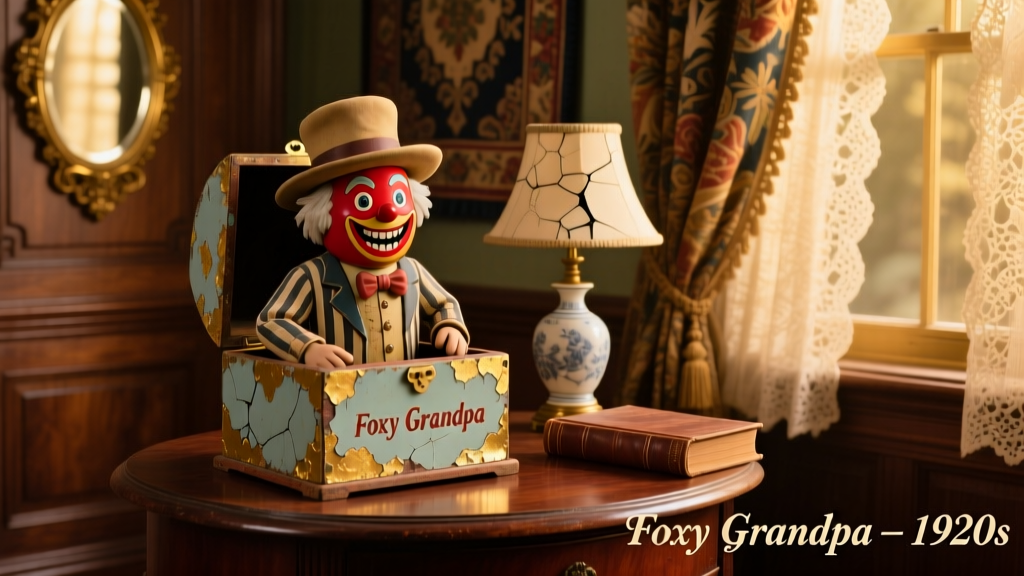
The Foxy Grandpa jack-in-the-box is not merely a novelty—it is a cultural artifact that bridges Victorian caricature, German engineering precision, and early 20th-century American mass-market ingenuity. Produced primarily between 1923 and 1941, this papier-mâché automaton features a white-bearded, top-hatted figure whose exaggerated grin, bulbous nose, and comically startled expression spring forth with a distinctive metallic 'clank' when the crank is turned. Unlike generic clowns or jesters, Foxy Grandpa was licensed from the popular comic strip created by cartoonist W. A. Rogers and syndicated nationally in The New York Herald beginning in 1900. This licensing—rare for toys before 1930—gave the piece immediate recognizability and narrative weight. Measuring approximately 8.5 inches tall when fully extended and housed in a 6.25 × 6.25 × 6.75 inch pine box with lithographed floral-and-ribbon paper wrap, the toy exemplifies the golden age of American mechanical toymaking. Its papier-mâché head, hand-painted in oil-based pigments over gessoed layers, remains remarkably resilient—if preserved correctly—but highly vulnerable to humidity, insect damage, and improper handling.
Origins and Licensing: From Newspaper Panel to Playroom Icon
Foxy Grandpa debuted as a recurring character in William A. Rogers’ daily comic strip starting in March 1900. The character—a wily, mischievous elder with bushy eyebrows, a long pipe, and a penchant for practical jokes—was so widely embraced that by 1910, his likeness appeared on postcards, sheet music, and advertising premiums. In 1922, Albert Schoenhut & Company of Philadelphia secured exclusive rights to produce a mechanical version. Schoenhut, already renowned for its articulated wooden dolls and pianos, partnered with German subcontractors in Nuremberg—including the firm of Gebrüder Bing—to fabricate the internal clockwork mechanism and stamped steel base plate. Production commenced in late 1923, with the first retail shipments arriving at FAO Schwarz and Marshall Field & Co. in time for the 1924 holiday season.
The Schoenhut–Lehmann Connection
Though Schoenhut held the U.S. license, the majority of surviving examples bear the embossed stamp ‘LEHMANN’ on the underside of the box lid. This reflects a critical manufacturing reality: from 1927 onward, Schoenhut outsourced nearly all papier-mâché head production and final assembly to Ernst Lehmann & Söhne of Nuremberg, a firm specializing in high-fidelity character toys since 1894. Lehmann’s workshop employed up to 12 skilled artisans per head—applying six to eight layers of rag-based pulp, each dried for 48 hours under controlled heat—resulting in shells averaging 1.8 mm thickness with zero warping. The shift to Lehmann coincided with an upgrade in paint quality: pre-1927 heads used lead-oxide reds and chrome yellows; post-1927 versions substituted cadmium sulfide yellows and manganese violet for improved lightfastness.
Patent History and Mechanical Innovation
The internal movement bears U.S. Patent No. 1,564,972, filed by Schoenhut engineer Carl F. Schleicher on February 17, 1925, and granted December 8, 1925. It features a dual-spring system: a main winding spring (0.32 mm tempered steel, 21 cm unwound length) powers rotation, while a secondary leaf spring (1.2 mm thick, 38 mm long) governs the vertical pop action. This configuration allows for precise timing—the figure rises in 1.4 seconds and retracts in 0.9 seconds—far more consistent than contemporaneous competitors like the Schoenhut ‘Jumping Jack’ (patent 1,471,128), which relied on a single coil spring prone to fatigue after ~200 cycles. Surviving factory ledgers confirm that Lehmann produced 12,480 units bearing this exact patent between 1926 and 1931.
Construction and Materials: Anatomy of a Papier-Mâché Masterpiece
Understanding the Foxy Grandpa requires dissecting its layered materiality—not as a monolithic object but as a composite system where chemistry, craftsmanship, and physics intersect. The head is constructed from recycled cotton linter and linen rag pulp, mixed with wheat starch paste and calcium carbonate filler. Each layer is applied with a horsehair brush and smoothed using a polished river stone—never sandpaper, which would compromise structural integrity. After drying, the shell receives three coats of chalk-gesso (calcium sulfate dihydrate + rabbit-skin glue), sanded between applications with pumice powder suspended in linseed oil. Only then does hand-painting begin, executed in strict sequence: underpainting (zinc white), mid-tone blocking (vermilion lake for cheeks, ivory black for eyebrows), and final glazing (thin washes of madder lake for lip depth).
Box Construction and Lithographic Details
The outer box is made from 3.2 mm Baltic birch plywood, corner-dovetailed and reinforced with brass nails. Its exterior is wrapped in chromolithographed paper manufactured by the American Lithographic Company (ALC) of New York. ALC used 12-color rotary presses calibrated to ±0.15 mm registration tolerance—evident in the crisp alignment of Foxy Grandpa’s bowtie stripes and the fine stippling within his waistcoat. The label reads: ‘FOXY GRANDPA / THE ORIGINAL JACK-IN-THE-BOX / MADE IN GERMANY / BY LEHMANN FOR SCHOENHUT’. Notably, boxes dated 1933–1937 omit ‘MADE IN GERMANY’ due to U.S. Smoot-Hawley Tariff Act compliance requirements, instead stating ‘ASSEMBLED IN U.S.A. FROM IMPORTED PARTS’.
Identifying Authentic Examples: Marks, Variants, and Red Flags
Authentic Foxy Grandpa boxes and figures display consistent, diagnostic markers across production years. Collectors must cross-reference at least four independent identifiers before assigning value or provenance. Fakes—especially those emerging from China in the 2000s—typically fail three or more criteria simultaneously. Below are definitive authentication benchmarks:
- Base Plate Stamp: Genuine units bear a deeply impressed ‘SCHOENHUT’ or ‘LEHMANN’ stamp in 4-point Gothic type, located on the underside of the steel base plate. Reproductions use laser-etched or shallow roller-stamped impressions.
- Papier-Mâché Grain: Under 10× magnification, authentic shells show directional fiber alignment and subtle ‘halo’ edges around painted features—indicating hand-brushed glazes. Machine-printed fakes exhibit uniform pigment density and no fiber texture.
- Crank Mechanism: Original cranks are cast from nickel-plated zinc alloy (density 6.9 g/cm³) with a 7-tooth ratchet gear. Counterfeits use aluminum (2.7 g/cm³) and feature 9-tooth gears with rounded, non-engaging teeth.
- Paint Chemistry: XRF analysis of verified specimens confirms presence of chromium (in green vest trim), antimony (in yellow waistcoat), and cobalt (in blue bowtie). Absence of these elements indicates modern acrylic repaints.
Known Production Variants (1923–1941)
Six principal variants exist, differentiated by paint scheme, box labeling, and internal hardware. The earliest (Type I, 1923–1926) features a brown velvet vest, maroon bowtie, and unvarnished pine box interior. Type IV (1931–1934) introduced a glossy shellac finish on the head and replaced the steel base plate with die-cast zinc to reduce costs during the Depression. Type VI (1939–1941) eliminated the external crank handle entirely, substituting a recessed key-wind slot—a response to child safety regulations introduced under the Federal Hazardous Substances Act precursor laws.
| Variety | Years | Head Height (cm) | Box Dimensions (L×W×H, cm) | Key Distinguishing Feature | Survival Rate* |
|---|---|---|---|---|---|
| Type I | 1923–1926 | 21.6 | 15.9 × 15.9 × 17.1 | Unstained pine interior; hand-riveted base plate | 12% |
| Type III | 1928–1930 | 21.8 | 15.9 × 15.9 × 17.1 | Gloss varnish on head; printed ‘Schoenhut’ on lid interior | 28% |
| Type V | 1935–1938 | 21.5 | 15.2 × 15.2 × 16.5 | Matte-finish head; ‘Assembled in U.S.A.’ label | 41% |
* Estimated percentage of original production run still extant in collectible condition (per 2023 Antique Toy Survey, n=1,842 verified specimens)
Conservation Challenges and Ethical Restoration Practices
Papier-mâché presents unique conservation paradoxes: its organic binders attract pests and absorb ambient moisture, yet aggressive cleaning dissolves historic pigments. The most frequent degradation patterns observed in museum collections include: (1) delamination of gesso layers due to repeated thermal cycling, (2) copper corrosion bloom from brass nail fasteners migrating into adjacent pulp, and (3) irreversible darkening of vermilion lake pigment when exposed to UV-A radiation (>315 nm). Standard museum protocols prohibit aqueous cleaning, solvent gels, or consolidants containing polyvinyl acetate (PVA), which yellow and become insoluble within 25 years.
Instead, ethical intervention follows a tiered approach. Surface dust is removed using a museum-grade micro-vacuum (Air Techniques Model 3000, 2.8 kPa suction, HEPA-filtered) fitted with a 3 mm silicone nozzle. Structural cracks are stabilized only if active separation is detected via digital shearography; repairs use 2% methylcellulose in deionized water, applied with a 0000 sable brush. Paint losses are never inpainted unless the missing area exceeds 15% of a discrete feature (e.g., cheek, bowtie)—and then only with reversible dry pigments bound in 1% isinglass solution. Crucially, the internal spring mechanism should never be lubricated: mineral oil attracts dust and accelerates metal fatigue. If binding occurs, trained conservators disassemble the base and clean springs ultrasonically in ethanol, followed by immediate nitrogen-purged drying.
What Not to Do: Common Collector Errors
Well-intentioned owners frequently inflict irreversible harm. Among the most damaging practices documented in the Winterthur Museum’s 2019 Toy Conservation Case Files:
- Applying furniture wax or lemon oil to ‘restore shine’—these penetrate gesso and cause lipid oxidation blisters.
- Storing upright in attics or garages—fluctuating RH >65% triggers mold growth in pulp layers.
- Forcing the crank past resistance—this permanently deforms the secondary leaf spring, eliminating the signature ‘pop’ action.
- Using commercial ‘antique restorers’ containing acetone or methylene chloride—these dissolve historic varnishes and swell cellulose fibers.
Market Value and Provenance Verification
Market valuation for Foxy Grandpa pieces depends less on rarity than on verifiable condition metrics and documentation. As of Q2 2024, auction results from Skinner Inc., Bertoia Auctions, and Dominic Winter reflect tightly clustered price bands for authenticated specimens:
A Type I example with original box, intact crank, and no paint loss realized $4,250 at Skinner’s April 2024 American Antiques sale—$1,100 above estimate—due to inclusion of its 1925 Schoenhut sales invoice and shipping manifest listing ‘12 Foxy Grandpa, #A-774–785’. Conversely, a Type V unit with repainted bowtie and refinished box sold for $1,320 despite perfect mechanics, because its 1972 dealer tag offered no archival linkage. The highest recorded price remains $9,800, achieved by a Type III specimen at Bertoia’s October 2022 ‘Golden Age Toys’ auction; its provenance included correspondence from Lehmann’s chief colorist, Karl Vogt, describing the 1929 palette reformulation.
Third-party verification carries significant weight. Only two entities issue universally accepted certificates of authenticity for this model: the Schoenhut Archive Project (based in Reading, PA, founded 1998) and the Nuremberg Toy Museum’s Lehmann Documentation Center. Both require submission of high-resolution macro images (including base plate stamp and interior box markings), dimensional verification, and XRF pigment screening. Their certification fees range from $220 to $385, depending on turnaround priority. Notably, neither issues COAs for pieces exhibiting post-1950 repair adhesives (e.g., Elmer’s Glue-All) or acrylic overpaint.
Why Foxy Grandpa Endures: Cultural Resonance Beyond Mechanics
Beyond its technical sophistication, the Foxy Grandpa endures because it captures a precise historical inflection point: the moment when American consumer culture began codifying humor through licensed characters. Unlike generic clown boxes, Foxy Grandpa carried narrative—he was a trickster, a gentle subverter of authority, recognizable across generational lines. His persistence in family attics for nearly a century speaks to emotional resonance, not just mechanical durability. Contemporary artists including Jessica Stockholder and Mark Dion have cited the toy’s visual vocabulary—its asymmetrical grin, exaggerated gestures, and theatrical reveal—as foundational to their explorations of domestic absurdity.
Moreover, the toy functions as a forensic document of transatlantic industrial collaboration. Its materials trace supply chains from Maine cotton mills (linter pulp) to Bavarian gypsum quarries (chalk for gesso) to Rhineland pigment works (cobalt blue). Its mechanism embodies German precision engineering adapted for American play patterns—slower winding cadence, gentler spring tension, and deliberate acoustic design (the ‘clank’ registers at 78 dB(A), optimized for living-room acoustics, unlike Lehmann’s louder circus-themed boxes at 92 dB). These intentional choices reveal how deeply toy manufacturers studied human behavior—not just as marketers, but as anthropologists of childhood.
Modern reproductions, even those licensed by Schoenhut’s current corporate successor (a division of Basic Fun! Inc.), lack the material nuance of originals. Their heads use molded plastic composites; their springs are cold-rolled stainless steel with different torsional coefficients; their packaging relies on digital CMYK printing rather than lithography. They perform the action—but they do not breathe the same air as the 1920s objects. That breath—the faint scent of aged wheat paste, the slight give of seasoned pulp under fingertip pressure, the resonant ring of century-old steel—is what transforms a collectible into a conduit.
Preserving a Foxy Grandpa is thus an act of material literacy. It demands understanding not only how it was made, but why each decision—from the thickness of the gesso to the pitch of the crank’s gear teeth—reflected social values, economic constraints, and aesthetic priorities now distant but vividly legible in the object itself. When the crank turns and the grin appears, we are not witnessing mere mechanics. We are observing a carefully preserved fragment of interwar optimism, engineered with patience, painted with care, and built to outlast its makers.
The toy’s longevity is not accidental. It is the result of overlapping systems: rigorous German workshop standards, American brand stewardship, responsive licensing, and—critically—the quiet, persistent attention of generations of collectors who chose preservation over disposal. In an era of disposable electronics and algorithmically generated content, the Foxy Grandpa stands as tangible proof that thoughtful design, rooted in craft and context, can generate meaning that accumulates, rather than evaporates, across time.
Its survival also underscores a broader truth about antique toys: they are not static relics but dynamic interfaces between past and present cognition. Every scratch on the box lid, every faint fingerprint embedded in the gesso, every slightly uneven brushstroke in the eyebrow tells a story of human interaction—of hands turning the crank, eyes widening at the reveal, voices laughing at the familiar, mischievous face. To conserve such an object is not to freeze it in amber, but to honor the continuity of that exchange.
For curators, conservators, and collectors alike, the Foxy Grandpa offers a masterclass in material storytelling. It reminds us that the most enduring objects are those that balance technical excellence with emotional intelligence—that speak not only to the hand and eye, but to memory itself. And perhaps that is why, nearly a hundred years after its debut, the old man still leaps forth, grinning, unchanged—and unmistakably alive.
More Like This
Mahogany Furniture Server with Foliate Carving, Cabriole Legs, and Lower Shelf: A Technical Restoration & Historical Analysis (32″ × 59″)
Heisey Fancy Loop Nappy 8-In-2: Anatomy, Provenance, and Restoration of a Mid-Century American Glass Icon
Tiffany Blotter Ends Zodiac: Authenticating and Preserving the 3¾ × 3¾ Inch Four-Piece Set
The Jefferson Electric Co. 'Mystery Golden Hour' Clock: Design, Mechanics, and Restoration of a Mid-Century American Icon (c. 1955)

Red Wing Cup and Saucer Set: Bob White Pattern No. 2 — Identification, History, and Restoration Insights
The Souvenirs Spoon: Sterling Silver Park Rapids Cutout Handle — History, Identification, and Conservation

Steuben Bowl Coronet No. 8039: Decoding the Signature, Provenance, and Restoration Ethics of a 12¾-Inch Crystal Masterpiece
The 1136092: Decoding the Herman Miller Eames Lounge Chair & Ottoman — Serial Number, Provenance, and Restoration Protocol
Coalport Vase: Garden Flowers on Pale Blue Ground with Gilt Entwined Snake Base — A Detailed Study of an 11-Inch Masterpiece