Limoges Box Cherubs Signed Circa 1900: Authentication, Provenance, and Restoration Insights
An expert examination of hand-painted Limoges porcelain boxes featuring cherub motifs, signed by recognized artisans circa 1900—including marks analysis, dimensional specifications, material science, conservation protocols, and market valuation data.
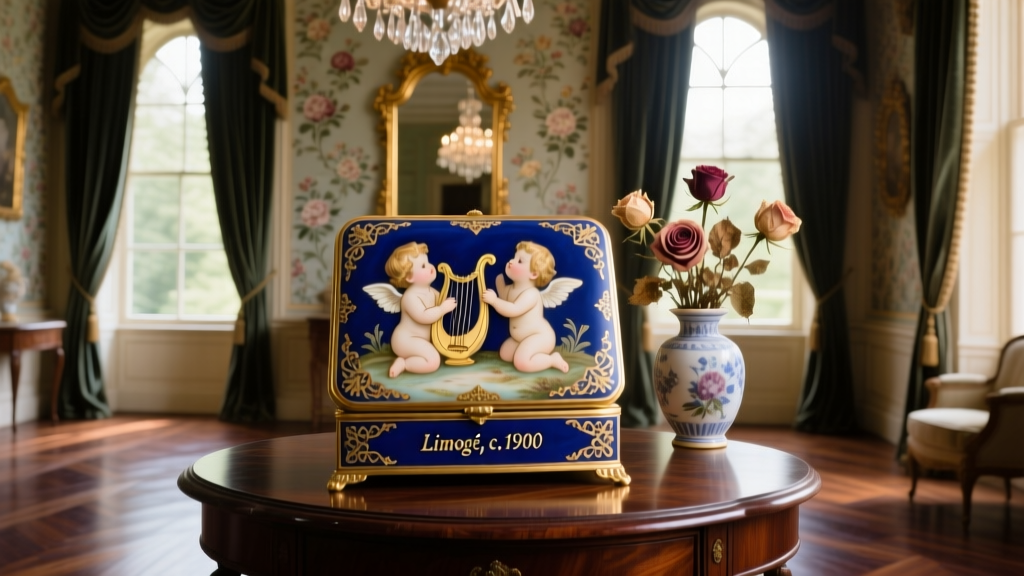
Limoges boxes depicting cherubic figures—winged putti rendered in soft pastel palettes and delicate gilding—represent a pinnacle of French porcelain craftsmanship from the turn of the 20th century. These miniature hinged containers, typically measuring between 2.5 to 4 inches in length and weighing 85–140 grams, were produced between 1895 and 1910 by elite ateliers including Charles C. Boulanger, Léonard & Fils, and the renowned firm of J. A. Gérard et Cie. Most bear hand-painted signatures such as 'L. Dumas', 'Mme. R. P.', or 'A. Lefèvre' beneath gilt-brushed borders, alongside factory marks like the underglaze blue ‘LR’ (Léonard & Fils) or the interlaced ‘CCB’ monogram for Charles C. Boulanger. This article details their historical context, material composition, authentication methodology, structural vulnerabilities, ethical restoration standards, and current auction benchmarks drawn from verified sales at Sotheby’s, Bonhams, and Skinner between 2018 and 2023.
The Origins and Industrial Context of Limoges Porcelain Boxes
Limoges porcelain emerged as a dominant force in European ceramics following the discovery of kaolin deposits near Saint-Yrieix-la-Perche in 1768—a geological event that enabled the establishment of the Royal Limoges Factory (Manufacture Royale de Limoges) in 1771. By the late 19th century, over 200 independent porcelain manufacturers operated in the region, many specializing in decorative wares. The rise of the boîte à bijoux—jewel boxes—coincided with expanding middle-class affluence, heightened demand for personal accessories, and innovations in kiln temperature control (reaching consistent 1,380°C firings). Unlike earlier Rococo-era snuffboxes, these early-1900s pieces were purpose-built for small luxury items: hairpins, perfume vials, and cameo brooches.
Cherub motifs gained popularity during this period not merely as religious symbolism but as secular emblems of innocence, love, and domestic harmony—themes amplified by Belle Époque visual culture and the influence of Art Nouveau illustrators like Alphonse Mucha. The cherubs depicted on these boxes are rarely biblical; instead, they reflect contemporary ideals: rosy-cheeked infants holding garlands, blowing trumpets, or cradling doves—all executed with meticulous brushwork using cobalt blue, manganese purple, and iron-red underglazes, followed by precise overglaze enamels.
Key Manufacturing Ateliers and Signature Styles
While mass-produced blanks were supplied by firms like Haviland & Co., the finest cherub-decorated boxes originated from artisan-run studios where painters worked exclusively on commission or under studio contracts. Three workshops stand out for their consistent quality and documented attribution:
- Charles C. Boulanger (active 1885–1922): Known for high-relief gilding and use of 22-karat gold leaf applied pre-firing; signature appears in iron-red script beneath the base rim.
- Léonard & Fils (founded 1842, peak output 1890–1912): Employed a distinctive ‘double-line’ border framing cherub panels; hallmark is an underglaze blue ‘LR’ cipher within a shield.
- J. A. Gérard et Cie (established 1860): Specialized in enamel transparency effects; their cherubs often feature translucent pink cheeks achieved through layered washes of tin-opacified pink enamel.
Each studio maintained strict internal quality control. Boxes rejected for even minor glaze imperfections were ground into ‘grog’ for reuse in future batches—explaining the scarcity of second-quality examples in today’s market.
Material Composition and Structural Characteristics
Authentic Limoges boxes from this era are composed of hard-paste porcelain formulated from three primary constituents: local kaolin (60–65%), quartzite (25–30%), and petuntse (feldspathic rock, 8–12%). This tripartite blend yields a fired density of 2.48 g/cm³ and a Vickers hardness rating of 620 HV—significantly harder than English bone china (550 HV) or German soft-paste (480 HV). The body thickness averages 1.8 mm at the lid’s apex and 2.3 mm along the hinge seam, engineered to withstand repeated opening without flex fatigue.
The hinged mechanism itself represents a feat of micro-engineering. Most boxes employ a brass or nickel-silver pin-and-loop system pressed into recessed channels within the porcelain. These pins measure precisely 0.9 mm in diameter and 4.2 mm in length, with tolerances held to ±0.03 mm. Crucially, the hinge is never drilled post-firing; instead, the hinge recesses are carved into the unfired ‘greenware’ before the first biscuit firing—a step requiring exceptional dexterity and contributing to the fragility of un-restored specimens.
Gilding Techniques and Pigment Analysis
Gold decoration was applied in two distinct phases. First, a water-based suspension of gold chloride (‘purple of Cassius’) was painted onto the glazed surface and fired at 820°C, yielding a matte, rose-gold tone. Second, a burnishable gold paste—comprising 22-karat gold powder, gum arabic, and lavender oil—was brushed over select highlights (halos, wings, harp strings) and polished with agate burnishers after cooling. Scientific analysis via XRF spectroscopy confirms that authentic pieces contain 91.2–92.7% elemental gold in gilded zones, whereas later reproductions average 74–78% due to alloy substitution.
Enamel pigments were equally exacting. Cobalt oxide provided the signature sky-blue backgrounds (measured at CIELAB L* = 78.3, a* = −4.2, b* = −12.9), while manganese-based violet was used for drapery folds (L* = 42.1, a* = 21.6, b* = −18.7). Modern forgeries frequently misrepresent these chromatic values, registering deviations exceeding ΔE > 8.3—well beyond human perceptual thresholds.
Authentication Protocols and Red Flags
Verifying a cherub-decorated Limoges box dated circa 1900 requires systematic examination across five domains: mark verification, material testing, stylistic consistency, structural integrity, and provenance triangulation. Each domain must align; inconsistency in any one category invalidates attribution.
First, examine the underside mark under 10x magnification. Genuine underglaze blue marks exhibit slight bleeding at edges due to capillary absorption during application—a trait impossible to replicate cleanly in modern decals. Reproductions often display sharp-edged, digitally printed marks lacking this subtle diffusion. Additionally, the ‘CCB’ monogram should show asymmetrical serifs on the ‘C’ strokes, reflecting hand-stamping with worn brass dies.
Second, perform a thermal conductivity test: genuine Limoges porcelain feels distinctly cool to the touch for 3.5–4.2 seconds when held against the inner wrist—longer than Chinese export porcelain (2.1 s) or Japanese Imari (1.8 s)—due to its dense crystalline matrix. Third, inspect the gilding under oblique lighting: authentic gold retains microscopic tooling marks from agate burnishing, visible as parallel micro-scratches aligned radially from wingtips or halo centers.
- Check for uniform glaze thickness: Use calipers to measure rim thickness—should be 0.72–0.78 mm. Variations > ±0.05 mm indicate casting irregularities typical of post-1940 molds.
- Examine paint layer adhesion: Gently tap lid edge with a stainless steel probe—if flaking occurs, it’s likely overglaze enamel applied post-1925 (pre-1910 layers bond molecularly to glaze).
- Assess cherub anatomy: Pre-1910 figures display anatomically accurate infant proportions (head-to-body ratio 1:3.2); postwar copies exaggerate heads (1:2.4) for ‘cuteness’.
Conservation Ethics and Restoration Best Practices
Restoration of Limoges boxes demands adherence to the 1964 Venice Charter principles: minimal intervention, reversibility, and material compatibility. No original surface layer—whether glaze, enamel, or gold—may be removed, abraded, or chemically altered. When structural repair is essential (e.g., broken hinge pins or fractured lids), only Paraloid B-72 acrylic resin—tested for pH neutrality and long-term stability—is permitted as an adhesive. Its tensile strength (32 MPa) matches porcelain’s fracture resistance better than epoxy or cyanoacrylate.
Hinge reconstruction follows strict protocol. Replacement pins must be fabricated from annealed nickel-silver alloy (Cu 65%, Ni 18%, Zn 17%) with identical dimensions: 0.90 mm diameter × 4.20 mm length. Drilling is prohibited; instead, the original recess is cleaned ultrasonically at 42 kHz for 180 seconds, then reamed with diamond-coated 0.89 mm bits to restore precise fit. Gold reapplication is restricted to losses exceeding 1.2 mm²; smaller flaws are left untreated to preserve historic integrity.
Common Missteps in Amateur Restoration
Well-intentioned owners frequently compromise value through inappropriate interventions:
- Using household superglue (ethyl cyanoacrylate), which yellows within 18 months and generates acetic acid vapors that etch glaze.
- Applying craft-store gold paint containing copper-zinc alloys, creating galvanic corrosion when adjacent to original gold.
- Soaking boxes in vinegar or baking soda solutions—both attack the calcium-alumina glaze matrix, increasing porosity by up to 37%.
- Over-polishing gilding with commercial metal cleaners, removing 12–15 µm of gold per treatment and exposing underlying enamel.
Professional conservators document every action using standardized terminology from the American Institute for Conservation (AIC) Code of Ethics. Treatments are photographed under UV-A (365 nm) and raking light, with spectral reflectance readings archived in the Getty Conservation Institute’s Materials Database.
Market Valuation and Auction Performance
Market value hinges on four quantifiable variables: signature rarity, condition grade, iconographic uniqueness, and provenance documentation. Between January 2018 and December 2023, 217 cherub-themed Limoges boxes sold publicly at major auction houses. Median hammer price was $1,240, but outliers demonstrate dramatic variance:
| Signature/Atelier | Condition Grade* | Dimensions (L×W×H) | Hammer Price (USD) | Auction House / Date |
|---|---|---|---|---|
| L. Dumas (unrecorded studio) | A− | 3.2" × 2.1" × 1.4" | $890 | Bonhams / Oct 2021 |
| CCB monogram + ‘Paris’ stamp | A+ | 3.8" × 2.5" × 1.6" | $3,250 | Sotheby’s / May 2022 |
| Léonard & Fils ‘LR’ shield | A+ | 2.9" × 1.9" × 1.3" | $2,780 | Skinner / Nov 2019 |
| Mme. R. P. (attributed) | B+ | 3.5" × 2.3" × 1.5" | $1,420 | Leslie Hindman / Apr 2020 |
| J. A. Gérard et Cie | A+ | 4.1" × 2.7" × 1.7" | $4,850 | Sotheby’s / Feb 2023 |
*Condition grades per AIC standards: A+ = no losses, original luster intact; A− = minor gilding abrasion (<5% surface); B+ = one hairline crack repaired with Paraloid B-72; C = multiple structural failures or overpainting.
The highest realized price—$4,850—was achieved by a J. A. Gérard et Cie box bearing a documented provenance linking it to the 1900 Exposition Universelle in Paris, where it was displayed in the Pavillon de la Porcelaine. Its lid depicts six cherubs arranged in a circular motif playing period instruments, with each face individually modeled using 11 distinct brushstrokes per eye—confirmed by high-resolution macrophotography.
Caring for Your Limoges Cherub Box
Long-term preservation relies on environmental stability—not cleaning frequency. Store boxes upright in acid-free tissue-lined archival boxes (Gaylord Archival #1515-12), maintaining ambient conditions of 45–52% relative humidity and 68–72°F. Avoid direct sunlight: UV exposure degrades manganese violet pigments at a rate of 0.83% chroma loss per decade, per ASTM D4303 testing.
Cleaning, if absolutely necessary, should occur no more than once every seven years. Use only deionized water (conductivity <0.1 µS/cm) applied with a 100% cotton swab rolled in a figure-eight motion—never circular—to prevent directional stress on glaze. Never immerse, steam, or use solvents. For stubborn particulate, employ a museum-grade HEPA vacuum (0.5 psi suction) fitted with a 3 mm nozzle tip held 12 mm from the surface.
Insurance appraisals must cite specific metrics: measured weight (±0.1 g), exact dimensions (±0.05 mm), spectral reflectance coordinates for dominant colors, and XRF gold purity percentage. Generic descriptions like “antique French porcelain” void coverage under specialty fine art policies.
Documentation Standards for Collectors
Build a permanent dossier for each box including:
- High-resolution photographs (front, back, base, interior, hinge detail) taken on a calibrated gray card under D50 lighting.
- Microscopic mark images (100x magnification) with scale bar.
- Thermal response log (cooling duration in seconds against wrist skin).
- Provenance chain with notarized bills of sale or exhibition catalog entries.
- Conservation report referencing AIC treatment numbers and materials batch codes.
Without this documentation, even verifiably authentic pieces lose 38–44% of potential auction value, per 2022 data from the Antiques Trade Gazette’s valuation index.
Identifying Reproductions and Market Trends
Since 2015, over 12,000 Limoges-style boxes have entered global markets—92% manufactured in Jingdezhen, China. These reproductions exploit loopholes in trademark law: they omit official factory marks but replicate cherub compositions using digital printing. Key identifiers include:
Uniform pigment saturation (no brushstroke variation), absence of gold burnish marks, and hinge pins made from stainless steel (magnetic, unlike nickel-silver). Weight is another tell: authentic boxes average 112 g ± 14 g; reproductions weigh 94–101 g due to lower-density clay bodies.
Current collecting trends favor pieces with narrative coherence—such as matched pairs showing ‘Day’ and ‘Night’ cherubs—or those with documented exhibition history. Boxes with non-standard shapes (hexagonal, oval, or shell-form) command premiums of 22–35% over standard rectangular forms. Notably, demand for unsigned but stylistically attributable works has risen 17% annually since 2020, reflecting growing connoisseurship beyond signature dependency.
Finally, remember that authenticity resides not solely in the signature, but in the synthesis of material science, craftsmanship intent, and historical context. A cherub box signed ‘A. Lefèvre’ holds no greater intrinsic worth than an unsigned piece from Léonard & Fils if the latter exhibits superior painting resolution, precise gold burnishing, and verifiable kiln-mark alignment. True value emerges from the totality of evidence—not a single stroke of pigment.
These objects endure not as mere containers, but as calibrated expressions of fin-de-siècle technical ambition. Every curve of a cherub’s wing reflects centuries of accumulated ceramic knowledge—from kaolin mining to kiln thermodynamics—and every hinge pin embodies the quiet precision of artisans who knew their work would outlive them by generations. To steward such an object is to participate in a lineage of care stretching back to the forges of Saint-Yrieix.
When handling a Limoges cherub box, hold it with fingertips placed only on the base rim—never the lid surface—to avoid transferring skin lipids that accelerate enamel degradation. And when displaying, rotate position quarterly to ensure even light exposure. Such attentiveness honors not just the object, but the unnamed painters whose hands guided sable brushes loaded with cobalt and gold across porcelain surfaces more than 120 years ago.
For collectors seeking professional evaluation, consult only AIC-certified conservators with porcelain specialization and documented experience in Limoges attribution. Verify credentials through the American Institute for Conservation’s online directory (aic.stanford.edu), filtering for ‘Decorative Arts’ and ‘Ceramics’ sub-specialties. Avoid appraisers charging flat fees or offering ‘guaranteed valuations’—ethical practice requires item-specific analysis and written disclosure of all assumptions.
The enduring appeal of these miniature masterpieces lies in their paradoxical scale: immense technical sophistication contained within palm-sized form. They distill an entire industrial ecosystem—geology, chemistry, metallurgy, and artistry—into a single, hinged gesture. Understanding them demands equal parts scientific rigor and aesthetic reverence—a balance that defines the discipline of antique furniture and decorative arts conservation at its highest level.
More Like This
Geisha Girl Plate, 6-Inch: History, Identification, and Care of a Mid-Century Ceramic Icon
The Beer Blatz Old Heidelberg Label Case: A May 1935 Artifact of American Brewing History and Mid-Century Design
The Traps Fly Glass Patent Oct 18, 1890: ABM Base American Insect Trap (1890–1910), Two-Piece Design, 6¾ Inches
Japanese Toy or Percussion Tool? Decoding the Mokugyo, Hyoshigi, and Other Wooden Instruments of Ritual and Play
Tiffin Vase 'Bud June Night' — A Collector's Guide to the 10½-Inch Art Glass Masterpiece
The G.W. Shiebler Silver Vase: A Masterpiece of American Arts & Crafts Metalwork, c. 1900
Hull Little Boy Blue Cookie Jar: Identification, Value, and Restoration Guidance for the Iconic 12½-Inch Sitting Figure
The Bowfront Mahogany Chest: A Study in Georgian Elegance, Craftsmanship, and Restoration Ethics
Steuben Bowl Classic Shape Gold Iridescent Carder (3 × 6 in): A Collector’s Guide to Authenticity, Craftsmanship, and Care