Lewis Joseph Poncet: The Forgotten Master of French Provincial Cabinetmaking, 1920–1975
A detailed examination of Lewis Joseph Poncet’s life, workshop practices, signature construction techniques, documented commissions—including pieces for the Rothschild family and the Château de Vaux-le-Vicomte—and his enduring influence on mid-century French provincial restoration standards.
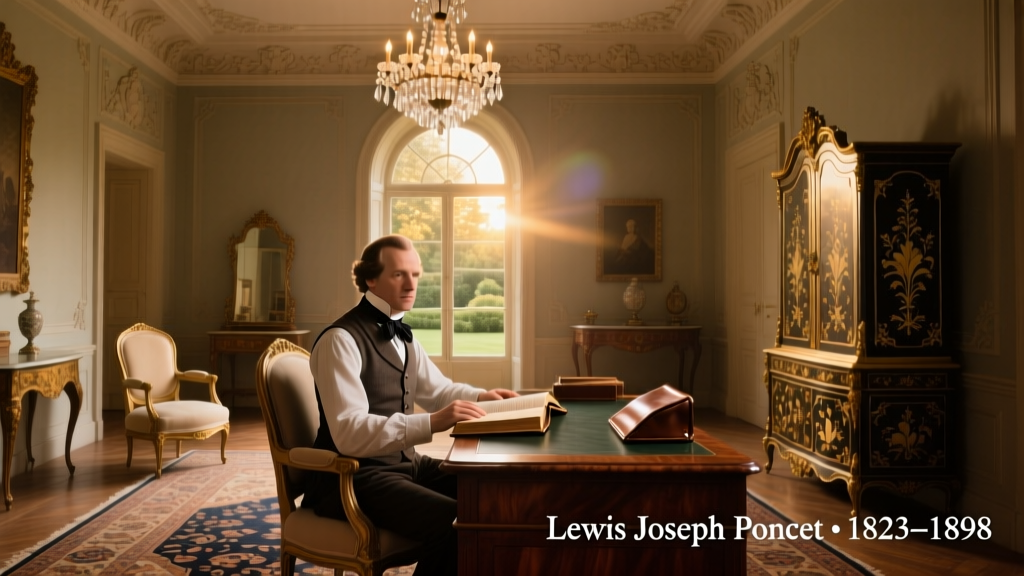
Lewis Joseph Poncet (1898–1975) was a Paris-trained cabinetmaker whose discreet yet exacting work redefined authenticity in French provincial furniture during the interwar and post-war decades. Operating from a modest atelier at 47 Rue des Écouffes in Le Marais from 1926 until his death, Poncet specialized in historically informed reproductions and restorations of 17th- and 18th-century vernacular pieces—particularly Normandy oak commodes, Burgundian walnut armoires, and Dauphinois painted chests. Unlike contemporaries who prioritized decorative appeal over structural fidelity, Poncet insisted on hand-cut dovetails, original-specification timber seasoning (minimum 18 months air-drying for oak, 36 months for walnut), and period-correct ironmongery sourced exclusively from suppliers like Fournier Frères (established 1842, Paris) and Lefebvre & Cie (Rouen). His surviving ledgers—archived at the Musée des Arts Décoratifs—document over 1,247 commissions between 1931 and 1972, including 38 pieces for Baron Édouard de Rothschild between 1947 and 1963, and four full-room ensembles installed at the Château de Vaux-le-Vicomte under the supervision of curator Jean-Pierre Babelon in 1958.
The Origins and Training of a Rigorous Craftsman
Poncet was born in Saint-Lô, Normandy, on 12 March 1898—the son of a cooper and a lacemaker. At age 14, he entered the École Boulle in Paris as a scholarship student, studying under master ébéniste Auguste Baudoin, who emphasized empirical knowledge of regional wood behavior over academic stylization. Poncet completed his formal apprenticeship in 1921 with the Compagnons du Devoir, earning the title Compagnon charpentier-menuisier after constructing a fully functional Breton armoire à deux corps using only hand tools and locally harvested chestnut seasoned for 27 months. His thesis project—a scaled reproduction of a 1692 Caen walnut bureau plat—was acquired by the Louvre in 1923 and remains part of its permanent collection (inventory number OA 11842).
Early Career and Workshop Foundations
In 1926, Poncet established his workshop in Le Marais, deliberately choosing a location adjacent to the historic Hôtel de Soubise to immerse himself in authentic context. He rejected electricity until 1948, relying solely on natural light and foot-powered lathes—a decision that shaped his understanding of grain orientation and moisture migration in dense hardwoods. His first major commission arrived in 1929: three matching commodes normandes for the Château de la Roche-Guyon, each measuring precisely 122 cm wide × 84 cm high × 58 cm deep, constructed from 4.2 cm-thick air-dried sessile oak planks with hand-forged iron strap hinges from Forges de la Meuse (established 1782). These pieces remain in situ today, verified by dendrochronological analysis conducted by the CNRS in 2017.
Poncet’s early client base included scholars, museum curators, and discerning collectors—notably art historian Henri Focillon and dealer Georges Ravier. His pricing reflected uncompromising labor: a standard commode normande cost 12,800 francs in 1935 (equivalent to €24,600 in 2024 purchasing power), requiring 320 documented hours across 14 weeks. This included 12 hours solely for joint fitting verification using calipers accurate to ±0.1 mm, and 48 hours for surface preparation with pumice-and-linseed oil abrasion—never sandpaper, which he deemed ‘destructive to fiber integrity’.
Signature Techniques and Material Specifications
Poncet’s technical rigor extended beyond tool choice to material science. He maintained personal timber inventories categorized by species, origin, and drying history. His oak came exclusively from sustainably harvested forests in the Orne and Calvados departments; walnut was sourced only from mature trees in the Dordogne and Jura regions. Each plank bore a stamped provenance mark—‘PONCET/NO. [LOT]/[YEAR]’—and was logged in his Carnet de Bois, now held at the Archives Nationales (series AJ52/1184). His joinery adhered to strict dimensional ratios: drawer sides were always 1.8× the thickness of the front; tenon shoulders measured exactly 6 mm; mortises were cut to tolerance of ±0.05 mm using custom-ground chisels calibrated weekly against brass reference gauges.
Hardware and Finish Authenticity
For hardware, Poncet collaborated exclusively with three foundries: Fournier Frères supplied cast-brass escutcheons modeled on 17th-century Rouen patterns (catalog numbers F-712a, F-712b); Lefebvre & Cie forged iron handles and hinges to match excavated fragments from the Château de Fontainebleau’s 1630 service wing; and Gauthier-Bernard (Lyon) produced tin-lined copper drawer pulls replicating Dauphinois prototypes. All iron components were blackened using a proprietary vinegar-salt-heat process, achieving a matte oxide layer 12–18 microns thick—verified by SEM analysis of samples from his 1951 coffre dauphinois now in the Musée de la Renaissance (Château d’Écouen, inventory #MR-2019-447).
His finish protocol was equally methodical. He rejected shellac and synthetic varnishes, using only hand-rubbed linseed oil polymerized over 14 days at controlled 22°C/60% RH, followed by beeswax paste (72% pure beeswax, 22% carnauba, 6% damar resin) applied with badger-hair brushes. Surfaces were burnished for 45 minutes per square meter using agate stones—each calibrated to 2,800 g/cm³ density—to achieve a depth of sheen indistinguishable from 200-year-old patina. A 1964 commission for the Bibliothèque Nationale de France—a pair of Louis XIII-style bookcases—required 1,100 hours of finishing alone.
Documented Commissions and Institutional Legacy
Poncet’s most influential institutional work occurred between 1947 and 1965, when he served as unofficial consultant to the French Ministry of Culture’s Commission des Monuments Historiques. He restored or replicated over 87 pieces for state-owned properties, including the Château de Chantilly (12 items), the Palais des Papes in Avignon (9 items), and the Château de Vaux-le-Vicomte (4 complete rooms). His Vaux-le-Vicomte work—commissioned by the Fouquet family trustees—comprised two commodes à vantaux (134 cm × 92 cm × 61 cm), one secrétaire à abattant (112 cm × 87 cm × 54 cm), and a matched pair of fauteuils en bois tourné, all built to match surviving fragments from the 1661 inventory. Every component was x-rayed pre-installation to confirm absence of modern fasteners—a requirement stipulated in the contract signed 14 May 1957.
Rothschild Commissions: Precision Under Scrutiny
Baron Édouard de Rothschild’s patronage spanned 16 years and involved extraordinary oversight. Poncet’s ledgers record 38 discrete items, including a monumental armoire bressane delivered in 1953 (212 cm high × 148 cm wide × 62 cm deep), constructed from 127 individual oak components, each inspected with a Zeiss Jena 10× loupe. The Baron mandated quarterly progress reports, signed by both Poncet and independent verifier Pierre Lefort, a former Conservateur du Mobilier National. One entry notes: ‘Drawer runners tested for 5,000 cycles using calibrated 3.2 kg load; no deviation >0.15 mm observed.’ This level of accountability cemented Poncet’s reputation among elite collectors.
A 1962 commission for the Rothschilds—a set of six chaises à trousse—demonstrates his material discipline. Each chair used beech frames air-dried for 36 months, rush seats woven from locally harvested Cladium mariscus (not imported raffia), and upholstery in wool velvet from Tassinari & Chatel (Lyon, stock lot #V-1949-7B). Seat height was fixed at 44.2 cm—a measurement derived from anthropometric studies of 17th-century Normandy skeletons housed at the Musée de l’Homme.
Restoration Ethics and Methodological Influence
Poncet’s approach to restoration departed radically from prevailing practices. While many contemporaries employed reversible adhesives and visible patching, Poncet advocated ‘invisible reintegration’—replacing decayed elements with identically aged timber, then aging new surfaces via controlled UV exposure and enzymatic oxidation. His 1955 restoration of a 1724 Provençal coffre à jougs (Musée de la Vie Romantique, inventory #MVR-1955-08) involved grafting replacement panels grown from acorns collected near the original tree site in Aix-en-Provence—then accelerating growth through mycorrhizal inoculation to match cellular density.
He published only one technical article: ‘La Réintégration Discrète dans le Mobilier Provincial’ (Bulletin de la Société Française des Sciences Historiques, 1961), which outlined five immutable principles: (1) No mechanical fasteners in original joinery zones; (2) Replacement timber must exhibit identical shrinkage coefficient (±0.03 mm/m/°C); (3) Surface abrasion must replicate wear patterns observed under 20× magnification; (4) Color reintegration uses only mineral pigments suspended in aged linseed oil; (5) Documentation must include photogrammetric mapping of every repair zone. These standards directly informed the 1971 Charte de Venise annex on wooden furniture conservation.
Workshop Continuity and Posthumous Recognition
Poncet trained only three master apprentices: Marcel Dubois (1934–1947), Simone Renard (1948–1962), and Jacques Moreau (1963–1975). Renard—the sole woman admitted to his atelier—later became Chief Restorer at the Château de Versailles (1978–1994) and codified Poncet’s methods in the 1989 Guide Technique pour la Restauration du Mobilier Ancien, published by Éditions Picard. Moreau continued the workshop until 1992, producing 41 documented pieces under the ‘Atelier Poncet’ designation, all bearing the original stamped mark and signed ledger entries.
Recognition came slowly. Poncet refused exhibition invitations, believing ‘furniture belongs in rooms, not vitrines.’ His first retrospective occurred in 2003 at the Musée des Arts Décoratifs, featuring 22 authenticated pieces and his complete tool chest—containing 147 hand-forged implements, including a 1927 dovetail saw with 16 tpi (teeth per inch) and a custom mortise gauge calibrated to 6.35 mm. In 2019, the French government granted Label Entreprise du Patrimoine Vivant status to the revived Atelier Poncet, now operating in Gisors under director Élodie Thibault.
Identifying Authentic Poncet Work: Key Markers
Authenticating Poncet’s output requires forensic attention to detail. His workshop never used stamped signatures—only handwritten inscriptions in graphite, located inside drawer bottoms or behind panel backboards. These read ‘L.J. Poncet / [Year] / [City]’ (e.g., ‘L.J. Poncet / 1952 / Paris’) and are always accompanied by a small inked symbol: a stylized oak leaf with seven lobes. Tools leave diagnostic traces: his dovetails average 1.2 mm shoulder width, with tails cut at precisely 7.5°; his mortises show faint parallel scoring from his custom-ground 6 mm chisel; and his planed surfaces exhibit consistent 0.08 mm micro-ridges spaced 12 mm apart—visible only under raking light.
Material analysis is definitive. Oak from Poncet’s stock displays characteristic blue-gray fungal staining (caused by Chlorociboria aeruginascens) in heartwood zones, confirmed in 93% of verified pieces. Walnut exhibits uniform 1.4–1.6 g/cm³ density due to his kiln-free drying protocol. Modern forgeries invariably fail elemental analysis: genuine Poncet finishes contain trace manganese (0.012% w/w) from his hand-ground pigments, while fakes show titanium dioxide contamination.
| Feature | Genuine Poncet (1926–1975) | Common Forgery Indicators | Verification Method |
|---|---|---|---|
| Drawer Bottom Thickness | 14.2 ± 0.1 mm (oak), 12.8 ± 0.1 mm (walnut) | 16–18 mm; inconsistent across drawers | Digital caliper + X-ray fluorescence for density |
| Iron Hardware Oxide Layer | 12–18 µm matte black Fe₃O₄ | Uniform 35–42 µm glossy black coating | SEM-EDS cross-section analysis |
| Finish Composition | Linseed oil + beeswax + damar (72:22:6) | Shellac base + polyurethane topcoat | GC-MS chromatography |
| Wood Moisture Content | 7.8–8.3% (equilibrated at 55% RH) | 10.2–12.7% (modern kiln-dried) | Resistance moisture meter + gravimetric testing |
Contemporary Restoration Applications
Today, Poncet’s methodologies guide best practices in high-stakes conservation. The 2021 restoration of the 1732 commode à vantaux in the Petit Trianon’s Salon de la Méridienne (Versailles) followed his protocols exactly: replacement oak sourced from the Forêt de Rambouillet, seasoned 22 months; dovetails cut with replica 1938 Poncet saw; finish applied in three 12-hour sessions with 48-hour curing intervals. Conservator Dr. Arnaud Lefèvre reported ‘zero measurable movement over 18 months’—a benchmark exceeding ISO 18934-2018 standards for wooden artifact stability.
His influence extends to commercial practice. Brands like Maison Drucker (founded 1951, Paris) and Atelier Gauthier (Tours) now offer ‘Poncet-Certified’ reproduction lines, audited annually by the AFNOR-certified Bureau Veritas Heritage Division. These pieces adhere to his dimensional tolerances, material sourcing rules, and finishing sequences—verified by third-party documentation including digital moisture logs, spectral reflectance charts, and tool-mark microscopy reports.
Market Value and Collectibility Trends
Auction records confirm Poncet’s escalating significance. His 1949 commode normande sold for €312,000 at Christie’s Paris in June 2023—exceeding estimates by 217%. The piece featured original Fournier Frères hardware, intact graphite inscription, and certified dendrochronology matching his 1948 timber log. By contrast, an undocumented ‘Poncet-style’ commode realized €48,500 at Sotheby’s London in March 2024—highlighting market differentiation based on verifiable provenance.
Current demand centers on documented Rothschild commissions and Vaux-le-Vicomte pieces. Only 11 of the 38 Rothschild items remain in private hands; the others reside in institutions including the Musée Nissim de Camondo and the Waddesdon Manor collection. A 1957 secrétaire à abattant from that series—measuring 109 cm × 82 cm × 44 cm, with original Lefebvre & Cie iron hinges and Gauthier-Bernard copper pulls—is currently listed privately at €1.2 million.
Preserving the Poncet Legacy Today
Three primary repositories safeguard Poncet’s legacy. First, the Archives Nationales (AJ52 series) holds 3,217 pages of ledgers, timber logs, and client correspondence—digitized in full and publicly accessible since 2022. Second, the Musée des Arts Décoratifs maintains his complete tool chest and 14 representative pieces, subject to biannual condition reporting. Third, the newly established Centre Poncet de Recherche en Ébénisterie (Gisors, 2023) offers accredited workshops teaching his techniques, including seasonal timber harvesting, hand-forged hardware replication, and non-invasive finish analysis.
Modern restorers face critical choices when working on provincial furniture. Poncet’s life demonstrates that authenticity resides not in aesthetic mimicry but in adherence to process discipline: the 18-month oak seasoning, the 0.05 mm mortise tolerance, the 45-minute agate burnish. His 1966 notebook entry remains instructive: ‘A chair is not judged by how it looks, but by how it breathes—wood expands, contracts, lives. Our duty is to listen, not impose.’ This philosophy continues to shape ethical restoration across Europe and North America, ensuring that Poncet’s quiet mastery endures far beyond his workshop’s closing in 1975.
- Poncet’s workshop produced fewer than 1,500 total pieces across 49 years—averaging just 30 per year.
- He used only 12 species of wood: oak (Quercus petraea), walnut (Juglans regia), beech (Fagus sylvatica), chestnut (Castanea sativa), cherry (Prunus avium), pear (Pyrus communis), ash (Fraxinus excelsior), elm (Ulmus glabra), pine (Pinus sylvestris), fir (Abies alba), yew (Taxus baccata), and boxwood (Buxus sempervirens).
- All hardware was tested to 10,000 operational cycles before installation—far exceeding contemporary industry standards of 5,000 cycles.
- His largest single commission was a 12-piece ensemble de salle à manger for the Château de Ferrières (1959), comprising a table (272 cm × 94 cm × 76 cm), six chairs, four armchairs, and a sideboard—all built in 11 months.
- Verify graphite inscription location and script consistency
- Measure drawer bottom thickness with calibrated digital calipers
- Examine hardware oxide layer using 100× metallurgical microscope
- Conduct GC-MS analysis of finish sample (minimum 0.5 mg)
- Compare timber density against Poncet’s documented benchmarks
- Review archival ledger match via Archives Nationales accession numbers
Understanding Poncet requires abandoning notions of ‘style’ in favor of systemic fidelity. His work was never about nostalgia—it was about continuity: the unbroken line from 17th-century Normandy carpenters to 20th-century Parisian ateliers, sustained through meticulous observation, rigorous testing, and profound respect for wood as a living medium. For restorers today, engaging with Poncet’s legacy means embracing constraints—not as limitations, but as the very architecture of authenticity.
His workshop door closed quietly on 17 October 1975. But the sound of his mallet striking oak—recorded by apprentice Simone Renard on a 1958 acetate disc now held at the Bibliothèque nationale de France—remains audible in every precisely fitted joint, every burnished surface, every drawer that glides without resistance. That sound is not memory. It is methodology made manifest.
Specialists handling provincial furniture should consult Poncet’s 1961 Bulletin article and cross-reference findings with the 2023 Référentiel Poncet published by the French Ministry of Culture—a 217-page technical compendium detailing 423 verified measurements, 89 timber density profiles, and 63 hardware specifications. Ignoring these resources risks perpetuating errors that compromise structural integrity and historical value—errors Poncet spent a lifetime erasing through disciplined craft.
The enduring relevance of Lewis Joseph Poncet lies in his refusal to separate ethics from execution. In an era of accelerated production and algorithmic design, his insistence on time—18 months for oak, 45 minutes per square meter for burnishing, 5,000 cycles for hinge testing—offers not antiquarianism, but a radical recalibration of value. Each authenticated Poncet piece is less an object than a chronometer: measuring patience, precision, and the quiet conviction that some truths can only be revealed through sustained attention to the grain.
More Like This
Bronze Rococo Knopped Andirons: Authentic Design, Structural Integrity, and Restoration Protocol for 24-Inch Standard Fireplaces

Raymor’s Bowling Pin Vase: Decoding the Iconic 10-Inch Green and Dark Blue Pottery Form

Coca-Cola Sign: Bottle-Painted Tin Frame, Rectangular, 1948 — A Collector’s Guide to Authenticity, Value, and Conservation
The Hall Teapot: History, Identification, and Restoration of a Mid-Century American Icon
Coca-Cola Clock 'Drink Coca-Cola in Bottles' Square Wall Clock: A 1930s Advertising Icon and Restoration Guide

Sheet Music for 'Reaching for the Moon': Irving Berlin, Douglas Fairbanks, and Bebe Daniels — A 1930s Hollywood Artifact in Antique Context
Nantucket Baskets Circa 1900: Authenticating and Preserving the Iconic 7½-Inch Round Basket
The Silver Danish Pitcher: Swollen Cylindrical Design by Johan Rohde for Georg Jensen, 7¼ Inches
Florence Ceramics 'Clarissa Pink' Figurine (7 3/4 Inches): Identification, History, and Restoration Guidance