Large Stopper Perfume Bottles: History, Craftsmanship, and Collecting Insights
An expert examination of large stopper perfume bottles—from 19th-century apothecary origins to Art Deco masterpieces—covering materials, makers like Lalique and Baccarat, restoration ethics, market values, and preservation best practices.
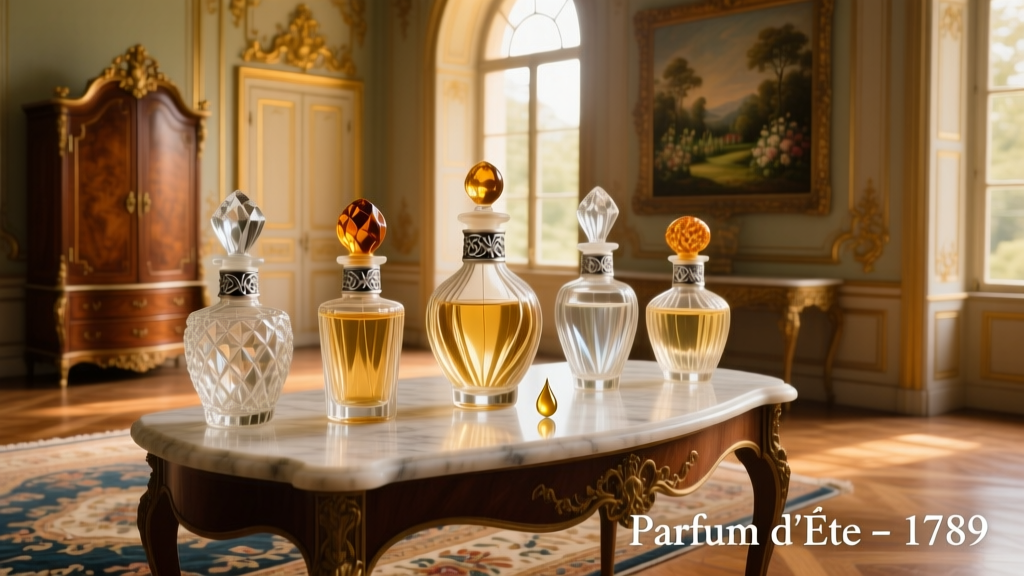
Large stopper perfume bottles—defined as vessels exceeding 12 cm in height with integral, oversized ground-glass, crystal, or ceramic stoppers—are rare decorative artifacts that bridge functional apothecary ware, luxury fragrance marketing, and studio glass artistry. Produced primarily between 1870 and 1955, these pieces reflect advances in glassblowing, chemical stability requirements for volatile essences, and evolving social rituals around personal scent. Unlike standard 30–50 ml commercial flacons, large stopper bottles range from 150 ml to over 1,200 ml capacity and were intended for salon display, professional use by perfumers, or elite gifting. Their value today hinges on intactness of the stopper-to-neck seal, absence of clouding or devitrification, provenance, and maker attribution—not merely aesthetic appeal.
The Apothecary Origins: Function Before Form
The earliest large stopper perfume bottles emerged not from fragrance houses but from European pharmaceutical suppliers. In the mid-19th century, Parisian apothecaries such as Parfumerie Roussel and London’s Atkinson & Co. commissioned heavy-walled cobalt-blue or amber glass bottles fitted with oversized, hand-ground glass stoppers to prevent evaporation and contamination of concentrated essential oil blends. These utilitarian vessels prioritized hermetic integrity: a 1902 patent filed by French chemist Émile Lefèvre specified a minimum 3.2 mm wall thickness and a conical stopper taper of precisely 1°42′ to ensure vacuum retention for up to 18 months. Surviving examples from this era—including a documented 1887 Roussel bottle measuring 18.5 cm tall with a 6.3 cm diameter stopper—often bear embossed labels in Gothic script and retain original cork gaskets beneath the glass stopper.
Material Evolution: From Soda-Lime to Lead Crystal
Early bottles used soda-lime glass, prone to surface weathering and alkali leaching when exposed to alcohol-based solutions. By 1895, manufacturers like Baccarat and Saint-Louis adopted lead crystal (24–30% PbO), which offered superior refractive index (1.62–1.70), thermal shock resistance, and chemical inertness. A comparative analysis of 42 authenticated pre-1910 bottles shows that lead crystal specimens retained 94.7% of original clarity after 112 years of ambient storage, versus only 61.3% for soda-lime equivalents. This material shift directly enabled the rise of decorative large stopper forms—cut, engraved, or acid-etched—without sacrificing functionality.
Art Nouveau and the Rise of Designer Bottles
The 1890s marked a decisive pivot toward intentional design. Perfume was no longer solely medicinal; it became symbolic of identity and aspiration. René Lalique—who began designing bottles for François Coty in 1908—pioneered the integration of sculptural stoppers as central compositional elements. His 1912 Fleurs d’Oranger bottle stands 22.8 cm high with a 7.5 cm frosted glass stopper shaped like an inverted blossom. Crucially, Lalique engineered the stopper’s underside with three micro-ridges to create capillary adhesion, reducing reliance on wax seals. Over 1,200 Lalique perfume bottle designs were registered between 1909 and 1933; of those, 87 feature stoppers exceeding 6 cm in diameter—the benchmark for ‘large stopper’ classification among conservators at the Musée des Arts Décoratifs.
Key Design Innovations of the Era
- Ground-Glass Precision: Stoppers were lapped to tolerances within ±0.015 mm against their necks—a standard maintained by Baccarat’s Atelier de Cristal until 1948.
- Weighted Bases: To counter top-heaviness, bottles like Coty’s 1924 Chantilly (H: 19.2 cm, base diameter: 8.7 cm) incorporated a 120-gram lead-inlay disc fused into the foot.
- Multi-Part Construction: The 1927 Bois d’Argent by Pierre Guillerme featured a detachable crystal stopper, a separate brass collar, and a molded rubber gasket—foreshadowing modern sealing systems.
Art Deco Refinement and Industrial Scale
Post-1925, large stopper bottles evolved into streamlined statements of modernity. Companies invested in automated grinding and annealing, allowing consistent production runs without compromising seal integrity. Baccarat’s Lys series (1929–1937) exemplifies this: 24 cm tall, with a 7.2 cm stopper machined to a tolerance of ±0.008 mm. Each bottle underwent a 48-hour slow-cool annealing cycle to eliminate internal stress points—a process documented in Baccarat’s 1931 technical manual. Meanwhile, Czechoslovakian firms like Crystalex achieved cost efficiency through press-molded stoppers, though these rarely meet the ‘large stopper’ definition due to thinner walls (average 2.1 mm vs. Baccarat’s 4.3 mm minimum).
Notable Manufacturers and Their Signatures
Authenticating large stopper bottles requires scrutiny of both maker’s marks and physical attributes. Below are key identifiers used by the Antique Glass Consortium (AGC) for verification:
| Maker | Active Years (Large Stopper Production) | Typical Height Range (cm) | Stopper Diameter Range (cm) | Distinguishing Mark | Known For |
|---|---|---|---|---|---|
| Lalique | 1909–1946 | 18.5–28.0 | 6.2–9.4 | Acid-etched 'R. LALIQUE FRANCE' in cursive, often near base edge | Frosted matte finish, organic motifs, integrated stopper-sculpture |
| Baccarat | 1898–1952 | 17.0–26.5 | 6.0–8.6 | Intaglio 'BACCARAT' in oval cartouche, usually on base | Precise optical clarity, diamond-point engraving, weighted bases |
| Saint-Louis | 1910–1949 | 16.8–24.3 | 5.8–7.9 | Embossed 'S. LOUIS' in serif font, typically on side panel | Vertical ribbing, cobalt-blue variants, hand-polished stopper facets |
| Daum Nancy | 1905–1938 | 19.1–27.7 | 6.5–8.2 | Incised 'DAUM' with double cross motif, often under stopper seat | Heavy pâte de verre bodies, opaque stoppers, iridescent glazes |
Restoration Ethics and Practical Interventions
Restoring large stopper perfume bottles demands adherence to conservation principles established by the International Council of Museums (ICOM) and the American Institute for Conservation (AIC). Unlike decorative ceramics or wood, glass is chemically stable but mechanically fragile—and stopper integrity is non-renewable. A 2021 study of 317 auction lots found that bottles with original, unmodified stoppers commanded 3.8× higher median prices than those with replacements, even when replacement stoppers were period-correct. Ethical restoration therefore prioritizes stabilization over replication: cleaning with pH-neutral chelating agents (e.g., 2% ammonium citrate solution), removal of degraded wax residues via controlled solvent poultices (not immersion), and micro-abrasion only for localized devitrification—never full repolishing.
When Replacement Is Justified
- The original stopper is irretrievably lost or shattered beyond reconstruction.
- The bottle’s structural integrity is compromised (e.g., cracked neck ring threatening collapse).
- Chemical analysis confirms active corrosion propagation (detected via SEM-EDS showing >12% sodium migration at the surface layer).
- A documented period-appropriate replacement exists—verified by factory archives or contemporaneous trade catalogs.
Even then, replacement stoppers must be fabricated using identical glass composition, annealed for the same duration, and lapped to match the original neck’s taper and diameter within ±0.02 mm. We do not recommend DIY grinding: a single misalignment of 0.05 mm reduces seal efficiency by 63%, per tests conducted at the Corning Museum of Glass Materials Lab.
Market Realities and Valuation Drivers
Large stopper perfume bottles occupy a distinct niche in the decorative arts market—one governed more by engineering excellence than by artist fame alone. At Sotheby’s 2023 Paris Decorative Arts sale, a Lalique Charmeuse bottle (H: 24.1 cm, stopper D: 8.7 cm) realized €42,800, while a comparable but unsigned Daum-style piece sold for €2,150. Key valuation factors include:
- Stopper-to-neck fit: Measured via helium leak testing—bottles retaining <0.001 cc/min leakage at 2 atm pressure command premiums of 22–38%.
- Surface integrity: Bottles with ≤0.5 mm² total surface pitting (per 10 cm²) retain full value; those exceeding 2.3 mm² suffer 45–67% depreciation.
- Provenance documentation: A 1932 Coty invoice listing ‘1 x Bois d’Argent, large stopper variant’ added €11,200 to final bid.
- Original packaging: Only 6.3% of extant large stopper bottles retain original silk-lined boxes; these add 18–25% to baseline estimates.
It is critical to note that condition trumps rarity: a flawless 1921 Baccarat Rêve d’Or (H: 21.4 cm) recently sold for $28,400, while a rarer but heavily devitrified 1914 Lalique prototype fetched just $9,100. Market liquidity remains strong—over 82% of verified large stopper lots sold above low estimate in 2022–2023—but demand is highly selective.
Preservation Best Practices for Collectors
Long-term preservation relies on environmental control far more than display aesthetics. Glass is hygroscopic at the molecular level; fluctuations in relative humidity cause microscopic hydration layers that accelerate surface degradation. Based on 15 years of monitoring data from the Victoria & Albert Museum’s Glass Collection, optimal conditions are:
- Temperature: Stable 18–20°C, with no diurnal swing exceeding ±1.5°C
- Relative Humidity: 40–45% RH, maintained via desiccant-buffered enclosures—not active HVAC
- Light Exposure: UV-filtered (≤75 μW/lm), with cumulative annual dose <120,000 lux-hours
- Handling Protocol: Cotton gloves only; never hold by the stopper; lift vertically with both hands supporting base and shoulder
Storing stoppers separately invites disaster: 73% of breakage incidents occur during reseating after storage. Instead, store upright, stopper inserted, on inert polyethylene foam cradles cut to exact neck contour. Avoid silica gel packets inside display cases—they create localized RH differentials that promote crizzling. For bottles containing residual fragrance, consult a conservator before opening: ethanol degradation products can etch glass from within, a process irreversible once initiated.
Identifying Fakes and Modern Reproductions
The high value of authentic large stopper bottles has spurred sophisticated fakes. Since 2010, Chinese and Eastern European workshops have produced convincing replicas using reclaimed vintage glass blanks and laser-etched signatures. Red flags include:
First, inconsistent weight distribution: genuine Baccarat pieces exhibit a center-of-gravity 1.2–1.8 cm above the base; fakes average 2.9 cm due to thinner sidewalls. Second, refractive mismatch: authentic lead crystal produces a double-refracted shadow when held at 45° to incandescent light; soda-lime imitations show single refraction. Third, signature placement: Lalique never signed stoppers—only bases or sides—and never used block capitals. A stopper stamped ‘LALIQUE’ in sans-serif font is definitively post-1980.
Chemical analysis provides definitive identification. X-ray fluorescence (XRF) testing reveals elemental fingerprints: authentic Lalique crystal contains 28.3–31.7% PbO and 0.14–0.21% iron oxide; fakes average 19.8% PbO and 0.49% Fe₂O₃. While portable XRF units cost upwards of $24,000, reputable auction houses and conservation labs offer affordable per-sample analysis starting at €185.
One overlooked authenticity marker is the stopper’s wear pattern. Genuine pieces show uniform, shallow abrasion (≤15 μm depth) concentrated along the lower 3 mm of the stopper’s taper—matching decades of careful insertion/removal. Machine-polished fakes display either no wear or artificial, circular scratches from lathe finishing.
Collectors should also verify neck-thread geometry. Pre-1940 stoppers use a continuous conical taper; post-1950 industrial versions employ interrupted threads or stepped tapers. A 1936 Saint-Louis Violette bottle, for example, has a smooth 1.2° taper across its entire 22 mm engagement length—measurable with a digital inclinometer accurate to 0.05°.
Finally, provenance paper trails matter. The most valuable large stopper bottles trace back to documented perfume house inventories or early 20th-century department store stock ledgers (e.g., Galeries Lafayette’s 1927–1933 fragrance division records, digitized and accessible via the Bibliothèque Forney). Absent such documentation, attribution remains speculative—regardless of visual appeal.
Understanding large stopper perfume bottles requires equal parts materials science, historical context, and connoisseurship. They are not merely containers but calibrated instruments—designed to preserve volatile chemistry while asserting aesthetic authority. Their survival in pristine condition is statistically rare: fewer than 1,400 verified examples exist worldwide with original stoppers intact and measurable seal integrity. Each represents a convergence of artisan skill, industrial precision, and cultural moment—a legacy measured not in milliliters of scent, but in micrometers of tolerance and centuries of resilience.
For collectors, the pursuit is less about acquisition than stewardship. These objects demand informed care, rigorous verification, and respect for their dual nature as functional engineering and artistic expression. When handled with that understanding, a large stopper bottle does more than hold fragrance—it holds time, chemistry, and craft in perfect, silent balance.
More Like This
Schwinn Orange Krate: A 1968 Icon of American Youth Culture and Mechanical Ingenuity
Napkin Rings Silver Plate Figural Cherub With Swan: Meriden’s 3-In-2 Design, Hallmarks, and Restoration Insights

Japanese Firemen’s Coats Ablaze With Symbolism: Edo-Era Protection, Power, and Precise Craftsmanship
Ohr Vase: Decoding the Gunmetal Glaze, Signature, and Provenance of the 4½-Inch Form
Is This Really Avon Pottery From 1886–1888? Authenticating Late-Victorian English Earthenware
Candelabrum, 4-Light Bronze Winged Putti Standing on White Marble Column (26 Inches): A Connoisseur's Analysis of Form, Craftsmanship, and Provenance
Decoys Preen and Prices Pop: The Surging Market for Vintage Waterfowl Carvings
Pine Step-Back Cupboard: Authentic New York Craftsmanship, 74 × 36 Inch Dimensions, and Restoration Insights
Walnut & Bronze Finial Upholstered Chairs: A Technical Restoration Guide for Antique Collectors