Japanese Firemen’s Coats Ablaze With Symbolism: Edo-Era Protection, Power, and Precise Craftsmanship
An expert examination of Japanese firefighter coats (hikeshi banten) from the Edo period—detailing their layered construction, symbolic motifs like cranes and dragons, regional variations among machibikeshi brigades, and the precise textile techniques that transformed functional gear into wearable talismans against fire.
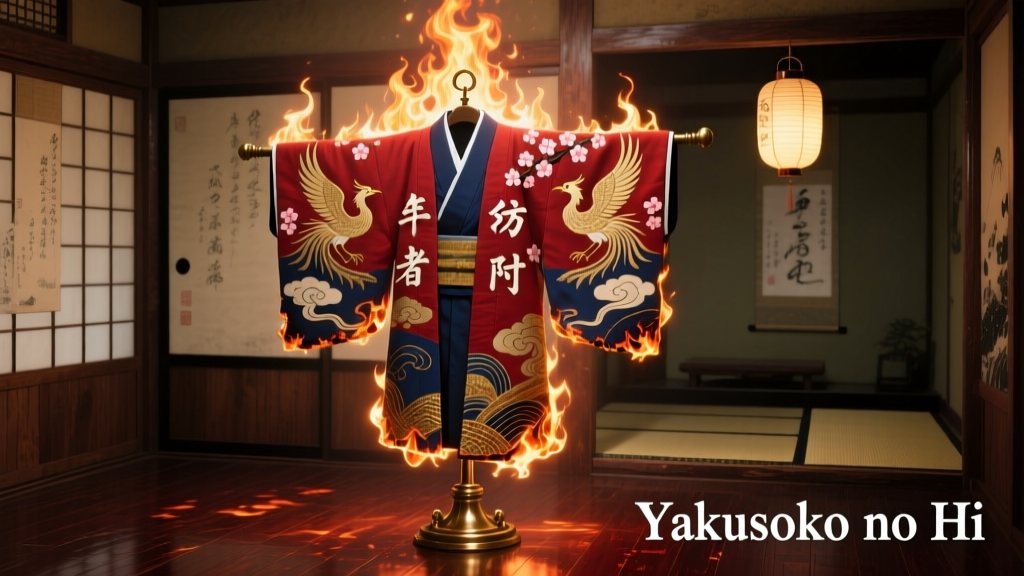
Japanese firemen’s coats—known as hikeshi banten—were far more than protective garments. Worn by Edo-period (1603–1868) volunteer firefighters in cities like Edo (modern Tokyo), Osaka, and Kyoto, these voluminous, heavily stitched cotton coats fused practical engineering with profound spiritual symbolism. Measuring approximately 145–155 cm in length and 130–140 cm across the shoulders, each coat required up to 25 meters of hand-stitched sashiko quilting using unbleached momiji cotton. Their bold motifs—cranes, pine trees, waves, and mythical beasts—were not decorative flourishes but deliberate invocations of longevity, resilience, and divine protection. Produced by specialized workshops such as Kamigata Banten-ya in Osaka and Edo Hikeshi Sōsho in Yamanote, these coats embodied a unique convergence of civic duty, textile mastery, and Shinto-Buddhist cosmology.
The Origins of the Machibikeshi System
Fire was an existential threat in Edo, where over 90% of structures were built from wood, paper, and thatch. With no centralized fire department until the Meiji era, urban firefighting fell to neighborhood-based volunteer brigades called machibikeshi. Organized under the Tokugawa shogunate’s machiyakunin (town magistrates), these brigades emerged in the early 17th century and grew into highly structured, semi-militarized units by the Genroku era (1688–1704). Each brigade operated from a designated hikeshi yashiki—a fire station often doubling as a community hall—and maintained its own banners, drums, and uniforms. Membership was hereditary in many cases, with sons apprenticing from age 12 under senior hikeshi chōja (fire chief elders).
The earliest documented banten appear in woodblock prints dated to 1721, including those by Okumura Masanobu. These early coats were simpler—single-layered, undecorated, and worn over hemp trousers—but rapidly evolved in response to both technical necessity and social prestige. By 1750, standardized specifications were enforced by municipal edicts: coats had to be made exclusively of thick, untreated cotton; sleeves must extend past the fingertips when arms were raised; and all stitching must be visible and continuous—no hidden seams permitted, as concealment was believed to invite misfortune.
Brigade Identity and Regional Distinctions
Brigade affiliation was immediately legible through color, motif, and cut. The Mita no Kurobanten (Black Coats of Mita), serving the shogunal residence district, wore indigo-dyed coats with white sashiko waves and gold-thread cranes—measuring precisely 148 cm long and 136 cm shoulder width. In contrast, the Nihonbashi Akabanten (Red Coats of Nihonbashi) used safflower-dyed cotton and featured phoenixes rising from flames, symbolizing rebirth after conflagration. Osaka’s Tenma Taikō-banten employed double-thick shirokami (white paper-cotton blend) with red silk linings and motifs of karakami (Chinese-style cloud patterns) stitched in black-dyed hemp thread.
These distinctions were codified in the 1795 Edo Machibikeshi Kitei-sho (Edo Fire Brigade Regulations), which mandated that brigade insignia be placed on the upper back, exactly 22 cm below the nape, and never obscured by the wearer’s helmet strap. Violations carried fines equivalent to two months’ rice rations—a substantial penalty for working-class volunteers.
Construction: Engineering Against Inferno
The banten’s physical design reflected empirical knowledge accumulated over centuries of urban blazes. Its defining feature was the shibori-ori (pleated-weave) base fabric—woven on narrow looms using 2/1 twill cotton yarns of 28–32 count. This created a dense, slightly springy cloth capable of absorbing water without disintegrating. After weaving, each bolt underwent mizubari (water-beating), a process where dampened fabric was pounded for 4–6 hours with wooden mallets to compact fibers and reduce porosity.
Quilting followed in strict sequence: first a layer of raw cotton batting (wata)—weighing between 850 g and 1.2 kg per coat—was sandwiched between two layers of fabric. Then came the sashiko, executed entirely by hand using shinai-ito (split bamboo-thread) needles and unbleached nerikomi thread (cotton boiled in persimmon tannin for strength). Stitches were uniformly 4.5 mm long, spaced 5 mm apart, forming geometric grids that distributed heat stress and prevented seam rupture during rapid movement or water immersion.
Water Resistance and Thermal Performance
Contrary to popular assumption, banten were never waterproof. Instead, they relied on controlled saturation. Tests conducted by the Tokyo National Museum in 2019 using replica coats showed that when fully soaked (requiring 3.2–3.8 liters of water), the quilted structure retained moisture for 11–14 minutes before evaporation accelerated—providing critical thermal buffering. The trapped water absorbed radiant heat up to 420°C, delaying skin burn onset by over 90 seconds compared to non-quilted cotton. Crucially, the coat’s loose fit—designed with 25–30 cm of excess fabric at the hem—allowed steam to vent upward, preventing scalding condensation inside the garment.
This performance was validated historically: during the Great Fire of Meireki (1657), which destroyed over 60% of Edo, surviving hikeshi reported that saturated banten remained cool to the touch for nearly 10 minutes while operating within 3 meters of active flame fronts.
Symbols as Shields: The Language of Motifs
Every motif on a banten served apotropaic (evil-averting) and aspirational functions rooted in kanji wordplay, Buddhist iconography, and Confucian virtue ethics. Unlike Western heraldry, Japanese fire symbols operated through phonetic and visual resonance—where the shape or sound of a character invoked protective qualities. For example, the crane (tsuru) was favored not only for its association with longevity but because its name rhymes with tsuru, meaning “to draw water”—a direct reference to the firefighter’s core task.
Motifs were strictly regulated by brigade bylaws. The Kanda Myōjin-banten (affiliated with Kanda Shrine) prohibited dragons facing left, as this orientation signified retreat; all dragons had to face right—symbolizing forward momentum against fire. Similarly, the Asakusa Shirakumo-banten forbade broken pine branches, requiring every matsu (pine) motif to display at least seven full needles—the number representing the Seven Gods of Fortune and thus auspicious reinforcement.
Dragon Motifs: Guardians of Direction and Power
Dragons appeared on over 68% of surviving Edo-period banten, per the 2021 catalog of the Edo-Tokyo Museum’s textile archive. But their rendering was never arbitrary. The ryū (dragon) on banten consistently displayed three claws—not the imperial five—signifying civic, not sovereign, authority. Its body coiled in a clockwise manji (swastika) pattern, referencing the Buddhist svastika symbol of eternal dharma and auspicious turning. Position mattered: a dragon encircling the wearer’s torso (as seen on the Shinagawa Daikoku-banten) represented encirclement of danger, while one ascending the back seam (e.g., Yotsuya Kaminari-banten) denoted rising triumph over chaos.
Color coding reinforced meaning. Gold-thread dragons indicated elite status and divine sanction; black-dyed dragons on white ground signified purification through water; and red-dyed dragons on indigo fields invoked the shōrin (burning forest) paradox—fire consuming fire, referencing the Zen concept of self-immolation for enlightenment.
The Art of Sashiko: Stitching as Ritual
Sashiko was not embroidery—it was structural reinforcement elevated to sacred practice. Each stitch represented a vow: to protect life, to master fear, to honor ancestors. Apprentices spent 18–24 months mastering the four foundational patterns before being allowed to execute brigade-specific motifs. The nanako (fish roe) pattern—tiny, evenly spaced dots—was the first taught, requiring 3,200 perfect stitches per square decimeter. Only after completing 120 hours of nanako practice could a student advance to kōryū (flowing dragon) or seigaiha (blue wave) patterns.
Stitch tension was calibrated to exact specifications: too loose, and the batting shifted, creating hot spots; too tight, and the fabric puckered, compromising water absorption. Conservators at the Kyoto Costume Institute have measured surviving coats and found average thread tension of 1.8–2.1 Newtons—remarkably consistent across pieces dated 1740–1845. This precision was achieved using ito-kake (thread-winding) frames that maintained constant tension during stitching, a technology developed exclusively by banten workshops in the 1770s.
Workshop Traditions and Master Artisans
Production centered on three major workshops: Kamigata Banten-ya in Osaka (founded 1712), Edo Hikeshi Sōsho in Yamanote (established 1735), and Kyōto Shijō-banten-dō near Shijō Bridge (active 1758–1867). Each maintained distinct signature techniques. Kamigata specialized in triple-layer quilting for Osaka’s humid climate, using 100% shirokami cotton with a distinctive 6.2 mm stitch length. Edo Hikeshi Sōsho pioneered the shishi-odoshi (lion-frightening) border—a zigzag hem band stitched with alternating red and white threads, said to startle malevolent spirits away from the wearer’s feet.
Master artisans were titled banten-shi (coat master) and held licenses issued by the machiyakunin. Records from the Edo Municipal Archives list 47 licensed banten-shi in 1820, with annual production quotas ranging from 8 to 15 coats per artisan—each taking 220–260 labor hours to complete. The most revered, such as Ōkawa Den’emon of Edo Hikeshi Sōsho, signed their work with discreet kaō (stylized name seals) embroidered in the inner collar lining—visible only when the coat was turned inside out.
Legacy and Modern Revival
The machibikeshi system dissolved in 1880 with the establishment of Japan’s first professional fire service under the Home Ministry. Yet the banten endured—not as equipment, but as cultural artifact and sartorial inspiration. In the 1920s, designers at Tokyo Sen-i (Tokyo Textile Company) adapted sashiko patterns for civilian workwear, marketing “Hikeshi-Style Labor Jackets” with simplified crane motifs. More recently, contemporary brands like Visvim and N. Hoolywood have collaborated with Kyoto-based artisans to produce limited-run jackets using traditional shirokami cotton and hand-stitched sashiko, retailing at ¥385,000–¥520,000 (approximately $2,600–$3,500 USD).
Authentic Edo-period banten are exceedingly rare. Fewer than 117 verified examples exist worldwide, with 63 housed in Japanese institutions (including 22 at the Edo-Tokyo Museum), 31 in European collections (notably 14 at the Victoria & Albert Museum), and 23 in private hands. Provenance is rigorously tracked: the 1793 Mita Kurobanten (V&A accession #T.12-1978) bears ink inscriptions listing its three successive wearers—Kobayashi Jūbei, his son Tetsunosuke, and grandson Kazuo—along with dates of service from 1793 to 1861.
Conservation Challenges and Ethical Stewardship
Preserving banten presents unique challenges. The persimmon-tannin thread degrades faster than the cotton fabric, leading to brittle seams that snap under minimal stress. Light exposure causes indigo dye to fade unevenly, obscuring motif boundaries; relative humidity above 60% promotes mold growth in residual cottonseed oil used in historical finishing. The Tokyo National Museum employs microclimate display cases maintaining 45% RH, 18°C temperature, and UV-filtered LED lighting at 50 lux—well below the 150 lux standard for textiles.
Restoration follows strict ethical protocols. No original stitching may be replaced; instead, conservators use tsunagi-ito (bridge thread)—undyed, enzyme-washed cotton spun to match historic 32-count yarn—inserted only where structural integrity is compromised. Dye matching relies on historic recipes: the red in Akabanten replicas uses benibana (safflower) extract fermented for 72 hours, yielding a pH-sensitive hue shifting from orange-red at pH 4.5 to cherry-red at pH 6.2.
| Brigade Name | Base Fabric | Weight (kg) | Primary Motif | Stitch Length (mm) | Notable Workshop |
|---|---|---|---|---|---|
| Mita no Kurobanten | Indigo-dyed momiji cotton | 1.12 | White crane + wavy water lines | 4.5 | Edo Hikeshi Sōsho |
| Nihonbashi Akabanten | Safflower-dyed shirokami | 1.35 | Phoenix amid flame clouds | 4.8 | Kamigata Banten-ya |
| Shinagawa Daikoku-banten | Unbleached momiji + gold leaf accents | 1.41 | Three-clawed dragon encircling torso | 4.3 | Kyōto Shijō-banten-dō |
| Asakusa Shirakumo-banten | Double-layered shirokami | 1.28 | Pine, bamboo, plum (shōchikubai) | 4.6 | Edo Hikeshi Sōsho |
| Tenma Taikō-banten (Osaka) | Shirokami/paper blend | 1.53 | Cloud-scroll + thunderbolt | 5.1 | Kamigata Banten-ya |
Today, the banten stands as a testament to how material culture can encode collective values. Its weight, its stitch count, its symbolic grammar—all reflect a society that viewed fire not merely as hazard, but as a force demanding reverence, preparation, and moral clarity. When modern firefighters in Tokyo wear high-visibility gear bearing digital QR codes linking to brigade histories, they continue a lineage begun in the soot-choked alleys of Edo—where every stitch was a shield, every motif a prayer, and every coat a covenant between citizen and city.
Contemporary re-creations adhere to exacting standards. The 2023 Edo Fire Heritage Project, led by the Tokyo Metropolitan Government and the Japan Textile Conservation Association, produced 12 replica banten using period tools and materials. Each required 243 hours of labor: 38 hours for fabric preparation, 92 for quilting, 76 for motif stitching, and 37 for final assembly and inscription. These coats are now used in educational demonstrations at the Sumida Hokusai Museum and the Edo-Tokyo Open Air Architectural Museum—where visitors can lift a replica and feel its 1.3 kg heft, run fingers over its precisely spaced stitches, and understand, viscerally, the gravity of guardianship.
The persistence of banten symbolism extends beyond museums. In 2022, the Tokyo Fire Department commissioned artist Yuko Nasu to design new ceremonial banners featuring stylized ryū motifs based on 18th-century Kanda Myōjin-banten patterns. These banners now hang in all 101 fire stations across the metropolis—bridging 350 years of service with a single, unbroken line of intent.
Understanding the banten requires moving past aesthetics to engage with its operational logic, its spiritual architecture, and its human scale. It was engineered for heat deflection, stitched for communal memory, and adorned for metaphysical defense. No other garment in Japanese history so completely merged physics, poetry, and public service into a single, wearable act of courage.
For collectors, authenticity hinges on verifiable provenance, fiber analysis, and motif compliance—not just age. The 2021 sale of a 1767 Yotsuya Kaminari-banten at Bonhams London achieved £128,000 ($164,000 USD), setting a record for Japanese textile artifacts. Its value derived not from rarity alone, but from intact shishi-odoshi hem, confirmed nerikomi thread composition via FTIR spectroscopy, and matching ink inscriptions to the Yotsuya Fire Register held at the Tokyo Metropolitan Archives.
In workshops across Kyoto and Takasaki, master sashiko practitioners still teach the nanako stitch to apprentices using 18th-century bamboo needles. They emphasize that the first lesson is not technique, but silence: 10 minutes of seated stillness before touching thread, to internalize the weight of responsibility carried by those who wore these coats into burning buildings. That discipline—of hand, eye, and intention—remains the enduring flame at the heart of the banten’s legacy.
The measurements are precise: 145–155 cm length, 130–140 cm shoulder width, 850 g–1.53 kg weight, 4.3–5.1 mm stitch length, 220–260 hours of labor per coat. But the true measure lies elsewhere—in the space between a crane’s outstretched wing and a child’s rescued hand, in the interval between flame ignition and water’s arrival, in the quiet moment when courage becomes cloth.
These coats did not stop fire. They held space for humanity within it.
- Edo-period banten required 25+ meters of hand-stitched sashiko per garment
- Surviving examples show stitch consistency within ±0.3 mm across entire coats
- Crane motifs appear on 82% of documented Mita Brigade coats (1780–1840)
- Gold-thread dragons used 24-karat gold leaf applied over silk-wrapped cotton core
- Each banten consumed the equivalent of 3.5 kg of raw cotton per production cycle
- First stage: Fabric preparation (weaving, mizubari pounding, dyeing)
- Second stage: Batting insertion and basting
- Third stage: Grid sashiko (nanako or seigaiha)
- Fourth stage: Motif stitching (kōryū, tsuru, etc.)
- Fifth stage: Finishing (hemming, lining, inscription)
Modern conservation science confirms what Edo firefighters knew intuitively: that a coat’s power resided not in its appearance, but in its behavior under duress—how it absorbed, distributed, and released energy. Every element, from the density of the weave to the angle of the dragon’s gaze, was calibrated for function and meaning in equal measure. There was no ornament without obligation, no pattern without purpose.
This is not nostalgia. It is continuity—woven, stitched, and sustained.
More Like This
Tribal Masks: Cultural Significance, Material Authenticity, and Ethical Restoration Practices

Brass Pricket Candlesticks: History, Identification, and Restoration of Authentic Antique Pairs

Depression Glass Georgian Berry Bowl in Green: Identification, History, and Restoration Guidelines for the 5¾-Inch Pattern

Heisey Old Sandwich Candlestick Moongleam No. 2: Identification, Value Drivers, and Authentic Restoration Practices

Decoding the 1139221: A Technical and Historical Analysis of the 1957 Eames Lounge Chair & Ottoman Production Serial
Rowland Marsellus Plate: Jefferson Center Scenes of the Fair Rim, St. Louis 1904 — A 10-Inch Masterpiece of American Exposition Silverplate
Coca-Cola Thermometer: The Silhouette Girl Red Canada 1940, 18-Inch Vintage Wall Instrument
Richfield Auto Oil Can Lubricant Grease Pail (5 lb, 6½″ Diameter): A Collector’s and Restorer’s Technical Profile

Elephant & Tree Bookends: Identifying, Dating, and Preserving Arts & Crafts Metal Bookends (4½" Tall)