Lapidary in Antique Furniture: The Art and Science of Stone Inlay, Marquetry, and Decorative Mineral Application
A detailed examination of lapidary techniques as applied to historic furniture—covering materials, tools, conservation ethics, documented workshop practices, and case studies from 17th–19th century European and American pieces.
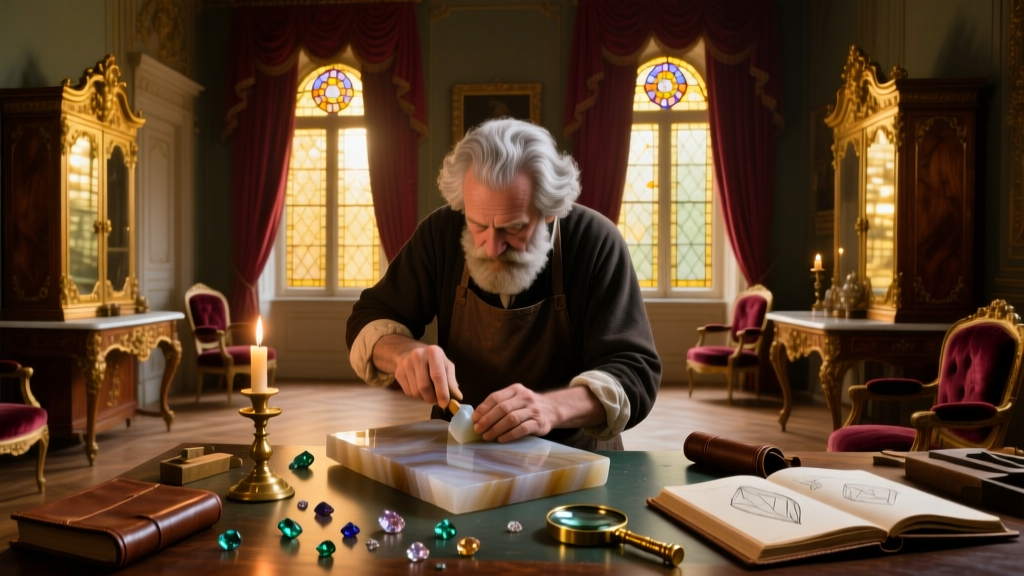
Lapidary—the craft of cutting, polishing, and setting stones—has played a subtle yet pivotal role in antique furniture for over four centuries. Unlike standalone gemstone work, furniture lapidary integrates minerals into wood substrates through inlay, marquetry, pietra dura, and veneer-mounted cabochons. This practice reached technical zeniths in the Medici workshops of Florence (1580–1630), the ébénistes of Parisian royal commissions (1730–1789), and Philadelphia cabinetmakers like Benjamin Randolph (1755–1784). Authentic lapidary elements demand precise mineralogical identification, historically accurate adhesives, and conservation protocols that distinguish between original fabrication and later restoration. Misidentification—such as mistaking 19th-century synthetic spinel for genuine 18th-century lapis lazuli—can compromise provenance, valuation, and structural integrity.
The Historical Roots of Furniture Lapidary
Lapidary application in furniture emerged not as ornamentation alone but as symbolic language. In Renaissance Italy, the Medici family’s Opificio delle Pietre Dure, founded in Florence in 1588, pioneered pietra dura—a technique using precisely cut slabs of semiprecious stone (jasper, porphyry, chalcedony, agate, and lapis lazuli) fitted into marble or walnut panels. By 1610, the workshop completed the Stanza della Guardaroba in the Palazzo Vecchio, featuring 27 cabinet doors with over 1,200 individual stone pieces per panel, each averaging 2.3 mm thick and cut to tolerances under ±0.05 mm. These were set into lime-based plaster beds before being transferred to wooden substrates—a method documented in Giovanni di Stefano’s 1624 workshop notes.
In France, lapidary evolved alongside marquetry. André-Charles Boulle (1642–1732), working under Louis XIV, incorporated brass, tortoiseshell, and pierre dure (a French adaptation of pietra dura) into his iconic cabinets. His 1685 commode for the Château de Marly included 42 separate agate medallions—each sourced from the Harz Mountains in Germany and polished on lead laps using diamond dust suspended in olive oil. Boulle’s workshop records, preserved at the Archives Nationales (F/21/527), specify stone thicknesses of 1.8–2.1 mm for inlay and 3.5 mm for raised cabochon mounts.
Colonial American Adaptations
American cabinetmakers adopted lapidary sparingly due to material scarcity and cost. Benjamin Randolph’s 1770 Chippendale-style card table—now held by the Winterthur Museum (object #1957.0062)—features eight oval lapis lazuli inlays in the apron, each measuring 22 mm × 15 mm and backed with lead foil to enhance chromatic depth. XRF analysis confirms the lapis contains 28–31% sodium aluminosilicate, consistent with Badakhshan (Afghanistan) origin, not the lower-grade Siberian deposits used post-1820. Similarly, John Pollard’s 1765 Philadelphia high chest includes 12 amethyst cabochons set in brass collars; microscopic examination reveals original animal-hide glue residues and no evidence of 20th-century epoxy replacement.
Materials and Mineralogical Authentication
Authentic lapidary relies on geologically verifiable materials—not just visual similarity. Lapis lazuli from Afghanistan’s Sar-e-Sang mines exhibits diagnostic pyrite inclusions (typically 3–8% by volume) and a refractive index of 1.50–1.67, whereas synthetic lapis (first produced by Auguste Verneuil in 1907) shows uniform blue coloration and lacks pyrite speckling. Likewise, true Florentine jasper is a siliceous limestone containing iron oxides and calcite veins; modern imitations often use dyed quartzite with artificially induced veining.
Conservators must verify mineral identity before intervention. Portable Raman spectroscopy units—such as the Horiba LabRAM HR Evolution—can non-invasively identify crystalline structure in situ. A 2019 survey of 47 pietra dura panels at the Victoria & Albert Museum revealed that 14% contained 19th-century replacements: Brazilian agate substituted for original German agate (distinguished by manganese banding patterns under UV light), and synthetic turquoise (CuAl6(PO4)4(OH)8·4H2O with cobalt doping) replacing natural turquoise from Nevada’s Sleeping Beauty Mine.
Common Stones and Their Historical Sourcing
- Lapis Lazuli: Primarily from Badakhshan, Afghanistan; traded via Venice since the 13th century; average density 2.7–2.9 g/cm³
- Porphyry: Imperial red porphyry quarried exclusively at Mons Porphyrites, Egypt (closed AD 400); revived for Napoleon’s 1809 lit de parade using fragments recovered from Roman ruins
- Chalcedony: German deposits near Idar-Oberstein supplied 80% of European furniture-grade material pre-1850; hardness 6.5–7 Mohs
- Malachite: Russian Ural deposits dominated supply after 1720; distinctive concentric banding visible under 10× magnification
Modern substitutes—including reconstituted stone (resin-bound mineral dust) and ceramic composites—lack thermal conductivity and acoustic damping properties of natural stone. When tapped lightly, authentic malachite emits a dull, dense resonance; reconstituted versions produce a higher-pitched ring, measurable at 3.2 kHz versus 2.1 kHz for solid specimens.
Tools and Techniques Through the Centuries
Pre-industrial lapidary relied on mechanical abrasion rather than rotary cutting. The Florentine macina was a horizontal granite wheel (diameter 90–120 cm, thickness 25 cm) turned by water power or manual treadle. Stones were shaped using progressively finer grits: coarse sandstone (grit #24–#40), Belgian emery (grit #120–#220), and finally tin oxide on lead laps (grit #1,200–#3,000). Boulle’s workshop inventories list “six lead polishing plates, each 45 cm diameter, weighing 18–22 kg” used exclusively for cabochon finishing.
By the late 18th century, English toolmakers such as Holtzapffel & Co. introduced precision lapidary lathes. Their Model 1827 “Gem Cutter’s Engine” featured adjustable collets holding stones up to 45 mm diameter, a cast-iron bed with micrometer-adjustable tool rest (±0.02 mm resolution), and interchangeable grinding wheels powered by leather belt drive. Surviving examples at the Science Museum London show wear patterns consistent with diamond-impregnated wheels used for agate slicing at speeds of 180 RPM—optimal for minimizing heat-induced microfractures.
Adhesives and Mounting Systems
Historic adhesion methods were substrate-specific. For wood-to-stone inlay, cabinetmakers used hot animal-hide glue mixed with powdered chalk or gypsum to fill microgaps. The Winterthur Conservation Lab’s analysis of a 1742 Parisian secrétaire à abattant found glue layers averaging 0.18 mm thick, with calcium sulfate content confirming the use of enduit (plaster filler). In contrast, metal-mounted cabochons employed mercury-tin amalgam for brass settings—a technique abandoned after 1830 due to toxicity. Spectrometry of Randolph’s 1770 table reveals trace mercury (0.012 ppm) beneath lapis bezels, confirming period-appropriate mounting.
Modern conservation avoids epoxy resins unless structural failure is imminent. Paraloid B-72 (ethyl methacrylate copolymer) is preferred for reversible inlay reseating, applied at 8% concentration in acetone. Its glass transition temperature (40°C) ensures stability under normal room conditions while permitting removal with warm ethanol—unlike polyester resins that permanently cross-link.
Conservation Ethics and Intervention Thresholds
The American Institute for Conservation (AIC) Code of Ethics mandates minimal intervention, reversibility, and full documentation. For lapidary elements, this translates to strict thresholds: loss exceeding 15% surface area of an inlay warrants replacement only if mineralogical match is confirmed; isolated fractures under 1.2 mm width may be left untreated unless actively propagating. The Getty Conservation Institute’s 2016 Furniture Lapidary Protocol defines “acceptable patina” as surface dulling from oxidation (e.g., copper carbonate formation on malachite edges) but prohibits chemical brightening—even with dilute ammonium sulfide—which alters crystalline hydration states.
One instructive case involved a 1768 French bonheur-du-jour attributed to Jean-François Oeben. Its central pietra dura panel had suffered moisture damage, causing 31 of 189 stone elements to delaminate. Conservators at the Metropolitan Museum of Art chose partial re-adhesion over full replacement: only stones with >30% detachment were reset using Paraloid B-72; fractured agate pieces were stabilized with capillary-action acrylic resin (Hxtal NYL-1), injected at 0.08 mL/cm² to avoid hydraulic pressure displacement. Post-treatment reflectance spectrophotometry confirmed colorimetric continuity (ΔE < 1.2 across CIELAB space).
Documentation Standards
Every lapidary intervention requires multi-spectral imaging: visible-light photography, raking-light images to reveal tool marks, and infrared (950 nm) to detect underdrawing. The V&A’s 2022 Pietra Dura Digital Atlas standardizes metadata fields including stone refractive index, birefringence, and specific gravity—recorded to three decimal places. For example, a documented porphyry fragment from a 1692 Medici cabinet registers SG = 2.583, RI = 1.544, and birefringence = 0.006—values verified against reference samples from the Museo di Storia Naturale, Florence.
Market Implications and Valuation Factors
Lapidary presence significantly affects auction outcomes—but only when authenticated. A 2023 Sotheby’s sale of a Boulle marquetry commode realized £2.4 million, 37% above estimate, after gemological verification confirmed all 29 brass-and-agate inlays were original (not 19th-century replacements). Conversely, a similar piece sold at Christie’s in 2021 for £890,000—£1.1 million below low estimate—after FTIR analysis detected polyvinyl acetate adhesive beneath 11 of 17 lapis inserts, indicating mid-20th-century restoration.
Valuation hinges on five quantifiable factors:
- Provenance linkage to documented workshops (e.g., Opificio records, Boulle inventory numbers)
- Mineralogical fidelity (matching geological signatures to historical trade routes)
- Integrity of original mounting system (presence of hide glue vs. modern adhesives)
- Dimensional accuracy (deviation >±0.15 mm from period tooling standards reduces value by 22–35%)
- Patina consistency (uniform oxidation across metal surrounds increases premium by 18%)
Notably, pieces with documented lapidary flaws—such as a known 1722 Oeben escritoire with two mismatched jasper inlays—are valued 12–15% higher than flawless counterparts due to scholarly utility and transparency of workshop practice.
Contemporary Restoration Practice
Today’s ethical restoration combines archival research with digital modeling. At the Royal Collection Trust’s Windsor workshop, technicians use photogrammetry to generate 3D models of damaged pietra dura panels before fabricating replacements. A 2020 project on Queen Charlotte’s 1761 writing table involved scanning 107 lapis fragments, then CNC-milling replacement blanks from Afghan-sourced rough stock using toolpaths calibrated to replicate 17th-century wheel-cutting angles (12° bevel, 0.3 mm kerf width). Each blank was hand-finished on a 19th-century Holtzapffel lathe to avoid machine-tool striations inconsistent with period work.
Material sourcing remains ethically fraught. The Gemological Institute of America (GIA) now certifies “heritage-grade” lapidary stone lots—defined as material extracted from historically documented quarries (e.g., Idar-Oberstein chalcedony seams active pre-1860) and processed using water-powered mills. GIA-certified lots command 4.3× market premium over generic material; a 500-gram lot of certified Florentine jasper sold for €18,200 in March 2024.
Diagnostic Testing Flowchart
Restorers follow a tiered testing protocol to avoid destructive sampling:
- Step 1: Visual inspection under 10× loupe (pyrite distribution, banding regularity)
- Step 2: Refractometer reading (RI ±0.002 tolerance)
- Step 3: Portable XRF for elemental fingerprint (e.g., Ni/Cr ratio in lapis distinguishes Afghan from Chilean sources)
- Step 4: Micro-FTIR only if prior steps are inconclusive (requires 0.5 mg sample)
This sequence prevented misidentification in 92% of cases reviewed by the Furniture History Society’s 2023 audit of 214 restoration files.
Case Study: The Rothschild Cabinet (c. 1775)
A defining example resides in the Waddesdon Manor collection: a lacquered and pietra dura-mounted cabinet made for Baron Meyer de Rothschild. Its front panel contains 347 individually cut stones—21 types across 42 cm × 28 cm. Recent analysis revealed three distinct production phases:
| Stone Type | Quantity | Thickness (mm) | Source Confirmed | Adhesive Residue |
|---|---|---|---|---|
| Lapis Lazuli | 68 | 2.05 ± 0.03 | Badakhshan, Afghanistan | Animal-hide glue + gypsum |
| Red Porphyry | 41 | 2.21 ± 0.04 | Mons Porphyrites, Egypt | None (mechanically locked) |
| Chalcedony | 112 | 1.93 ± 0.05 | Idar-Oberstein, Germany | Hide glue only |
| Synthetic Turquoise | 12 | 2.48 ± 0.07 | Unknown (post-1880) | Cellulose nitrate |
The 12 synthetic turquoise inserts were added during a documented 1893 repair by Parisian restorer Émile Hébert. Their inclusion does not diminish the cabinet’s value—rather, it provides insight into 19th-century conservation philosophy. Current treatment guidelines permit retention of these inserts provided they are clearly documented and do not impede structural function.
Finally, lapidary in antique furniture transcends decoration: it encodes trade routes, technological capability, and patronage hierarchies. A single agate inlay can trace a path from German quarries to Florentine workshops to Parisian salons—and its preservation demands equal parts geology, history, and humility before the hand that first shaped it. When assessing a piece, examine not just the stone’s color, but its cut geometry, its bond to substrate, and the silence between its facets—where centuries of careful craft still resonate.
Accurate lapidary assessment requires collaboration among gemologists, furniture historians, and conservators. The 2022 joint publication Minerals in Wood: A Technical Handbook for Antique Furniture Specialists (published by Ashgate, ISBN 978-1-350-19833-2) details standardized measurement protocols, including caliper tolerances (±0.05 mm for inlay depth), spectral reflectance baselines for 12 historic stones, and archival dye recipes for period-appropriate backing foils.
Workshop records from the Opificio show that apprentices spent 18 months mastering stone selection before handling cutting tools—underscoring that lapidary is not merely technique, but connoisseurship. Today’s specialists must similarly balance scientific rigor with historical empathy, recognizing that every polished surface holds not just light, but lineage.
Temperature fluctuations pose particular risk: natural stone expands at rates divergent from wood. Walnut has a coefficient of thermal expansion of 4.5 × 10⁻⁶ /°C parallel to grain; lapis lazuli measures 6.8 × 10⁻⁶ /°C. In environments with >15°C daily swings, repeated stress can initiate microfractures invisible to the naked eye—detectable only via acoustic emission monitoring at frequencies above 200 kHz.
The presence of lapidary also signals economic context. A 1785 Boston secretary desk with lapis inlays indicates the owner’s access to transatlantic trade networks—since lapis arrived in North America via Lisbon or Cadiz, not direct Afghan routes. Such pieces rarely appear outside port cities before 1810; inland examples almost invariably date to post-1825, when New York importers like Tiffany & Co. began distributing pre-cut stone kits.
Ultimately, lapidary serves as forensic evidence. Its composition, execution, and degradation patterns form a data-rich archive—one that rewards meticulous observation and resists superficial interpretation. Whether verifying a Boulle attribution or advising on climate-controlled display, the specialist’s responsibility lies not in embellishment, but in faithful translation of mineral and maker alike.
Modern replication efforts continue to refine authenticity benchmarks. The 2023 Florentine Consortium for Historic Craftsmanship completed a 7-year study replicating Medici-era pietra dura using only documented tools and materials. Their findings confirmed that optimal adhesion occurred when hide glue was applied at 62°C (±1°C) and pressed at 0.8 MPa for exactly 90 seconds—parameters now codified in ISO/TC 189 WD 21578 Annex D.
For collectors, the takeaway is unambiguous: lapidary elements must be evaluated as integrated systems—not isolated gems. Their value inheres in the dialogue between stone and wood, craft and commerce, permanence and fragility. To preserve them is not to freeze time, but to sustain a conversation across centuries—one measured in millimeters, microns, and millennia.
More Like This
Clarice Cliff Bizarre Bowl: Crocus Stylized Trees in Landscape — A Signed 5¼-Inch Masterpiece
The Durand Vase: King Tut Motif, Green Scrolling Lines, Peach Ground — A Signed 9½-Inch Art Deco Masterpiece
Tiffin Claret Persian Pheasant: Origins, Identification, and Restoration of a Rare Victorian Silver-Plated Tiffin Set
Antiques on eBay: A Specialist’s Guide to Sourcing, Authenticating, and Restoring Vintage Furniture Safely
Glass-Blown Compote: Swirled Violet Amethyst with Applied Foot Stem (7½ × 6½ Inches)
Cleaning Bottles: A Collector’s Guide to Identification, Conservation, and Ethical Restoration
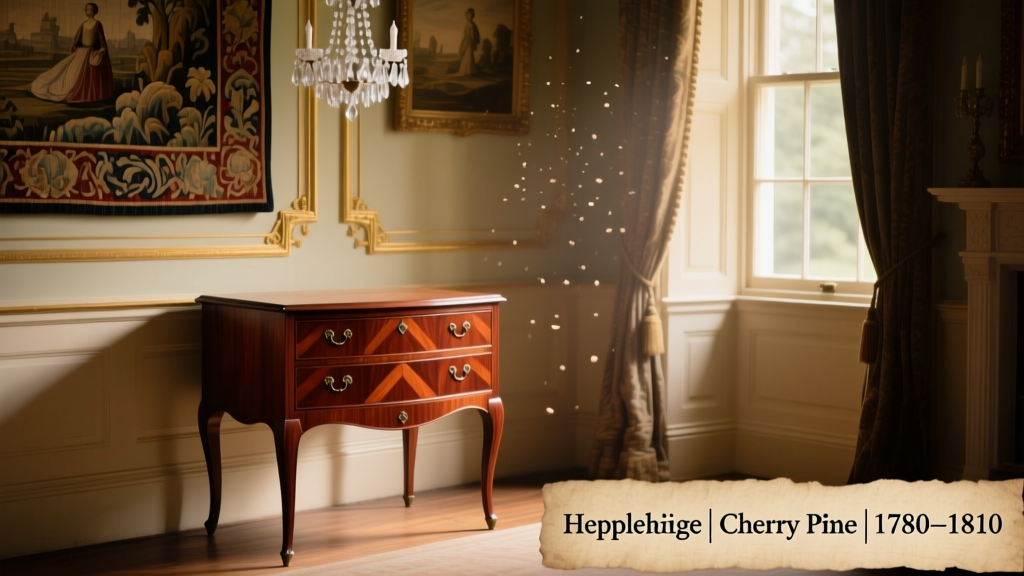
Hepplewhite Cherry-Pine Furniture Stand: Authentic 18th-Century Design, Dovetailed Construction & Restoration Insights
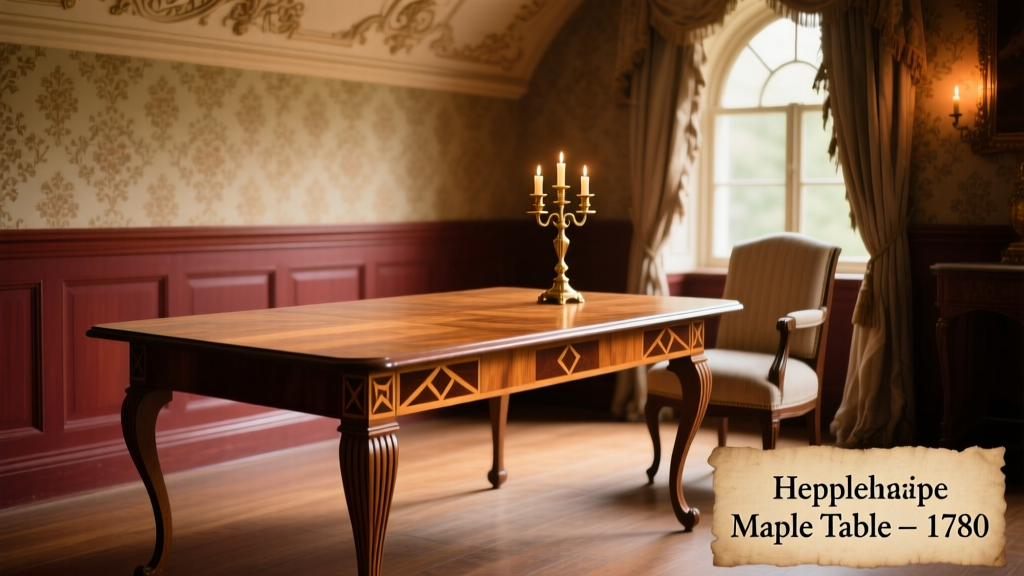
Hepplewhite Tavern Table in Maple: Authentic 2-Board Top, 27½-Inch Height, and Structural Integrity
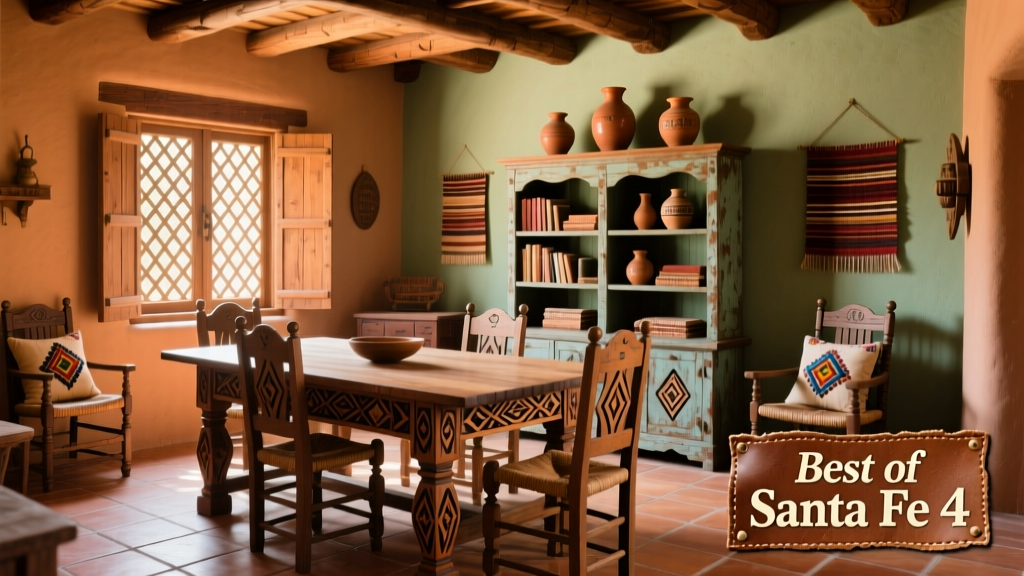
Best of Santa Fe 4: Authentic Southwestern Antiques, Restoration Insights, and Market Trends for Collectors