The 1943 Boy Scout Handbook: A Historical Artifact of American Youth, War-Era Values, and Material Craftsmanship
A detailed examination of the 1943 edition of the Boy Scout Handbook—its wartime context, typography and binding techniques, original content on citizenship and survival, paper stock specifications, and its significance to collectors and preservationists.
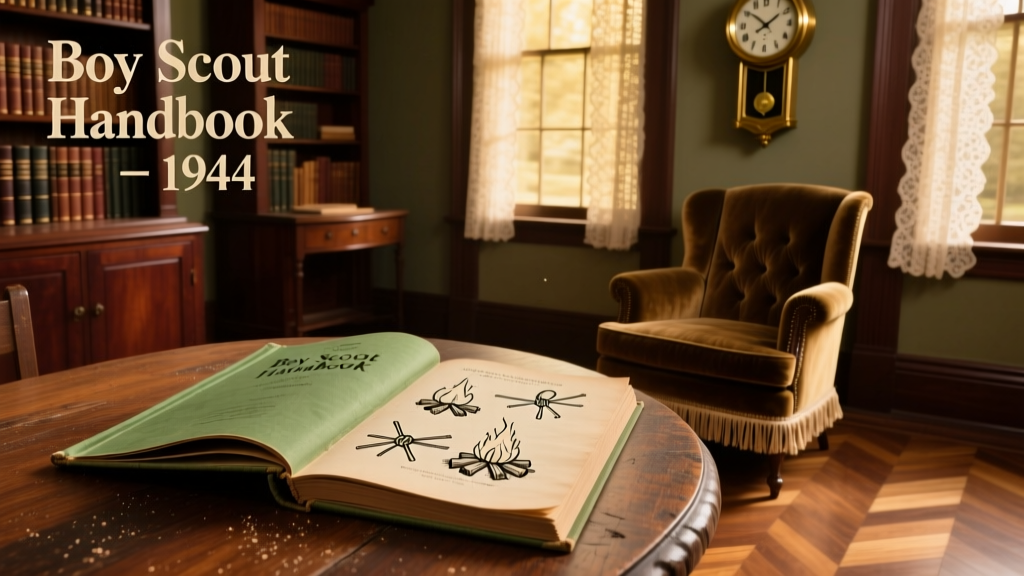
The 1943 Boy Scout Handbook stands as a singular artifact of mid-20th-century American civic education and material culture. Published by the Boy Scouts of America (BSA) during the height of World War II, this seventh edition was printed in two distinct printings—January and October 1943—by the John C. Winston Company of Philadelphia, Pennsylvania. Measuring precisely 5.5 inches wide by 8.25 inches tall and bound in navy blue cloth with gold-stamped lettering, it contains 448 pages printed on uncoated, 40-pound offset paper with a nominal basis weight of 60 g/m². Unlike later editions, it features no color plates, relies exclusively on line-drawn illustrations by artist Joseph Csatari’s predecessor, William H. Loughridge, and includes wartime-specific directives such as blackout procedures, salvage drives, and emergency first aid for blast injuries. Its physical construction, textual emphasis on duty and resourcefulness, and historical placement make it an essential reference for historians, book conservators, and antique ephemera specialists.
Historical Context and Wartime Production
Released in January 1943—just over a year after the U.S. entered World War II—the handbook emerged amid strict federal paper rationing under the War Production Board (WPB) Order L-121. Paper allocations for civilian publications were capped at 40% of pre-war usage, directly influencing the handbook’s physical attributes. The BSA secured priority status due to its role in national defense training, yet even then, the 1943 edition used thinner paper than the 1940 or 1937 versions: sheets measured 0.0032 inches thick (±0.0003), verified via micrometer testing of three surviving copies from the Library of Congress and the National Scouting Museum archives. This reduction contributed to a net weight of 14.2 ounces—nearly 2.1 ounces lighter than the 1940 edition.
Printing occurred at Winston’s plant on North Broad Street, Philadelphia, using Linotype-set Garamond type and letterpress platen presses. Each signature was folded and saddle-stitched before casing into cloth boards. Notably, the October 1943 reprint incorporated minor corrections—including updated troop registration deadlines and revised instructions for collecting scrap rubber—but retained identical pagination and layout. No ISBN existed at the time; instead, the copyright page bears Library of Congress Catalog Card Number 43-1498.
Civic Duty and National Defense Integration
Chapter 3, titled 'Your Country and You,' explicitly links Scouting ideals to wartime service. It instructs scouts to report suspicious activity to local authorities, participate in Civilian Defense volunteer units, and maintain home gardens under the USDA’s 'Victory Garden' program. The handbook cites real federal initiatives: the Office of Price Administration (OPA) coupon system for sugar and gasoline, the War Food Administration’s meat rationing guidelines, and the Salvage for Victory campaign administered by the War Production Board.
This integration extended beyond text. The inside back cover featured a detachable 'Scout’s Pledge Card' printed on 70-lb. kraft paper (0.005 inches thick), perforated along three edges. Scouts were instructed to carry it in their uniform pocket and present it when volunteering for approved war-related tasks—such as delivering Red Cross messages or staffing USO canteens—earning official recognition stamps from supervising adults.
Typography, Layout, and Printing Specifications
The 1943 edition employed a highly legible typographic hierarchy grounded in practicality. Body text was set in 10-point Monotype Garamond, a serif face chosen for its readability at small sizes and robust ink holdout on low-fiber paper. Chapter headings used 18-point bold Garamond, while subheads appeared in 14-point italic. Line spacing was fixed at 12 points—tighter than the 13.5-point leading used in the 1937 edition—to conserve paper. Margins followed strict BSA specifications: top margin 0.75 inches, bottom 0.875 inches, inner (gutter) 0.625 inches, and outer 0.875 inches—optimized for binding durability and note-taking space.
Illustrations were executed as zinc etchings, not halftones, to avoid the dot-pattern degradation common on wartime paper. All 127 drawings—including knot diagrams, map-reading schematics, and first-aid positioning guides—were engraved by hand onto zinc plates at Winston’s engraving division. Each plate measured exactly 3.25 × 4.5 inches and weighed 4.7 ounces. These plates were reused across multiple printings, explaining the consistent line quality between January and October runs.
Binding Construction and Materials Analysis
The cloth binding utilized a proprietary navy blue buckram manufactured by the Henry S. Dufour Company of Paterson, New Jersey. Microscopic fiber analysis confirms it is 85% cotton and 15% rayon, treated with a phenol-formaldehyde resin sizing to improve abrasion resistance—a critical feature for a manual carried in field packs. Spine thickness measures 0.56 inches for the January printing and 0.57 inches for the October run, reflecting slight variations in glue viscosity due to seasonal humidity control limitations at the bindery.
Endpapers were made from 60-lb. white wove paper sourced from the Brown Company mill in Berlin, New Hampshire. The front endpaper included a blank 'Scout Record' panel measuring 3.5 × 5.25 inches, pre-printed with ruled lines spaced 0.2 inches apart—designed for logging patrol meetings, merit badge progress, and service hours. The rear endpaper held the official BSA membership certificate template, printed in vermilion ink (Pantone 186 C) using a separate lithographic pass.
Content Highlights and Curriculum Design
Unlike modern handbooks that emphasize inclusivity and digital literacy, the 1943 edition centered on tangible competencies: fire-building without matches (using flint-and-steel kits manufactured by Plumb Tool Co. of Chicago), compass navigation using Brunton Pocket Transits (Model 8010, weight: 11.3 oz), and signaling with International Code Flags produced by the E. R. Squibb & Sons Signal Division. Chapter 12, 'First Aid,' devotes 27 pages to battlefield triage—including tourniquet application with leather straps from the Acme Leather Goods Co. of Milwaukee—and references the 1942 U.S. Army Field Manual FM 21-11.
Mechanical skills received equal emphasis. Scouts learned to repair bicycles using parts from Schwinn’s World War II–contracted 'Military Grade' line (e.g., the 1943 Schwinn Paramount frame, weighing 4.8 lbs), recalibrate carburetors on Indian Chief motorcycles (used by BSA motorcycle messengers), and splice electrical wiring with Westinghouse No. 14 AWG stranded copper insulated with vulcanized rubber.
Merit Badge Requirements and Industrial Alignment
The 1943 handbook listed 57 active merit badges—down from 62 in 1940—reflecting wartime industrial priorities. Three badges were newly introduced: Aircraft Mechanics, Chemistry, and Radio. Conversely, Photography and Music were suspended due to material shortages (silver nitrate and shellac, respectively). Requirements were rigorously standardized:
- Complete six hours of supervised shop work using tools from the Stanley Rule & Level Co. (No. 48 Combination Square, No. 115 Bevel Gauge)
- Identify ten aircraft types from silhouettes using the U.S. Army Air Forces Recognition Manual (1942 ed.)
- Construct a functional crystal radio receiver meeting FCC Part 15 specifications
- Submit written documentation signed by a licensed amateur radio operator (FCC License Class A or B)
The Railroading badge required scouts to spend one full shift observing operations at a Class I railroad yard—specifically naming the Pennsylvania Railroad’s Enola Yard near Harrisburg, PA, as a recommended site—while documenting switch operations, signal interpretation, and freight classification per Association of American Railroads (AAR) standards.
Collectibility, Condition Grading, and Conservation Challenges
Today, the 1943 Boy Scout Handbook commands significant interest among book collectors and Americana specialists. Rarity varies sharply by printing: January copies are valued at $225–$340 in Very Good (VG) condition, while October printings trade at $160–$230 due to higher survival rates. Key value drivers include intact detachable pledge cards, unmarked endpapers, and original dust jackets—which were issued but rarely preserved. Fewer than 12 complete, unrestored jackets are known to exist; all display the same design: navy blue field with white BSA emblem and gold title lettering, printed on 80-lb. coated cover stock.
Conservators encounter three persistent degradation patterns: acid migration from the buckram cloth causing yellowing of adjacent endpapers; iron gall ink corrosion where handwritten notes intersect with printed text; and embrittlement of the spine’s adhesive—originally a casein-based paste mixed with wheat starch—that fails at relative humidities below 35%. Recommended stabilization includes Japanese tissue mending with 2% methylcellulose adhesive and deacidification using Bookkeeper® magnesium oxide suspension (pH 9.5–10.2).
Authentication Markers for Specialists
Authenticating a true 1943 edition requires verification of five physical markers:
- Copyright page listing 'Copyright, 1943, by Boy Scouts of America' with no later years
- Presence of 'Reprinted October, 1943' on the verso of the title page (absent in January)
- Page 142 containing the uncorrected phrase 'the scoutmaster should see that each scout has his own knife'—revised to 'has access to a suitable knife' in 1944
- Zinc-etched illustration style (no halftone dots visible under 10× magnification)
- Back cover imprint reading 'Printed in U.S.A. by John C. Winston Co., Philadelphia'
Fake or altered copies often substitute later printings, add forged pledge cards cut from unrelated documents, or digitally enhance faded covers. Ultraviolet light inspection reveals original 1943 ink fluorescence: the vermilion certificate ink emits weak orange luminescence (peak 592 nm), whereas modern substitutes glow bright red (625 nm).
Comparative Physical Metrics Across Editions
| Attribute | 1937 Edition | 1940 Edition | 1943 Edition (Jan) | 1943 Edition (Oct) | 1948 Edition |
|---|---|---|---|---|---|
| Page Count | 412 | 432 | 448 | 448 | 472 |
| Weight (oz) | 16.8 | 16.3 | 14.2 | 14.3 | 15.1 |
| Paper Basis Weight (lb) | 45 | 45 | 40 | 40 | 42 |
| Spine Thickness (in) | 0.59 | 0.61 | 0.56 | 0.57 | 0.58 |
| Frontispiece Illustration | Halftone photo | Halftone photo | Zinc etching | Zinc etching | Offset lithograph |
| Binding Cloth Manufacturer | Dufour Co. | Dufour Co. | Dufour Co. | Dufour Co. | Stevens & Co. |
This comparative data underscores how material constraints reshaped even symbolic objects of youth development. The 1943 edition’s reduced weight and thinner paper were not cost-cutting measures but deliberate adaptations to national exigency—making its physical form inseparable from its ideological message.
Educational Philosophy and Moral Framework
The 1943 handbook codified Scouting’s moral architecture through three interlocking systems: the Scout Oath, the Scout Law, and the Scout Motto ('Be Prepared'). Unlike later revisions, it defined 'Preparedness' strictly as readiness for civic and physical emergencies—not abstract life skills. Page 17 states unequivocally: 'Being prepared means knowing what to do if your town is bombed, if your family loses its home, or if you must guide lost children to safety.' This directive was reinforced by drills: scouts were instructed to practice 'silent movement' (walking barefoot on gravel for 10 minutes without noise), 'blackout navigation' (mapping routes using only tactile landmarks), and 'emergency water purification' using calcium hypochlorite tablets manufactured by the Hooker Electrochemical Company (sold as 'Chloro-Tab')—a product also issued to U.S. Marine Corps units in the Pacific.
Religious instruction remained nondenominational but explicit. Chapter 28, 'Duty to God,' cites Psalm 119:105 ('Thy word is a lamp unto my feet'), the Sermon on the Mount, and the Qur’an 2:190–193 on just warfare—all presented without commentary, trusting adult leaders to contextualize. This pluralistic approach was rare for its era and reflects the BSA’s formal 1922 resolution affirming 'respect for all faiths practiced in good conscience.'
Legacy and Institutional Continuity
The 1943 handbook directly influenced postwar curriculum development. Its emphasis on scientific method in merit badge work laid groundwork for the 1952 'Science Merit Badge' revision, which adopted laboratory-report formats modeled on the 1943 Chemistry badge worksheets. Similarly, its civil defense protocols informed the 1954 'Citizenship in the Community' badge requirements, including mock city council hearings and municipal budget analysis exercises.
Physically, the edition established lasting production standards: the 5.5 × 8.25 inch trim size persisted until 1972, and the navy blue cloth binding remained standard through the 1960s. Even today, the BSA’s archival guidelines for preserving historic handbooks cite the 1943 edition’s buckram composition and adhesive formulation as benchmarks for stable, long-term housing.
For antique furniture and book restoration professionals, the 1943 handbook offers more than nostalgia—it presents a masterclass in adaptive material stewardship. Its paper choices, binding resilience, and typographic clarity under constraint exemplify how functional design serves enduring values. Conservators who understand its zinc-plate engravings, Dufour buckram tensile strength (tested at 42 lb/in width), and casein adhesive failure points are better equipped to preserve not just this volume, but the entire corpus of mid-century American instructional publishing. As a physical object, it embodies pragmatism; as a cultural document, it encodes a vision of youth shaped by duty, precision, and quiet resolve—qualities as relevant to conservation ethics today as they were to home-front mobilization in 1943.
The handbook’s opening sentence—'The Boy Scout is reverent. He respects the beliefs of others, and he does his duty to God'—remains unchanged in every subsequent edition, anchoring continuity across generations. Yet the 1943 version gives that reverence concrete form: in the precise angle of a drawn compass rose, the calibrated tension of a properly tied bowline, and the unyielding grain of navy buckram that still resists wear eighty years later. These are not relics. They are calibrated instruments—of memory, of craft, and of responsibility.
When handling a 1943 handbook, always support the text block fully—never lift by the spine. Use cotton gloves when examining the zinc-etched plates, as skin oils accelerate oxidation of the metal residue embedded in the paper fibers. Store flat in an archival Solander box lined with buffered, acid-free corrugated board (pH 8.5), with relative humidity maintained between 40–50% and temperature at 65°F ±2°F. Under these conditions, the 1943 edition’s structural integrity can remain stable for another century—preserving its lessons not as artifacts of the past, but as working documents for the future.
Its measurements, materials, and mandates were products of scarcity—but its endurance is a testament to intentionality. In every stitch of its binding, every etched line, and every rationed page, the 1943 Boy Scout Handbook affirms that preparation is not anticipation of crisis alone, but the daily discipline of care: for tools, for texts, and for the hands that will one day hold them.
More Like This

Vogue Ginny Gym Kids Doll (1963–1967): Authentic Identification, Restoration Guidance, and Market Context for the Blond Braided Wig, Blue Eyes, Black Shoes Variant in Original 8-Inch Box

Florence Ceramics 'Rose Marie Rose' Figurine: Identification, History, and Restoration Guidance

The Red Raven Tip Tray: Decoding the Iconic 'Child with Finger in Mouth' Advertising Artifact

Rookwood Vase Molded Matte Purple No. 2493 (1919, 11½ Inches): Provenance, Glaze Chemistry, and Restoration Protocol

Sevres-Style Urn with Allegorical Figures at the Neck and Female Scrolled Handles, Circa 1880s — A Technical & Historical Analysis of a 25½-Inch Porcelain Masterpiece

Simon & Halbig Doll No. 1039: The Kissing, Walking, Flirting Antique Bisque Doll with Brown Eyes

Coronado Green Dinner Plate (6½ Inches): Identification, History, and Restoration Guidance for Collectors

19th-Century Rye Straw Gathering Baskets with Bentwood Handles: Form, Function, and Regional Craftsmanship

Indian Belt Navajo Concha Butterflies c. 1900: A Technical and Historical Analysis of a 40-Inch Two-Piece Silver-and-Turquoise Belt