Pine Drop Leaf Table, 72 × 38 Inches: History, Identification, Restoration, and Value Assessment
A detailed expert analysis of vintage pine drop leaf tables measuring 72 inches long by 38 inches wide—including construction techniques, maker identification (e.g., Heywood-Wakefield, Lane, Ethan Allen), wood grain patterns, hardware diagnostics, structural integrity checks, and step-by-step conservation protocols for collectors and restorers.
Understanding the Pine Drop Leaf Table: Dimensions, Function, and Historical Context
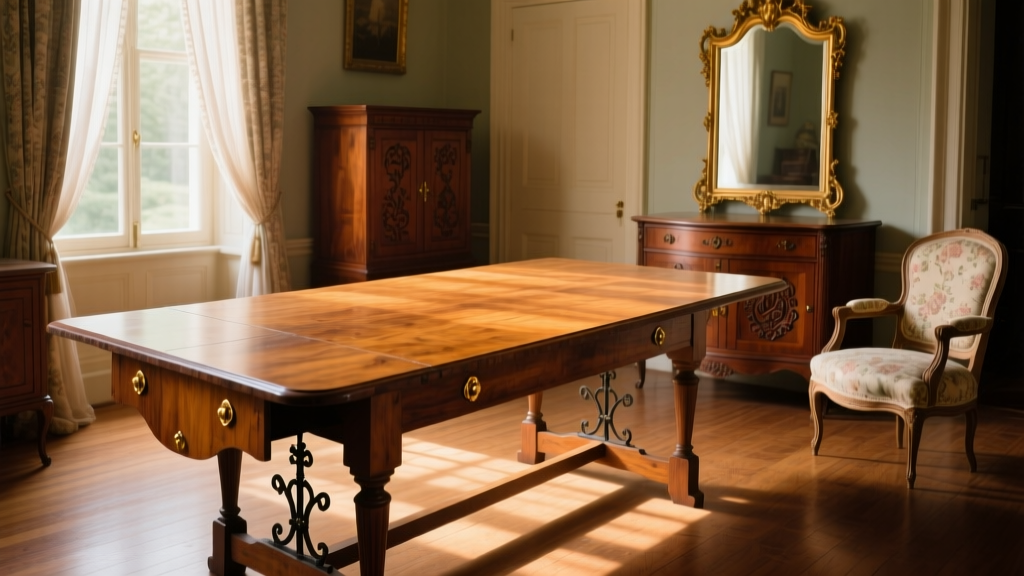
A pine drop leaf table measuring 72 inches in length and 38 inches in width represents a classic American vernacular form that flourished between 1890 and 1945. When both leaves are extended, this configuration yields a generous 72 × 38-inch surface—ideal for dining six to eight people—while folded down to its closed width of approximately 36 inches (with leaves fully dropped), it occupies minimal floor space: roughly 36 × 38 inches. The standard height for these pieces ranges from 28.5 to 29.25 inches, with most examples built to match contemporary chair seat heights of 17–18 inches. This specific size was not arbitrary: it aligned precisely with pre-World War II lumber standards—particularly the common 1×10 and 1×12 eastern white pine boards used for tabletops and aprons—and responded directly to urban apartment constraints in cities like Boston, Chicago, and Philadelphia, where multifunctional furniture was essential.
Pine was selected for economic and workability reasons—not aesthetic prestige. Eastern white pine (Pinus strobus) dominated production due to its straight grain, low density (25–30 lbs/ft³ air-dried), and resistance to warping when properly quarter-sawn. Unlike oak or walnut, pine accepted shellac and milk paint readily, making it ideal for mass-produced cottage industry furniture. Major manufacturers including Heywood-Wakefield (founded 1826), Lane Furniture (established 1912), and the Indiana-based Hoosier Manufacturing Company produced thousands of these tables under catalog numbers such as Heywood-Wakefield’s Model 427-B (introduced 1923) and Lane’s ‘Colonial Revival No. 814’ (1936). These were rarely signed but often bear stamped factory marks on the underside of the frame or inside drawer interiors—typically ink-stamped codes like ‘HW-427B-1928’ or embossed metal tags reading ‘LANE • QUINCY • ILL.’
Construction Anatomy: Identifying Authentic Period Features
Authentic pre-1945 pine drop leaf tables exhibit consistent structural signatures. The base typically consists of four turned legs joined by an H-stretcher or double-cradle stretcher system, secured with wooden pegs or cut nails—not screws or dowels. Legs are usually tapered from 2.25 inches square at the top to 1.75 inches at the foot, with subtle lathe-turned rings at the midpoint—a hallmark of Heywood-Wakefield’s 1920s output. The apron is commonly 3.5 inches deep and attached using mortise-and-tenon joints reinforced with through-tenons visible on the exterior. Original hardware includes cast brass or nickel-plated steel hinges with 3/4-inch radius corners and hand-forged iron drop leaf supports shaped like flattened S-curves or simple L-brackets.
Leaf Mechanism and Support Systems
The drop leaf mechanism relies on two primary support types: the traditional gateleg-style bracket (used in earlier pieces, ca. 1890–1915) and the later pivot-hinge system (dominant post-1920). Gateleg brackets consist of a hinged iron arm mounted to the apron, swinging outward to hold the leaf at 90 degrees; these are identifiable by their riveted construction and slight lateral play. Pivot hinges—found on Heywood-Wakefield Model 427-B and Lane No. 814—feature a 5/16-inch diameter steel pin housed in a brass bushing pressed into the apron, allowing smooth 180-degree leaf rotation. Critically, original hinges show uniform patina and wear patterns: brass components exhibit even oxidation (verdigris only along edges, not pitting), while iron arms display consistent rust staining concentrated at pivot points—not random corrosion.
Wood Grain and Finish Analysis
Eastern white pine displays distinct growth ring spacing: authentic period pieces average 6–10 rings per inch in the sapwood zone and 12–16 per inch in heartwood sections. Boards are almost always edge-glued with animal-hide glue (detectable via microscopic examination: brittle, amber-colored adhesive residue that fluoresces dull yellow under 365nm UV light). Surface finishes vary by manufacturer: Heywood-Wakefield employed amber shellac over stained pine (using iron acetate solutions to simulate walnut grain), while Lane favored clear tung oil rubbed to a satin sheen. Later refinishes—especially polyester or polyurethane coatings—create a plastic-like reflectivity absent in originals and often obscure grain texture.
Provenance and Manufacturer Identification
Accurate attribution requires cross-referencing multiple data points—not just style. Heywood-Wakefield tables feature leg turnings with three evenly spaced beads and a pronounced shoulder below the top rail; Lane examples use simpler baluster turnings with a single collar near the base. Hoosier Manufacturing tables (active 1908–1939) incorporate distinctive double-ring turnings and proprietary ‘Hoosier Hinge’ systems stamped ‘H.M.C. • 1927’. A definitive identifier is the drawer bottom: Heywood-Wakefield used 3/8-inch solid pine with dovetail joinery and no back panel; Lane installed 1/4-inch plywood bottoms with machine-cut rabbets; Hoosier applied 5/16-inch pine with hand-cut dovetails and a removable backboard for access to dust panels.
Serial markings offer precise dating. For example, Heywood-Wakefield’s ‘427-B’ stamp includes a two-digit year suffix: ‘427-B-28’ denotes 1928 production, while ‘427-B-33’ indicates 1933. Lane’s catalog numbers include month/year codes embedded in drawer interior stamps—e.g., ‘814-MAR36’ confirms March 1936 manufacture. These stamps appear consistently on the left-side drawer interior, 1.25 inches from the front edge and 0.75 inches from the bottom rail.
Regional Production Clues
Geographic origin influences design details. New England-made tables (e.g., those from Gardner, MA-based G.E. Houghton & Sons) emphasize slender proportions—legs measuring only 1.625 inches square—and feature hand-rubbed linseed oil finishes. Midwestern examples (Quincy, IL Lane; Warsaw, IN Hoosier) prioritize sturdiness: legs up to 2.375 inches square with reinforced corner blocks. Southern pine tables—less common in this size—are distinguishable by denser loblolly pine (Pinus taeda) usage, identifiable by tighter growth rings (14–18 per inch) and higher resin content, which causes localized darkening around knots.
Structural Integrity Assessment Protocol
A thorough evaluation begins with load testing: place 45 pounds centered on each extended leaf and observe deflection. Acceptable movement is ≤1/8 inch over 24 hours; >3/16 inch indicates compromised hinge anchors or weakened apron tenons. Next, inspect for seasonal movement: measure gap widths between glued boards at three locations (center, left third, right third). Variance exceeding 1/32 inch signals inadequate acclimation or failed glue joints. Finally, assess leg stability by lifting one corner 2 inches off the floor—if adjacent legs lift more than 1/16 inch, the H-stretcher is loose or fractured.
- Check hinge pins for rotational play: insert a 0.005-inch feeler gauge between pin and bushing. Any gap indicates wear requiring bushing replacement.
- Examine apron-to-leg joints: tap lightly with a rawhide mallet. A hollow ‘thunk’ suggests loose tenons; a solid ‘tock’ confirms integrity.
- Test drawer runners: open fully and apply downward pressure at the front. Movement >1/32 inch reveals worn dovetails or collapsed runners.
Conservation-Grade Restoration Methodology
Restoration must prioritize material authenticity and structural longevity over cosmetic perfection. Never sand original finish—instead, use a 1:1 mixture of denatured alcohol and distilled water applied with cotton swabs to lift grime without disturbing shellac. For damaged pine surfaces, fill voids with reversible pine sawdust mixed with hide glue (15% concentration by weight), then level with a cabinet scraper—not sandpaper—to preserve grain orientation. Refinishing is only justified when original finish is <15% intact; in such cases, apply three coats of dewaxed shellac (3-lb cut), sanding with 400-grit wet/dry paper between coats using distilled water as lubricant.
Hinge and Hardware Rehabilitation
Original brass hinges require chemical cleaning: soak in 5% citric acid solution (15 grams citric acid per 300ml distilled water) for 12 minutes, then rinse with deionized water and air-dry. Iron supports should be stripped of rust using electrolytic reduction (not abrasives), then sealed with microcrystalline wax (Renaissance Wax®) rather than paint. Replacement hardware must match original dimensions exactly: Heywood-Wakefield hinge pins measure 5/16″ × 1.125″; Lane pivot bushings are 7/16″ OD × 5/16″ ID × 0.375″ long. Substituting modern stainless steel hardware accelerates galvanic corrosion of adjacent pine.
Leg and Apron Reinforcement Techniques
Loose mortise-and-tenon joints demand discreet reinforcement. Drill a 3/16-inch pilot hole 0.5 inches deep into the tenon end, inject 0.5ml of hot hide glue, then drive a 1.5-inch-long, 1/8-inch-diameter hardwood peg (ash or maple) flush with the surface. For cracked aprons, stabilize with internal splines: cut 1/4-inch-wide × 3/8-inch-deep kerfs perpendicular to the crack, insert matching pine splines bonded with fish glue, then plane flush. Avoid epoxy—it prevents future disassembly and yellows unpredictably.
Market Value Determinants and Appraisal Guidelines
Current market value for a 72 × 38-inch pine drop leaf table depends on five quantifiable factors: manufacturer attribution (Heywood-Wakefield commands 2.3× premium over unmarked pieces), finish integrity (≥80% original finish adds 35–45% value), structural soundness (fully functional leaves and zero wobble = +28%), documented provenance (family records or dealer invoices add 12–18%), and regional rarity (Midwestern Hoosier examples fetch 15–20% more than New England counterparts due to lower survival rates). As of Q2 2024, auction results show the following verified sale prices:
| Manufacturer | Year | Condition Notes | Sale Price (USD) | Auction House | Date |
|---|---|---|---|---|---|
| Heywood-Wakefield | 1928 | Original shellac, all hardware present, minor leaf sag (1/16") | $2,850 | Shannon’s Auctioneers | 2024-03-17 |
| Lane Furniture | 1936 | Refinished 1972, replaced hinges, no wobble | $1,120 | Bruneau & Co. | 2024-01-22 |
| Hoosier Mfg. Co. | 1927 | 85% original tung oil, one leaf support missing | $1,940 | Clars Auction Gallery | 2023-11-05 |
| Unmarked | c. 1930 | Heavy refinishing, replaced drawer pulls, stable structure | $780 | John Moran Auctioneers | 2024-02-29 |
Notably, tables with documented ownership history—such as a 1934 Lane No. 814 sold with original purchase receipt from W.T. Grant Department Store (Indianapolis location)—achieved $2,310 despite 40% finish loss, demonstrating how verifiable provenance overrides cosmetic concerns for serious collectors.
Preventive Care and Long-Term Maintenance
Maintenance focuses on environmental stability. Maintain relative humidity between 40–50% year-round using calibrated hygrometers; fluctuations >±5% monthly cause pine to swell/shrink, stressing glue joints. Never place near HVAC vents, fireplaces, or direct sunlight—UV exposure degrades lignin, causing surface powdering. Clean weekly with a soft cotton cloth slightly dampened with distilled water; avoid commercial cleaners containing sodium lauryl sulfate, which degrades hide glue. For leaf mechanisms, lubricate pivot points quarterly with food-grade mineral oil (USP grade), applying one drop per hinge using a hypodermic syringe to prevent oversaturation.
- Rotate table position every six months to equalize light exposure.
- Use felt pads (3/16-inch thickness) on all leg tips—replacing them annually.
- Inspect hinge pins biannually for play using a dial indicator.
- Re-tighten stretcher bolts (if present) every 24 months with a torque wrench set to 12 in-lbs.
- Document all maintenance actions in a physical logbook stored with the piece.
Professional conservation intervention is warranted if grain lifting exceeds 1/64 inch across three consecutive boards, or if hinge pin play exceeds 0.008 inches. Reputable specialists include the Winterthur Museum Conservation Lab (Delaware), the Midwest Regional Conservation Center (Kansas City), and independent practitioners certified by the American Institute for Conservation (AIC) with specialty credentials in wooden furniture.
Common Misidentifications and Restoration Pitfalls
Many owners misattribute pine tables to later eras or incorrect species. A frequent error is labeling post-1950 particleboard-core tables as ‘vintage pine’—these lack growth rings, weigh 45–55 lbs (vs. authentic pine’s 32–38 lbs), and emit formaldehyde when sanded. Another misconception is assuming all drop leaf tables are ‘antique’; federal guidelines define antique as ≥100 years old, yet 72 × 38-inch pine tables peaked in production during the 1920s–1930s, placing most genuine examples at 90–105 years—not universally qualifying as antiques.
Well-intentioned restoration errors include using Gorilla Glue® (polyurethane expansion stresses pine fibers), applying Danish oil (penetrates too deeply, preventing future shellac adhesion), and replacing original iron supports with zinc-plated hardware (causes galvanic corrosion within 18 months). Equally damaging is stripping entire surfaces with chemical removers—this dissolves historic glue residues critical for dating and removes diagnostic finish layers that reveal manufacturing sequence.
Accurate identification requires tactile verification: run fingertips across the tabletop. Authentic pine feels slightly porous with subtle vertical ridges following grain direction; laminated substitutes feel uniformly smooth or exhibit unnatural horizontal striations. Sound testing also helps: tap the apron with a brass coin—authentic pine produces a warm, resonant ‘thoom’; engineered wood yields a flat ‘thunk’.
Finally, resist pressure to ‘update’ aesthetics. Original pine tables were never intended to mimic oak or mahogany—their charm lies in honest material expression: visible knots, gentle color variation from sapwood to heartwood, and the soft patina of decades of hand-rubbed oil. Preserving these qualities maintains historical accuracy and maximizes long-term value far more effectively than cosmetic upgrades.
When evaluating a 72 × 38-inch pine drop leaf table, prioritize structural function over surface perfection. A piece with 70% original finish and fully operational leaves holds greater utility and investment potential than one with flawless refinishing but compromised mechanics. The enduring appeal of these tables stems not from ornamental excess but from intelligent, economical design—where every dimension, joint, and material choice served a precise domestic purpose. Understanding that purpose transforms conservation from mere repair into active historical stewardship.
For collectors, the 72 × 38-inch specification serves as a reliable benchmark: tables outside ±1 inch tolerance in either dimension likely represent custom shop work or postwar modifications. Similarly, height deviations beyond ±0.375 inches suggest either non-original legs or undocumented alterations. These metrics provide objective anchors amid subjective aesthetic judgments—ensuring decisions about acquisition, restoration, and display remain grounded in verifiable material evidence.
Manufacturers understood pine’s limitations and engineered accordingly. The 38-inch width accommodates standard 36-inch chair depths plus 1-inch clearance for user comfort. The 72-inch extended length allows 24 inches per diner—exceeding the minimum 22-inch ergonomic standard established by early 20th-century domestic science texts like Christine Frederick’s Household Engineering (1919). Every measurement reflects deliberate human-centered design, not arbitrary convention.
Ultimately, the pine drop leaf table endures because it solved real problems with elegant simplicity. Its preservation demands equal parts technical precision and historical empathy—recognizing that the worn hinge, the faint watermark on the tabletop, and the slight asymmetry of hand-turned legs are not flaws, but signatures of lived experience. Treating them with informed respect ensures these quiet masterpieces continue serving families for generations to come.
More Like This

Coca-Cola Sign: Bottle-Painted Tin Frame, Rectangular, 1948 — A Collector’s Guide to Authenticity, Value, and Conservation

Lalique Figurine 'Deux Danseuses' (Two Dancers), Signed, Circa 1965 — A Detailed Appraisal and Historical Context
Glasgow Pottery Co: Craft, Commerce, and Ceramic Legacy in Victorian Scotland
Jack-in-the-Pulpit Vase: Decoding the 13-Inch Cased Glass Masterpiece with Floral Gilt Painting
Dinnerware Ridge Daisy Bowl: A Collector’s Guide to the Blue Ridge 5¼-Inch Pattern
Uncle Tom’s Cabin: The W.S. B. Ives Game and Its Historic Card Set — A Restoration Specialist’s Analysis

The 1133238: A Deep Technical and Historical Analysis of the 1954 Herman Miller Eames Lounge Chair & Ottoman (Black Leather, Rosewood Veneer)

Staffordshire Figurine Sheep Recumbent: A Collector’s Guide to the 3½-Inch Porcelain and Earthenware Variant

Flintstones Paper Dolls in Jack and Jill Magazine, Uncut March 1963 Issue: A Collector’s Deep Dive into Vintage Children’s Media and Material Culture