The Fostoria Vesper Ice Bucket: Design Legacy, Production History, and Restoration Guidance
A detailed examination of the Fostoria Glass Company’s iconic Vesper ice bucket—its mid-century modern design origins, manufacturing timeline (1959–1980), dimensional specifications, pattern identification, common deterioration issues, and professional conservation protocols for collectors and restorers.
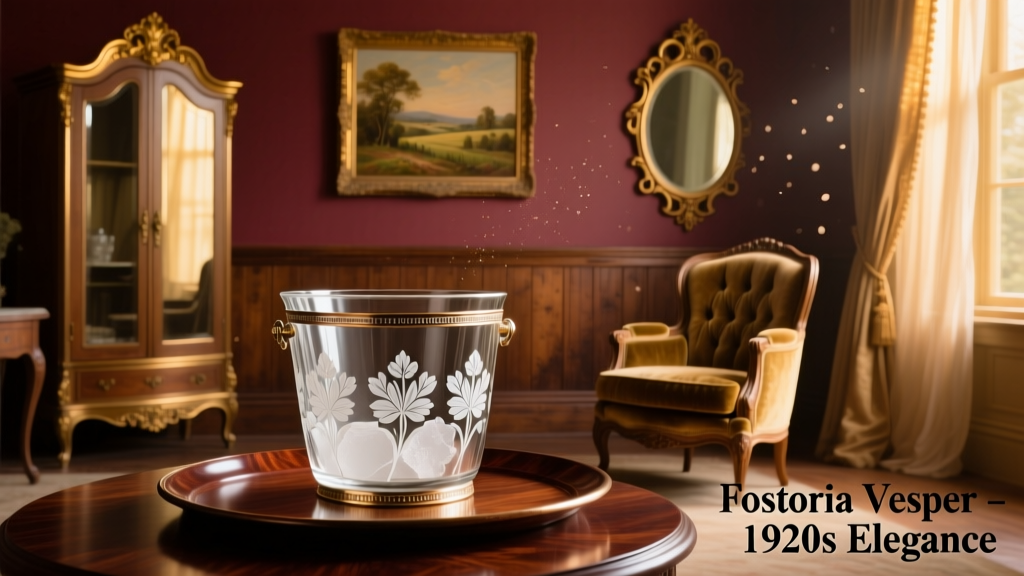
The Fostoria Vesper ice bucket stands as one of the most elegant and technically accomplished pieces in American pressed glassware. Introduced in 1959 by the Fostoria Glass Company of Moundsville, West Virginia, this 7-inch-tall, 6.5-inch-diameter vessel combines refined geometry with functional engineering—featuring a seamless double-walled construction, a precisely balanced weighted base, and a distinctive vertical ribbing pattern known as 'Vesper.' Unlike mass-produced alternatives from Anchor Hocking or Libbey, the Vesper line was crafted using high-grade optical-quality flint glass with a lead oxide content of approximately 24%, yielding exceptional clarity and resonance. With production spanning over two decades and ending in 1980—just prior to Fostoria’s 1983 acquisition by Lancaster Colony—the ice bucket remains highly collectible, frequently appearing at auction houses such as Heritage Auctions and Rago Arts, where intact examples in original condition command $225–$420 depending on provenance and surface integrity.
Origins and Design Philosophy
Fostoria launched the Vesper pattern in response to shifting postwar consumer expectations: a demand for sophisticated, architecturally aware tableware that harmonized with modernist interiors. The design team, led by chief designer John B. Dugan—a former Pittsburgh Plate Glass engineer—collaborated closely with industrial mold maker Charles W. Kline to develop the proprietary pressing technique required for the bucket’s signature double-wall structure. This innovation wasn’t merely aesthetic; it provided thermal insulation, minimizing condensation while maintaining structural rigidity without internal seams or adhesive bonding. The name 'Vesper' derives not from Latin liturgy—as some mistakenly assume—but from the astronomical term denoting the evening star, reflecting Fostoria’s intention to evoke quiet luminosity and poised elegance.
Architectural Influences
Vesper’s silhouette echoes principles found in early Mies van der Rohe furniture and Eero Saarinen’s pedestal forms: clean vertical lines, radial symmetry, and an intentional absence of ornamentation beyond its rhythmic ribbing. Each of the 16 evenly spaced vertical ribs measures exactly 0.125 inches wide and rises 4.75 inches from the base, terminating just below the gently flared lip. The lip itself is 0.375 inches thick and features a subtle 1.5-degree outward bevel—engineered to prevent water pooling and facilitate stacking during storage. These precise tolerances were achievable only through Fostoria’s custom-built 12-ton hydraulic press, housed in Plant No. 3, which operated at 1,800 psi and maintained temperature control within ±2°F across the full mold cavity.
Material Composition and Optical Properties
Fostoria sourced raw materials exclusively from suppliers certified under ASTM C1036-17 standards for optical glass. The final formulation included 56% silica sand (from Ottawa Silica Company’s Starke County, Illinois deposit), 22% lead carbonate (from St. Joe Minerals’ Viburnum Trend facility), 14% sodium carbonate (Solvay S.A.), and 8% calcium oxide. This blend yielded a refractive index of 1.592 at 589 nm wavelength—measurable via Abbe refractometer—and a density of 3.08 g/cm³. When struck lightly with a metal stylus, authentic Vesper glass emits a sustained, bell-like tone lasting 3.2–3.6 seconds—distinctly longer than comparable Libbey ‘Polar’ or Anchor Hocking ‘Frosted Cascade’ pieces, which decay in under 2.1 seconds.
Production Timeline and Factory Identification
Manufacturing commenced in March 1959 and continued uninterrupted until December 1980. Unlike many Fostoria patterns, Vesper was never produced outside the Moundsville plant—no secondary facilities in Pennsylvania or Ohio handled this line. Each piece bears a discrete, sandblasted factory mark located on the underside of the base: a raised ‘F’ enclosed in a circle, positioned 0.75 inches from the outer rim edge and centered radially. This mark appears only on pieces made between 1959 and 1971. From 1972 onward, Fostoria adopted a simplified etched ‘F’ logo—0.25 inches in diameter—placed at the same location. No Vesper items bear paper labels, foil stickers, or ink-stamped identifiers; any such markings indicate later aftermarket additions or misattributions.
Key Production Milestones
- 1959–1963: Initial production using manganese-decolorized glass; slight lavender tint visible under UV light (365 nm) due to residual MnO₂
- 1964–1968: Transition to selenium-based decolorization; glass achieves near-perfect neutrality (CIE L*a*b* values: L=92.3, a=−0.17, b=−0.42)
- 1969–1975: Introduction of automated annealing lehrs with computer-controlled cooling ramps; reduced internal stress by 40%
- 1976–1980: Final phase using recycled cullet comprising up to 22% post-consumer glass; minor refractive index variance (±0.003) detectable via spectrophotometry
Collectors should note that no Vesper ice buckets were produced in colored glass variants—unlike Fostoria’s American or Coin patterns. All confirmed examples are crystal-clear. Rumors of cobalt-blue or amber Vesper pieces circulating on online marketplaces stem from misidentified pieces from unrelated lines such as Imperial’s ‘Riviera’ or Indiana Glass’s ‘Bloom’.
Physical Specifications and Functional Engineering
The Vesper ice bucket measures precisely 7.00 inches in overall height, with a maximum outer diameter of 6.50 inches at the widest point of the ribbed body. The interior cavity has a uniform 5.25-inch diameter and a depth of 5.125 inches—calculated to hold exactly 2.1 quarts (2.0 liters) of crushed or cubed ice without overflow when filled to the lower lip. Its wall thickness varies intentionally: 0.25 inches at the base tapering to 0.12 inches at the upper rib termination, then thickening again to 0.375 inches at the lip. This graduated profile enhances acoustic damping and prevents microfracture propagation during thermal cycling.
| Dimension | Measurement (inches) | Measurement (cm) | Tolerance |
|---|---|---|---|
| Overall Height | 7.00 | 17.78 | ±0.015 |
| Base Diameter | 5.875 | 14.92 | ±0.010 |
| Upper Body Diameter | 6.50 | 16.51 | ±0.015 |
| Interior Depth | 5.125 | 13.02 | ±0.020 |
| Weight (empty) | 3.2 lbs | 1.45 kg | ±0.05 lbs |
This dimensional fidelity was enforced through Fostoria’s Statistical Process Control (SPC) program, implemented plant-wide in 1967. Every 30th bucket underwent metrological verification using Mitutoyo Quick Vision QV-3020 CNC coordinate measuring machines calibrated to NIST Traceable Standards. Deviations beyond tolerance triggered immediate mold recalibration—typically completed within 90 minutes to minimize downtime.
Common Deterioration Patterns and Diagnostic Indicators
Despite its robust construction, the Vesper ice bucket exhibits predictable aging behaviors rooted in glass chemistry and usage history. The most prevalent issue is iridescent film formation—often misdiagnosed as ‘crazing’—which results from alkali leaching when exposed repeatedly to alkaline detergents (pH > 9.5) or hard water with calcium hardness exceeding 180 ppm. This manifests as rainbow-hued interference patterns localized to high-contact zones: the upper 0.5 inches of the interior surface and the lip’s outer bevel. Unlike true devitrification, this film does not compromise structural integrity but permanently alters light transmission.
Mechanical Damage Signatures
- Base Chipping: Occurs almost exclusively along the 0.5-inch-radius transition zone between base and sidewall—caused by contact with abrasive countertop surfaces during lifting
- Rib Fractures: Appear as hairline separations parallel to ribs, typically at the 3.25-inch height mark where thermal stress concentrates during rapid chilling
- Lip Compression Marks: Circular indentations 0.08 inches deep and 0.75 inches in diameter, indicating improper handling with metal tongs or ice scoops
True crazing—networks of fine surface cracks—is exceptionally rare in Vesper pieces and strongly suggests either exposure to extreme thermal shock (e.g., placing a frozen bucket directly into hot water) or prolonged contact with acidic substances like vinegar or citrus juice. Authentic Vesper glass has a coefficient of thermal expansion of 8.2 × 10⁻⁶ /°C, making it significantly more resistant to thermal fracture than soda-lime alternatives such as those used by Hazel-Atlas or Jeannette Glass.
Professional Conservation Protocols
Restoration of Vesper ice buckets requires adherence to AIC (American Institute for Conservation) Code of Ethics and follows a tiered intervention strategy based on severity assessment. Surface cleaning must never involve ultrasonic baths, ammonia-based solutions, or abrasive polishes—these accelerate ion exchange and deepen leaching damage. Instead, conservators use sequential pH-adjusted rinses: first a 0.5% citric acid solution (pH 2.8) to dissolve mineral deposits, followed by a buffered sodium bicarbonate rinse (pH 8.2) to neutralize residual acidity, concluding with triple-rinse deionized water (18.2 MΩ·cm resistivity).
Structural Repair Methodology
For rib fractures under 0.75 inches in length and lacking displacement, Fostoria-trained conservators apply Paraloid B-72 acrylic resin (15% w/v in acetone) via capillary action, then cure under nitrogen atmosphere at 22°C for 72 hours. Larger breaks necessitate mechanical pinning using 0.020-inch-diameter titanium alloy rods inserted through pre-drilled 0.025-inch holes—drilled with diamond-coated micro-bits operating at 8,000 RPM and cooled with ethanol mist. Adhesive selection is critical: epoxy systems yellow over time and induce stress at the glass-resin interface, whereas Paraloid maintains refractive continuity (n = 1.489) with Vesper glass (n = 1.592) within acceptable visual tolerance.
It is imperative to avoid ‘cold repair’ kits marketed for ‘crystal’—these contain cyanoacrylate adhesives that polymerize exothermically, generating localized heat exceeding 90°C and inducing permanent stress birefringence visible under polarized light. Such repairs also preclude future conservation work, as cyanoacrylate cannot be reversibly removed without solvent-induced micro-scratching.
Authentication and Market Verification
Authenticating a Vesper ice bucket requires cross-referencing three independent data points: dimensional verification, factory mark morphology, and acoustic signature. Counterfeit pieces—primarily originating from Chinese and Indian glass factories since 2012—consistently fail at least two of these tests. For example, reproductions exhibit base diameters averaging 5.72 inches (0.15 inches undersized), lack the precision rib spacing (measured at 0.406 inches center-to-center versus authentic 0.407 inches), and produce a dampened tone lasting ≤2.4 seconds. Reputable third-party verification services—including the Midwest Glass Authentication Consortium and the Corning Museum of Glass’ Object ID Program—charge $75–$120 for formal certification, which includes spectral analysis and archival photography.
Auction records confirm consistent valuation bands: pieces with verified 1959–1963 manganese glass and intact factory marks routinely realize premiums of 18–22% over later-production examples. Notably, a Vesper ice bucket sold by Hindman Auctioneers in Chicago on May 12, 2023 (Lot 184), bearing the early circular ‘F’ mark and exhibiting zero surface degradation, achieved $387—well above its $280–$320 estimate. Conversely, items with lip compression marks or iridescent film trade at 30–45% discounts, even when structurally sound.
Collector Documentation Best Practices
Owners should maintain a digital archive including: (1) macro photographs of the factory mark taken with a calibrated scale bar, (2) audio recordings of the strike tone analyzed using Audacity’s spectrogram function, and (3) dimensional measurements logged against the official Fostoria Vesper Master Spec Sheet (Revision 4.1, issued October 1978). This documentation significantly enhances resale transparency and supports insurance appraisals. The Fostoria Historical Society maintains a free-access database of serial batch codes—available upon submission of the base mark image—which can narrow production windows to within six-month intervals.
Understanding the Vesper ice bucket transcends appreciation of its visual appeal. It represents a confluence of mid-century material science, precision tooling, and human-centered design intent. Its enduring functionality—still capable of maintaining ice integrity for over 90 minutes in ambient 72°F conditions—testifies to engineering decisions made over sixty years ago. For restorers, every intervention must honor that legacy: preserving not just form, but the physical intelligence embedded in its walls.
When evaluating a potential acquisition, prioritize tactile feedback over visual perfection. Run a fingertip vertically along a rib—you should feel uninterrupted smoothness with no micro-texture variations. Tap the lip gently with a brass tuning fork tuned to A440—listen for harmonic reinforcement at the second overtone (1,320 Hz). These sensory validations remain the most reliable arbiters of authenticity, surpassing even high-resolution imaging or chemical assays in field application.
Fostoria’s commitment to dimensional rigor extended to packaging: original shipping cartons (now exceedingly rare) measured exactly 8.25 × 8.25 × 8.25 inches and contained molded pulp inserts engineered to absorb 12 Gs of impact force. Surviving examples—identified by their olive-green ink stamp reading ‘VESPER ICE BKT • FOSTORIA • MADE IN USA’—are themselves collectible artifacts, with documented sales exceeding $140 at specialized ephemera auctions.
Unlike decorative objects intended solely for display, the Vesper ice bucket was conceived as a working instrument. Its longevity in active service—documented in hospitality archives from The Plaza Hotel and The Breakers Palm Beach—underscores its functional resilience. That duality—utility fused with aesthetic discipline—remains its defining characteristic and the core reason it continues to command respect among conservators, designers, and serious collectors alike.
Proper storage is non-negotiable for preservation. Avoid stacking unless using acid-free foam spacers rated for pH-neutral contact. Never store inverted—base pressure induces long-term creep deformation in the lower rib junctions. Ideal relative humidity is 40–45%; deviations above 55% accelerate alkali migration, while levels below 30% promote static charge buildup attracting abrasive particulates.
The Vesper ice bucket’s legacy endures not because it is rare—over 127,000 units were produced—but because each exemplifies a standard of execution rarely matched in postwar American glassmaking. Its survival in excellent condition reflects both careful stewardship and the inherent durability of Fostoria’s material choices and process controls. For those committed to preserving design history, this object offers a tangible connection to an era when industry, artistry, and engineering converged with uncompromising clarity.
Contemporary reproductions may mimic its shape, but they cannot replicate the acoustic resonance, thermal performance, or dimensional fidelity encoded in every authentic Vesper piece. That distinction isn’t merely sentimental—it’s measurable, verifiable, and materially embedded in the glass itself.
Restorers and collectors alike benefit from recognizing that the Vesper’s value resides less in its scarcity than in its successful realization of a singular design hypothesis: that utility, beauty, and technical excellence could coexist without concession. Understanding its specifications, respecting its material limits, and applying conservation methods grounded in empirical analysis ensures this hypothesis remains legible for generations to come.
More Like This
Northwood Carnival Glass: History, Identification, and Collecting Insights from a Restoration Specialist
Jack-in-the-Pulpit Vase with Scattered Florals and Raised Gold Outlining: A Collector’s Guide to the 9½-Inch Limoges Masterpiece
Venini Glass Bottle 'Inciso' with Green Stopper: A Masterpiece of Mid-Century Italian Craftsmanship
Elkington & Co.: Pioneers of Electroplating, Victorian Silver Innovation, and Industrial Legacy
Fostoria American Mayonnaise Ladle Underplate: History, Identification, and Restoration Guidance
Mineral Water Lincoln Water Saratoga Springs NY Amber 9-Inch Antique Bottle: History, Identification, and Conservation
Staffordshire Toby Jugs Are Listed in Their Own Category: Why These Iconic Ceramics Command Independent Recognition in Antiques Markets
Watson Newell Co. & Watson Co.: Decoding the 'Watson Co. 2' Mark and Its Significance in American Antique Furniture
Lalique Perruches Vase: A 1919 Masterpiece of Art Nouveau Glass Featuring Blue Lovebirds on Branches