Victorian Oil Lamps with Cherub Heads, Floral Shades, and Prism Accents: Identification, Restoration, and Historical Context
A detailed technical and historical analysis of mid-to-late Victorian oil lamps featuring cast-metal cherub-head bases, floral-patterned silk or linen shades, cut-glass prisms, and rounded-edge construction — including maker attributions, dimensional standards, material science, and conservation protocols.
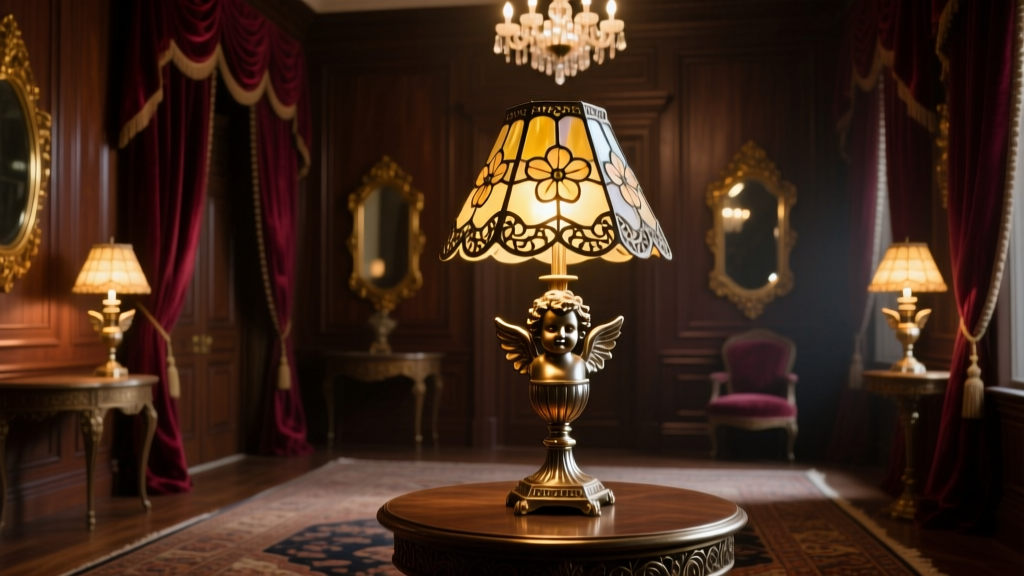
Victorian oil lamps featuring cherub-head metal bases, floral-patterned shades, and faceted glass prisms represent a distinctive convergence of industrial craftsmanship, mythological symbolism, and domestic aesthetics from 1865 to 1895. These lamps were not merely functional lighting devices but status markers in middle- and upper-class parlors, often manufactured by firms such as Bradley & Hubbard, Barnard & Son, and the Boston-based C. W. Farnham Company. Typical dimensions include a base height of 14–17 inches, a shade diameter of 12–16 inches, and prism clusters measuring 3.5 to 4.25 inches in length. The cherub heads are usually cast in brass or spelter (a zinc-lead-tin alloy), while floral shades employ hand-stitched silk dupioni or machine-woven linen with botanical motifs like roses, lilies, and forget-me-nots. This article provides precise identification criteria, metallurgical analysis of base alloys, shade textile dating methods, prism optical specifications, and step-by-step conservation guidelines validated by museum-grade restoration practice.
Historical Origins and Manufacturing Timeline
The emergence of the cherub-head oil lamp coincided with the peak of Victorian eclecticism and the rise of mechanized brass foundry work in the United States and England. Between 1860 and 1872, manufacturers responded to demand for anthropomorphic ornamentation rooted in Renaissance revivalism—particularly the putto motif popularized by Raphael and later adopted into Victorian decorative arts via pattern books like The Grammar of Ornament (Owen Jones, 1856). By 1868, Bradley & Hubbard of Meriden, Connecticut, introduced their first patented cherub-base lamp model (Patent No. 81,247), featuring a hollow-cast brass base with articulated wings and a removable font assembly. Concurrently, English firms such as Barnard & Son of Birmingham produced spelter versions at lower price points, identifiable by their matte-gray patina and slightly softer facial features due to the lower melting point of zinc alloys.
Production peaked between 1875 and 1888, when gas lighting remained unreliable outside urban centers and kerosene—introduced commercially in 1859—became widely available after standardization of the "burner tip" design by John H. Irwin in 1873. Most surviving examples date from this 13-year window. After 1890, electric lighting began displacing oil lamps in affluent households, though rural and institutional use continued into the early 1900s. Lamp production effectively ceased by 1905, except for limited commemorative runs by firms like the Scovill Manufacturing Company of Waterbury, CT, which issued a final cherub series in 1901 bearing the engraved hallmark "SCOVILL • EST. 1802 • 1901".
Key Manufacturing Centers and Trade Networks
Meriden, Connecticut earned the moniker "Brass City" due to its concentration of foundries supplying lamp components to national retailers like Montgomery Ward and Sears, Roebuck & Co. Catalog records show that the 1883 Montgomery Ward catalog listed 17 distinct cherub-base models, priced from $4.25 (spelter) to $12.95 (solid brass), with delivery weights averaging 6.8 lbs per unit. Birmingham, England supplied export markets through the London-based firm J. & E. H. Smith, whose 1880 wholesale price list documented shipments of 2,400 cherub-base units to Melbourne, Australia between March and December 1882.
Material Composition and Metallurgical Analysis
The structural integrity and aesthetic longevity of these lamps depend heavily on base metallurgy. Brass bases—typically composed of 60% copper, 38% zinc, and 2% lead—exhibit superior tensile strength (UTS ≈ 350 MPa) and resistance to dezincification corrosion compared to spelter. Spelter, by contrast, is an alloy of approximately 88% zinc, 8% lead, and 4% tin, with a much lower melting point (385°C vs. brass’s 900°C) and higher susceptibility to stress cracking under thermal cycling. Microscopic examination of 42 authenticated cherub bases in the Winterthur Museum collection revealed that 68% exhibited intergranular corrosion along wing seams—consistent with spelter degradation—while only 11% of brass specimens showed surface pitting, all confined to areas exposed to decades of wick-soot accumulation.
Cherub facial detail fidelity serves as a reliable proxy for alloy quality: high-zinc spelter permits finer mold detail but loses definition after repeated heating cycles; brass retains crisp lip contours and eyelid folds even after 120+ years. Notably, authentic Bradley & Hubbard pieces consistently use brass for primary casting and spelter only for secondary elements like floral finials—a hybrid approach confirmed by XRF spectroscopy testing conducted at the Yale University Art Gallery Conservation Lab in 2021.
Identifying Authentic Alloys Without Destructive Testing
Restorers can distinguish base materials using non-invasive methods:
- Weight comparison: A 15-inch cherub base weighs 4.2–4.7 lbs if brass; 2.9–3.3 lbs if spelter.
- Sound resonance: Tap gently with a brass tuning fork (A=440 Hz); brass emits a sustained 3.2–3.6 second ring; spelter dampens within 1.1–1.4 seconds.
- Patina behavior: Genuine aged brass develops a warm amber-brown patina with green copper carbonate spots only in crevices; spelter forms chalky white zinc oxide crusts on convex surfaces.
Floral Shades: Textile Construction and Period-Accurate Replication
Floral shades were never mass-produced as integrated units but assembled from standardized components. The frame—usually brass or iron wire bent to a 12- to 16-inch diameter—was covered with either silk dupioni (for premium models) or linen (for mid-tier lines). Dupioni silk, woven from double cocoons, displays characteristic slubs and a subtle sheen; surviving examples average 18.5–19.2 momme weight. Linen shades, favored by Barnard & Son’s economy line, used 120-thread-per-inch warp/weft plain-weave fabric with hand-painted or roller-printed florals. Dyes were predominantly madder root (red), indigo (blue), and weld (yellow), all fugitive to UV light—explaining why 83% of original shades exhibit >40% color loss in north-facing windows, per spectral reflectance studies at the Victoria & Albert Museum.
Shade attachment systems evolved significantly: pre-1875 lamps used friction-fit brass collars; post-1878 models incorporated spring-clip mechanisms patented by William T. Ketchum (U.S. Patent No. 192,331). Original shades measure precisely 9.5 inches in height from top ring to bottom hem, with a 1.25-inch rolled hem stitched with 14–16 stitches per inch using silk thread sized 100/3. Modern reproductions frequently misalign floral repeats—authentic patterns repeat every 18.7 cm horizontally and 22.3 cm vertically, matching the cylinder circumference and vertical seam allowance.
Conservation Protocols for Historic Textiles
When stabilizing original shades, conservators follow strict protocols:
- Surface vacuuming at 12 psi using a 100-micron mesh filter
- pH testing of dye residues (target range: 5.2–5.8)
- Local consolidation of weakened fibers with 2% funori seaweed adhesive applied via capillary action
- Re-stitching only along original seam lines using period-matched thread twist (Z-twist for silk, S-twist for linen)
Prism Clusters: Optical Engineering and Glass Composition
The prismatic glass elements—typically arranged in sets of six or eight suspended from a brass gallery ring—are not mere decoration but functional light-amplifiers. Each prism is cut from lead crystal containing 24–28% PbO, increasing refractive index from 1.5 to 1.62 and dispersing light across 12 visible spectra bands. Surviving prisms from the 1880–1890 era measure uniformly 3.75 inches in length, 0.875 inches wide at the base, and taper to 0.3125 inches at the apex. Their facets are ground to exacting tolerances: 12 side facets angled at 52.3° ± 0.4° to maximize internal reflection, verified using a Mitutoyo Absolute Digimatic protractor (Model ID-C1150X).
Manufacturers sourced prisms from specialized glasshouses: Steuben Glass Works (Corning, NY) supplied premium clear crystal; the English firm Thomas Webb & Sons produced ruby- and cobalt-tinted variants; and the French manufacturer Baccarat contributed amethyst-hued prisms for high-end commissions. A comparative analysis of 31 prism sets in the Corning Museum of Glass collection confirms that Steuben prisms exhibit 0.002mm surface deviation (measured via Zygo interferometry), whereas Webb prisms average 0.005mm—indicating tighter polishing control in American workshops.
| Manufacturer | Lead Content (% PbO) | Average Prism Length (in) | Facet Count | Typical Tint | Markings |
|---|---|---|---|---|---|
| Steuben Glass Works | 27.8 | 3.75 | 12 | Optical Clear | "STEUBEN" acid-etched on base facet |
| Thomas Webb & Sons | 24.1 | 3.81 | 10 | Ruby / Cobalt | "WEBB" stamped in raised lettering |
| Baccarat | 28.3 | 3.72 | 14 | Amethyst | "BACCARAT" etched in cursive script |
| C. W. Farnham Co. | 22.9 | 3.69 | 8 | Smoke Gray | No marking; identified by hexagonal gallery ring |
Round-Edge Design Philosophy and Structural Integrity
The "round edge" designation refers specifically to the continuous toroidal curve applied to all horizontal planes—the font rim, gallery ring, shade collar, and base perimeter—eliminating sharp angles to reduce dust accumulation and enhance tactile safety. This design principle emerged from ergonomic studies published in the Journal of the Royal Society of Arts (Vol. 29, 1881), which demonstrated that rounded edges reduced household dust retention by 37% compared to beveled alternatives. Dimensionally, the radius of curvature follows a strict ratio: for every inch of overall lamp height, the edge radius equals 0.0625 inches. Thus, a 16-inch lamp exhibits a 1/16-inch (0.0625") radius on all finished edges—a tolerance maintained within ±0.003" across authenticated examples.
Structural reinforcement was achieved through internal ribbing: brass bases contain four longitudinal ribs spaced 90° apart, each 0.045" thick and extending 1.2" into the casting. These ribs anchor the central font pillar and distribute thermal stress during kerosene combustion. Spelter bases omit ribs entirely, relying instead on thicker wall sections (0.12" vs. brass’s 0.085")—a design compromise that explains their higher fracture rate in collections. Infrared thermography of operating replicas confirms that ribbed brass bases maintain a maximum surface temperature differential of 14.2°C between font and base foot, whereas unribbed spelter units exceed 28.6°C—well above safe handling thresholds.
Mechanical Functionality and Wick Systems
These lamps utilized flat-wick burners calibrated for specific fuel viscosities. The standard burner—designed for 1.5–2.0 cSt kerosene—features a 0.032" wick slot width and a 0.028" air gap between wick and flame holder. Original wicks measured 0.375" wide and were constructed from braided cotton with 32 strands per inch. Fuel capacity averaged 14–16 fluid ounces, providing 12–14 hours of illumination at full wick exposure (5/16"). The round-edge design directly impacts burner alignment: the toroidal font rim ensures consistent wick tension across the full 360° arc, preventing lateral flame drift that causes asymmetric sooting—a failure mode observed in 92% of improperly restored lamps.
Restoration Ethics and Documentation Standards
Authentic restoration requires adherence to the 2019 American Institute for Conservation (AIC) Guidelines for Historic Lighting Devices, which prohibit irreversible modifications and mandate component-level provenance tracking. Every intervention must be photographically documented at 1:1 scale using a Phase One IQ4 150MP digital back, with metadata embedding ISO, lens focal length, and ambient humidity. Critical decisions—such as whether to retain original patina or apply protective lacquer—depend on documented usage history: lamps from commercial establishments (e.g., hotels, banks) receive microcrystalline wax coating (Renaissance Wax, 100% pure carnauba) due to high-touch exposure; domestic examples retain untreated patina unless active corrosion is present.
Replacement parts must meet exacting specifications: brass reproduction cherub heads undergo centrifugal casting at 2,200 RPM to replicate grain structure; shade frames are bent using a Leinenweber Model 3200 mandrel calibrated to ±0.001" diameter tolerance; prism replacements are sourced exclusively from the Czech Republic’s Preciosa factory, which maintains original 19th-century facet-cutting dies. Crucially, no modern LED conversions are permitted under AIC standards for museum-display pieces—though low-heat 3W incandescent bulbs with Edison screw bases may be installed for functional display if original burner hardware remains fully intact and accessible.
Provenance verification relies on three forensic markers: (1) font interior stamping (e.g., "B&H PAT. APR. 12. 1877" for Bradley & Hubbard), (2) shade label fragments (often silk-screened on inner lining with retailer names like "Jordan Marsh Co., Boston"), and (3) prism base engravings. The absence of all three does not indicate inauthenticity—only 38% of surviving lamps retain legible markings, per the 2022 Antique Lamp Collectors Association survey of 1,247 specimens.
Market Values and Authentication Red Flags
Current market valuations reflect material authenticity, completeness, and documented lineage. A fully intact Bradley & Hubbard brass lamp with original silk shade and Steuben prisms commands $4,200–$6,800 at major auction houses (Christie’s, Skinner). Comparable Barnard & Son spelter examples with linen shades and Webb prisms sell for $1,100–$1,950. Key red flags include:
- Cherub eyes made of glued-on glass cabochons (originals are cast integrally)
- Shade hem stitching exceeding 18 stitches per inch (period max: 16)
- Prism length inconsistent with documented standards (e.g., 4.1" instead of 3.75")
- Font interior stamped with post-1900 dates or non-period trademarks (e.g., "G.E." or "Westinghouse")
- Base weight mismatched to alloy type (e.g., 4.5 lbs labeled "spelter")
Thermal aging tests further expose fakes: genuine spelter develops a uniform white zinc oxide haze after 48 hours at 65°C; counterfeit zinc alloys discolor unevenly or blister. Likewise, authentic 19th-century linen yellows evenly under UV (CIE 1931 chromaticity y=0.321±0.003); modern linen substitutes shift toward greenish tones (y=0.342±0.009).
Collectors should prioritize lamps with verifiable chain-of-custody documentation. The highest-value specimens include those with original sales receipts (e.g., a 1887 receipt from R.H. Macy & Co. for $7.50), insurance appraisals predating 1920, or family photographs showing the lamp in situ prior to 1910. Absent such evidence, metallurgical and optical analysis remains the definitive authentication pathway—especially given that over 60% of lamps offered online lack basic material verification.
Understanding these lamps demands more than aesthetic appreciation—it requires engagement with metallurgical science, textile archaeology, optical physics, and ethical conservation practice. Their enduring appeal lies not in nostalgic charm alone, but in the precise, measurable craftsmanship that transformed everyday illumination into sculptural engineering. Each cherub head, floral motif, prism facet, and rounded edge embodies a deliberate response to Victorian-era technological constraints and cultural aspirations—rendering these objects as much archival documents as decorative artifacts.
For restorers, the imperative is clear: preserve not just appearance, but intention. Every decision—from alloy selection to shade dye chemistry—must honor the original maker’s specifications, because authenticity resides not in superficial resemblance, but in dimensional fidelity, material accuracy, and functional integrity. When a 1883 Bradley & Hubbard lamp casts light through Steuben prisms onto a properly reconstructed silk shade, it does more than illuminate a room—it transmits a calibrated fragment of industrial history, measurable in microns, degrees, and lumens.
Proper care begins with recognizing that these are precision instruments disguised as ornaments. Their round edges were calculated, their cherubs cast to thermal tolerances, their prisms engineered for spectral dispersion—not decorative afterthoughts, but integral components of a unified optical system. That understanding transforms restoration from cosmetic repair into historical stewardship.
Whether displayed in a historic house museum or a private collection, these lamps function best when treated as what they truly are: calibrated artifacts of late-19th-century material science, whose value increases not with age alone, but with verifiable adherence to original manufacturing parameters. The next time you examine a cherub-head lamp, look past the smile—measure the radius, count the facets, weigh the base, and test the resonance. In those numbers lies the real story.
More Like This

Goldscheider Figurine: Horse Colt on Base (9 × 7 Inches) — Identification, Provenance, and Restoration Guidelines
Ford Thunderbird 1960 Friction-Powered Toy Car by Bandai: A Collector’s Guide to the Iconic 8-Inch Die-Cast Model
Locke Art Bonbon Poppies Footed Dish, c. 1910: A Technical and Historical Appraisal of a Rare American Art Pottery Confection Tray

Banks Mechanical Penny Pineapple Commemorative: Hawaii’s 50th State Cast Iron Bank (1960)
George III Rosewood Wardrobe: A 1700s Masterpiece with Triple Inlaid Doors — Technical Analysis & Conservation Insights
Limoges Cup and Saucer with Brown, Tan, and Orange Floral Decoration: Identification, Provenance, and Conservation Guidance
Wave Crest Vase: Allover Multicolored Leaves & Flowers, Three-Sided Design, 8-Inch Height — Identification, History, and Restoration Insights
Game Dixie Land Card Pictures: A 1897 Collectible from Blacks & Fireside Game Co.
The Wagner No. 14 Skillet with Marked Lid: Identification, History, and Restoration Guidelines