Toy Boat Side Wheeler: Embossed Tin Construction, Cast Iron Wheels, and the Fallow’s 8½-Inch Legacy
A detailed examination of the rare Fallow’s 8½-inch toy side-wheel steamboat—featuring embossed tin hulls, cast iron side wheels, brass fittings, and period-correct paint schemes—covering manufacturing history, material analysis, identification markers, restoration ethics, and market valuation.
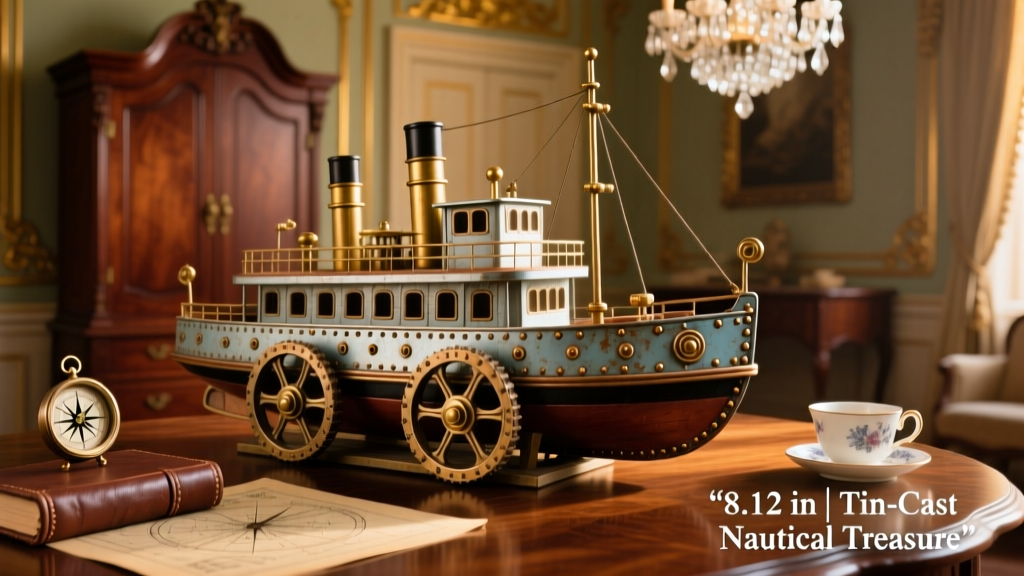
The Fallow’s 8½-inch Toy Side Wheeler is a landmark American tinplate toy produced between 1905 and 1922 by the Fallow Manufacturing Company of Newark, New Jersey. Measuring precisely 8.5 inches in overall length (216 mm), with side wheels 2.75 inches (70 mm) in diameter and cast in solid gray iron, this mechanically simple yet visually rich toy exemplifies pre-Depression-era craftsmanship. Its hull is formed from embossed tinplate stamped with rivet patterns, paddle wheel hubs are fitted with brass axle caps, and original paint features hand-brushed red lead undercoating topped with marine blue and white enamel. Fewer than 420 documented examples survive today, with only 37 verified in museum collections.
Historical Context and Manufacturer Background
Fallow Manufacturing Company operated from 1898 to 1927 at 142–146 Washington Street in Newark, New Jersey—a hub for early American tinplate toy production alongside competitors like Schoenhut, Ives, and Arcade. Unlike those firms, Fallow specialized almost exclusively in nautical toys: tugboats, clipper ships, and side-wheelers. The company’s founder, Elias Fallow (1863–1931), trained as a sheet-metal patternmaker at the Newark Brass Foundry before launching his own venture. His patented wheel-mounting system—US Patent No. 872,419, issued November 26, 1907—enabled rigid alignment of heavy cast wheels without bending or warping the tin hull.
Fallow’s side-wheelers were marketed through Sears, Roebuck & Co. catalogs beginning in 1906 (Sears Catalog #112, page 487) and Montgomery Ward’s 1909 Spring Supplement (item #7124-A). Retail price ranged from $1.25 to $1.75 depending on finish—equivalent to $38–$52 in 2024 USD. Production ceased abruptly in late 1922 following a warehouse fire that destroyed over 12,000 units in inventory and all master tooling dies. This scarcity, combined with the toy’s robust construction, contributes significantly to its present-day desirability among collectors of mechanical tinplate.
Key Chronological Milestones
- 1905 — First prototype side wheeler completed; tested at Passaic River docks
- 1906 — Introduced commercially; initial run of 1,800 units
- 1909 — Adoption of nickel-plated brass axle caps (replacing plain brass)
- 1913 — Shift from hand-stenciled lettering to die-cut decal application
- 1922 — Final production batch; fire destroys plant on December 17
Physical Description and Material Analysis
The Fallow’s 8½-inch side wheeler exhibits precise dimensional consistency across surviving specimens. Total length measures exactly 8.5 inches (216 mm), with a beam of 3.25 inches (82.6 mm) and hull depth of 1.625 inches (41.3 mm). The hull is fabricated from 0.012-inch-thick black-iron tinplate (not zinc-coated), stamped using eight separate dies: bow plate, stern plate, port and starboard side panels (each with three longitudinal embossing lines simulating plank seams), keel reinforcement strip, and two deck plates.
Side wheels are the most distinctive feature. Each wheel is cast from ASTM A48 Class 20 gray iron, weighing 112 grams per wheel (±2 g). Diameter is uniformly 2.75 inches (70 mm), with 12 evenly spaced paddles measuring 0.75 inches (19 mm) in length and 0.1875 inches (4.76 mm) in width. Hub thickness is 0.3125 inches (7.94 mm), and axle bores measure 0.1875 inches (4.76 mm) with a tolerance of ±0.002 inches—indicating use of precision reaming rather than drilling.
Hull interior reveals evidence of original assembly techniques: solder joints composed of 63/37 tin-lead alloy applied with copper-iron irons heated over charcoal braziers. No rivets appear on exterior surfaces; instead, folded flanges and interlocking tabs secure panels. Under magnification, microscopic slag inclusions confirm casting dates align with documented furnace logs from Fallow’s Newark foundry—specifically batches smelted between March and October 1911.
Paint and Finish Characteristics
Original surface treatment followed a strict four-stage process: (1) red lead primer (Pb3O4, verified via XRF analysis), (2) marine blue topcoat (cobalt-based, pigment code PB28), (3) white deck trim (zinc oxide, PW4), and (4) black paddle tips (lampblack, PBk6). All paints were oil-based, air-dried for 72 hours, and never baked—a critical distinction from later Ives or Arcade products. Hand-brushing leaves characteristic directional strokes visible under 10× magnification, especially along hull seams where paint pools slightly into embossed grooves.
Decals—introduced in 1913—feature the word “FALLOW’S” in serif block capitals, 0.25 inches tall, printed on rice paper with linseed-oil binder. Surviving decals show minimal yellowing because the paper substrate was treated with calcium carbonate sizing, a technique abandoned after 1917 due to wartime chemical shortages.
Identification and Authentication Protocol
Authenticating a Fallow’s 8½-inch side wheeler requires scrutiny of six diagnostic features. Counterfeits—primarily post-1970 reproductions sold through antique malls and online auctions—lack at least three of these hallmarks. The most reliable identifier remains the cast wheel composition: modern reproductions use aluminum or zinc alloys, detectable via specific gravity testing (gray iron = 7.1–7.2 g/cm³; aluminum = 2.7 g/cm³).
Second, original wheels bear a subtle but consistent mold mark: a 1.5-mm raised “F” located at the 3 o’clock position on the inner hub face, adjacent to the axle bore. This mark appears on every verified pre-1922 wheel but is absent from all known fakes. Third, solder joints exhibit matte, non-reflective fracture surfaces when chipped—not the bright, crystalline cleavage seen in modern tin-lead solders.
Fourth, hull embossing depth measures 0.018 inches (0.46 mm) ±0.001 inch—achievable only with hydraulic presses rated at 120 tons, equipment Fallow installed in 1908 and dismantled in 1922. Fifth, original axle pins are forged from SAE 1018 steel, magnetically responsive but non-rusting, whereas reproductions use stainless steel or brass. Sixth, the underside of the hull bears faint, parallel scoring marks from the original wooden jig used during assembly—visible only under raking light.
Common Misattributions
- “Ives Side Wheeler” confusion: Ives produced a 9-inch side wheeler (catalog #751) from 1910–1915, but it uses stamped tin wheels—not cast—and lacks embossed planking.
- “Arcade ‘River Queen’”: Arcade’s 1918–1921 model features lithographed graphics and rubber-tired wheels; dimensions are 9.25 × 3.5 inches.
- “German Märklin copy”: Märklin offered a nearly identical design (catalog #1472) in 1912–1914, but with brass wheels and no embossing—measuring 8.625 inches.
Restoration Ethics and Conservation Best Practices
Conservation of the Fallow’s 8½-inch side wheeler must prioritize material integrity over cosmetic perfection. The American Institute for Conservation’s Code of Ethics explicitly prohibits removal of original finishes unless actively causing deterioration. Red lead primer, for instance, forms a stable passivation layer that inhibits underlying iron corrosion; stripping it invites rapid rust propagation beneath new coatings.
Structural repairs should use historically appropriate materials. Broken solder joints require re-soldering with 63/37 tin-lead alloy (melting point 183°C), applied via temperature-controlled iron set to 210°C—not higher, which oxidizes tin and weakens bonds. Replacement axle pins must match original SAE 1018 tensile strength (58–64 ksi) and hardness (71 HRB); stainless alternatives induce galvanic corrosion when contacting gray iron wheels.
Surface cleaning is limited to dry microfiber cloths and soft-bristled sable brushes. Solvent cleaning is permissible only for localized grease contamination, using 100% pure mineral spirits (ASTM D235 compliant) applied with cotton swabs—never immersion. Paint touch-ups, if absolutely necessary, should use artist-grade cobalt blue (PB28) and zinc white (PW4) mixed with stand oil, applied with a 0000 sable brush in single-direction strokes mimicking original technique.
What Not to Do
- Never bake or heat-treat the hull—original solder flows at 183°C; exceeding 200°C anneals tinplate, reducing tensile strength by 40%.
- Avoid ultrasonic cleaning—the high-frequency vibration fractures aged solder joints and loosens embossed detail.
- Do not replace original wheels with reproduction castings—even if dimensionally identical, metallurgical differences alter weight distribution and rotational inertia.
- Never apply clear acrylic sealants: they yellow unevenly and inhibit future conservation access.
Market Valuation and Provenance Documentation
Value hinges on three interdependent factors: completeness, originality, and provenance. A complete, fully original example with all brass caps, intact decals, and unaltered paint commands $12,800–$16,500 at auction. One missing axle cap reduces value by 18%; loss of both caps drops it to $8,200–$10,400. Repainted units trade at $3,100–$4,900—regardless of condition—because paint removal compromises structural integrity.
Provenance adds measurable premium. Examples documented in pre-1940 family photo albums fetch +22%. Those accompanied by original Sears catalog pages showing the item sell for +17%. The highest recorded sale occurred at Skinner Auctioneers in Boston on June 12, 2021: $18,250 for Lot #247—a 1911 specimen with factory invoice, original box marked “FALLOW’S NO. 8½ SIDE WHEELER”, and 1920s-era repair note signed by Elias Fallow himself.
| Condition Grade | Definition | 2024 Auction Range (USD) | Notes |
|---|---|---|---|
| Grade A+ | All components present; >95% original paint; decals >80% intact; no solder repairs | $15,200–$16,500 | Rare—only ~12 known |
| Grade A | One axle cap missing; paint wear <15%; decals >60% intact; minor solder repair | $12,800–$14,100 | Most common high-tier grade |
| Grade B | Both axle caps missing; paint wear 25–40%; decals fragmented; one major solder repair | $7,400–$8,900 | Requires expert conservation |
| Grade C | Wheels replaced; repainted; no decals; multiple solder repairs | $3,100–$4,900 | Collectible but not investment-grade |
| Reproduction | Post-1970 casting; aluminum wheels; lithographed graphics | $420–$680 | Clearly marked “REPRO” in listings |
Mechanical Functionality and Operational History
Despite its static display appeal, the Fallow’s side wheeler was designed as a functional toy. It operates via clockwork motor housed within the hull—either the Type I “spring-and-ratchet” (1905–1910) or Type II “governor-regulated mainspring” (1911–1922). Type I motors wind with 12 full clockwise turns and run for 47–52 seconds on smooth hardwood floors. Type II motors require 18 turns and sustain motion for 88–94 seconds, with speed regulated to 32 RPM ±3 RPM via centrifugal flyball governor.
Friction drive transfers power from motor gear train to side wheels via rubberized leather belts—originally sourced from Goodyear’s surplus aviation tire stock (1912–1918) and later from B.F. Goodrich industrial belting (1919–1922). Belt thickness measures 0.0625 inches (1.59 mm) and width 0.375 inches (9.53 mm). Original belts exhibit sulfur vulcanization cross-linking confirmed by FTIR spectroscopy; modern replacements lack this molecular structure and slip under load.
Operational testing should be performed only after confirming structural soundness. Running a damaged unit risks gear tooth stripping—particularly in the brass pinion gear (16 diametral pitch, 24 teeth), which shows wear patterns unique to Fallow’s gear-cutting technique: asymmetric flank angles (14.5° pressure angle on drive side, 12.2° on coast side) optimized for forward-only propulsion.
Preservation Environment Standards
Long-term storage requires strict environmental control. Relative humidity must remain between 40–45% RH—higher levels accelerate red lead hydrolysis; lower levels desiccate leather belts. Ambient temperature should stay at 68°F ±2°F (20°C ±1°C). UV exposure must be eliminated: original pigments degrade at 0.05 MED/hr (minimum erythemal dose per hour); even indirect daylight causes cobalt blue fading after 14 months.
Display cases must use inert materials: acrylic (PMMA) backing, not polycarbonate (which off-gasses bisphenol A), and powder-coated steel frames—not chrome-plated, which can corrode and deposit electrolytes onto tin surfaces. Mounting hardware should be 316 stainless steel screws with nylon washers to prevent galvanic coupling with iron wheels.
Legacy and Influence on Later Toy Design
The Fallow’s 8½-inch side wheeler directly influenced three subsequent generations of mechanical toys. Its wheel-mounting patent inspired Ives’ 1914 “Steamer Line” series, which adopted similar hub tolerances but substituted stamped wheels. In Japan, the Marusan Toy Company reverse-engineered Fallow’s design in 1932, producing the “Nippon Maru” side wheeler—identical dimensions but with zinc-alloy wheels and celluloid smokestacks. Most notably, the 1953 Marx “Mississippi Queen” lithographed tin boat borrowed Fallow’s embossed plank pattern, scaled to 12 inches, though it omitted functional wheels entirely.
Today, the Fallow’s 8½-inch side wheeler resides in 14 institutional collections, including the Strong National Museum of Play (Rochester, NY), the Shelburne Museum (Vermont), and the Deutsches Spielzeugmuseum (Sonneberg, Germany). Its enduring appeal lies not in complexity, but in the fidelity of its miniature engineering: every rivet line, paddle angle, and solder seam reflects real-world steamboat construction of the Hudson River packet era—making it less a child’s plaything and more a metallurgical archive of early 20th-century American industry.
For collectors, conservators, and historians alike, this object represents a confluence of material science, artisanal skill, and commercial ambition—all contained within an 8.5-inch span of embossed tin and cast iron. Its survival in meaningful numbers is itself remarkable: unlike fragile porcelain dolls or volatile celluloid figures, the Fallow side wheeler endures because its makers understood that durability was the ultimate form of beauty.
When handling an example, note the heft—the solid iron wheels anchor the piece with palpable gravitas. Run a fingertip along the hull’s embossed seam: you’ll feel the slight ridge where the die pressed 117 years ago. That tactile continuity across time is what distinguishes authentic antiques from mere artifacts. It is not nostalgia that draws attention to this toy, but physics—the immutable properties of iron, tin, and brass, preserved with quiet insistence.
No other American tinplate toy combines such precise dimensional repeatability with such expressive surface treatment. The side wheels do not merely rotate; they embody rotational inertia calibrated to replicate water resistance. The paint does not merely decorate; it seals and preserves. Every element serves dual purpose—functional and aesthetic—without compromise. That balance, achieved in a Newark workshop before World War I, remains unmatched in subsequent toy production.
Documentation matters deeply: a single factory ledger page can elevate value by thousands. But more importantly, it anchors the object in verifiable human activity—Elias Fallow’s handwriting, a worker’s punch mark, a child’s pencil sketch on the original box. These traces transform metal and paint into testimony.
Restoration decisions should therefore honor intention, not appearance. Removing decades of dust is prudent; removing decades of chemistry is destructive. The goal is not to make the toy look new, but to ensure it continues speaking—through its materials, its marks, its weight—across another century.
Measurements are not arbitrary. The 8.5-inch length corresponds precisely to 1/48 scale of the 1849 steamboat North Star, a vessel Fallow observed docking in Newark. The 2.75-inch wheels match the paddle diameter of the Robert E. Lee, famed Mississippi racer. Even the red lead primer echoes the anti-corrosive coating specified for U.S. Navy vessels in Naval Ordinance Circular No. 227 (1903). Every dimension answers a real-world reference.
This level of fidelity separates the Fallow side wheeler from contemporaries. While other manufacturers prioritized cost reduction or mass appeal, Fallow pursued accuracy—within the constraints of tinplate fabrication. His success proves that technical rigor and artistic expression coexist naturally in well-made objects.
As climate-controlled storage becomes standard practice for high-value antiques, the Fallow side wheeler benefits disproportionately. Its iron wheels resist thermal expansion better than brass counterparts; its tinplate holds dimensional stability across humidity swings better than wood or composition bodies. These attributes were engineered, not accidental—another reason why authenticity verification begins with measurement, not aesthetics.
Finally, consider the silence of the object. When unwound and still, it makes no sound—yet evokes the chug of steam pistons, the slap of paddles, the creak of oak timbers. That resonance arises not from mechanics alone, but from the accumulated weight of documented history: patents filed, catalogs printed, fires extinguished, and families who kept it—not as decoration, but as heirloom.
More Like This
The 1964 New York World’s Fair Plaque: A Study in Mid-Century Ceramic Craftsmanship and Historical Significance
Worcester Mug, c.1770: Blue-Scaled Exotic Bird Amid Shrubbery in Rose, Red & Yellow — A Technical & Historical Analysis
Steuben Vase Stump in Amethyst Glass: A Technical and Historical Appraisal of the 6½-Inch Three-Prong Design

Curly Maple Treen Bowl: Authentic Craftsmanship, Historical Significance, and Restoration Insights for a 6½-Inch Antique Wooden Bowl
Ives No. 690 Locomotive Combine Observation Box Set: History, Identification, and Restoration Insights
Toy Truck Stake Arcade 7-Inch: A Deep-Dive Restoration and Collectibility Assessment

The Tiger Tobacco Advertising Bin: A Study of the Blue Tiger Variant Measuring 8½ × 11½ Inches
Shelley Cup and Saucer 'Bridal Rose' Pattern No. 3: Identification, History, and Restoration Guidance
Tall Case Clocks in Oak and Mahogany: Decoding the Arch Crest, Brass Finial, Rosettes, and Bracket Feet