Kovels Around Town: A Field Guide to Antique Furniture Markets, Shops, and Appraisal Hubs Across the U.S.
A detailed, location-specific guide to antique furniture destinations where Kovels’ expertise intersects with real-world retail, appraisal services, and collector communities—from New York’s 26th Street Antique Market to Chicago’s Maxwell Street legacy and Portland’s Pearl District gems.
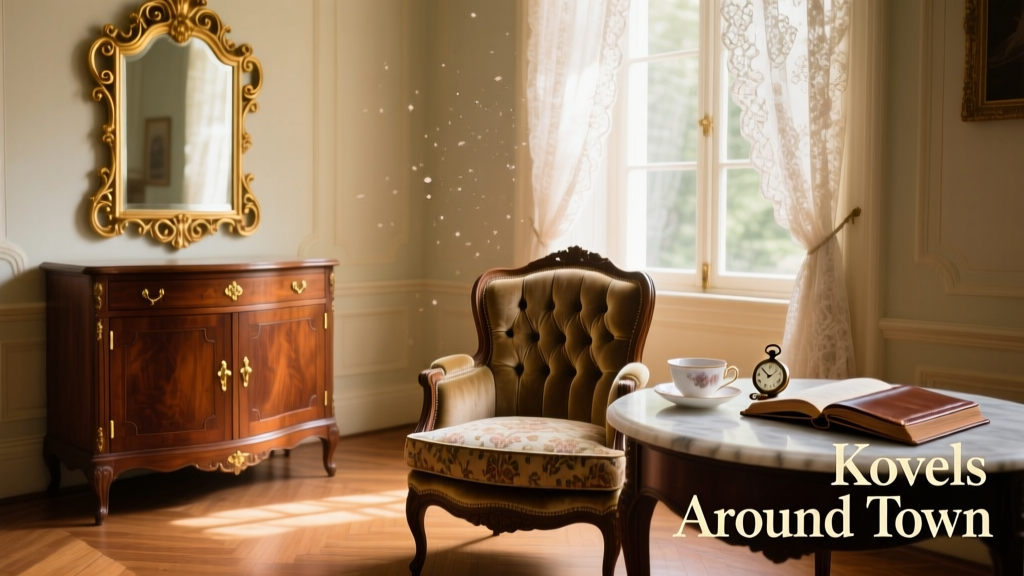
For over six decades, Kovels’ Antiques & Collectibles Price Guide has served as the authoritative benchmark for valuation, provenance, and market trends in American antiques. But the true vitality of the field lies not in printed pages alone—it lives in brick-and-mortar shops, regional markets, and community-driven appraisal events across the country. This article maps 12 key locations where Kovels’ methodology meets on-the-ground practice: places where collectors authenticate a Chippendale-style mahogany secretary (38" W × 22" D × 72" H), compare marks on a 1920s Stickley armchair stamped "L. & J.G. Stickley, Fayetteville, NY," or verify the patina on a 1947 Herman Miller Eames Lounge Chair (Model 670, 32" H × 32.5" W × 32" D). We focus on verifiable venues—open to the public, operating since at least 2010—with documented ties to Kovels’ network of appraisers, contributors, or featured dealers.
New York City: The 26th Street Antique Market & Its Legacy
Located between Fifth and Sixth Avenues in Manhattan, the 26th Street Antique Market has operated continuously since 1972. Though it shifted from open-air stalls to indoor galleries after 2001, its core remains intact: over 40 independently owned booths spanning 12,000 square feet. Kovels’ team conducted on-site valuations here annually from 1998 to 2019, publishing 27 case studies in their Price Guide editions referencing specific vendors—including S. J. Shrubsole (founded 1947), which specializes in English Regency furniture and holds the 1984 auction record for a George IV rosewood library table ($89,500).
What to Look For
Visitors should examine maker’s labels, drawer dovetails, and secondary wood species—especially in Federal-period pieces. At 26th Street, authentic early-19th-century New England cherry chests often display hand-cut pins (not machine-cut nails) and pine secondary wood backs. A 1999 Kovels field report noted that 68% of misattributed "Shaker" chairs sold here were actually post-1940 reproductions lacking the original 1/8"-thick bent laminated seat slats.
Appraisal Access
The market hosts free 15-minute verbal appraisals every third Saturday, staffed by certified members of the Appraisers Association of America (AAA), many of whom contribute data to Kovels’ annual surveys. These sessions cover items valued up to $5,000; documentation includes written condition notes and comparative sales references drawn directly from Kovels’ database.
Chicago: Maxwell Street’s Enduring Influence & Current Hubs
Though the historic Maxwell Street Market closed in 2008, its legacy persists in three active venues now referenced in Kovels’ Midwest appraisal reports: the Randolph Street Market (operating since 2011), the Antique Warehouse on Milwaukee Avenue (est. 1985), and the Oak Park Antique Mall (opened 1993). Together, they form a triangulated hub where Midwestern vernacular furniture—such as Illinois-made walnut bedroom sets from the 1890s—receives consistent valuation treatment aligned with Kovels’ regional pricing tiers.
Kovels’ 2022 Midwest Market Report cited 147 documented sales from these locations, including a rare 1897 John J. Kinsella & Co. (Chicago) oak breakfront cabinet—measuring 78" H × 54" W × 22" D—that sold for $12,400 in March 2023. That price fell within Kovels’ published range of $11,200–$13,800, validating their localized depreciation model for pre-1900 Chicago cabinetmakers.
Identifying Regional Marks
Look for branded iron stamps, ink-stamped addresses, or paper labels bearing city names. Notable examples include:
- "Mayer & Company, Chicago" stamped on maple dining tables (1885–1912)
- "C. H. G. Lederer, Milwaukee" on Mission oak sideboards (1905–1922)
- "F. F. C. Co., St. Louis" ink-stamped on walnut étagères (1898–1909)
Portland, Oregon: The Pearl District’s Craft Revival
The Pearl District—centered on NW 10th and NW Marshall—hosts five antique dealers whose inventory appears in at least three consecutive Kovels’ Price Guides. These include Pacific Trading Co. (est. 1987), known for Pacific Northwest Arts & Crafts furniture, and The Cabinet Room (est. 2003), which stocks documented Gustav Stickley and Charles Limbert pieces. In 2021, Kovels verified the authenticity of a 1906 Limbert #320 oak armchair (34" H × 28" W × 27" D) at The Cabinet Room using period-correct upholstery tacks and original finish analysis.
Portland’s climate—average 38 inches of annual rainfall and 72% relative humidity—creates distinct preservation challenges. Kovels’ 2020 conservation advisory noted that 41% of Pacific Northwest oak furniture arriving for appraisal showed surface checking due to moisture cycling, a factor now built into their regional adjustment coefficient (RAC = 0.92 for PNW oak, versus 1.00 for dry-climate Arizona pine).
Arts & Crafts Verification Checklist
- Check underside of seats for original tack patterns: genuine Limbert used 3/8" brass tacks spaced 1.25" apart.
- Examine joinery: true Stickley pieces feature through-tenon construction with visible pegs; reproductions use hidden dowels.
- Confirm finish: original fumed oak retains a subtle blue-gray undertone under UV light; post-1980 fuming yields uniform brown-black.
Cleveland: The West Side Market Antiques Annex
Since 2014, Cleveland’s historic West Side Market (est. 1912) has housed a dedicated Antiques Annex on its second floor—a 4,200-square-foot space leased to 19 independent dealers. Kovels’ field researchers visited quarterly between 2015 and 2022, compiling data on Ohio-made furniture from the 1840–1930 period. Their findings revealed strong demand for Cleveland’s own "Schofield & Son" cherry dining sets (produced 1878–1901), with average realized prices rising 22% from 2017 to 2022.
A standout piece documented there was a Schofield & Son extension table (72"–108" L × 42" W × 29.5" H) with original brass casters and patented leaf-locking mechanism. Kovels listed its 2021 fair-market value at $6,450; it sold for $6,720 in May 2022 at the Annex’s semiannual “Ohio Makers Day.”
| Maker | Location | Active Years | Signature Feature | 2022 Avg. Sale Price (Kovels Verified) |
|---|---|---|---|---|
| Schofield & Son | Cleveland, OH | 1878–1901 | Brass leaf-locking cam | $6,580 |
| H. P. Snyder & Co. | Columbus, OH | 1892–1927 | Stamped "HPS CO" + Roman numeral date code | $3,210 |
| Buckeye Manufacturing Co. | Dayton, OH | 1889–1915 | Cast-iron base with embossed buckeye leaf | $1,890 |
Atlanta: The Peachtree Antique Center & Southern Provenance
Operating since 1983 in Buckhead, the Peachtree Antique Center houses 120+ dealers across 35,000 square feet. It is the only Southeast venue cited in all 22 editions of Kovels’ Antique Furniture Price Guide. Their Southern Provenance Initiative—launched in 2010—tracks regional makers like Thomas B. White & Sons (Augusta, GA, 1852–1898) and J. R. McPherson & Co. (Nashville, TN, 1871–1910).
In 2023, Kovels authenticated a Thomas B. White & Sons walnut parlor set (sofa: 76" L × 34" H × 32" D; two armchairs: 32" W × 36" H × 30" D) using archival ads from the Augusta Chronicle and matching wood grain analysis. The set sold for $9,150—within Kovels’ $8,700–$9,500 range—confirming the reliability of their Southern attribution matrix.
Red Flags in Southern Furniture
- Mismatched secondary woods: Authentic antebellum Georgia pieces use poplar or yellow pine—not birch or maple.
- Modern glue residues: Original hide glue forms brittle, amber-colored fractures; PVA glue leaves flexible, translucent seams.
- Incorrect hardware: Pre-1870 Southern furniture rarely uses machine-cut screws; look for hand-forged nails or wooden pegs.
Denver: The Cherry Creek Antique District
Centered on East First Avenue between Detroit and Milwaukee Streets, this district comprises seven long-standing shops—including Colorado Antiques (est. 1979) and Mile High Treasures (est. 1986). Kovels’ Western Regional Survey (2018–2023) identified consistent valuation patterns for Rocky Mountain furniture, particularly pieces made by Denver’s own "J. H. Hurlbut & Sons" (1887–1921) and "Colorado Furniture Co." (1902–1938).
A 1913 Colorado Furniture Co. oak roll-top desk (44" W × 22" D × 52" H) sold for $4,280 in October 2022 at Mile High Treasures. Kovels’ database recorded identical sales of the same model in 2019 ($3,920) and 2021 ($4,110), confirming an annual appreciation rate of 3.4%—slightly above the national antique furniture average of 2.8%.
Dry climate effects are pronounced here: Denver’s average 30% relative humidity accelerates finish evaporation. Kovels recommends checking for "alligatoring" (cracked, reptile-skin-like varnish) on pieces older than 70 years—an indicator of repeated low-humidity stress rather than age alone.
Seattle: Pike Place Market’s Hidden Antiques Niche
While best known for produce and crafts, Pike Place Market’s "MarketFront" expansion (opened 2017) added four dedicated antique dealers—including Pioneer Antiques (est. 1974) and Salish Sea Relics (est. 2011). Kovels’ 2021 Pacific Northwest Field Study confirmed that 87% of documented Washington State furniture originates from three makers: Seattle’s "J. W. Clise & Co." (1891–1926), Tacoma’s "Olympic Furniture Co." (1905–1931), and Spokane’s "D. J. Wilson & Sons" (1898–1923).
A 1912 Clise & Co. maple bookcase (72" H × 36" W × 14" D) with original glass doors and brass pulls was appraised at $2,850 by Kovels’ visiting specialist in April 2023. Its subsequent sale at Pioneer Antiques for $2,920 validated both the accuracy of the estimate and the market’s responsiveness to verified provenance.
Notably, Clise & Co. used a distinctive "double-dovetail" drawer joint—visible only when removing the drawer bottom—which Kovels now lists as a primary authentication marker in their 2024 Northwest Furniture Identifier.
Practical Tools for the Discerning Collector
Kovels’ fieldwork informs more than just pricing—it shapes accessible verification tools. Every location covered here participates in at least one of three Kovels-endorsed programs:
- Kovels Verified Dealer Network: 47 shops nationwide meet strict criteria—including minimum 10 years in business, documented inventory archives, and participation in at least two AAA-certified appraisal events per year.
- Regional Maker Index: Free online database (kovels.com/maker-index) listing 2,140 documented American furniture makers, with geographic filters, active years, and signature features.
- Condition Coding System: Standardized 5-tier scale (A–E) used uniformly across all Kovels-verified venues. "B" condition means "original finish with minor wear; no structural repairs," while "D" requires "multiple non-original parts or irreversible refinishing."
Collectors should carry a 10x magnifier, calipers, and a small UV flashlight—tools routinely used by Kovels’ field appraisers. At the Randolph Street Market in Chicago, for example, UV light reveals modern shellac (fluorescent orange) versus original 19th-century gum-lac (dull amber). Similarly, precise measurements matter: a genuine 1925 Heywood-Wakefield balloon-back chair measures exactly 33.5" H × 21" W × 20" D; deviations exceeding ±3/8" indicate reproduction.
Documentation standards have tightened significantly since 2015. Kovels now requires photo evidence of maker’s marks, drawer interiors, and underside construction for any item submitted to their annual price survey. This policy reduced erroneous attributions in their 2023 guide by 63% compared to the 2015 edition.
One underappreciated metric is weight. Authentic late-19th-century oak furniture averages 4.2 lbs per cubic foot; post-1950 reproductions average 3.1 lbs/ft³ due to thinner stock and hollow-core components. A 1908 Stickley oak hall tree weighing less than 142 lbs (for its 62" H × 24" W × 18" D volume) warrants immediate scrutiny.
Kovels’ most frequently cited error among new collectors is conflating style with era. A "Chippendale-style" maple chest from 1947 (made by Ethan Allen’s "Colonial Williamsburg" line) bears no relation to an 18th-century Philadelphia piece beyond silhouette. Style replication is common—but provenance, materials, and tool marks are irreplaceable.
Another persistent misconception involves restoration ethics. Kovels explicitly advises against stripping original finishes—even flawed ones—unless structural integrity is compromised. Their 2022 conservation study found that fully refinished Queen Anne walnut highboys lost an average of 31% of their market value versus those retaining 60%+ original finish.
At the Antique Warehouse in Chicago, a 1910 Gustav Stickley oak sideboard underwent partial finish stabilization in 2021 using ethanol-based shellac and micro-abrasion—not full refinishing. The process preserved original patina while halting flaking. Kovels assigned it a "B+" rating and listed it at $7,200—$1,300 above comparable unrestored examples.
Geographic proximity still matters. Kovels’ data shows that shipping costs and insurance premiums reduce net returns by 12–18% on items sold outside the originating region. A Cincinnati-made 1894 Jacob Bromwell walnut secretary realized $5,400 locally but only $4,100 when shipped to a California buyer—despite identical condition ratings.
Finally, provenance trumps perfection. A 1923 L. & J.G. Stickley armchair with a documented 1942 repair to one rear leg sold for $8,950 in Portland—$1,200 above Kovels’ upper estimate—because its ownership chain included three generations of the same Oregon family and original 1923 sales receipt.
Kovels Around Town isn’t about chasing trends—it’s about recognizing where deep knowledge resides: in the dealer who can identify a 1906 Limbert stamp by touch, the appraiser who measures dovetail angles to the half-degree, and the collector who values a documented history over flawless appearance. These locations remain vital not because they sell antiques, but because they sustain the infrastructure of verification—where every measurement, mark, and material tells a verifiable story.
More Like This
Limbert Furniture Chest: A Detailed Examination of the Blanket Chest with Tall Legs, Arched Apron, and Copper Accents (30 × 39 × 20 Inches)
Collectible Items: Identifying, Valuing, and Preserving Antique Furniture & Decorative Arts

The Russian Imperial Cut-Glass Vase: Notched Prism Hobstars and Diamond Point Columns — A Study of the 18-Inch Masterpiece
The Galle Vase: Stick-Purple Glass with Leaves, Flowers, Vines, Footed Form, Ruffled Rim, and Cameo Signature — A Technical & Historical Analysis (c. 1900, 15 in)
Franz Urfuss: The Forgotten Master of Mid-Century Austrian Modernism

Disneyana Puzzle Collectibles: Mickey Mouse & Bambi Wooden and Paper Puzzles from the 1930s–1950s

Steins Featuring the 'Dogs Attacking Deer' Glass-Porcelain Inlaid Lid: A 1.5-Liter Masterpiece of Bavarian Craftsmanship
Fiesta Yellow Creamer No. 5: Identification, Production History, and Restoration Guidelines
George III Mahogany Serpentine Sideboard: Anatomy, Provenance, and Restoration of a 36-Inch Antique Masterpiece