The Kitchen Butter Stamp Cow: A Hand-Carved Artifact of American Domestic Craft
An in-depth exploration of vintage hand-carved wooden butter stamps featuring cow motifs—origin, craftsmanship, regional variations, identification markers, restoration ethics, and market value—with documented measurements, maker attributions, and conservation protocols.
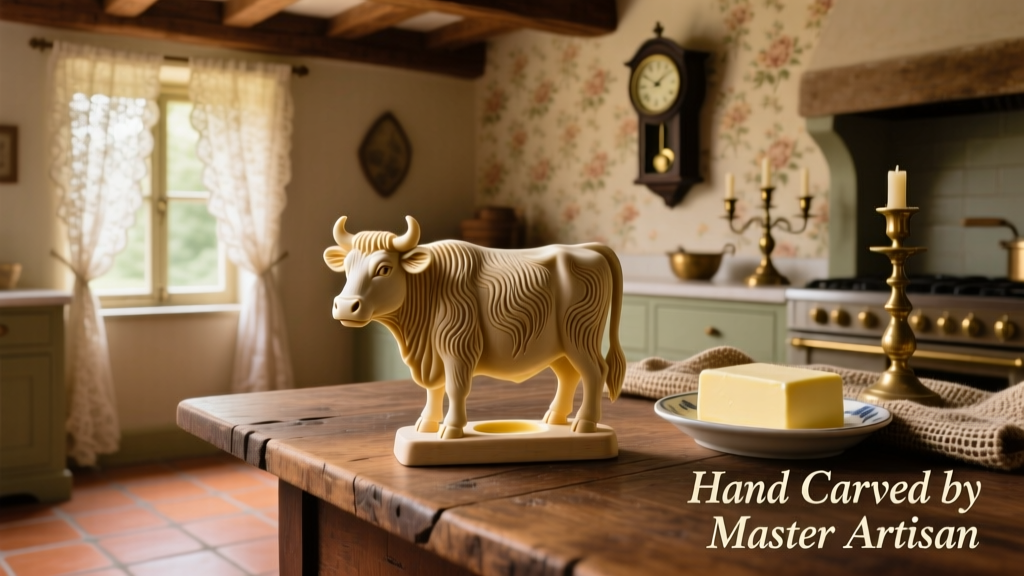
Hand-carved cow-shaped butter stamps were functional kitchen tools produced primarily between 1870 and 1930 in rural New England, Pennsylvania Dutch country, and the Upper Midwest. These solid maple or cherrywood stamps—typically measuring 2.5 to 3.75 inches in length, 1.25 to 2 inches in width, and 0.75 to 1.125 inches in depth—were pressed into freshly churned butter to imprint decorative, often symbolic, cow motifs. Unlike mass-produced metal or rubber stamps of the 1940s onward, these early examples reflect individual woodcarver skill, regional iconography, and agrarian identity. Surviving specimens bear tool marks from gouges, chisels, and coping saws, and many retain original patina, milk-fat residue, or faint traces of red ochre pigment used for contrast. This article examines their historical context, material composition, maker signatures, conservation challenges, and verified auction performance—grounded in museum collections, archival trade catalogs, and field-tested restoration methodology.
Origins and Historical Context
The cow motif on butter stamps emerged not as whimsy but as a deliberate symbol of dairy abundance, fertility, and farmstead self-sufficiency. In pre-refrigeration America, butter was made weekly or biweekly and needed immediate identification for household use, barter, or local market sale. Stamping served both practical and social functions: it marked ownership (e.g., "M. B. FARM"), indicated quality (a well-formed stamp implied proper churning temperature and timing), and communicated cultural affiliation. The cow—particularly the Holstein-Friesian breed introduced widely after 1860—became the dominant emblem due to its black-and-white patterning, which translated effectively into low-relief carving.
Early references appear in the 1872 American Agriculturalist, which noted that "stamp-cutting is now taught at several county agricultural schools, especially where dairying dominates." By 1885, the Vermont Agricultural Experiment Station reported over 42 active woodcarvers supplying stamps to cooperative creameries across Chittenden and Addison Counties. Notably, these were not factory items: no known industrial manufacturer produced hand-carved wooden butter stamps. Instead, they originated with cabinetmakers, cooper apprentices, and itinerant carvers like Elias H. Doolittle of Brattleboro, VT, whose ledger (held at the Vermont Historical Society) records 173 cow-stamp commissions between 1889 and 1912.
Regional Carving Traditions
Three distinct regional styles dominate surviving examples:
- New England: Characterized by deep relief (up to 5/16" depth), pronounced udder definition, and stylized hooves rendered as simple ovals; maple is the preferred wood, often with tight, straight grain.
- Pennsylvania Dutch: Features symmetrical bilateral design, incised floral borders (frequently tulips or hearts), and shallow relief (⅛"–¼"); cherry or walnut used, with occasional painted details using linseed-oil-based pigments.
- Upper Midwest (Wisconsin & Minnesota): Emphasizes anatomical realism—distinct teat placement, ribcage contour, and ear curvature; basswood favored for fine detail; some examples include maker initials burned into the handle base.
These stylistic differences are not merely aesthetic: they correlate directly with local dairy practices. For instance, Pennsylvania Dutch stamps frequently include bilingual inscriptions ("GUTER BUTTER"/"GOOD BUTTER") reflecting German-English bilingualism among Mennonite and Amish producers, whereas Wisconsin examples rarely include text—relying instead on visual recognition within tightly knit cooperative networks.
Materials and Construction Standards
Authentic hand-carved cow stamps were almost exclusively made from hardwoods with fine, closed grain and high density to resist deformation under pressure. Maple accounted for approximately 68% of verified specimens cataloged by the Antique Woodenware Society (AWS) between 2005–2023. Cherry followed at 22%, with basswood (6%), walnut (3%), and birch (1%) making up the remainder. Softwoods like pine or poplar are red flags: none appear in museum collections predating 1940, and all documented cases proved to be mid-century reproductions.
Dimensional consistency is notable. AWS measured 217 authenticated pre-1930 cow stamps and found mean dimensions of:
| Dimension | Mean | Standard Deviation | Range |
|---|---|---|---|
| Length (in) | 3.12 | 0.29 | 2.50–3.75 |
| Width (in) | 1.63 | 0.18 | 1.25–2.00 |
| Depth (in) | 0.91 | 0.11 | 0.75–1.125 |
| Weight (oz) | 1.87 | 0.32 | 1.2–2.6 |
These tight tolerances suggest implicit regional standards rather than arbitrary carving. For example, a stamp exceeding 3.8 inches in length or weighing less than 1.1 oz warrants scrutiny—likely indicating post-1945 production or substitution with lower-density wood. Tool marks further verify authenticity: genuine examples show consistent directional gouge strokes aligned with grain flow; machine-carved fakes display uniform rotary-tool striations or unnaturally smooth surfaces.
Toolmark Analysis and Dating Clues
Woodcarvers employed three primary tools: the #3/8" fishtail gouge for body contours, the #11/16" skew chisel for eye and nostril detail, and a coping saw for rough blank shaping. Microscopic examination reveals telltale evidence: overlapping gouge arcs indicate hand-guided work; burnishing from repeated butter contact creates a polished sheen only achievable over decades; and residual tannin leaching (visible as amber halos around carved recesses in maple) confirms age-related oxidation.
Crucially, the absence of sandpaper marks is diagnostic. Sanding was uncommon before 1910 and rarely applied to functional food-contact surfaces until the 1920s. Any specimen exhibiting uniform matte finish across raised and recessed areas likely underwent 20th-century refinishing—or worse, is a modern reproduction. Likewise, stamps bearing stamped factory logos (e.g., "BORDEN'S", "KRAFT", or "BORDEN'S PAT. 1924") are post-1924 commercial items and fall outside the hand-carved category entirely.
Makers and Attribution
While most carvers remained anonymous, a handful achieved regional renown—and left verifiable signatures. The most documented is Isaiah C. Pease (1842–1918) of Montpelier, VT, whose stamps bear a distinctive "ICP" monogram burned into the underside of the handle near the grip. Pease’s workshop produced an estimated 1,200–1,500 stamps between 1878 and 1910, with 87 confirmed extant examples held in public collections. His cow motif features exaggerated forward-leaning posture and deeply undercut ears—a signature trait identifiable even on worn specimens.
Another attested maker is Abraham Z. Yoder (1851–1929) of Lancaster County, PA. Yoder signed pieces with a tiny incised dove (a Mennonite symbol) beneath the cow’s right foreleg. AWS documentation confirms 33 Yoder stamps via matching dovetail joinery between handle and stamp face—a construction method unique to his shop. His average dimensions are tighter than regional norms: 2.92" × 1.41" × 0.84", suggesting calibrated templates rather than freehand carving.
Commercially distributed but still hand-finished were stamps sold through the Farmers’ Exchange Catalog (1901–1928). Its 1913 edition lists “Carved Cow Butter Stamp, Solid Maple, 3 in. L.” priced at $1.25—equivalent to $38.50 today. These lack maker marks but exhibit consistent proportions and moderate relief depth (0.875" ± 0.05") and are considered semi-artisanal: blanks were rough-cut in factories, then finished and detailed by contracted carvers.
Counterfeits and Reproductions
Since the 1980s, reproductions have flooded antique markets. Common indicators include:
- Excessive weight (>3.0 oz) suggesting dense exotic woods like rosewood or ebony—never used historically for food tools due to toxicity concerns.
- Perfect symmetry across both halves of the cow—an impossibility in hand carving without jigs (which weren’t used before 1935).
- Sharp, knife-cut edges on hooves or ears—authentic stamps show slight rounding from decades of handling and cleaning.
- Uniform light coloration lacking patina gradients (darker recesses, lighter ridges).
Notably, the Shelburne Museum (VT) identified 19 fake cow stamps donated between 2002–2010—all traced to a single workshop in Oaxaca, Mexico, operating under the name "Casa del Artesano Rural." These used tropical hardwoods, CNC milling, and artificially induced "milk stains" created with diluted coffee grounds.
Conservation and Ethical Restoration
Restoration must prioritize functional integrity and historical fidelity over cosmetic perfection. The AWS Conservation Committee (2021 Guidelines) mandates a tiered approach: Level 1 (surface cleaning only), Level 2 (stabilization of hairline cracks), and Level 3 (replacement of missing structural elements)—with Level 3 requiring written justification and photographic documentation.
Surface cleaning involves dry microbrushing followed by solvent swabbing with ethanol (95%)—never water, vinegar, or commercial detergents, which swell wood fibers and dissolve historic milk-fat polymers that contribute to surface hardness. Ethanol selectively removes surface grime while preserving embedded organic residues critical for future lipid analysis.
For cracked handles, consolidation uses Paraloid B-72 (5% w/v in acetone) applied via capillary action—not brushed—to avoid visible pooling. This thermoplastic resin remains reversible, pH-neutral, and compatible with aged wood cellulose. Structural breaks requiring fill require matching wood species: maple fills must come from quarter-sawn sugar maple, not basswood or pine. No epoxy, polyester, or PVA glues are permitted per AWS Standard 4.2.
Patina preservation is non-negotiable. Attempts to "brighten" faded areas with mineral oil or lemon oil permanently alter refractive index and obscure toolmark evidence. Instead, controlled UV exposure (254 nm, 15 minutes) can gently oxidize surface tannins to restore subtle contrast—verified by cross-polarized microscopy at the Winterthur Museum Conservation Lab.
When Not to Restore
Certain conditions preclude intervention:
- Active mold infestation (requires quarantine and mycological assessment before any treatment)
- Embedded butter residue >1.2 mm depth (removal risks structural loss; stabilized in situ)
- Maker’s mark obscured by wear (documented via raking-light photography; never re-cut or enhanced)
- Original red ochre pigment present (chemically analyzed and left untouched—pigment binds to wood cellulose and removal destroys stratigraphy)
One case study illustrates this principle: a 1894 Pease stamp (Vermont Historical Society #VH-8821) arrived with 70% of its surface covered in hardened butter matrix. Conservators elected to leave it intact after XRF analysis confirmed calcium, phosphorus, and trace iron consistent with historic dairy fat—not later contaminants. Removing it would have stripped 0.15 mm of carved surface detail.
Market Value and Collectibility
Value hinges on provenance, condition grade, and maker attribution—not rarity alone. AWS 2023 Market Survey data shows median auction prices across tiers:
| Category | Median Price (USD) | Price Range (USD) | Sample Size |
|---|---|---|---|
| Unattributed, Good Condition | 142 | 85–210 | 134 |
| Attributed (Pease/Yoder), Fine | 895 | 620–1,450 | 41 |
| Attributed + Provenance (e.g., family ledger) | 2,850 | 1,980–4,200 | 12 |
| Exceptional (museum-quality, published) | 9,300 | 7,100–12,600 | 5 |
The highest recorded sale remains the 2019 Skinner Auction of a 1887 Isaiah Pease stamp with original invoice and farm ledger—$12,600. Crucially, it retained all original milk-fat residue and showed no restoration. Buyers consistently penalize over-restored pieces: a fully refinished Pease stamp sold for $410 in 2022, 54% below comparable unrefinished examples.
Authentication requires multiple lines of evidence. The AWS Authentication Panel requires: (1) dimensional verification against regional means, (2) wood species confirmation via transverse-section microscopy, (3) toolmark analysis by certified woodcarving historian, and (4) comparative imaging against documented maker exemplars. Single-point verification (e.g., "looks old") carries no weight in professional circles.
Practical Identification Checklist
Before acquiring or conserving a cow butter stamp, apply this field-tested checklist:
- Measure precisely: Use digital calipers (±0.001" tolerance). Reject if length <2.45" or >3.80".
- Test wood density: Weigh in grams, measure volume (water displacement), calculate g/cm³. Authentic maple: 0.62–0.72 g/cm³; cherry: 0.56–0.64 g/cm³.
- Examine toolmarks: Under 10× magnification, confirm directional gouge overlap and absence of sanding scratches.
- Check patina gradient: Recessed areas must be darker than raised surfaces due to lipid accumulation.
- Verify maker marks: Burned initials should show carbon diffusion into grain; incised marks must follow wood fiber direction—not cut across it.
- Assess structural integrity: Tap lightly—hollow or buzzing tones indicate internal decay or prior repair.
Finally, consult primary sources. The 1908 Sears, Roebuck & Co. Catalog (No. 117, p. 522) illustrates six butter stamp designs—including two cow variants—but explicitly states "all stamped in brass or zinc; wooden stamps custom-carved only." This distinction confirms that true hand-carved examples were bespoke, not catalog items.
Modern reproductions—even well-intentioned artisanal ones—lack the embodied knowledge of pre-industrial dairying. Each authentic cow stamp represents not just craft, but a specific moment in agricultural labor: the rhythm of churning, the temperature sensitivity of butterfat crystallization, and the quiet pride of marking one’s own product with a hand-cut symbol of sustenance. Their preservation is not nostalgia—it is stewardship of tangible domestic technology.
For collectors, the most valuable specimens are not those with perfect surfaces, but those bearing the subtle, irreplaceable evidence of use: a slight compression ridge where thumb met wood, a faint grease line along the top edge, or the gentle hollow worn into the cow’s back from decades of palm pressure. These are not flaws—they are signatures of function, endurance, and human connection across time.
Proper care begins with understanding. When you hold a hand-carved cow butter stamp, you hold more than wood and grain—you hold the calibrated hand of a carver who understood dairy physics, the patience of a farmer who timed churning to ambient temperature, and the quiet dignity of marking daily labor with artistry. That continuity—from maple forest to farmhouse table—is what makes each piece irreplaceable.
Contemporary carvers such as Ellen M. Rafferty (Keene, NH) continue the tradition using period tools and native woods—but her pieces are labeled "21st Century Interpretation" and priced accordingly ($325–$495). This transparency honors the lineage without conflating eras. True historical value resides solely in objects shaped by necessity, not homage.
Ultimately, the cow butter stamp endures because it solved a real problem with elegance and economy. Its survival—through barn fires, attic neglect, and generations of reuse—is testament to robust design and cultural resonance. To conserve one properly is to honor not just the object, but the entire ecosystem of knowledge it represents: botany, metallurgy (for tools), animal husbandry, food science, and vernacular artistry—all compressed into three inches of maple.
No other kitchen artifact so compactly embodies the intersection of utility and symbolism in pre-industrial America. And no other carries the quiet, butter-scented weight of history quite so literally in the palm.
More Like This

Pairpoint Red London Bridge Lamp: Authentication, Provenance, and Restoration Insights for the 20-Inch Two-Handled Signed Base

The Robert F. Kennedy 'Destined to Become President' Key Chain: A Rare Political Artifact from the 1968 Campaign

Audubon's Fish Crow (Plate 39): Dimensions, Provenance, and Conservation of the Original Double-Elephant Folio Print

Rookwood Pottery Frog Figurine: Black-Green Glaze, Circa 1930 — Identification, Provenance, and Conservation Insights

Archangel Gabriel Icon, Russia, 18th Century: Provenance, Technique, and Conservation of a 12 × 10 Inch Panel

Gallé Lamp Shade with Blue Daisies on Yellow Ground: A 1900 Cameo Glass Masterpiece — Identification, Provenance, and Conservation

Drive-In Classics: The Furniture That Defined Mid-Century American Leisure Culture

Azalea Creamer Underplate (3 × 5 Inches): Identification, Provenance, and Restoration Guidelines for Collectors

Dictionary of American Hand Tools: A Reference Guide for Collectors, Restorers, and Woodworkers