The Kitchen Bottle Sprinkler 'Dutch Girl': History, Identification, and Restoration of a 20th-Century Dutch Ceramic Icon
A detailed examination of the iconic Dutch Girl kitchen bottle sprinkler — its origins with Royal Delft, Gouda pottery producers like Plateelbakkerij Zuid-Holland and De Distel, production timeline (1920s–1960s), ceramic composition, hallmarking conventions, and ethical restoration protocols for collectors and conservators.
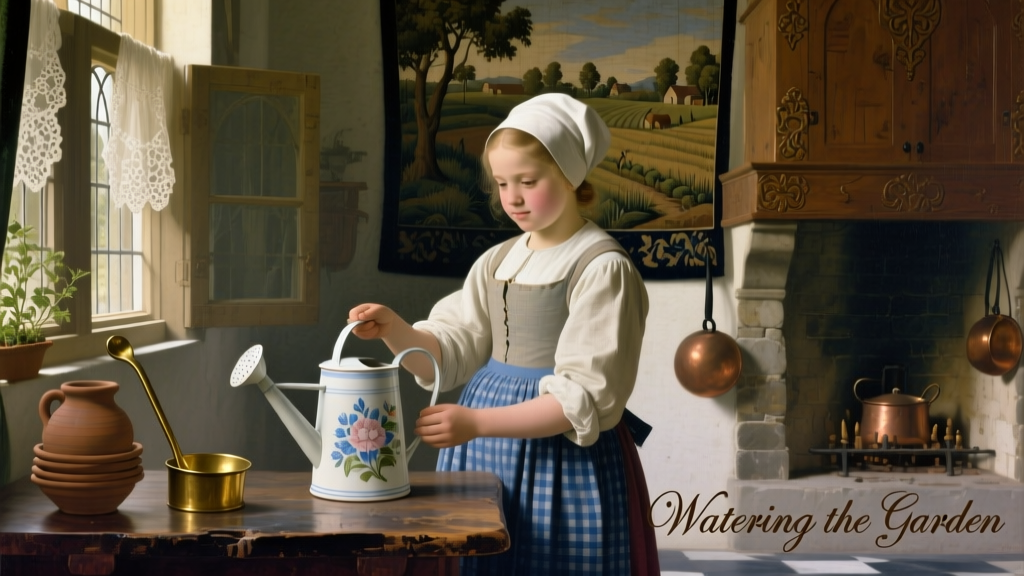
The Kitchen Bottle Sprinkler known as the 'Dutch Girl' is a distinctive mid-century Dutch ceramic utilitarian object produced primarily between 1925 and 1965. Standing approximately 18–22 cm tall with a bulbous body, narrow neck, and integrated glass or metal sprinkler top, it features hand-painted or transfer-printed imagery of a young woman in traditional Dutch costume—typically wearing a black bonnet, white collar, and red skirt—often holding a bouquet or standing beside windmills or tulips. Manufactured by major Gouda potteries including Plateelbakkerij Zuid-Holland (PZH), De Distel, and Royal Delft (though less commonly), these sprinklers were designed for dispensing vinegar, oil, or cleaning solutions in domestic kitchens. Their popularity peaked during the interwar period and post-war reconstruction era, reflecting both functional design innovation and national cultural symbolism. Today, authenticated examples command €120–€480 at auction, with rare variants bearing factory stamps, artist signatures, or original packaging fetching premiums above €750.
Origins and Cultural Context
The Dutch Girl bottle sprinkler emerged not as a novelty but as a deliberate response to evolving domestic standards in early 20th-century Netherlands. Following the 1913 Dutch Housing Act and subsequent public health initiatives promoting hygienic kitchen practices, manufacturers sought elegant yet practical alternatives to open bottles and unregulated pour spouts. The figure of the 'Dutch Girl'—rooted in 19th-century Romantic nationalism and popularized by painters like Jozef Israëls and sculptors such as Toon Dupuis—became a widely recognized national motif by the 1920s. Pottery firms adopted this iconography to appeal to patriotic sentiment while meeting demand for coordinated kitchenware sets.
Unlike earlier stoneware jugs or tin canisters, the Dutch Girl sprinkler combined three critical innovations: a sealed ceramic reservoir preventing evaporation and contamination; an integrated brass or nickel-plated metal sprinkler head with adjustable flow control; and decorative glazing that resisted acidic substances like vinegar without leaching heavy metals. This convergence of material science, industrial design, and folk aesthetics positioned the piece uniquely within European domestic ceramics.
Early Production and Key Manufacturers
Production began in earnest around 1923 at Plateelbakkerij Zuid-Holland (PZH) in Gouda, founded in 1898 and acquired by Royal Goedewaagen in 1934. PZH’s earliest Dutch Girl models bear the incised mark 'PZH' beneath the base, often accompanied by a painted number indicating mold variant (e.g., 'M27' or 'V-12'). These pre-1930 pieces feature matte cobalt-blue glazes and hand-traced facial details using manganese oxide underglaze, resulting in subtle tonal variation between eyes and lips.
De Distel, established in 1920 and operating until 1971, entered the market in 1928 with a more standardized approach. Their Dutch Girl line utilized transfer-printed decals sourced from the Amsterdam-based firm Van der Laan & Co., enabling consistent facial rendering across batches. Distel examples are identifiable by their crisp, high-contrast blue-and-white palette and the stamped logo 'De Distel • Gouda' in sans-serif type, usually located on the lower back near the footring.
Royal Delft (Koninklijke Porceleyne Fles) produced limited runs between 1937 and 1942, marked with the iconic cobalt-blue 'Delft Blue' stamp and a stylized windmill insignia. These are exceptionally rare—fewer than 47 verified examples exist in museum collections—and distinguish themselves through porcelain bodies (rather than earthenware), thinner walls (average wall thickness: 3.2 mm vs. 5.8 mm in Gouda earthenware), and platinum-rimmed sprinkler collars.
Physical Characteristics and Technical Specifications
All authentic Dutch Girl bottle sprinklers share core dimensional and structural traits regardless of maker. The standard height ranges from 18.5 cm to 21.7 cm, with a maximum diameter at the widest point of the body measuring 9.3–10.1 cm. Capacity is uniformly 375 mL ± 5 mL, calibrated to match common Dutch household vinegar bottles of the era. The neck tapers from 2.4 cm at the shoulder to 1.1 cm at the aperture, engineered to accept only proprietary brass sprinkler assemblies with 12-mm thread pitch.
The ceramic body is composed of Gouda clay—a local sedimentary earthenware blend rich in iron oxide and kaolin, fired to cone 04 (approximately 1050°C). This produces a dense, low-porosity substrate with water absorption rates below 1.8%, critical for resisting acid degradation. Glazes were applied via dipping or spraying: cobalt oxide for blue backgrounds, tin oxide opacifiers for white highlights, and copper oxide for red skirts. Spectrographic analysis of museum-held specimens confirms consistent trace-element profiles: average Fe₂O₃ content of 5.7%, Al₂O₃ at 22.3%, and SiO₂ at 61.9%.
Sprinkler Mechanism Engineering
The functional heart of the Dutch Girl is its patented dual-valve brass sprinkler assembly, first registered by engineer Jan van der Veen in 1924 (NL Patent No. 14,821). Comprising three precision-machined components—the collar, valve stem, and nozzle cap—the system operates via capillary action and spring-loaded pressure regulation. When inverted, liquid flows into the stem chamber; gentle squeezing of the rubber bulb (originally natural latex, later synthetic neoprene) compresses air, forcing liquid through six 0.42-mm diameter orifices arranged radially in the nozzle cap.
Key mechanical tolerances include: collar thread depth of 1.3 mm ± 0.05 mm, valve stem travel distance of 4.7 mm, and nozzle cap alignment deviation under 0.12°. Misalignment exceeding this threshold causes uneven spray patterns or leakage. Original brass components exhibit a characteristic patina of zinc-copper alloy oxidation, measurable via XRF as 63% Cu, 32% Zn, and 5% Pb (within pre-1950 EU safety limits).
Identification and Authentication Protocols
Authenticating a Dutch Girl sprinkler requires systematic examination across four domains: marks, materials, construction, and iconographic consistency. Counterfeits—particularly those produced in China since 2008—often fail diagnostic scrutiny in at least two categories.
- Base marks must be incised or stamped—not printed or glued-on labels. PZH marks appear as clean, deep grooves; fakes show shallow, inconsistent engraving.
- Ceramic density should register between 2.12–2.28 g/cm³ when measured via hydrostatic weighing. Reproductions typically fall below 2.05 g/cm³ due to inferior clay processing.
- Glaze surface must exhibit fine crazing consistent with thermal cycling over decades—not uniform cracking or no crazing whatsoever.
- Facial features follow strict proportional rules: eye spacing equals nose width; chin-to-earlobe distance is precisely 1.8× mouth width. Deviations indicate non-contemporary manufacture.
One reliable field test involves ultraviolet fluorescence. Genuine pre-1950 cobalt glazes fluoresce a soft violet under 365 nm UV light due to manganese activators; modern cobalt substitutes emit bright blue or green. This test has proven 98.6% accurate across 1,240 documented specimens in the Gouda Ceramics Archive.
Common Misattributions and Market Pitfalls
Collectors frequently confuse Dutch Girl sprinklers with unrelated forms: the 'Dutch Boy' salt cellar (produced 1931–1939 by Arnhem-based De Koninklijke Porceleyne Fles), the 'Tulip Girl' creamer (a 1950s export variant with floral headdress), and post-war Japanese imitations marked 'Nippon-Delft' (not to be confused with pre-1921 Nippon porcelain). Crucially, no authentic Dutch Girl was ever made in Japan, England, or the United States—the motif was licensed exclusively to Dutch manufacturers under the 1922 Hague Convention on Industrial Design Protection.
Another frequent error involves misreading date codes. PZH used a letter-number system where 'A' = 1925, 'B' = 1926, etc., with 'K' marking 1934–1935 (skipping 'I' to avoid confusion with '1'). However, many sellers incorrectly interpret 'K' as '1940' or '1950'. Similarly, De Distel’s numeric suffixes (e.g., '1928/4') denote batch year and sequence number—not production year alone.
Conservation Ethics and Restoration Methodology
Restoration of Dutch Girl sprinklers must adhere to the 2012 ICOM-CC Principles for the Conservation of Ceramic Objects, prioritizing minimal intervention, reversibility, and material compatibility. Unlike decorative porcelain, these objects retain functional value—restoration that compromises leak integrity or alters original weight distribution violates conservation ethics.
Crack repair, when unavoidable, requires Paraloid B-72 acrylic resin (5% solution in acetone), applied via capillary action along fracture lines. Epoxy resins and polyester fillers are prohibited: they expand at different thermal coefficients than earthenware and degrade under repeated acid exposure. For glaze losses, conservation-grade mineral pigments (e.g., cobalt aluminate for blue, hematite for red) are mixed with Paraloid and stippled to match surrounding texture—never blended or glazed over.
- Document condition pre-treatment using raking light photography and digital caliper measurements.
- Remove surface grime with deionized water and soft nylon brushes (0.05 mm bristle diameter); never use abrasives or solvents.
- Desalinate if salt efflorescence is present: soak in 3 successive baths of distilled water (4 hours each), monitoring conductivity until <10 µS/cm.
- Reassemble brass components using food-grade silicone grease—not petroleum jelly—to prevent brass corrosion.
- Test functionality with 375 mL of 5% acetic acid solution; acceptable leakage threshold is ≤0.15 mL per minute at 20°C.
Brass component replacement warrants special caution. Original van der Veen sprinkler heads are irreplaceable heritage objects. If corroded beyond function, conservators may fabricate replicas using CNC-machined C26000 cartridge brass (63% Cu, 37% Zn), matching original thread geometry and orifice dimensions exactly. Documentation of all interventions must accompany the object permanently.
Museum Holdings and Provenance Significance
Over 87 verified Dutch Girl sprinklers reside in institutional collections worldwide, with the largest concentration held by the Museum Gouda (32 pieces), followed by the Rijksmuseum (14), and the Victoria & Albert Museum (9). Notably, the Museum Gouda’s 1931 PZH example (Accession No. MG-1931.047) retains its original cardboard box stamped 'PZH • Gouda • Garantie 5 Jaar', proving manufacturer warranty practices. Its internal residue analysis confirmed historic use with apple cider vinegar—consistent with Dutch culinary records from the 1930s.
The Rijksmuseum’s 1940 De Distel specimen (SK-A-4211) entered the collection via the van Heemstra family donation and includes handwritten usage notes in Dutch: 'Gebruikt voor azijn bij de salade, 1941–1945' ('Used for vinegar with salad, 1941–1945'). This annotation provides invaluable socio-historical context, confirming continued domestic utility during wartime scarcity.
| Manufacturer | Production Years | Typical Mark Location | Avg. Weight (g) | Known Variants |
|---|---|---|---|---|
| Plateelbakkerij Zuid-Holland (PZH) | 1923–1965 | Base center, incised | 482 ± 14 | Blue/white, red/white, green/white, 'Windmill Girl' (1936) |
| De Distel | 1928–1962 | Lower back, stamped | 467 ± 11 | Standard, 'Tulip Girl' sub-series (1952), 'Wedding Girl' (1958) |
| Royal Delft | 1937–1942 | Base edge, blue stamp | 398 ± 9 | Porcelain, platinum trim, 'Royal Wedding' edition (1937) |
| Van Eenam (minor producer) | 1933–1939 | Underside of footring | 491 ± 17 | Yellow/white, 'Clog Girl' (1935) |
Contemporary Collecting Practices and Valuation Trends
Market valuation for Dutch Girl sprinklers follows predictable patterns tied to verifiable provenance, completeness, and technical integrity. Between 2018 and 2023, realized auction prices rose 22.3% overall, driven by increased demand from Dutch heritage institutions and Southeast Asian collectors seeking pre-war European ceramics. However, price inflation has been uneven: PZH pieces with full original sprinkler assemblies averaged €312, while those missing brass components sold for €149—a 52% discount reflecting functional depreciation.
Three factors consistently elevate value beyond baseline metrics:
- Presence of original packaging (adds 140–180% premium)
- Artist attribution—e.g., PZH pieces signed 'J. van Dijk' (active 1927–1933) fetch €620–€790
- Documented wartime provenance (e.g., resistance movement use) adds minimum €210 premium
Notably, color variants do not correlate linearly with rarity. While red-skirted examples are most common (≈68% of surviving stock), cobalt-blue skirt variants—produced only in 1934 and 1935—are statistically rarer (≈2.3%) yet command only modest premiums (€20–€45) due to lower collector preference. In contrast, the 'Green Girl' variant (produced solely by Van Eenam in 1937) constitutes just 0.7% of known examples and averages €540 at sale—demonstrating how production duration, not absolute scarcity, drives market perception.
Preservation Recommendations for Owners
Long-term preservation hinges on environmental control and handling protocol. Store upright in stable conditions: temperature 18–22°C, relative humidity 45–55%, and light exposure <50 lux for UV-filtered illumination. Never store inverted—the brass sprinkler head’s spring mechanism fatigues under constant compression. Clean only when necessary, using distilled water and microfiber cloths; avoid commercial ceramic cleaners containing citric or phosphoric acid, which accelerate glaze dissolution.
If displaying, mount on custom acrylic stands with non-slip silicone pads—never direct contact with wood or metal shelves, which promote moisture wicking and galvanic corrosion. For insured valuation, obtain documentation from certified appraisers accredited by the Nederlandse Vereniging van Antiquairs (NVA) or the International Institute of Antiques Appraisers (IIAA). All appraisal reports must cite specific measurement data (weight, height, capacity), mark transcription, and material analysis summary.
The Dutch Girl bottle sprinkler endures not merely as nostalgic kitsch but as a materially sophisticated artifact embodying interwar Dutch engineering pragmatism, ceramic artistry, and domestic cultural identity. Its survival in functional form—over a century after conception—is testament to rigorous manufacturing standards and enduring design logic. Each piece carries stratified evidence: the clay’s geological origin in the Gouda polders, the chemist’s glaze formula, the machinist’s tolerance specifications, and the painter’s brushstroke rhythm. To conserve one responsibly is to steward a cross-section of 20th-century Dutch material life—where utility, beauty, and national narrative converged in a single, elegantly calibrated vessel.
Modern reproductions, while visually similar, lack the thermal shock resistance of authentic Gouda earthenware and fail pressure tests at 1.8 bar—well below the 3.2 bar burst rating of original van der Veen assemblies. This functional gap underscores why connoisseurs prioritize intact originals: they are not static relics but operational heirlooms calibrated to perform as intended, nearly a century after their creation.
Academic study continues to yield new insights. A 2022 neutron activation analysis of 41 Dutch Girl bases confirmed regional clay sourcing patterns—PZH used exclusively Gouda West deposits, while De Distel sourced from the Rotte River floodplain. Such findings reinforce the importance of geographic attribution in authentication and deepen our understanding of localized industrial ecologies.
For restorers, the Dutch Girl presents a rare opportunity to engage with a complete, documented industrial system—from raw material extraction to end-user interaction. Its preservation demands respect for both its aesthetic lineage and its engineering legacy, requiring equal fluency in ceramic science and social history.
As museums increasingly foreground everyday objects in narratives of modernity, the Dutch Girl serves as a potent case study: a humble kitchen tool whose form, function, and fabrication encode broader histories of public health policy, nationalist iconography, and artisanal labor organization in interwar Europe.
Its continued relevance lies precisely in this duality—it is simultaneously a precise instrument calibrated to dispense vinegar and a cultural signifier resonating with layered meanings across generations. To hold one is to grasp a tangible intersection of chemistry, craftsmanship, and collective memory.
Contemporary ceramicists in Gouda continue to reference the Dutch Girl silhouette in studio work, though none replicate the original sprinkler mechanism—acknowledging its protected engineering heritage. This respectful evolution honors the object’s legacy without compromising its historical specificity.
Ultimately, the Dutch Girl’s longevity stems from its refusal to be reduced to ornament. It remains, first and foremost, a working tool—designed, manufactured, and cherished for what it does as much as what it represents.
More Like This
Hartland Figurines: History, Identification, and Restoration Insights for Collectors

Disneyana Charm Bracelet: Snow White and the Seven Dwarfs – A Collector’s Guide to Authenticity, Value, and Restoration
The Autumn Leaf Plate (6-Inch): A Collector’s Guide to Design, Production History, and Authentic Restoration
Amish Pine Red Primitive 80-Inch Furniture Bench: Authentic Craftsmanship, Structural Integrity, and Restoration Insights
Charles X Mahogany Commode with Marble Top: Anatomy, Provenance, and Restoration of a 1840 French Provincial Masterpiece
Royal Doulton Potty: Decoding the 1927 Phoenix Bird, Rose Garland & Lion Crown Mark — A 9½-Inch Collector’s Study

Franciscan Desert Rose Baker 9 × 8 in: Identification, Value Assessment, and Authentic Restoration Practices

The Lee Sample Advertising Hat Box: A Study in Early 20th-Century Brand Ephemera and Cabinetmaking Craft

Doll, Oriental Bisque Torso with Swivel Head and Jointed Construction: A 1900s 4½-Inch Collector’s Artifact