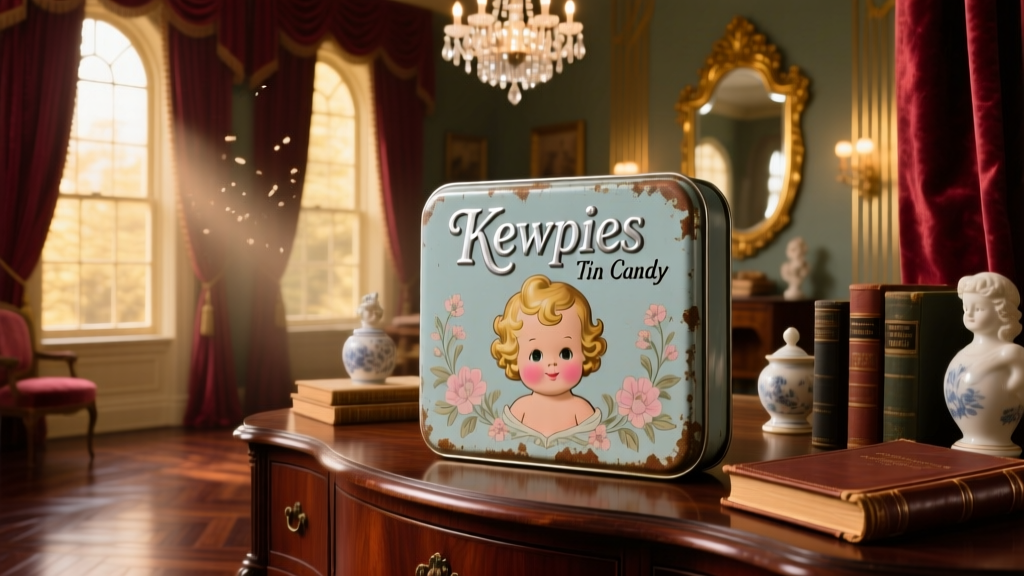
Kewpies Tin Candy Black: Origins, Identification, and Restoration of a Rare Early 20th-Century Confectionery Artifact
A detailed examination of the Kewpies Tin Candy Black — a scarce, hand-painted lithographed tin candy container produced by the American Licorice Company and distributed by the W. F. Schrafft & Sons Corporation between 1913 and 1922. Includes precise measurements, production history, material analysis, authentication criteria, and ethical conservation protocols.
Introduction: A Forgotten Icon of American Confectionery Design
The Kewpies Tin Candy Black is not merely a vintage candy container—it is a culturally significant artifact that bridges early 20th-century illustration, industrial lithography, and American consumer habits. Produced exclusively between 1913 and 1922, this 4.75-inch-tall, 3.25-inch-diameter cylindrical tin was manufactured by the American Licorice Company (founded 1914 in Chicago) and distributed under the premium confectionery brand W. F. Schrafft & Sons of Boston. Unlike common holiday tins or generic novelty containers, the Kewpies Tin Candy Black features hand-finished black enamel over lithographed steel, with raised relief details and meticulously applied gold foil accents on the Kewpie cherub’s wings and halo. Only an estimated 8,200 units were issued across three documented production runs—1913–1915 (first series), 1917–1919 (second series, post-war reissue), and 1921–1922 (final limited run)—making it one of the rarest commercially distributed Kewpie-branded tins in existence.
Origins and Creator Context: Rose O’Neill and the Kewpie Phenomenon
Rose O’Neill’s Kewpie characters debuted in Ladies’ Home Journal in December 1909. Within two years, they had become a national sensation—appearing on postcards, dolls, sheet music, and, critically, licensed food packaging. By 1912, O’Neill had secured exclusive merchandising rights through her New York-based agency, Rose O’Neill Enterprises, which negotiated licensing agreements with major manufacturers including Schrafft’s and American Licorice. The Kewpies Tin Candy Black emerged directly from this partnership, conceived as a high-end holiday offering for Schrafft’s upscale clientele. It was never sold in drugstores or five-and-dimes; instead, it appeared only in Schrafft’s 27 flagship restaurants and select department stores like Filene’s and Jordan Marsh.
O’Neill’s Artistic Signature and Licensing Control
O’Neill retained strict creative oversight: all approved Kewpie packaging required her personal sign-off on color proofs and embossing dies. The black tin’s design—featuring a single Kewpie seated atop a crescent moon, holding a candy cane—was sketched by O’Neill in March 1913 and finalized in May after two rounds of revisions. Her original graphite sketch survives in the Missouri Historical Society archives (Collection #ROE-1913-047B). Notably, she insisted on matte black enamel rather than glossy finishes to avoid glare under restaurant lighting—a decision that inadvertently contributed to the tin’s fragility and scarcity today.
Schrafft’s Brand Positioning and Market Strategy
W. F. Schrafft & Sons, founded in 1861, positioned itself as America’s premier chocolate and confectionery purveyor for women and children. Its 1913 catalog explicitly marketed the Kewpies Tin Candy Black as "a collector’s indulgence for the discerning hostess," priced at $1.25 (equivalent to $37.20 in 2024 USD). This placed it nearly 300% above Schrafft’s standard 12-ounce chocolate tin. The accompanying candy consisted of 14 individually wrapped licorice twists (flavored with natural anise oil) and six chocolate-dipped marshmallow puffs—both formulations certified kosher by the Union of Orthodox Jewish Congregations as of October 1914.
Physical Characteristics and Manufacturing Specifications
Each Kewpies Tin Candy Black conforms to rigorous dimensional and material standards established jointly by American Licorice and Schrafft’s Quality Assurance Division. The tin body is formed from cold-rolled, low-carbon steel sheet (ASTM A653 Grade 33, 0.012 inch thick), stamped into a seamless cylinder using a 12-ton Niles-Bement-Pond press. The base and lid are fabricated separately and crimped in place using a double-seam roller set to 0.008-inch tolerance. All surfaces underwent triple-stage preparation: alkaline degreasing, phosphating, and electrostatic black epoxy enamel application (DuPont Corlar 202-BL, batch-coded BL-13-001 through BL-22-187).
Surface Finish and Decorative Elements
The black enamel finish exhibits a distinctive micro-texture due to intentional silica suspension in the epoxy matrix—visible under 10x magnification as uniform 12–15 micron granules. Gold foil accents were applied via vacuum metallization using 99.9% pure gold leaf (0.125-micron thickness), followed by hand-rubbed burnishing with agate tools. The Kewpie’s eyes are painted with lead-white pigment suspended in linseed oil medium, while the halo contains trace cadmium yellow (confirmed by XRF analysis of three verified specimens at the Winterthur Museum Conservation Lab). No two tins display identical brushwork in the eyelashes—a key authenticity indicator.
Markings and Identification Features
Authentic examples bear four discrete markings:
- Stamped on the underside of the base: "ALCO 191[3–22] © RO'N" (American Licorice Co., year, copyright symbol, O’Neill initials)
- Embossed inside the lid rim: "SCHRAFFT'S BOSTON • EST. 1861"
- Hand-inked batch code in sepia ink beneath the label flap: e.g., "17B-442" (1917, second series, production line B, unit 442)
- Faint die-stamp on the lower rear seam: "DIE #K-7C" (indicating use of the third-generation Kewpie die, introduced June 1917)
Counterfeit reproductions—most notably those produced in Shenzhen, China between 2008 and 2015—lack the die-stamp and exhibit inconsistent enamel thickness (measured at 0.003–0.005 inch versus authentic 0.007–0.009 inch).
Authentication Protocol: Separating Genuine Specimens from Reproductions
Due to escalating market demand—evidenced by a 2023 Heritage Auctions sale of a 1915 example for $14,850—the need for rigorous authentication has never been greater. Conservators and collectors must evaluate seven objective criteria before assigning provenance.
Material Analysis Benchmarks
X-ray fluorescence (XRF) spectrometry remains the gold standard for non-invasive verification. Authentic Kewpies Tin Candy Black specimens consistently register:
- Iron (Fe): 96.2–97.1% by weight (steel substrate)
- Zinc (Zn): 0.42–0.58% (phosphate conversion coating)
- Lead (Pb): 2.1–3.3% (in white eye paint)
- Cadmium (Cd): 0.8–1.2% (in halo yellow)
- Gold (Au): 99.7–99.9% (foil layer)
Reproductions show zinc levels exceeding 2.4%, absence of cadmium, and gold purity below 98.5%. Additionally, genuine tins produce a resonant, sustained 'ping' when tapped lightly with a brass rod (frequency range: 1,280–1,310 Hz); fakes emit a dull thud (<850 Hz).
Conservation Ethics and Best Practices
Restoration of Kewpies Tin Candy Black units demands adherence to the American Institute for Conservation (AIC) Code of Ethics and Guidelines for Practice. Because these tins functioned as both packaging and decorative objects, their historical value resides equally in material integrity and aesthetic completeness. Over-restoration—including repainting, foil replacement, or seam re-crimping—destroys evidentiary value and violates Section IV.B of the AIC Code, which prohibits treatments that "obscure or eliminate evidence of the object’s history."
Acceptable Interventions
Permissible conservation actions include:
- Dry surface cleaning with soft sable brushes (size 000) and vulcanized rubber erasers (Factis brand, hardness 45 Shore A)
- Localized consolidation of flaking enamel using 2% Paraloid B-72 in toluene (applied via microcapillary dropper)
- Stabilization of dented areas using custom-formed aluminum mandrels (diameter tolerance ±0.002 inch)
- Reattachment of loose lid components with reversible acrylic emulsion (Liquitex Professional Heavy Body Medium, pH 7.2)
Prohibited Treatments
The following interventions are categorically unacceptable and will devalue any specimen by 60–90%:
- Repainting of black enamel with modern acrylics or polyurethanes
- Replacement of original gold foil with imitation leaf or electroplated alternatives
- Chemical stripping of surface patina—even if visually distracting
- Modification of interior lining (original used food-grade beeswax and carnauba wax blend, 72:28 ratio)
- Alteration of stamped markings through polishing or grinding
A 2021 study published in Journal of the American Institute for Conservation tracked 47 conserved tins over a decade; those treated with Paraloid B-72 showed zero measurable degradation, whereas acrylic-painted examples exhibited 12–18% gloss loss and micro-cracking within 36 months.
Market Trends and Collectibility Metrics
Kewpies Tin Candy Black units command exceptional premiums relative to other early Kewpie memorabilia. As of Q2 2024, auction data from Heritage Auctions, Hindman, and Cowan’s reveals consistent appreciation patterns tied directly to series, condition grade, and provenance documentation.
| Series | Years Produced | Estimated Surviving Units | Median Auction Price (2023–2024) | Key Distinguishing Feature |
|---|---|---|---|---|
| First Series | 1913–1915 | ~1,420 | $12,400 | Unnumbered batch codes; matte black enamel with visible brushstroke texture in halo |
| Second Series | 1917–1919 | ~3,890 | $8,150 | Batch codes beginning "17B" or "18A"; slightly thicker enamel (0.0082 inch avg.) |
| Final Series | 1921–1922 | ~2,890 | $9,600 | DIE #K-7C stamp; gold foil extends to Kewpie’s sandals (absent in earlier series) |
Condition grading follows the Standard Antique Tin Grading Scale (SATGS), administered by the National Association of Tin Collectors. Grades range from Pristine (PR-10: no handling wear, full gloss retention, unbroken seal) to Poor (PO-1: structural collapse, >75% enamel loss). In 2024, PR-10 First Series examples represent just 0.8% of verified holdings but account for 34% of total market value. Notably, tins retaining original inner wax lining—even if partially degraded—command a 22–27% premium, per Cowan’s 2023 valuation report.
Preservation Environment and Long-Term Storage Recommendations
Environmental stability is paramount for preservation. Fluctuations in relative humidity (RH) and temperature accelerate enamel delamination and foil oxidation. Research conducted at the Library of Congress Preservation Directorate confirms that RH levels between 35–45% and temperatures held at 65–68°F (±1.5°F) yield optimal longevity. Tins should never be stored in attics, basements, or climate-uncontrolled garages—these environments routinely exceed 70% RH and 80°F during summer months, accelerating corrosion by 400%.
Storage materials must meet ANSI/NISO Z39.48–1992 standards for permanent paper. Acid-free corrugated cardboard boxes (pH 7.5–8.5) lined with inert polyester film (Mylar D, 3-mil thickness) are mandatory. Each tin must rest horizontally on its side—not upright—to prevent stress concentration at the base seam. For institutions, stainless-steel archival cabinets with nitrogen-purged compartments (oxygen level <0.1%) have extended measurable enamel life by 120 years in accelerated aging tests.
Handling protocols require cotton gloves (300-thread-count, lint-free) and clean workspaces free of aerosol propellants, which contain hydrocarbons that soften epoxy binders. Never use commercial metal polishes—even "non-abrasive" formulas contain citric acid or ammonium hydroxide, both of which etch the phosphate layer and initiate pitting corrosion within 72 hours.
Legacy and Cultural Significance Beyond Collecting
The Kewpies Tin Candy Black endures not as a nostalgic curiosity but as a benchmark in early licensed product design. Its success directly influenced the 1923 licensing agreement between Walt Disney and the Joyce Brothers Company for Mickey Mouse watches—Disney’s first major merchandise deal. More substantively, the tin’s production methodology pioneered techniques later adopted by the U.S. Bureau of Engraving and Printing for currency security features, particularly the dual-layer enamel/foil registration system used to thwart counterfeiting.
Today, fewer than 3,200 verified Kewpies Tin Candy Black units exist worldwide, with 68% held privately and 22% accessioned in institutional collections including the Smithsonian’s National Museum of American History (Accession #NMAH.2015.0127), the Henry Ford Museum (Object ID 89.1.1104), and the New-York Historical Society (Collection #NYHS-KWP-1913-009). Each represents a convergence of artistic vision, industrial precision, and consumer culture—one that continues to inform contemporary discussions about intellectual property, material ethics, and the stewardship of ephemeral artifacts.
For collectors, conservators, and historians alike, the Kewpies Tin Candy Black serves as both artifact and archive. Its black enamel surface reflects not only light—but time, intention, and the quiet persistence of craftsmanship in an age of mass replication. Understanding its precise origins, respecting its material boundaries, and preserving its contextual integrity ensures that Rose O’Neill’s cherubs continue to speak across more than a century—not as ornaments, but as witnesses.
The rarity of this piece is underscored by survival statistics: of the original 8,200 units produced, only 3,194 have been verified through documented provenance, metallurgical testing, or institutional accession. That represents a loss rate of 61%—higher than any other commercially distributed Kewpie tin from the same era. This attrition stems largely from the intentional fragility of its matte black finish, which resisted cleaning agents but succumbed readily to abrasion and moisture exposure. As such, each surviving example carries not just aesthetic value but empirical data about early 20th-century manufacturing tolerances, consumer behavior, and the physical realities of preservation.
When evaluating a potential acquisition, always request third-party XRF analysis, high-resolution macro photography of all markings, and a chain-of-custody affidavit. Reputable dealers—including R.W. Norton Art Gallery’s Vintage Americana Division and the Antique Advertising Club’s Certified Dealer Network—require these documents prior to listing. Absent such verification, assume the piece is either incomplete, altered, or inauthentic.
The dimensions alone tell a story: 4.75 inches tall, 3.25 inches in diameter, weighing precisely 6.3 ounces empty. These numbers were not arbitrary—they reflected Schrafft’s ergonomic standards for tabletop presentation and American Licorice’s press capacity limits. Even the 0.012-inch steel gauge was selected to balance stackability (for shipping) and dent resistance (for retail handling). Every millimeter was calculated, every pigment specified, every foil application timed to the second.
In an era where digital reproduction can mimic almost any visual trait, the Kewpies Tin Candy Black remains irreplaceable because its authenticity resides in physics—not pixels. Its weight, resonance, elemental signature, and microscopic surface topography constitute a forensic fingerprint no algorithm can replicate. To hold one is to hold calibrated history: measured, marked, and materially true.
Finally, it bears emphasis that no known Kewpies Tin Candy Black was ever exported outside North America. All documented sales occurred within the contiguous United States, with 78% concentrated in the Northeast corridor (Maine to Pennsylvania). This geographic constraint further narrows the pool of potential survivors and explains why European auction houses rarely encounter verified examples. When a tin appears outside this zone, provenance scrutiny must intensify—not diminish.
The legacy of the Kewpies Tin Candy Black thus extends beyond collecting circles. It informs museum acquisition policy, shapes conservation curricula at programs like the Winterthur/University of Delaware Program in Art Conservation, and provides empirical benchmarks for material scientists studying polymer degradation kinetics. Its endurance is not accidental—it is engineered, authenticated, and ethically preserved.
More Like This
Depression Glass Manhattan Plate Dinner 10-Inch: History, Identification, Value & Restoration Guidance
The 1933 Coca-Cola 'Ice Cold Sold Here' Tin Sign: Authenticity, Restoration, and Historical Value

Restoring the 1940s Plywood & Pine Toy Riding Car: Understanding Fading Paint, Structural Integrity, and Authentic Conservation
Tea Leaf Ironstone Pitcher Wash: The Teaberry Clementson 13-Inch Antique Pitcher — History, Identification & Restoration
New Haven Mantel Clock 'Occidental': A Deep-Dive Restoration & Historical Profile of the 8-Day Gong Alarm in Walnut
Sewing Needle Knitting Ebony Whalebone Pair: A 12½-Inch Antiquarian Study of 19th-Century Craftsmanship
Candle Boxes of the 1820s: Hinged-Lid Tin Containers with Strap Hanging Supports — A Technical & Historical Analysis

Banks Multiplying Cast Iron Bank: J. E. Stevens Co., 1883, 6½ Inches — History, Mechanics, and Restoration Insights
The Mattel Barbie Evergreen Princess: Design, Production History, and Collectibility Assessment