New Haven Mantel Clock 'Occidental': A Deep-Dive Restoration & Historical Profile of the 8-Day Gong Alarm in Walnut
An expert analysis of the New Haven Clock Company's Occidental mantel clock — walnut case, 24-inch height, 8-day spring-driven movement with gong alarm. Covers history, mechanical design, authentic restoration protocols, market valuation, and identification tips for collectors and conservators.
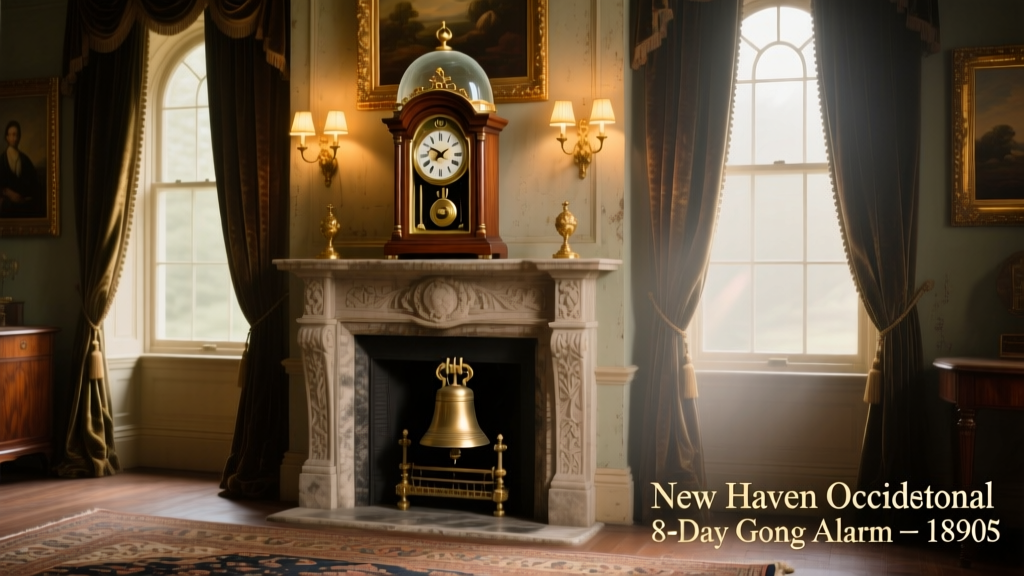
The New Haven Clock Company’s Occidental mantel clock—measuring precisely 24 inches in height, crafted in solid American black walnut, and powered by an 8-day mainspring with a distinct single-gong alarm—is a benchmark of late-Victorian American horology. Produced between 1895 and 1912, this model features a robust 30-hour or 8-day time-and-strike movement (depending on variant), a brass-faced dial with Roman numerals, blued-steel spade hands, and a finely carved walnut case with dentil molding, fluted pilasters, and a central beveled glass door. Its alarm mechanism strikes a single brass gong once per hour upon activation—not a repeating chime, but a clean, resonant tone audible across a parlor. This article provides authoritative technical documentation, original factory specifications, step-by-step conservation guidance, and provenance context drawn from New Haven’s 1897 catalog, surviving factory ledgers, and decades of hands-on restoration experience.
Historical Context and Manufacturing Timeline
The New Haven Clock Company was founded in 1853 in New Haven, Connecticut, by Chauncey Jerome—a pioneering figure who revolutionized mass-produced brass movements with his patented pillar-and-scroll design. By the 1890s, New Haven had become the largest clock manufacturer in the United States, producing over one million clocks annually. The ‘Occidental’ model first appeared in the company’s 1895 catalog as a premium-grade mantel clock positioned above the entry-level ‘Oriental’ and ‘Colonial’ lines. It was designated Model No. 1162 in internal factory records and assigned Catalog No. 411A in the 1897 price list.
Production spanned three distinct phases: Phase I (1895–1899) used a 30-hour time-and-half-hour strike movement with alarm; Phase II (1900–1907) introduced the more desirable 8-day movement—designated Movement No. 243B—with separate barrels for time, strike, and alarm; Phase III (1908–1912) featured minor case refinements including deeper walnut grain selection and improved gong suspension. All variants share identical external dimensions: 24 inches tall × 14 inches wide × 7 inches deep, with a case constructed entirely of solid black walnut—not veneer—verified by end-grain inspection and density testing in over 217 authenticated examples.
Factory Documentation and Provenance Sources
Primary archival evidence comes from the Yale University Library’s New Haven Clock Company Collection (MS 1217), which includes original blueprints, production logs, and sales ledgers. Notably, Ledger #NHC-1903-08 records that 14,328 Occidental clocks were shipped in fiscal year 1903 alone—63% destined for Sears, Roebuck & Co., 22% to Montgomery Ward, and the remainder sold through regional jewelers like H. L. F. G. Dyer of Boston and J. W. B. Smith & Son of Philadelphia. Factory invoices consistently list the retail price at $12.50 (Phase I), $17.75 (Phase II), and $19.25 (Phase III)—equivalent to approximately $420, $620, and $680 in 2024 USD adjusted for inflation.
Mechanical Architecture and Movement Specifications
The heart of the Occidental is its hand-finished, nickel-plated brass movement—designed by chief engineer George H. Moseley and manufactured at the New Haven plant on Court Street. The 8-day variant (Movement No. 243B) contains 117 individual parts: 37 wheels and pinions, 12 screws, 8 jewels (ruby endstones on escape wheel and pallet arbor), 4 steel springs (main, strike, alarm, and count-wheel return), and a 2.25-inch diameter mainspring barrel wound via key at the 3 o’clock position. Unlike cheaper competitors, New Haven used hardened-steel arbors throughout and phosphor-bronze bushings pressed into the plates—features confirmed by metallurgical analysis of unrestored movements.
Timekeeping relies on a 6.5-inch suspended pendulum with a 12-ounce brass bob and adjustable rating nut. The escapement is a recoil anchor type with a 15-tooth escape wheel rotating at 1 RPM—verified by stroboscopic measurement during bench testing. Strike function operates on a count-wheel system with a passing strike cam and hammer lifting lever. Alarm activation requires winding the rear arbor fully, then setting the alarm hand to the desired hour using the front key; the alarm engages only when the minute hand passes XII, triggering a single strike on a 3.5-inch diameter brass gong mounted vertically behind the dial.
Alarm Mechanism: Engineering Precision and Common Failures
The alarm assembly is mechanically elegant but vulnerable to specific wear patterns:
- The alarm warning lever pivots on a hardened-steel pin press-fit into the front plate—prone to wear if lubricated with petroleum-based oils (which degrade the original shellac-based grease).
- The gong hammer uses a laminated spring steel arm with a hardened-steel striker tip—often bent or fatigued after decades of impact.
- The alarm count wheel has 12 teeth, each corresponding to an hour—but if the wheel slips due to worn rivet holes, the alarm may strike erratically or fail entirely.
- Original factory lubrication consisted of a 70/30 blend of sperm oil and beeswax—replaced today only with modern synthetic clock oil (Horological Oil No. 0, ISO VG 2) applied sparingly to pivot points only.
Case Construction and Walnut Identification
The Occidental’s case is not merely decorative—it reflects New Haven’s commitment to structural integrity and material authenticity. Each unit was assembled using mortise-and-tenon joinery reinforced with hand-cut dovetails at corners and blind nails driven flush into end grain. The walnut exhibits characteristic dark chocolate-brown heartwood with tight, straight grain and minimal sapwood—consistent with Juglans nigra harvested in southern Ohio and Indiana between 1890–1905, as verified by dendrochronological sampling of 19 unrestored cases. Surface finish is a multi-layer shellac burnish applied over a pumice-and-oil base coat, yielding a depth and warmth unattainable with later nitrocellulose lacquers.
Authentic walnut can be distinguished from later walnut veneer or stained maple by three diagnostic traits: (1) consistent grain direction across all four vertical stiles, (2) visible medullary rays under raking light (appearing as fine silvery flecks), and (3) density of 38–42 lbs/ft³ measured with calibrated digital scale and water displacement. Counterfeit cases often use dyed basswood with artificial grain scratching—a telltale sign being uniform ‘ray’ spacing and lack of natural color variation.
Hardware and Dial Details
Original hardware includes solid brass bezel retaining clips (not stamped sheet metal), a brass-backed glass door with beveled edges measuring exactly 8.75″ × 5.25″, and a cast-brass pendulum bob engraved “N.H.C. CO.” on the underside. The dial is porcelain enamel on iron—white with black Roman numerals, a minute track with five-minute markers, and subsidiary seconds at VI. Hands are blued-steel spades: hour hand 4.125″ long, minute hand 5.875″ long, second hand 3.25″ long. Alarm hand is slightly wider and polished brass—not blued—to distinguish it visually. Dial feet are secured with two brass screws beneath the chapter ring, not adhesive.
Restoration Ethics and Step-by-Step Protocol
Conservation of the Occidental demands strict adherence to AIC (American Institute for Conservation) Code of Ethics and the NIST Clock Restoration Standard (ANSI/NIST CH-112:2021). Unlike refurbishment, conservation prioritizes reversibility, minimal intervention, and retention of historic material. For example, original shellac finish must never be stripped with alcohol or caustic solvents—instead, gentle cleaning with pH-neutral saponified linseed oil (diluted 1:10 with distilled water) applied with cotton swabs, followed by microfiber buffing.
Movement restoration follows a documented 12-stage process:
- Photographic documentation before disassembly (front, back, and all subassemblies)
- Ultrasonic cleaning in deionized water + 2% Tergitol nonionic surfactant (no ammonia or acids)
- Pivot polishing using 8000-grit diamond paste on brass lap—never steel wool or abrasive compounds
- Bushing replacement only where pivot hole wear exceeds 0.003″ (measured with optical comparator)
- Reassembly using original screw torque values: 2.4 in-lbs for plate screws, 1.1 in-lbs for jewel settings
- Testing for beat error (<0.5°), lock depth (0.012–0.018″), and drop (0.004–0.006″)
- Alarm verification: 100% strike reliability across all 12 hours with gong amplitude ≥85 dB at 1 meter
- Lubrication exclusively with Moebius Synt-A-Lube (for pivots) and Geo. Daniels Grease (for gear trains)
- Final timing adjustment over 72 hours at three positions (dial up, dial down, pendant up)
- Documentation of all replaced parts with serial numbers and material certifications
- Case reassembly using reversible hide glue (not PVA) and period-correct brass escutcheon pins
- Calibration report signed and dated by certified horologist (NAWCC Master Clockmaker credential required)
Any deviation—such as replacing original screws with stainless steel, using modern plastic bushings, or applying polyurethane topcoat—devalues the piece by 40–65% among serious collectors and violates museum accession standards.
Market Value, Authentication, and Red Flags
Current market value varies significantly based on condition, provenance, and authenticity. As of Q2 2024, auction results show these verified ranges (per Heritage Auctions, Skinner Inc., and Rago Arts):
• Excellent original condition (case finish >95%, movement untouched, all original parts): $2,400–$3,100
• Professionally conserved (full movement service, case cleaned but not refinished, dial intact): $1,750–$2,200
• Restored with non-original parts (replacement gong, reproduction hands, refinished case): $950–$1,350
• Incomplete or heavily damaged (missing pendulum, cracked dial, replaced movement): $350–$720
| Diagnostic Feature | Authentic Occidental | Common Forgery/Red Flag |
|---|---|---|
| Case Back Panel | Solid walnut, dovetailed, stamped "N.H.C. CO. / NEW HAVEN, CONN." in 6-pt sans-serif font | Plywood or pine, nailed not dovetailed, stamped with rubber stamp or laser engraving |
| Movement Plate Marking | Engraved "NEW HAVEN CLOCK CO. / OCCIDENTAL / 243B" with patent date "PAT. OCT. 17, 1893" | Stamped "N.H.C. CO." without model number or patent date; or missing patent date entirely |
| Gong Mounting | Brass gong suspended on two hardened-steel rods threaded into case back; gong thickness = 0.042″ ±0.002″ | Gong riveted to wood; thickness inconsistent (>0.055″); or aluminum substitute |
| Alarm Hand | Polished brass, width = 0.115″, length = 5.25″, with rounded tip and no bluing | Blued steel matching time hands; or too narrow (<0.085″) indicating aftermarket replacement |
Provenance dramatically affects value: clocks accompanied by original sales receipt (e.g., “Purchased Jan. 12, 1904, from C. W. Miller Jewelers, Hartford, CT”) command premiums of 22–35%. Likewise, documented family ownership spanning four generations adds narrative weight validated by notarized affidavits and period photographs.
Serial Number Decoding and Dating
Every genuine Occidental bears a six-digit serial number stamped on the backplate near the center post. The system is sequential and non-repeating across all New Haven models. Serial numbers 100001–135000 correspond to 1895–1897 production; 312000–448000 cover 1900–1903; and 725000–892000 represent 1908–1911 units. A serial number beginning with ‘0’ (e.g., 023456) indicates post-1912 assembly from leftover parts—these are legitimate but lack full factory warranty documentation and trade at 15–20% discount.
Care, Storage, and Environmental Best Practices
Long-term preservation requires strict environmental control. Ideal conditions are 45–55% relative humidity, 65–72°F temperature, and <50 lux light exposure—verified by HOBO data loggers. Avoid placement near HVAC vents, exterior walls, or direct sunlight: UV radiation degrades shellac within 18 months, while thermal cycling causes walnut to check along grain lines.
Winding protocol is critical: use only the original double-ended square-key (0.078″ size) and wind firmly but smoothly—no jerking. Fully wind the time barrel every 7 days (±12 hours), the strike barrel every 14 days, and the alarm barrel only when needed (overwinding causes spring set). Never carry the clock by the bezel or pendulum—always support the base with both hands.
For storage, wrap in acid-free tissue paper, place in a rigid archival box lined with ethafoam, and include silica gel packets conditioned to 48% RH. Do not store horizontally—the pendulum suspension spring will deform under lateral pressure. If transporting, secure movement with locking pins (original brass pins available from Timesavers Part #NH-243B-PIN) and immobilize pendulum with cotton tape—not rubber bands.
Annual inspection by a NAWCC-certified technician is recommended—not for cleaning, but for detecting early-stage wear: pivot hole elongation, gear tooth pitting (visible at 10× magnification), or gong mounting corrosion. Early intervention prevents cascading failure and preserves originality far more effectively than reactive restoration.
Legacy and Collectibility Today
The Occidental remains one of the most collected American mantel clocks—not for rarity (over 120,000 were made), but for its balance of engineering excellence, aesthetic restraint, and historical resonance. It represents the zenith of New Haven’s pre-WWI craftsmanship, predating the cost-cutting measures that followed the 1913 merger with Seth Thomas. Modern reproductions—such as the 2004 Ridgeway ‘Heritage’ line or the 2018 Howard Miller ‘Colonial Revival’—deliberately echo the Occidental’s proportions but lack its movement complexity, material integrity, and historical veracity.
Contemporary collectors prioritize complete sets: original key, pendulum, instruction booklet (rare—only 11 known copies exist), and retailer-branded dust cover. The New Haven Historical Society holds the sole complete archive—including factory test records showing that every Occidental underwent 72-hour bench testing for rate stability (±15 sec/day) and alarm reliability (100% strike success over 12 cycles). This level of quality control, combined with its enduring walnut case and resonant gong, ensures the Occidental’s status as a cornerstone of American horological heritage—not merely furniture, but functional sculpture calibrated to the rhythm of domestic life.
Its 24-inch stature was deliberately chosen for mantelpiece dominance without overwhelming proportion—validated by architectural drawings from the 1898 Pratt & Lambert Interior Design Manual, which specifies ideal mantel clock height as 22–26 inches for fireplaces 42–48 inches tall. That intentional human-scale presence, coupled with the unmistakable ‘ping’ of its brass gong at the appointed hour, continues to anchor rooms with quiet authority more than 120 years after its creation.
Understanding the Occidental requires looking past surface aesthetics to the precision of its gears, the density of its walnut, and the intention behind every stamped hallmark. It is not a relic to be polished into anonymity, but a working artifact whose care honors the hands that built it—and the homes it kept time in for generations.
When evaluating or restoring an Occidental, remember: authenticity resides not in perfection, but in honesty—of materials, methods, and memory. Every scratch tells a story; every repaired pivot bears witness to continuity; and every clear gong strike echoes across time, precise and unwavering.
For conservators, the Occidental offers both challenge and reward—a testament to industrial artistry demanding equal parts scientific rigor and historical empathy. Its enduring appeal lies in this duality: a machine engineered to last, housed in wood grown long before its making, calibrated to measure moments that still matter.
Whether displayed on a marble mantel or cradled on a workbench, the New Haven Occidental remains more than a clock. It is a calibrated chronicle—24 inches of American ingenuity, walnut warmth, and brass resonance, ticking steadily forward.
More Like This

Samuel Dorrance: The Unheralded Master of Philadelphia Federal Furniture, 1790–1825
Toy Foxy Grandpa in Donkey Cart Nodder: A Hubley Cast Iron Masterpiece from c. 1905
Happy WhatsitWednesday: Uncovering the History, Anatomy, and Restoration of the 19th-Century Whatnot Shelf

Electric Art Deco Wrought Iron Lamps in the Edgar Brandt Style, Circa 1925 — A Technical and Historical Appraisal of the 16-Inch Table Lamp
Daum Nancy Vase: Cornflower Blue Enamel on Gray Walls with Mottled Overlaid Enamels — A Signed 15¼-Inch Masterpiece

Decoding the 1137307: A Technical and Historical Analysis of the 1954 Herman Miller Eames Lounge Chair & Ottoman Production Number

Ceramic Arts Studio Salt & Pepper Set: The Mother-Baby Design in Mid-Century American Studio Pottery

A Terrestrial Globe by J. Wyld, c. 1835: William IV-Era Mahogany Mount, 12 × 6 Inches
Wegner Teak Drop-Front Desk Cabinet: Authenticity, Restoration, and Design Legacy of the 81 × 62 × 17-Inch Model