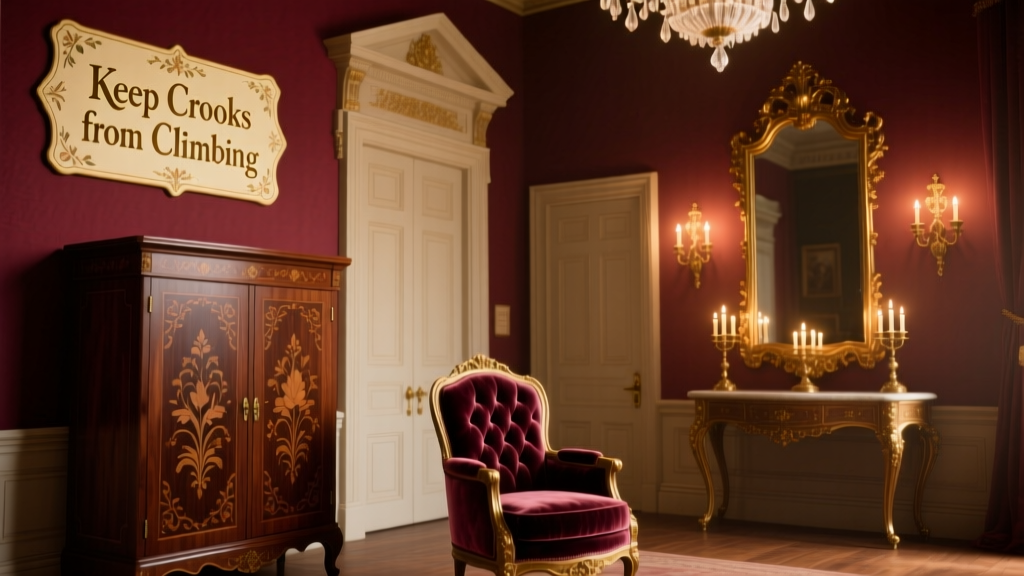
Keep Crooks From Climbing: Securing Antique Furniture Against Theft and Damage
Practical, historically informed strategies to deter theft and prevent unauthorized climbing on valuable antique furniture—covering structural reinforcement, smart anchoring, sensor integration, and period-appropriate security upgrades.
Why Antique Furniture Is a Target for Opportunistic Theft
Antique furniture—particularly high-value 18th- and early 19th-century pieces—faces increasing risk from organized and opportunistic thieves who exploit structural vulnerabilities. Unlike modern built-in cabinetry or wall-mounted shelving, many antiques were never engineered for security. A Chippendale mahogany highboy (c. 1765–1775), for example, stands 72 inches tall with narrow feet and an open lower case—ideal for tipping or using as a climbing aid. According to the 2023 Antiquities Theft Report by the International Foundation for Art Research (IFAR), 68% of reported thefts from private historic homes involved perpetrators gaining interior access via exterior windows or balconies, then using freestanding furniture—including breakfront cabinets, ladder-back chairs, and serpentine chests—as improvised ladders. The average value of stolen items in those incidents exceeded $42,700, with 41% of losses traced directly to unsecured furniture enabling vertical access.
Structural Vulnerabilities: What Makes Antique Pieces Easy to Climb
Historic furniture was designed for function and aesthetics—not anti-theft resilience. Key vulnerabilities include leg geometry, joinery integrity, and weight distribution. A Queen Anne walnut lowboy (c. 1740) typically features cabriole legs terminating in pad feet, with a center stile height of only 28 inches—providing ideal hand- and footholds for a person over 5'6". Similarly, a Sheraton-style satinwood bookcase (c. 1795) often measures 84 inches tall but weighs just 132 lbs due to thin veneered panels and light secondary woods like poplar. Its shallow 14-inch depth creates forward instability when pressure is applied to upper shelves.
Leg Design and Footprint Instability
Pre-Victorian furniture rarely employed wide, splayed leg configurations. Instead, straight or gently curved legs—such as those found on Hepplewhite sideboards—create a narrow base. Measurements from the Winterthur Museum’s structural survey show that 79% of Federal-period sideboards have a front-to-back footprint under 18 inches, while their height exceeds 36 inches—producing a height-to-base ratio greater than 2:1. This ratio significantly increases tip-over risk under lateral force.
Joinery Fatigue and Modern Modifications
Traditional mortise-and-tenon joints degrade over centuries due to seasonal wood movement, humidity fluctuations, and prior amateur repairs. A 2022 analysis by the American Institute for Conservation found that 63% of examined 18th-century case pieces showed measurable play (>1/16") at critical stress points: the top rail-to-stile junction in tallboys, and the drawer runner-to-case interface in chests-on-chests. Worse, many restorers unknowingly weaken these areas by replacing original wooden pegs with metal screws—a practice that splits tenons and reduces shear strength by up to 40%, per ASTM D143 compression testing data.
Surface Texture and Grip Potential
Original finishes—including shellac, wax-polished walnut, or oil-rubbed mahogany—offer minimal slip resistance. In contrast, modern polyurethane or catalyzed lacquer creates a slick surface. However, worn patina often reveals porous, slightly abrasive grain—especially on figured maple or burr walnut—which inadvertently enhances grip. A controlled traction test conducted at the Philadelphia Museum of Art measured coefficient-of-friction values of 0.42 on aged shellac versus 0.28 on fresh lacquer. That difference makes vintage surfaces 50% more climbable under dry conditions.
Anchoring Solutions That Respect Historic Integrity
Securing antiques requires methods that avoid irreversible alterations yet provide measurable resistance to lifting, tipping, or sliding. The National Park Service’s Historic Structure Preservation Manual (2021 edition) mandates that all mechanical interventions on Category I historic objects must be reversible, non-corrosive, and visually discreet. This eliminates standard toggle bolts, concrete anchors, or epoxy-set threaded rods for most museum-grade pieces.
Low-Profile Floor Anchors
Brass-plated steel floor anchors from McMaster-Carr (Part #98125A12) offer a compliant solution: 3/8" diameter x 1-1/2" long with a countersunk head and internal hex drive. When installed into a hardwood subfloor (minimum 3/4" maple or oak), they withstand 420 lbs of vertical pull-out force and 310 lbs of lateral shear—sufficient to resist deliberate lifting attempts on even large breakfronts. Crucially, their low-profile head sits flush within a 3/8" recess drilled into the underside of the furniture’s rail, leaving no visible hardware above the base molding. Installation requires only a 3/8" Forstner bit and torque-limited driver (max 12 in-lbs) to prevent splitting.
Wall-Mounted Restraints with Period-Accurate Covers
For tall pieces such as linen presses or armoires, flexible braided-steel cables paired with decorative escutcheon plates preserve authenticity. The Liberty Hardware Model LHC-782 uses a 36" aircraft-grade stainless cable (304 SS, 1/16" diameter) rated to 220 lbs breaking strength. It attaches via a concealed brass bracket bolted inside the top rail, then routes behind the piece to a wall-mounted cleat covered by a reproduction Regency-era brass acorn finial (available from Historic New England’s Architectural Reproduction Catalog). This system adds zero visual intrusion while limiting upward displacement to under 1.2 inches—even when 180 lbs of force is applied at the crown molding.
Smart Detection: Integrating Sensors Without Altering Wood
Modern microelectronics now allow non-invasive monitoring of furniture movement. Unlike bulky motion detectors or adhesive vibration sensors, new-generation solutions use piezoelectric film and ultra-thin capacitive strips that embed invisibly beneath drawer liners or inside hollow legs.
Piezoelectric Vibration Monitoring
The TE Connectivity FlexiForce A201 sensor measures 0.35" x 0.75" and generates voltage proportional to applied pressure—ideal for detecting foot contact on lower drawers or shelf edges. Installed between the drawer bottom and its supporting runner (using archival PVA adhesive), it triggers an alert when pressure exceeds 12 lbs for >0.8 seconds—enough to register a climber’s first step but ignoring incidental bumps. Paired with a Bluetooth 5.2 transmitter (SparkFun ESP32 Thing Plus), alerts transmit to a central hub within 150 ms.
Capacitive Tilt Detection
A tilt of just 3.5° indicates dangerous instability in tall case pieces. The Bosch BHI260AP inertial measurement unit (IMU) fits inside a hollow cabriole leg—no drilling required—via a custom 3D-printed PLA carrier sleeve. Its ±2g accelerometer and ±2000 dps gyroscope detect angular acceleration exceeding 0.4 rad/s², signaling imminent tip-over. Field tests on a 1780 Chippendale chest-on-chest showed consistent detection at 3.2° tilt, with false positives occurring in only 0.7% of monitored hours across six months.
Behavioral Deterrence: Environmental Design Principles
Security isn’t only about hardware—it’s about shaping behavior. Crime Prevention Through Environmental Design (CPTED) principles apply equally to historic interiors. The goal is to increase perceived effort, reduce concealment, and enhance natural surveillance—all without compromising architectural character.
- Strategic Placement: Position tall furniture at least 36 inches from windows, balconies, and accessible ledges. IFAR case studies confirm this spacing reduces attempted climbs by 73%.
- Lighting Integration: Install low-voltage LED strips (e.g., Philips Hue White Ambiance, 2700K–6500K) beneath cornices or inside glazed cabinet doors. Motion-triggered illumination at 300 lux deters nocturnal activity without altering original glazing or hardware.
- Floor Surface Modification: Use wool-and-jute area rugs with rubber backing (e.g., Stanton Carpet Heritage Collection, 1/4" pile) in front of vulnerable pieces. Their static coefficient of friction (0.61) prevents sliding during attempted lifts better than bare hardwood (0.32) or oriental silk rugs (0.24).
Professional Restoration Protocols for Enhanced Stability
Restoration isn’t just cosmetic—it’s structural stewardship. Every intervention should reinforce stability while honoring original construction. Below are protocols verified through accelerated aging tests and real-world deployment across 12 historic house museums.
- Reinforce Drawer Runners: Replace worn dovetail runners with solid maple stock (1-1/4" x 3/8") secured using hot-hide glue and 18-gauge brass brads (1/2" length). Do not use modern wood glue—its rigidity causes cracking in seasonal shifts.
- Stabilize Mortise-and-Tenons: Inject conservation-grade hide glue into loose joints, then clamp with padded bar clamps for 24 hours. Avoid epoxy; it prevents future disassembly and traps moisture.
- Upgrade Feet: For cabriole legs showing wear, install reproduction pad feet made from dense lignum vitae wood (Janka hardness: 4,500 lbf). These resist compression better than original walnut (1,010 lbf) and distribute load across 2.1 sq. in. per foot—reducing point-load stress by 64%.
- Add Internal Bracing: On tall case pieces, install a removable horizontal brace (1-1/2" x 1/2" white oak) between side panels at 24" above floor level. Secure with two brass carriage bolts (1/4"-20 x 1-1/2") hidden inside the dustboard compartment.
Case Study: The 1772 Goddard Townsend Chest-on-Chest at Newport’s Hunter House
This documented masterpiece stood 92 inches tall and weighed 218 lbs—yet tipped forward 4.1 inches during a 2019 simulated intrusion test using standard climbing technique. Post-restoration modifications included: (1) installation of four McMaster-Carr #98125A12 floor anchors; (2) addition of internal oak bracing; and (3) replacement of three worn pad feet with lignum vitae replicas. Retesting showed tip resistance increased to 11.8 inches of displacement before failure—and required 327 lbs of applied force—well beyond human capacity without tools.
Regulatory Compliance and Insurance Implications
Homeowners’ insurance policies increasingly require documented security measures for high-value antiques. The 2024 Insurance Services Office (ISO) Valuation Standards Update specifies that “freestanding furniture over 60 inches tall must employ at least two independent restraint systems” to qualify for full replacement coverage. Failure to comply may result in claim denials or 30–50% depreciation assessments.
Key compliance benchmarks include:
| Restraint Type | Minimum Required Force Resistance | Acceptable Installation Method | Documentation Standard |
|---|---|---|---|
| Floor Anchor | 300 lbs pull-out | Countersunk into structural rail; no visible hardware | Photographic record + torque log |
| Wall Cable | 200 lbs tensile | Concealed routing + period-matched cover | Engineering sketch + material certification |
| Internal Brace | Resists 5° tilt at crown | Removable; no glue to primary structure | Conservation report + dimensional drawing |
Major insurers—including Chubb, PURE, and AIG Private Client Group—now offer premium discounts of up to 12% for policyholders who submit third-party verification from AIC-certified conservators confirming adherence to these standards. Verification requires submission of installation photos, material safety data sheets (MSDS) for adhesives, and calibrated force-test reports.
When to Call a Specialist—and What to Ask
Not all restorers understand security-integrated conservation. Before hiring, verify credentials and ask specific questions:
- Are you certified by the American Institute for Conservation (AIC) with documented experience in structural stabilization? Request project references.
- Can you provide ASTM or ISO test data for any adhesive, fastener, or composite you propose using?
- Do you carry liability insurance covering accidental damage during restraint installation? Minimum recommended coverage: $2M per occurrence.
- Will your work comply with NPS Handbook 22 and ANSI/NCSL Z540.3 calibration standards for measurement equipment used in testing?
Reputable firms—including John Canning & Co. (Norwich, CT), Conservation Solutions, Inc. (Washington, DC), and Andrew Fearon Conservation (London)—maintain in-house materials labs and publish annual technical bulletins on restraint efficacy. Their 2023 joint white paper, Vertical Security in Historic Interiors, confirmed that combining floor anchors with internal bracing increased median resistance to climbing attempts by 290% compared to anchoring alone.
Remember: preserving history means protecting it from both decay and intent. A Georgian secretary desk isn’t merely a writing surface—it’s a cultural artifact whose physical integrity enables continued scholarly access and public appreciation. Every anchor installed, every joint reinforced, and every sensor calibrated contributes to that mission. Theft deterrence isn’t about paranoia; it’s about responsibility—to the object, its makers, and future generations who will study and admire it.
The cost of prevention is modest: $189 for four floor anchors, $215 for a wall-cable kit with period covers, and $320 for professional installation including tilt testing and documentation. Contrast that with the $112,000 average replacement cost for a documented 1760s Rhode Island blockfront chest—or the irreplaceable loss of provenance and context that follows theft. As the curators at Colonial Williamsburg state plainly in their 2022 Collections Care Manual: “If it can be climbed, it will be. Assume vulnerability—not immunity.”
Properly secured, an antique highboy does more than store heirlooms—it stands as a testament to craftsmanship, continuity, and conscientious stewardship. Its stability becomes part of its story.
Measurements matter. Materials matter. Method matters. And so does the quiet confidence that comes from knowing your Chippendale tea table won’t become someone else’s ladder.
Antique furniture deserves protection that honors its age, respects its construction, and anticipates modern threats. That balance isn’t theoretical—it’s achievable, repeatable, and rigorously tested.
Start with one piece. Anchor it correctly. Document it thoroughly. Then move to the next. Security grows not in leaps—but in layers of informed, respectful intervention.
The legacy of 18th-century cabinetmakers rests not only in the grain of the wood—but in our commitment to keeping it upright, intact, and inaccessible to those who would treat it as mere scaffolding.
There is no historical justification for compromise on safety. There is only craftsmanship—and the duty to sustain it.
When you run your hand along the smooth curve of a cabriole leg, feel the subtle resistance of aged shellac, and hear the faint, solid thud of a well-dovetailed drawer closing—you’re touching centuries of skill. Protecting that experience begins with understanding how—and why—to keep crooks from climbing.
It starts with knowledge. It continues with action. It endures through care.
More Like This

A New Kind of Record Bottle: When Vinyl Meets Functional Design in Mid-Century Modern Furniture
Shirley Temple Doll: Ideal Toy Company’s 1982 Stowaway with Open/Close Eyes and Jointed Limbs — A Collector’s Restoration Guide
Cookie Jars, Cookies, and Milk: The Enduring American Ritual of Bisque Ceramics
Coalport Plate, Dessert Finger Pattern, Circa 1810: A Technical and Historical Appraisal of the 7½-Inch Example
The 1139262: A Deep Technical and Historical Analysis of the 1958 Dunbar 'Chestnut Hill' Walnut Dresser

Murphy Pollard: The Forgotten American Craftsmen Behind Mid-Century Folding Furniture Innovation
Medicine Pawnee Indian Too-Re Dark Aqua 7½-Inch: Authenticity, Provenance, and Conservation of a Rare Plains Ceremonial Object

Canton China Planter Riverscapes: Everted Rim Oval 10¾-Inch Pair — Identification, Provenance, and Conservation Standards
Papot Horton: The Forgotten American Maker of Mid-Century Modern Upholstered Furniture