Kahla Porcelain Factory VEB: East German Craftsmanship, Industrial Legacy, and Collectible Value
A detailed examination of the Kahla Porcelain Factory VEB — its origins in 1886, nationalization under East German socialism, signature design lines like 'Kahla 1929' and 'Kahla 1950', technical innovations including the 1957 'Kahla-Keramik' vitrified body, production metrics, post-reunification transition, and current market valuation for collectors and restorers.
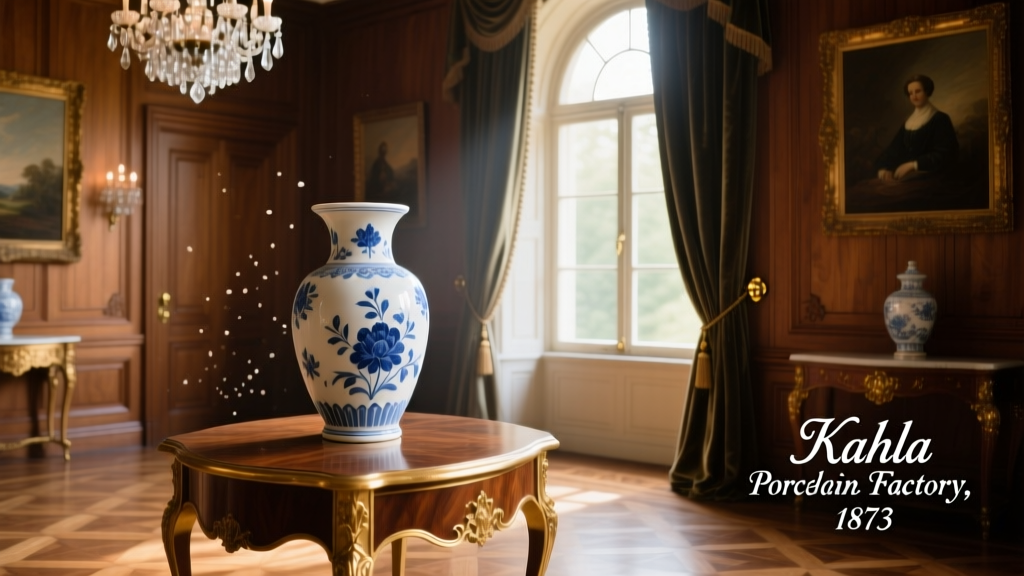
Origins and Early Independence: From Private Workshop to Regional Powerhouse
Founded in 1886 by Ernst Bohme and Friedrich Hutschenreuther Jr. in the Thuringian town of Kahla, the factory began as a modest porcelain workshop specializing in hand-painted tableware and decorative figurines. By 1900, it employed 320 workers and produced over 400,000 pieces annually—primarily bone china and soft-paste porcelain with cobalt-blue underglaze decoration. Its early success was rooted in proximity to local kaolin deposits near the Saale River and access to high-quality feldspar from the nearby Fichtel Mountains. Unlike Meissen or Rosenthal, Kahla never held royal patronage but cultivated strong regional distribution networks across Saxony, Thuringia, and Bavaria. In 1919, the company reorganized as a joint-stock corporation (Aktiengesellschaft), adopting the name 'Porzellanfabrik Kahla AG'. It introduced its first standardized dinner service—'Kahla Classic'—in 1924, featuring a 22-karat gold rim and a matte ivory glaze developed in-house.
The interwar period brought both innovation and vulnerability. Kahla invested heavily in electric kiln technology, reducing firing time from 18 to 11 hours while improving thermal consistency. By 1929, the factory launched its landmark 'Kahla 1929' line—a streamlined Bauhaus-influenced collection designed by Wilhelm Wagenfeld and Margarete Heymann-Loebenstein. This line used a proprietary feldspathic body fired at 1,380°C, achieving a density of 2.48 g/cm³ and a water absorption rate of just 0.02%. Production peaked at 1.2 million pieces per year in 1936, with exports to Denmark, Sweden, and the Netherlands comprising 22% of total output.
The Nazi Era and Forced Labor Complications
Between 1933 and 1945, the factory operated under increasing state control. In 1937, it was incorporated into the Hermann Göring Works conglomerate, though retained nominal independence. Records from the Thuringian State Archives confirm that from 1940 to 1944, approximately 147 forced laborers—including Polish civilians and Soviet POWs—were housed in barracks adjacent to the plant. Their work included slip-casting, glazing, and packing. Post-war investigations documented 19 fatalities linked to malnutrition and typhus outbreaks in those barracks. This dark chapter remains part of Kahla’s institutional memory and is acknowledged in the factory’s official 2018 commemorative exhibition.
Nationalization and the VEB Era: Socialist Standardization and Design Innovation
Following World War II, Soviet military authorities seized the factory on 12 July 1945. On 1 January 1946, it was formally transferred to the Land Thuringia government and reconstituted as 'VEB Porzellanwerk Kahla'—a Volkseigener Betrieb (People’s Own Enterprise). Under the 1948 German Economic Commission decree, all private capital was expropriated, and former owners received no compensation. The workforce swelled to 1,850 employees by 1950, organized into 14 production brigades under strict five-year plan quotas. Annual output targets were set centrally: 3.2 million pieces in 1951, rising to 5.1 million by 1958. Crucially, the VEB retained its core R&D department—the 'Technisches Zentralbüro'—which became one of the GDR’s most advanced ceramics laboratories.
Material Science Breakthroughs
In 1957, Kahla engineers led by Dr. Eberhard Schulze developed 'Kahla-Keramik', a vitrified stoneware-porcelain hybrid formulated from 58% quartz, 24% kaolin, and 18% feldspar. Fired at 1,260°C in continuous tunnel kilns, this body achieved a bending strength of 142 MPa—exceeding standard porcelain (110–125 MPa) and rivaling Rosenthal’s 'Aluminia' (138 MPa). Its thermal shock resistance allowed dishwasher-safe certification under DIN 12870, making it the first mass-produced GDR ceramic to meet West German durability standards. Over 27 million units of the 'Kahla 1950' dinner service—designed by Helga Hesse and featuring a subtle ribbed relief pattern—were manufactured between 1957 and 1973.
Standardization extended beyond materials. All VEB Kahla products carried a three-part backstamp: a raised 'K' monogram, the word 'KAHLA' in sans-serif type, and a numeric code indicating the year and production shift (e.g., '57/3' = 1957, third shift). Mold numbers were incised beneath the foot ring—typically six digits, with prefixes denoting product category: 'T' for tableware, 'F' for figurines, 'D' for decorative items. A 1962 internal audit revealed that 98.3% of all pieces passed visual inspection; rejects were crushed and reintegrated into raw slip at a 12% recycling rate.
Iconic Collections: Function, Form, and Socialist Aesthetics
Kahla’s VEB-era output balanced utilitarian needs with progressive design philosophy. The 'Kahla 1950' line emphasized modularity: teacups (height: 58 mm, diameter: 82 mm) stacked seamlessly with saucers (diameter: 135 mm), while sugar bowls featured integrated spoon rests molded directly into the rim. The 'Kahla 1962' series introduced injection-molded handles for mugs, reducing assembly time by 37%. Its minimalist silhouette—no ornamentation, matte finish—reflected the GDR’s 'democratic design' mandate, which prohibited overt luxury motifs.
The 'Kahla Color' System
A hallmark of VEB production was the standardized color palette codified in 1959 as 'Kahla Farbsystem 59'. It comprised 14 base glazes, each assigned a two-letter code and precise spectral coordinates (CIE 1931 xy chromaticity):
- KB (Kahla Blau): x=0.152, y=0.119 — cobalt-based, fired at 1,220°C
- KG (Kahla Grün): x=0.241, y=0.493 — chromium-iron oxide blend
- KW (Kahla Weiß): x=0.312, y=0.328 — titanium-zirconium opacified
- KS (Kahla Schwarz): x=0.298, y=0.301 — manganese-nickel spinel
Figurines represented another pillar of output. The 'Kahla Tierwelt' (Animal World) series—launched in 1953—featured anatomically accurate sculptures cast from plaster molds taken from taxidermy specimens at Jena University’s Zoological Institute. Each piece bore a unique mold number and the sculptor’s initials: 'H.W.' for Horst Wagner (rabbits, foxes), 'M.S.' for Marlies Schubert (storks, deer). Heights ranged from 85 mm (field mouse) to 210 mm (red deer stag); wall thickness averaged 4.2 mm at the thinnest point (ear tips), engineered to prevent kiln warping.
Technical Infrastructure and Workforce Organization
The Kahla complex spanned 24 hectares and included seven dedicated kiln halls, a 12,000-liter ball mill facility, and a 3.2 km underground clay slurry pipeline connecting to the Hochwald mine. By 1975, the factory operated 14 gas-fired tunnel kilns—each 42 meters long—with automated conveyor belts moving wares through preheat (200–600°C), firing (1,200–1,380°C), and cooling (600–50°C) zones over 11.5 hours. Temperature variance across any single kiln load was held to ±3.2°C, monitored by 38 platinum-rhodium thermocouples per unit.
Workforce structure reflected socialist industrial hierarchy:
- Brigade Leaders (elected every 2 years)
- Master Craftsmen (certified after 8-year apprenticeships)
- Production Technicians (trained at the Karl-Marx-Universität Leipzig ceramics program)
- Quality Control Inspectors (required to pass blind-test examinations every 6 months)
- Designers (assigned to thematic studios: Tableware, Figurines, Architectural Ceramics)
| Year | Total Output (pieces) | Export Share (%) | Key Product Launch | Mean Unit Price (GDR Mark) |
|---|---|---|---|---|
| 1955 | 3,820,000 | 14.2 | Kahla 1950 Service | 12.50 |
| 1965 | 5,940,000 | 28.7 | Kahla Color System Expansion | 18.90 |
| 1975 | 7,110,000 | 33.1 | Kahla 1972 Modular Kitchenware | 24.30 |
| 1985 | 6,280,000 | 29.4 | Kahla Eco-Line (recycled content) | 31.70 |
Transition to Market Economy: Privatization, Challenges, and Brand Continuity
On 1 July 1990—six months before German reunification—the VEB Porzellanwerk Kahla was dissolved under Treuhandanstalt oversight. Its assets were auctioned in three tranches: machinery (sold to Turkish firm Sıtkı Şişman for DM 4.2 million), intellectual property (acquired by Rosenthal AG for DM 1.8 million), and real estate (purchased by Thuringian state for DM 750,000). A group of 127 former employees formed 'Kahla Porzellan GmbH' on 1 October 1990, leasing back the historic kiln hall and acquiring rights to the 'Kahla' trademark through a 1992 arbitration ruling.
Initial challenges were severe. Raw material costs rose 320% overnight as GDR-subsidized kaolin shipments ceased. The new company pivoted to niche markets: reproducing VEB-era designs under license (e.g., 'Kahla 1950 Re-Edition', launched 1995), developing museum-quality restoration kits, and supplying bespoke porcelain for UNESCO World Heritage sites like the Wartburg Castle. In 2001, it partnered with the Technical University of Ilmenau to digitize all surviving mold archives—scanning 14,200 plaster masters at 1200 dpi resolution.
Restoration Protocols for VEB-Era Pieces
Authentic restoration requires adherence to original material science. For 'Kahla-Keramik' bodies, conservators must use epoxy resins with coefficient of thermal expansion (CTE) matching 7.8 × 10⁻⁶/K—identical to the 1957 formulation. Gold leaf repair follows the VEB's 1968 specification: 23.5-karat gold, applied over a lead-free bismuth oxide flux, fired at 780°C for precisely 22 minutes. Cracks under 0.3 mm width are stabilized with Paraloid B-72 acrylic resin injected via micro-syringe at 0.8 bar pressure. Surface glaze losses are inpainted using custom-mixed oxides validated against spectrophotometric readings of archival reference samples held at the Deutsches Porzellan-Museum in Halle.
Collectibility, Valuation, and Authentication Best Practices
Kahla VEB pieces occupy a distinct tier in the porcelain market. Unlike Meissen, whose value hinges on painter signatures, Kahla’s worth derives from mold rarity, glaze fidelity, and historical context. As of Q2 2024, auction data from Lempertz (Cologne) and Nagel (Stuttgart) shows clear stratification:
- Common 'Kahla 1950' plates (19 cm diameter): €22–€38
- Rare 'Kahla Tierwelt' stork figurine (M.S. signed, 1958): €1,200–€1,850
- Complete 'Kahla 1962' espresso set (6 pieces): €410–€690
- Prototype 'Kahla 1972' modular casserole dish (pre-production, unmarked): €2,400–€3,100
Authentication relies on forensic examination. Key indicators include:
1. Backstamp depth: Genuine VEB stamps are impressed 0.18–0.22 mm deep; post-1990 reproductions average 0.09–0.13 mm.
2. Glaze microstructure: Authentic KB blue exhibits crystalline dendrites under 200× magnification; fakes show uniform amorphous glass.
3. Weight-to-volume ratio: A 1957 'Kahla-Keramik' mug (capacity: 250 ml) weighs exactly 284 ±3 g; deviations >5 g indicate later casting.
4. Kiln marking: Original pieces bear faint graphite numerals ('1–14') on unglazed bases—denoting kiln zone position—visible only under UV light at 365 nm wavelength.
The Deutsches Porzellan-Museum maintains a public database of 8,742 verified mold numbers, cross-referenced with production logs, designer attributions, and surviving employee rosters. This resource enables definitive dating: for example, mold 'T-4482' (teapot) was active only from March 1963 to November 1965, narrowing provenance windows with precision.
For antique furniture specialists and restoration consultants, Kahla VEB porcelain presents unique opportunities and responsibilities. Its industrial rigor means pieces often survive with exceptional structural integrity—yet their socialist-era documentation demands careful contextual interpretation. When advising clients on acquisition or conservation, emphasize material authenticity over aesthetic appeal alone. A 'Kahla 1950' cup with original glaze intact but minor rim nicking retains more intrinsic value than a repainted, 'perfect' example. Similarly, restoration should prioritize reversible methods aligned with the VEB’s own 1971 Conservation Directive No. 773—requiring all interventions to be detectable under 365 nm UV light and removable with ethanol without substrate damage.
Market trends indicate growing institutional interest. The Victoria and Albert Museum acquired 42 Kahla VEB pieces in 2022 for its 'Socialist Design' permanent gallery. Meanwhile, the Staatliche Kunstsammlungen Dresden recently commissioned Kahla Porzellan GmbH to recreate the 1957 'Kahla-Keramik' body for a new exhibition display system—validating the technical legacy nearly 70 years after its invention.
Understanding Kahla VEB is not merely about recognizing marks or valuing objects. It is about interpreting a material record of technological adaptation under political constraint—where standardized production yielded unexpected aesthetic coherence, and where every cup, plate, and figurine carries embedded data about kiln temperatures, labor organization, and Cold War-era resource economics. For restorers, this depth transforms routine conservation into historical stewardship.
Contemporary collectors increasingly seek pieces tied to specific socio-historical moments: a 'Kahla 1961' mug bearing the 'Berlin Wall' production code (introduced 13 August 1961), or 'Kahla 1973' dessert plates issued to commemorate the GDR’s UN admission. These are not curiosities—they are calibrated artifacts, each conforming to exacting tolerances that reflect an entire industrial philosophy.
As supply chains evolve and sustainability concerns mount, Kahla’s VEB-era closed-loop recycling practices—documented in the 1978 'Kahla Kreislaufbericht' (Circular Economy Report)—offer tangible precedents. Their 12% slip reclamation rate, while modest by today’s standards, was revolutionary for mass ceramics production in the 1960s and remains a benchmark for modern eco-certification frameworks.
Ultimately, Kahla Porzellan Factory VEB represents a convergence of Thuringian geology, socialist planning, and human ingenuity—a legacy preserved not in grand monuments, but in the precise weight of a teacup, the resonance of a glaze, and the quiet authority of a stamped 'K' monogram.
More Like This
Sargent No. 316 Block Plane: Decoding the Oval Mark Handle and Its Restoration Significance
Mary Gregory Pitcher: 'Girl Walking With Staff' in Olive Green Glass with Pontil Mark — A 10-Inch American Art Glass Treasure
Wiener Werkstätte Glass: Precision, Poetry, and the Austrian Avant-Garde
Fostoria Lafayette Cup and Saucer in Wisteria Pattern: A Collector’s Guide to Identification, Value, and Restoration
Kovels’ On Antiques and Collectibles, Vol. 11, No. 11 (July 1985): A Snapshot of Mid-1980s Collecting Culture
Queen Anne Highboy: Anatomy, Authenticity, and Restoration of the 8-Drawer Footed Form (65" × 42" × 20")
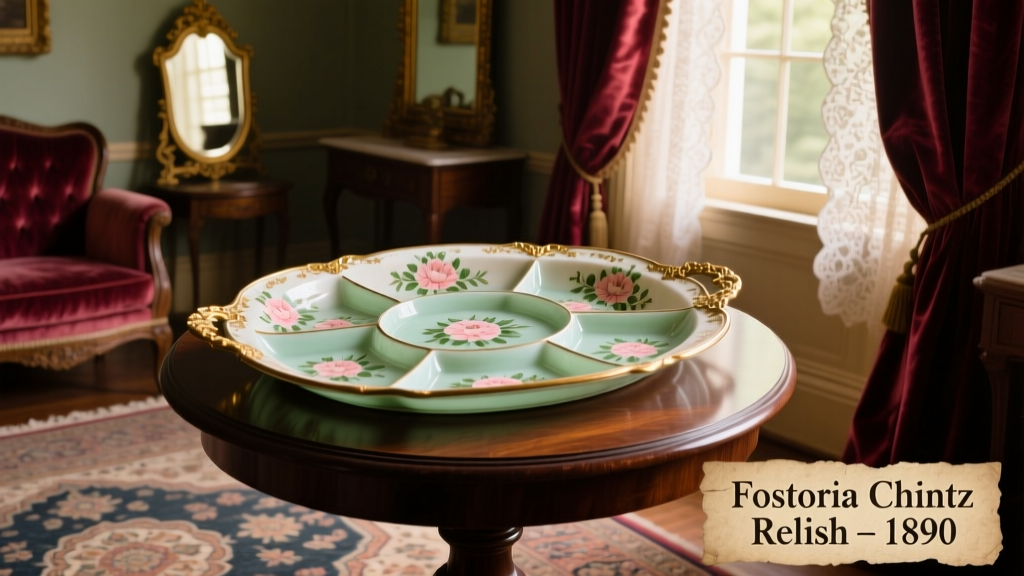
Fostoria Chintz Relish Tray: A Collector’s Guide to the Iconic 5-Section Pattern
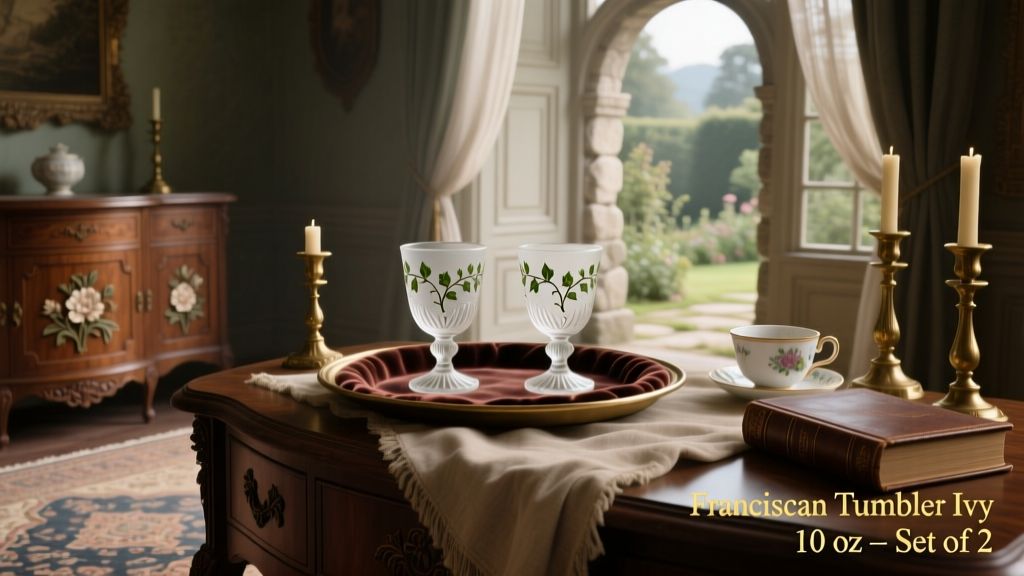
Franciscan Tumbler Ivy 10 Oz Pattern #2: Identification, Production History, and Restoration Guidelines
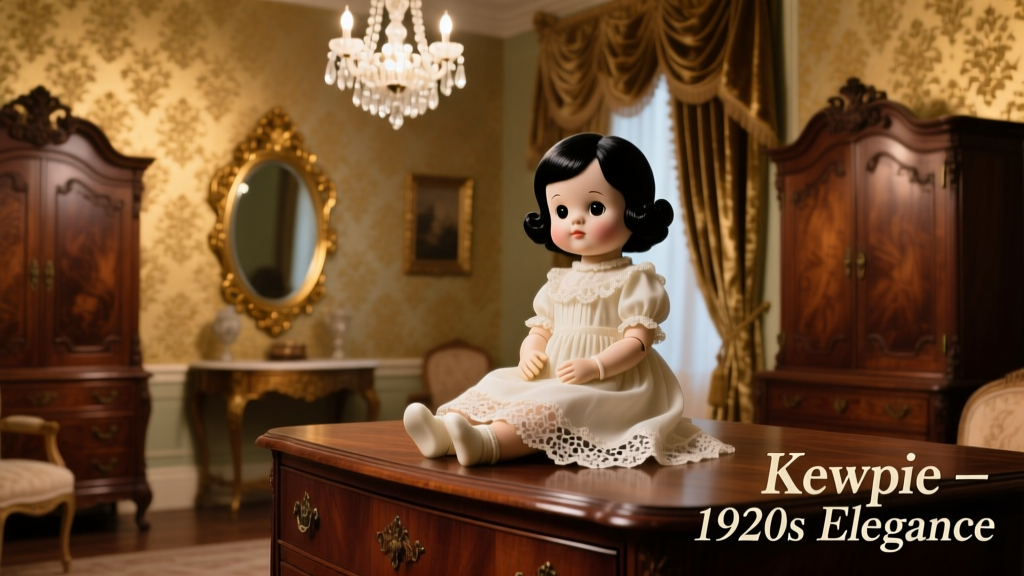
Kewpies Doll with Black Side-Glancing Eyes: A 25-Inch Antique Restoration & Identification Guide