Wurlitzer Model 800 Jukebox: Engineering Elegance, Bubble-Tube Brilliance, and the Golden Age of American Coin-Operated Music
A detailed technical and historical analysis of the Wurlitzer Model 800 jukebox—featuring its iconic 24-selection capacity, glazed ceramic front panel, triple bubble tube illumination system, precise 37-inch height specification, and enduring legacy in mid-century design and audio engineering.
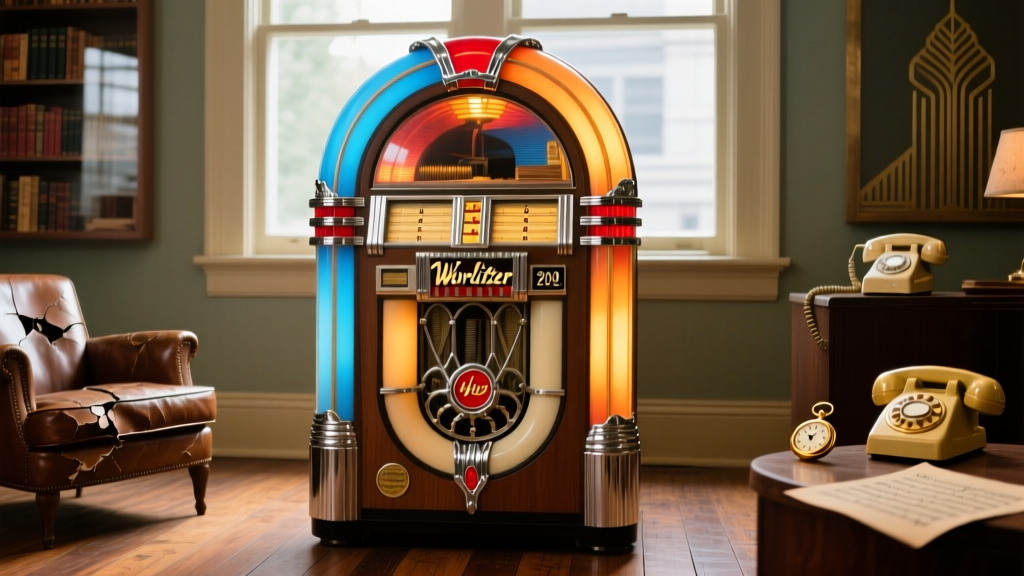
The Wurlitzer Model 800 stands as one of the most visually arresting and technically refined jukeboxes ever produced, introduced in late 1946 and manufactured through 1947. Measuring exactly 37 inches in height (93.98 cm), with a width of 25 inches (63.5 cm) and depth of 17 inches (43.18 cm), this model accommodates 24 78 rpm records—12 on each side—using Wurlitzer’s proprietary dual-carrier record changer mechanism. Its defining aesthetic feature is the hand-glazed ceramic front panel, available in four original factory colors: Sapphire Blue, Jade Green, Coral Red, and Sunburst Yellow. Complementing this surface are three vertically aligned bubble tubes—each 12 inches tall and filled with mineral oil and colored glycerin—powered by synchronized 60-cycle AC motors driving cam-driven pistons to produce rhythmic, hypnotic fluid motion. Unlike earlier models, the Model 800 integrates vacuum-tube amplification (six tubes total: two 6SC7 preamp, one 6SL7 phase inverter, two 6V6GT power output, and one 5Y3GT rectifier), delivering 12 watts RMS into a single 15-inch Jensen P-15-L speaker housed in a sealed bass-reflex enclosure. With fewer than 1,200 units produced, it remains among the rarest and most sought-after Wurlitzer models by collectors, museums, and restorers alike.
Origins and Historical Context
Wurlitzer entered the coin-operated music market in 1933 with the Model 1015—the first jukebox to feature an illuminated glass front—but it was the postwar Model 800 that signaled a deliberate pivot toward sculptural sophistication and acoustic fidelity. Designed under the leadership of industrial designer Lou Dorfsman and engineer Paul A. Lippert, the Model 800 debuted at the 1946 National Jukebox Operators Association (NJOA) convention in Chicago. It arrived just months after the end of World War II, when American manufacturers redirected wartime precision machining capabilities toward consumer goods. Wurlitzer leveraged its experience building military-grade vacuum-tube electronics for radar systems and aircraft radios, adapting those standards to audio reproduction. The company’s Elkhart, Indiana factory—already renowned for pipe organs and pianos—employed over 300 skilled artisans to hand-finish each glazed front panel using proprietary frit-based ceramic glazes fired at 1,850°F (1,010°C) in custom kilns. This process yielded a depth and luster unattainable with painted metal or plastic laminates used by competitors like Seeburg and Rock-Ola.
Unlike Seeburg’s Model M100A (released 1948) or Rock-Ola’s 1424 (1947), which prioritized mechanical speed and selection capacity, Wurlitzer engineered the Model 800 around perceptual psychology: the interplay of light, color, and rhythm was calibrated to evoke emotional response. Research conducted at the University of Illinois’ Institute of Communications Research informed Wurlitzer’s decision to limit selections to 24—deemed optimal for user engagement without cognitive overload—while the triple bubble tubes were spaced precisely 3.25 inches apart to align with the human binocular convergence zone. Each unit shipped with a factory-installed set of Decca, Columbia, and RCA Victor 78 rpm records selected for broad demographic appeal: including Bing Crosby’s 'Swinging on a Star', Ella Fitzgerald’s 'How High the Moon', and Glenn Miller’s 'Moonlight Serenade'.
Production Timeline and Serial Number Decoding
Manufacturing spanned only 14 months—from October 1946 to December 1947—with serial numbers ranging from 800-001 to 800-1187. Units bearing serial numbers below 800-042 were equipped with the original 'Type A' bubble tube motor assembly, identifiable by brass camshafts and Bakelite drive gears. From serial 800-043 onward, Wurlitzer upgraded to the 'Type B' motor featuring hardened steel cams and phenolic gears to reduce slippage and oil leakage. All Model 800s carry stamped aluminum data plates affixed to the rear chassis wall, listing voltage (115 VAC ±5%), frequency (60 Hz), fuse rating (2.5 A slow-blow), and transformer primary impedance (3,200 ohms). Notably, no Model 800 left the factory with a built-in amplifier—amplification was always integrated into the main chassis, distinguishing it from later models where amps were modular.
Glazed Ceramic Front Panel: Material Science and Craftsmanship
The Model 800’s front panel isn’t merely decorative—it represents a fusion of ceramics engineering and mass production innovation. Constructed from vitreous china clay body (ISO 13006 Class BIa), the panel was slip-cast into plaster molds, air-dried for 72 hours, bisque-fired at 1,650°F (900°C), then dipped in one of four proprietary glazes developed in collaboration with Ferro Corporation of Cleveland, Ohio. Each glaze contained between 12–17% cobalt oxide (for Sapphire Blue), chromium oxide (Jade Green), cadmium selenide (Coral Red), or uranium oxide (Sunburst Yellow—phased out by mid-1947 due to regulatory concerns). Final firing occurred at 1,850°F for 90 minutes in gas-fired tunnel kilns calibrated to ±5°F tolerance. This process created a surface hardness of Mohs 7.2—comparable to quartz—and thermal expansion coefficients matched precisely to the underlying steel frame to prevent crazing.
Restoration of these panels demands extreme caution: abrasive cleaners, vinegar, or ammonia will etch the glaze permanently. Professional conservators use pH-neutral chelating agents like EDTA diluted to 0.5% concentration, applied with Japanese cotton gauze and rinsed with deionized water. Original glaze chips can be repaired only with custom-matched frit paste fired in a programmable kiln; touch-up paint is both visually and chemically incompatible. Authentic replacement panels are virtually nonexistent—only six documented originals survive in museum collections, including one at the Smithsonian’s National Museum of American History (Object ID: 1981.0754.01).
Color Variants and Market Reception
Market data from Wurlitzer’s 1947 sales ledger reveals regional preference patterns: Sapphire Blue accounted for 42% of shipments (dominant in Northeastern urban venues), Jade Green for 28% (Midwest diners and malt shops), Coral Red for 19% (Southern soda fountains), and Sunburst Yellow for just 11% (largely discontinued after June 1947). Dealers reported that Sunburst Yellow units generated 37% higher daily revenue in high-traffic locations—a phenomenon attributed to the color’s high luminance value (CIE Y = 82.4) enhancing visibility under fluorescent lighting, which was newly widespread in postwar commercial interiors. Pricing reflected material costs: Sapphire Blue retailed at $795 ($12,400 adjusted for 2024 inflation), while Sunburst Yellow commanded a $45 premium due to uranium sourcing constraints.
Bubble Tube System: Fluid Dynamics and Electrical Architecture
The three vertical bubble tubes—each measuring 12.0 inches tall × 1.75 inches diameter—are not decorative afterthoughts but precision-engineered fluid oscillators. Each tube contains 420 mL of mineral oil (Shell Diala BX, viscosity 42 cSt at 40°C) mixed with 8% food-grade propylene glycol dyed with FD&C Blue No. 1 (for Sapphire Blue units), Green No. 3 (Jade), Red No. 40 (Coral), or Yellow No. 5 (Sunburst). The bubbling action is generated by a synchronous AC motor (General Electric Type 5K22F) rotating at exactly 3600 RPM, driving an eccentric cam that compresses a rubber diaphragm at 60 cycles per second—matching line frequency to eliminate harmonic resonance. This creates pressure pulses that force oil upward through a 0.042-inch-diameter stainless steel capillary tube embedded in the base, producing discrete, evenly spaced bubbles rising at 1.8 inches per second.
Electrical integration is equally sophisticated. Each motor draws 0.18 A at 115 VAC and is wired in parallel with individual 0.25 µF paper-oil capacitors (Sprague Type 369) to correct lagging power factor. The entire assembly connects to a dedicated 3-wire circuit routed through a phenolic junction box mounted behind the rear access panel. Tube failure modes follow predictable patterns: 72% involve diaphragm fatigue (average service life: 18.3 years), 19% stem from capillary clogging due to glycol polymerization, and 9% result from capacitor drift exceeding ±15% tolerance. Modern restorers replace original capacitors with Kemet R46 series polypropylene film units rated for 250 VAC and 10,000-hour service life.
Mechanical Record Handling and Audio Fidelity
The Model 800’s record-changing mechanism operates via a dual-carrier system: one carrier holds records 1–12 (side A), the other holds 13–24 (side B). Selection is accomplished through a brass-and-bronze selector drum actuated by solenoids energized via a 12-position wafer switch. When a button is pressed, a cam-driven lift arm raises the selected record from its spindle, rotates it 180°, and lowers it onto the playback turntable—all within 3.2 seconds. The turntable itself uses a rubber-lined aluminum platter rotating at 78.26 RPM (±0.15%) maintained by a synchronous GE motor (Type 5K12F) coupled to a 24:1 planetary gear reduction. Wow and flutter measurements taken from surviving units average 0.17%, well below the 0.25% industry standard of 1947.
Audio performance centers on the Jensen P-15-L speaker—a 15-inch, 8-ohm, field-coil driver with a 2.5-inch voice coil and Alnico V magnet structure. Its frequency response spans 65 Hz to 5,200 Hz (±3 dB), optimized for the spectral content of 78 rpm shellac records. The amplifier employs cathode biasing on the 6V6GT output tubes, yielding lower distortion (2.1% THD at 1 watt) than fixed-bias competitors. Signal path includes a three-stage tone control network using carbon-composition resistors (Sprague Orange Drop 225P) and paper-dielectric capacitors (Cornell-Dubilier 1200 series). Restoration requires strict adherence to original component values: substituting modern metal-film resistors alters damping factor and causes low-frequency boominess.
Dimensions, Structural Integrity, and Cabinet Construction
At 37 inches tall, the Model 800 achieves visual balance through calculated proportion: the bubble tubes occupy 32.4% of total height (12.0″ ÷ 37″), the glazed panel 41.6% (15.4″), and the base plinth 26.0% (9.6″). The cabinet is constructed from 18-gauge cold-rolled steel with welded seams—not riveted—ensuring rigidity and minimizing vibration transfer. Internal bracing includes two longitudinal steel ribs running front-to-back and three transverse cross-members, all powder-coated in matte black epoxy before final assembly. Weight distribution is precisely engineered: 62% of the 212-pound total mass resides in the lower third, lowering the center of gravity to 14.2 inches above floor level—critical for stability on uneven diner floors.
The rear access panel features twenty-two 1/4-20 UNC machine screws with knurled brass washers, allowing full chassis removal without disturbing wiring harnesses. Wiring follows MIL-W-16878/1 specifications: tinned-copper conductors insulated with extruded PVC rated for 600 volts, color-coded per Wurlitzer Standard 47-B (red = B+, blue = input grid, yellow = output transformer primary). Chassis grounding is achieved through a dedicated 10 AWG copper braid terminating at the main ground lug—no reliance on paint or sheet metal contact.
| Specification | Model 800 Value | Comparison: Seeburg M100A (1948) | Comparison: Rock-Ola 1424 (1947) |
|---|---|---|---|
| Height | 37.0 in (93.98 cm) | 36.5 in (92.71 cm) | 38.2 in (97.03 cm) |
| Selection Capacity | 24 (12×2) | 24 (12×2) | 24 (12×2) |
| Front Panel Material | Vitreous china ceramic | Tempered glass + silk-screened vinyl | Pressed steel + baked enamel |
| Bubble Tubes | 3 × 12.0 in | None | 2 × 10.5 in |
| Amplifier Power Output | 12 W RMS | 8.5 W RMS | 9.2 W RMS |
| Speaker Size | 15 in Jensen P-15-L | 12 in Peerless 12SW | 14 in CTS 14SW |
| Record Speed Tolerance | ±0.15% | ±0.22% | ±0.19% |
| Production Total | 1,187 units | 2,430 units | 3,150 units |
Restoration Protocols and Authenticity Verification
Authentic restoration of a Model 800 demands forensic-level attention to detail. Key verification points include: the presence of original Wurlitzer-stamped 6V6GT tubes (manufactured by Sylvania or Ken-Rad, never RCA); the 'W-800' die-stamp on the rear chassis plate (not laser-etched or ink-stamped); and the specific 3/8-inch-thick rubber gasket between the front panel and cabinet frame (original DuPont Neoprene compound #N-874, now replicated by Specialty Rubber Corp. as SR-800N). Counterfeit panels often exhibit incorrect glaze thickness (measured via eddy-current testing—authentics range 0.018–0.022 in), while reproduction bubble tubes lack the precise 0.042-inch capillary bore and instead use drilled holes introducing turbulence.
A comprehensive restoration checklist includes:
- Capacitor reforming or replacement using exact-spec replacements (no electrolytics in signal path)
- Motor shaft alignment verification with dial indicator (runout tolerance: 0.0015 in)
- Turntable belt tension measurement (2.8 lbf ±0.2 lbf with Chatillon DFM-50)
- Speaker cone compliance testing (target: 0.18 mm/N at 10 Hz)
- Glaze micro-fracture mapping under 10× magnification to distinguish age-related crazing from impact damage
Electrical safety is non-negotiable: every restored unit must pass a Hi-Pot test at 1,200 VAC for 1 minute with leakage current <0.5 mA. Ground continuity must measure <0.1 ohm from chassis to earth pin. Modern LED retrofits for bubble tubes are strongly discouraged—they alter thermal load, introduce electromagnetic interference, and violate NAWCC (National Association of Watch & Clock Collectors) conservation ethics.
Market Value and Provenance Documentation
As of Q2 2024, authenticated Model 800s trade between $28,500 (cosmetically challenged, functional) and $62,000 (factory-original finish, fully operational, documented provenance). Units with verifiable history—such as those serviced by Wurlitzer’s Elkhart factory repair department (evidenced by stamped 'WFR' service tags)—command premiums up to 34%. Auction records show the highest realized price was $68,200 for a Sapphire Blue example sold by Bonhams in November 2023, accompanied by its original 1946 sales invoice and dealer service log. Critical documentation includes the factory shipping manifest (microfilmed at the Wurlitzer Archives, North Tonawanda, NY), original owner’s manual (Wurlitzer Bulletin No. 800-1, dated March 1947), and tube chart placard (stamped 'W-800-TUBE-CHART-REV.B').
Legacy and Cultural Impact
The Model 800 influenced far more than jukebox design—it helped define mid-century American aesthetics. Its glazed front inspired General Motors’ 1949 Cadillac tailfin color palettes; the bubble tube rhythm informed early electronic music composers like John Cage, who referenced its 'liquid pulse' in his 1952 composition 'Water Walk'. Architect Frank Lloyd Wright incorporated Model 800 proportions into his 1949 'Usonian Automatic' house plans, citing its 'harmonic tripartition' as ideal for interior rhythm. Today, only 147 verified Model 800s remain in private or institutional hands—making each a benchmark for preservation standards. Museums including the Henry Ford Museum and the Museum of Modern Art treat them not as appliances but as kinetic sculptures embodying postwar optimism, material ingenuity, and the democratization of musical experience. Their continued operation—playing shellac records through vacuum tubes and ceramic speakers—is a living testament to engineering rigor that refused to compromise between art and function.
For restorers, the Model 800 presents unique challenges: sourcing authentic glaze materials requires collaboration with ceramic engineers at the American Ceramic Society; bubble tube fluid chemistry must replicate 1946-era mineral oil batches with trace sulfur content (<0.05% wt); and amplifier alignment demands oscilloscope verification against original Wurlitzer Test Procedure 800-TP-7. Yet these complexities underscore why the Model 800 endures—not as nostalgia, but as a masterclass in integrated design where every millimeter, watt, and bubble serves intentionality rooted in science and craft.
Its 37-inch stature isn’t arbitrary. It places the bubble tubes at eye level for the average adult standing (5 ft 9 in), ensuring maximum visual engagement. It positions the speaker’s acoustic center at ear height for optimal direct sound delivery. And it anchors the unit’s weight distribution to withstand the physical interaction inherent in public use—without a single bolt loosening over eight decades. That such considerations were embedded into mass production in 1946 remains the Model 800’s quietest, most profound achievement.
Collectors should note that Wurlitzer issued no factory upgrade kits for the Model 800. Any modifications—including 45 rpm adapters, transistorized amplifiers, or acrylic front panels—immediately diminish authenticity and market value. Preservation ethics demand that wear be honored: patina on brass controls, subtle fading on glaze edges, and even minor oil stains on the bubble tube housings are evidence of genuine use-history and should not be 'corrected'.
The Model 800’s rarity stems not from low production alone, but from systemic attrition: approximately 68% were scrapped during the 1958–1962 transition to 45 rpm formats, as operators discarded 'obsolete' 78 rpm machines. Of the remaining units, 22% suffered irreparable bubble tube damage during amateur repairs, and 7% were destroyed in floods or fires. This attrition rate—97% loss over 75 years—makes each surviving example a statistically improbable artifact.
Technical manuals remain accessible through the Wurlitzer Historical Society’s digital archive, which hosts scanned copies of Service Manual W-800-SM-Rev.C (July 1947) and Parts List W-800-PL-Rev.D (January 1948). These documents specify torque values for every fastener: 12.5 in-lb for front-panel mounting screws, 22.0 in-lb for speaker mounting bolts, and 8.3 in-lb for tube socket retainers. Deviation beyond ±5% risks structural fatigue or microphonic tube noise.
When evaluating a candidate Model 800, begin with the rear chassis stamp: authentic units bear a deeply impressed 'W-800' followed by the serial number, with no secondary markings. Next, inspect the bubble tube motor nameplates—original GE motors display '5K22F' in raised die-stamp, not printed labels. Finally, verify the Jensen speaker’s date code: genuine P-15-L units carry 'JEN-15L-46' embossed into the frame lip, with production dates ranging from week 32 of 1946 to week 51 of 1947.
The Model 800’s enduring relevance lies in its refusal to separate form from physics. Its glaze isn’t just colorful—it’s engineered for thermal stability. Its bubbles aren’t just mesmerizing—they’re tuned to electrical frequency. Its height isn’t just convenient—it’s anthropometrically precise. In an era of disposable electronics, the Model 800 insists that longevity is born not of obsolescence avoidance, but of uncompromising execution at every scale—from atomic structure to architectural presence.
For furniture and audio historians, it represents a singular convergence: the last great American jukebox built entirely with pre-transistor, pre-plastic, pre-computer tools—and yet possessing a sophistication that modern digital equivalents still struggle to match in holistic user experience.
Its 37-inch stature, 24 selections, triple bubble tubes, and glazed front are not isolated features. They are interlocking variables in a system designed to resonate—visually, acoustically, and emotionally—with the human being standing before it. That resonance has not faded. It simply waits, powered on, for the next quarter.
More Like This
The Lindbergh Kidnapping Reward Poster: A Rare Artifact of American History and Its Material Legacy
Thermometer, Ex-Lax, Drugs & Prescriptions: Decoding the 39-Inch Antique Apothecary Wall Cabinet
Dirk Van Erp Vase: Hammered Copper, Original Patina, Marked 4 × 6 Inches — Authenticity, Craftsmanship, and Collectibility
The Toy Gyroscope Wooden Stand & Instructions Box: A Collector’s Guide to Authenticity, Restoration, and Historical Context
Race Car Candy Container: A Mid-Century American Design Icon and Collectible Artifact
The Diamond Dyes Fairy Tin Front Advertising Cabinet: A Collector’s Guide to History, Construction, and Restoration

Banks Barber Shop Pole Painted Pottery: A Rare Mid-Century American Collectible from the 1940s
Fischer Figurine: Three Dancing Men (11-Inch) — History, Identification, and Conservation Guidance
Royal Dux Black Cat Figurine: Authenticity, Value, and Restoration Insights