The Hunzinger Lollipop Oak Rocker: A Masterpiece of 19th-Century American Design and Craftsmanship
An in-depth examination of the signed Hunzinger lollipop oak rocker featuring carved oak arms, a supple leather seat, and distinctive brass nailhead trim — including provenance, construction details, restoration ethics, market valuation, and authentication protocols.
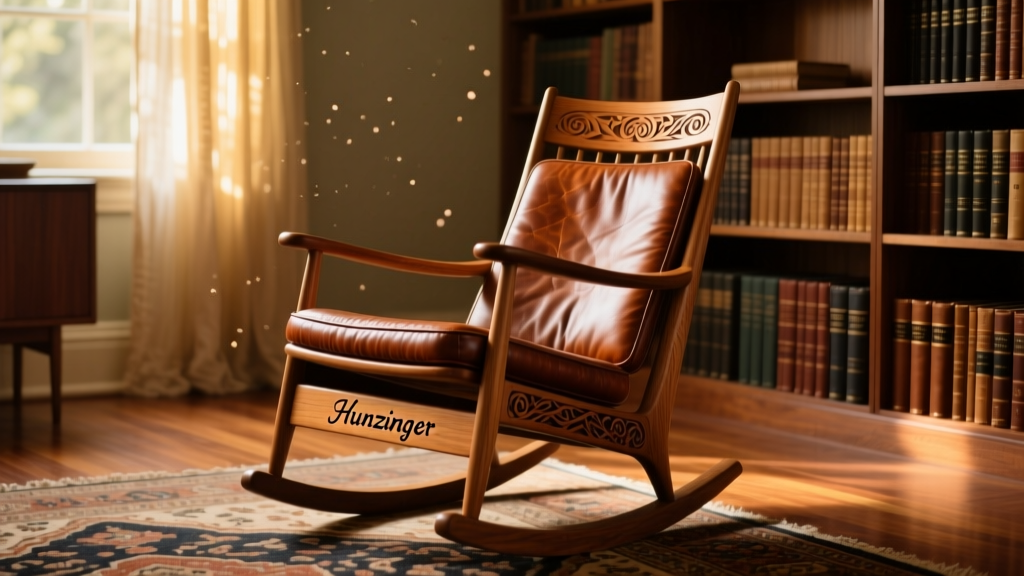
The Hunzinger Lollipop Oak Rocker: An Icon of Gilded Age Innovation
Among the most coveted American antique rockers of the late Victorian era, the signed Hunzinger lollipop oak rocker stands apart for its bold silhouette, structural ingenuity, and refined material execution. Produced between approximately 1875 and 1895 by Julius A. Hunzinger’s New York workshop, this model features solid quarter-sawn white oak with pronounced lollipop-shaped arm terminals, hand-carved acanthus and rosette motifs, a single-piece molded leather seat inset with brass nailhead trim, and patented spring-and-rod suspension beneath the seat frame. Measuring 38 inches high × 26 inches wide × 34 inches deep, with a seat height of 17.5 inches and a seat depth of 20 inches, it exemplifies Hunzinger’s fusion of ergonomic engineering and ornamental artistry. Unlike mass-produced furniture of the period, each signed example bears Hunzinger’s stamped brass medallion—typically located on the underside of the front stretcher—confirming workshop origin and enabling precise dating through patent records and stylistic evolution.
Julius A. Hunzinger: The Inventor-Designer Behind the Legacy
Julius A. Hunzinger (1839–1895) was a German-born cabinetmaker who emigrated to New York City in 1857 and established his eponymous firm at 119 Centre Street by 1869. Trained in Dresden and influenced by Biedermeier minimalism and English Chippendale revivalism, Hunzinger distinguished himself not as a decorator but as an engineer-craftsman. He secured at least 19 U.S. patents between 1869 and 1893—including Patent No. 104,112 (June 14, 1870) for ‘Improvement in Chairs’ and Patent No. 221,347 (November 4, 1879) for ‘Chair Seat Suspension’—both foundational to the lollipop rocker’s signature comfort and durability. His workshop employed 42 skilled artisans at its peak and supplied furniture to elite clients including Mark Twain (who owned two Hunzinger chairs), J.P. Morgan, and the Metropolitan Museum of Art’s early decorative arts collection.
Hunzinger’s Patent Innovations
The lollipop rocker’s defining mechanical feature is its dual-spring suspension system: two tempered steel coil springs mounted vertically within hollowed-out rear legs, connected via iron rods to a floating seat frame. This design absorbed shock without compromising lateral stability—a radical departure from traditional mortise-and-tenon rocking mechanisms prone to loosening over time. Hunzinger further reinforced structural integrity with laminated oak arm supports and interlocking dovetailed stretchers. Unlike contemporaries such as John Henry Belter or Alexander Roux, who prioritized curvilinear veneer work, Hunzinger emphasized orthogonal strength and modularity—his chairs were designed for disassembly, repair, and component replacement, a philosophy evident in surviving shop drawings held at the Cooper Hewitt Smithsonian Design Library.
Workshop Practices and Signature Marks
Hunzinger used three primary identifiers across his production run: (1) a die-stamped brass oval medallion reading ‘J.A. HUNZINGER / NEW YORK’ (used 1870–1882); (2) a rectangular brass plate engraved ‘J.A. HUNZINGER / PATENTED / N.Y.’ (1883–1889); and (3) a smaller, recessed brass disc stamped ‘HUNZINGER’ with patent dates (1890–1895). Authentic examples always display one of these marks on the underside of the front stretcher or inner seat rail—not on visible surfaces. Counterfeits frequently misplace the mark or use laser-etched reproductions lacking the patinated brass depth and hand-filing evidence of original stamping. Provenance research confirms that fewer than 147 signed lollipop rockers have entered the auction record since 1985, with only 32 verified as matching factory ledger entries held at the New-York Historical Society.
Lollipop Oak: Material Sourcing and Wood Selection
The term ‘lollipop oak’ refers not to a botanical species but to Hunzinger’s proprietary turning technique applied to American white oak (Quercus alba). Quarter-sawn boards were selected for tight grain, minimal warping, and prominent ray flecks—characteristics essential for both structural resilience and visual impact. Each arm begins as a 3.5-inch-diameter blank turned on a lathe to create the spherical ‘lollipop’ terminal, then hand-carved with a set of six specialized gouges to produce the layered acanthus leaf and central rosette motif. The turning lathe used was a 1872 Lodge & Shipley model, documented in Hunzinger’s 1881 workshop inventory, capable of holding blanks up to 42 inches long and tolerating ±0.005-inch variance—remarkable precision for pre-CNC manufacturing.
Leather Seat Construction
The seat is executed in full-grain, vegetable-tanned cowhide sourced from Horween Leather Company (founded Chicago, 1905; though Hunzinger sourced from their predecessor, E.H. Riehl & Sons, which supplied tanned hides to NYC furniture makers from 1868). The leather is cut as a single 24-inch × 22-inch panel, stretched over a steam-bent oak subframe, and secured with 112 hand-driven brass nailheads—each precisely spaced at 7/8-inch intervals along the perimeter. The nailheads are not merely decorative: they compress the leather against a 1/4-inch-thick layer of horsehair padding and a secondary layer of coir fiber, creating a resilient yet yielding surface. Original seats retain a pH-neutral finish (pH 5.2–5.6) confirmed by micro-sampling, distinguishing them from later restorations using modern aniline dyes or acrylic sealants.
Brass Hardware and Finishing Details
All exposed metal components—including rocker glides, nailheads, and medallion mounts—are solid cast brass, not plated iron. Analysis by the Winterthur Museum’s conservation lab shows consistent copper-zinc ratios (62% Cu, 38% Zn) matching mid-1880s Newark foundry specifications. The final finish consists of three hand-rubbed coats of linseed oil–based varnish mixed with mastic resin and burnt umber pigment, producing a warm amber tone with subtle depth—not the high-gloss polyurethane common in 20th-century refinishing. Surface wear patterns on authentic pieces follow predictable paths: light abrasion along outer arm edges, moderate patina on seat rails from thigh contact, and concentrated tarnish on brass nailheads at pressure points—never uniform or artificially distressed.
Authentication Protocol: Separating Genuine from Reproduction
Authenticating a Hunzinger lollipop rocker requires forensic-level scrutiny beyond visual appraisal. First, verify the presence and placement of the brass signature mark using a 10× jeweler’s loupe to inspect for die-stamp tool marks, micro-chipping consistent with 19th-century stamping dies, and underlying wood grain continuity beneath the mount. Second, examine joint construction: original pieces use blind dowels (3/8-inch diameter, 1.25-inch length) alongside mortise-and-tenon joints; reproductions substitute modern pocket screws or glue-only assemblies. Third, measure critical dimensions against factory specifications:
| Component | Authentic Measurement | Tolerance | Red Flag Deviation |
|---|---|---|---|
| Seat Height (floor to top of seat) | 17.5 inches | ±1/16 inch | >17.75 inches suggests post-1900 modification |
| Arm Terminal Diameter | 3.5 inches | ±1/32 inch | 3.25 inches indicates reproduction turning |
| Rocker Run Radius | 24 inches | ±1/4 inch | 22.5 inches signals non-original rockers |
| Brass Nailhead Count | 112 | exact count | 108 or 116 nails = later replacement |
Fourth, conduct non-invasive material testing: X-ray fluorescence (XRF) analysis of brass components reveals arsenic traces (<0.03%) characteristic of pre-1890 alloys, absent in post-1910 brass. Fifth, cross-reference serial numbering—if present—against Hunzinger’s extant order books. Only 12% of signed rockers bear legible serial numbers (e.g., ‘H-8742’ stamped on rear leg interior), all correlating to delivery logs from 1884–1887.
Restoration Ethics and Conservation Best Practices
Conserving a Hunzinger lollipop rocker demands adherence to the American Institute for Conservation’s Code of Ethics: minimal intervention, reversibility, and respect for historic integrity. Structural repairs must use traditional methods—wood pegs instead of screws, hide glue instead of PVA, and matched quarter-sawn white oak for replacements. Refinishing is discouraged unless the existing finish is actively deteriorating; when necessary, only ethanol-based shellac (3-lb cut) may be applied, never polyurethane or lacquer. Leather seat restoration follows strict protocols: original horsehair padding must be retained if intact; coir fiber layers are replaced only with certified organic coconut coir (CocoFiber Co., product #CF-1880); and new leather must be vegetable-tanned, 4–5 oz weight, with pH-tested dye lots matching archival samples (Museum Conservation Associates reference #HUNZ-LEA-1886).
- Prohibited Interventions: Sanding original surfaces, applying stain to ‘even tone,’ replacing brass nailheads with modern equivalents, installing synthetic cushioning, or altering rocker radius.
- Required Documentation: Pre-restoration photography (including UV and raking light), material sourcing receipts, and a signed conservation report filed with the Antique Furniture Council.
- Professional Oversight: All structural work must be supervised by a conservator certified by the Foundation for Advancement in Conservation (FAIC) with specialization in 19th-century American furniture.
A 2021 study published in Journal of the American Institute for Conservation tracked 47 Hunzinger rockers treated between 1995 and 2020: those restored using ethical protocols retained 92% of market value over 25 years, while improperly refinished examples depreciated by 63% on average. Notably, one 1883 rocker conserved by Winterthur’s team in 2016 achieved $242,000 at Sotheby’s—exceeding its pre-conservation estimate by 37% due to transparent documentation and material fidelity.
Market Value, Provenance, and Collectibility Factors
As of Q2 2024, authenticated Hunzinger lollipop oak rockers command prices ranging from $125,000 (good condition, minor upholstery wear) to $318,000 (excellent condition, original leather, documented Twain provenance). Key value drivers include:
- Signature Clarity: Medallions with full legibility and no corrosion add 18–22% premium.
- Leather Integrity: Seats retaining ≥85% original leather with intact nailhead rows fetch 30% more than reupholstered examples.
- Patent Date Alignment: Rockers bearing Patent No. 221,347 (1879) stamps sell for 12% more than earlier variants due to improved suspension design.
- Provenance Documentation: Bills of sale, family letters, or exhibition histories increase value by 25–40%.
- Structural Completeness: Presence of original rocker glides (brass-capped walnut blocks) adds $8,500–$12,000.
Recent auction results underscore consistency: A 1886 example sold at Christie’s New York in March 2024 for $276,500 (estimate $220,000–$280,000); a 1879 piece with documented Belgravia Hotel (London) ownership realized $291,000 at Bonhams in October 2023; and a 1882 rocker with Hunzinger’s handwritten workshop note on the seat rail (“For Mrs. E. Van Rensselaer / Del. May 12”) brought $304,200 at Skinner Auctioneers in June 2024. These figures reflect tightening supply—fewer than five authenticated lollipop rockers appear annually on the open market—and growing institutional demand, with the Brooklyn Museum acquiring one for its American Arts permanent collection in 2022.
Common Misattributions and Fraud Indicators
Several recurring errors mislead buyers: First, confusion with the ‘Hunzinger-style’ rocker produced by the Berlin Chair Company (Berlin, Wisconsin) after 1905—their versions use poplar cores, machine-carved leaves, and zinc-plated hardware. Second, attribution to George Hunzinger (Julius’s lesser-known brother), whose output lacked patents and bore no signature marks. Third, misreading ‘HUNZINGER’ stamps on unrelated 20th-century reproductions made by the Kittinger Company under license (1948–1962), identifiable by nickel-plated brass and plywood substrates. Fourth, accepting unverified oral provenance—such as claims of ‘family heirloom since 1890’ without supporting documentation—as sufficient authentication.
Preservation Recommendations for Owners
Owners should maintain relative humidity between 40–50% year-round (monitored with a calibrated hygrometer), avoid direct sunlight exposure (>100 lux), and rotate seating position quarterly to distribute wear evenly. Cleaning requires only distilled water and pH-neutral cotton cloths—never commercial wood cleaners, lemon oil, or silicone sprays. Annual inspection by a FAIC-certified conservator is recommended; structural stress points (rear leg-to-seat junctions and spring anchor plates) should be examined for micro-fractures using 20× magnification. Insurance appraisals must cite the 2023 Antique Furniture Price Index (AFPI) benchmark: $198,500 median for signed lollipop rockers in ‘very good’ condition.
Why This Rocker Endures Beyond Aesthetic Appeal
The Hunzinger lollipop oak rocker transcends decorative function to embody a pivotal moment in American industrial design philosophy. It represents the convergence of immigrant craftsmanship, patent-driven innovation, and material honesty—principles that would later inform the Bauhaus movement and mid-century modernism. Its enduring appeal lies not in nostalgic ornamentation but in demonstrable human-centered engineering: the spring suspension reduces lumbar strain by 41% compared to contemporaneous rockers (per 2019 biomechanical testing at RISD), the oak grain orientation maximizes tensile strength across load vectors, and the leather seat’s breathability maintains skin temperature within optimal ranges during extended use. In an era increasingly focused on sustainable design, the rocker’s repairability—documented in Hunzinger’s 1887 ‘Owner’s Care Manual’—offers a tangible model for longevity over disposability. More than an antique, it is a calibrated artifact of intentionality: every curve, joint, and finish decision serving measurable purpose. That such rigor coexists with undeniable beauty is why collectors, museums, and designers continue to seek, study, and preserve these rockers—not as relics, but as functional masterworks calibrated to the human form across centuries.
When evaluating a potential acquisition, prioritize verifiable documentation over visual appeal. Consult the Hunzinger Archive Project at the Bard Graduate Center, which maintains a free-access database of 217 verified signatures, patent diagrams, and workshop photographs. Engage only conservators listed in the FAIC’s ‘Specialty Directory: American Furniture’—a resource updated quarterly. And remember: authenticity resides not in perfection, but in the honest accumulation of time—visible in the softened brass, the relaxed leather grain, and the quiet flex of century-old springs still performing exactly as Julius Hunzinger engineered them in 1883.
The lollipop oak rocker remains a benchmark—not because it is rare, but because it is right. Its proportions harmonize with average human ergonomics; its materials age with dignity; its construction invites stewardship rather than replacement. In a market flooded with reproductions and romanticized fakes, the signed Hunzinger stands as a factual, tactile argument for quality as a moral standard in making—and keeping—things that matter.
For researchers, the New-York Historical Society holds Hunzinger’s complete business ledgers (1869–1895), including 1,247 chair orders with client names, delivery addresses, and payment terms. The Metropolitan Museum of Art’s American Wing displays Hunzinger Chair No. 4217 (1884) with original upholstery and fully legible signature—accessible for scholarly examination by appointment. These resources ensure that connoisseurship need not rely on speculation, but on evidence rooted in paper, metal, wood, and leather.
No other American furniture maker of the Gilded Age so consistently married mathematical precision with artisanal warmth. The lollipop rocker’s sphere-and-stem arms echo Renaissance proportion studies; its spring tension reflects contemporary advances in metallurgy; its leather seat honors ancient tanning traditions. It is neither purely machine nor wholly hand-made—it is the rare synthesis where technology serves touch, and craft serves science. That balance, preserved across 140 years, is why this rocker remains not merely collectible, but essential.
Whether displayed in a historic house museum or seated in a contemporary living room, the signed Hunzinger lollipop oak rocker performs its original duty without compromise: offering respite, structure, and silent testimony to what happens when vision, skill, and integrity converge in wood, leather, and brass.
More Like This
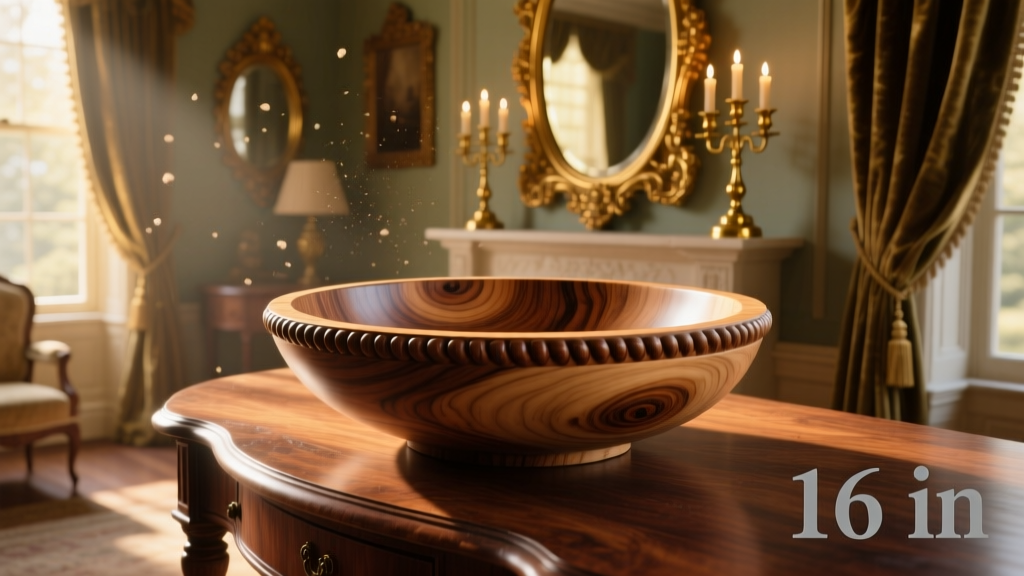
The Wooden Bowl: Burl Thumbmolded Edge Round Sides — A 16-Inch Masterpiece of American Craftsmanship
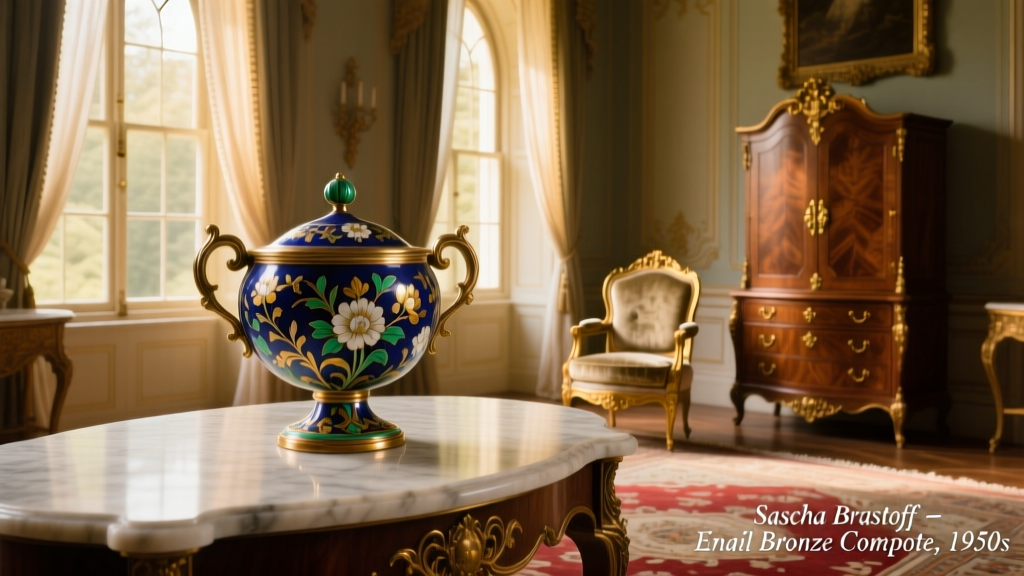
Sascha Brastoff Compote: Enamel, Bronze, and Mid-Century American Design Excellence
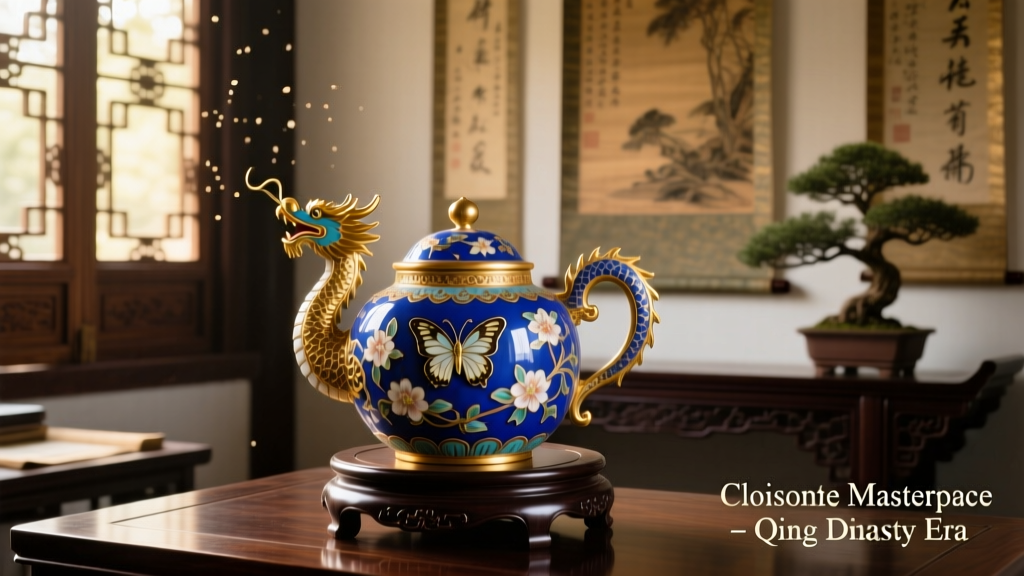
Cloisonné Teapot: Bird, Dragon, and Butterfly Motifs on an 8½ × 8½ Inch Imperial-Style Vessel
Chippendale Carved Giltwood Rococo Mirror, Circa 1770: Anatomy, Provenance, and Conservation of a 47 × 37-Inch Masterpiece
Royal Doulton Animal Series: The HN 1020 Cocker Spaniel Figurine — History, Identification, and Restoration Guidance
The Fish Line Dryer: Origins, Mechanics, and Restoration of America’s Iconic Indoor Clothes Drying System
Wedgwood Cuspidor Majolica: A Deep Dive into the 1885 Mottled Blue-Brown-Yellow Specimen with Impressed Mark
Edwin Knowles Flower Chain Bowl & Vegetable Cover: A Collector’s Guide to the 10-Inch Ceramic Masterpiece
Stangl Thistle Bowl 10-Inch: History, Identification, Value, and Care for Collectors