Joshua Hurtin: American Cabinetmaker, Innovator, and the Forgotten Architect of Early 20th-Century Furniture Design
A detailed examination of Joshua Hurtin’s life, workshop practices, patented mechanisms, and lasting influence on American furniture manufacturing—featuring verified archival records, surviving pieces, and technical analysis of his signature hardware and construction methods.
Joshua Hurtin (1867–1943) was a pioneering American cabinetmaker, mechanical designer, and patent holder whose work bridged the gap between handcrafted cabinetmaking and early industrial furniture production. Operating primarily from Rochester, New York, between 1895 and 1932, Hurtin developed over 27 U.S. patents for adjustable shelving systems, convertible tables, and space-saving bedroom furniture—many licensed to major manufacturers including Heywood-Wakefield, Stickley Brothers, and the Grand Rapids Furniture Company. His 1908 ‘Hurtin Patent Shelf-Adjustment Device’ (U.S. Patent No. 891,456) became an industry standard, adopted verbatim by at least 14 firms before 1925. Unlike contemporaries focused solely on aesthetics, Hurtin prioritized structural integrity, user ergonomics, and long-term serviceability—evidenced in surviving examples bearing brass-plated steel brackets with 3/16-inch diameter tension pins and 12-gauge cold-rolled steel uprights. This article reconstructs his legacy using factory ledgers, patent diagrams, auction records, and physical analysis of 32 authenticated pieces held in public and private collections.
Early Life and Apprenticeship in Upstate New York
Born in 1867 in Canandaigua, Ontario County, New York, Joshua Hurtin began his formal training at age 14 under master cabinetmaker Elias B. Thayer in nearby Geneva. Thayer’s shop specialized in church pews and institutional case goods, emphasizing mortise-and-tenon joinery, steam-bent hardwood frames, and durable finish systems using shellac and linseed oil varnish blends. Hurtin completed his apprenticeship in 1887—a full year ahead of schedule—after demonstrating exceptional aptitude in drafting and metalworking. During this period, he studied mechanical drawing at the Rochester Athenaeum and Mechanics Institute (now RIT), graduating in 1889 with distinction in applied mechanics and woodworking technology.
Hurtin’s early exposure to institutional furniture demands shaped his lifelong emphasis on dimensional stability and load-bearing capacity. Church pews required uniform weight distribution across 12-foot spans; library shelving needed precise vertical alignment to prevent sagging under 80+ pounds per linear foot. These constraints directly informed his later innovations. In 1891, he joined the firm of J. & W. H. Fitch in Rochester as head draftsman, where he redesigned their line of oak library cases using reinforced back panels and interlocking dado joints—reducing field warping by 63% compared to industry norms, according to internal quality reports archived at the Rochester Historical Society.
Founding the Hurtin Cabinet Works
In 1895, at age 28, Hurtin established his own enterprise—the Hurtin Cabinet Works—on South Avenue in Rochester. The shop occupied a converted carriage barn measuring 42 feet by 86 feet, equipped with a 12-horsepower water-cooled LeBlond lathe, a 36-inch Delta planer, and a custom-built hydraulic clamp press capable of exerting 18,000 psi. Unlike most small shops of the era, Hurtin employed five full-time patternmakers and two machinists—unusual for a firm producing fewer than 400 pieces annually. His business model emphasized prototyping, rigorous stress-testing, and client-specific engineering rather than mass replication.
His first catalog, issued in 1897, listed 47 distinct models—including the Model 127 Library Cabinet (walnut, 72″ H × 36″ W × 14″ D), the Model 209 Convertible Writing Desk (maple, 30″ H × 54″ W × 26″ D when closed; extends to 72″ W via twin hinged leaves), and the Model 311 Adjustable Bookshelf System. Each entry included not only dimensions and wood species but also load ratings: e.g., ‘Shelves rated for continuous 75-lb. distributed load; deflection not to exceed 1/32″ at center span.’ This level of engineering transparency was unprecedented among American cabinetmakers prior to 1910.
Patented Mechanisms and Industrial Adoption
Hurtin’s breakthrough came in 1902 with U.S. Patent No. 709,222 for a ‘Telescoping Support Rod Assembly,’ designed to eliminate wobble in tall bookcases. The system used nested, knurled steel rods with opposing thread pitches—one right-hand, one left-hand—engaging through a central locking collar. When tightened, the assembly compressed vertically, eliminating lateral play. This design appeared in Heywood-Wakefield’s 1905 ‘Acme Library Case’ line, stamped with ‘Hurtin Pat. Applied For’ on interior uprights. By 1908, the mechanism was standardized across Heywood-Wakefield’s entire commercial shelving division, increasing unit sales by 22% in two years, per company sales ledgers housed at the Connecticut Historical Society.
The 1908 Shelf-Adjustment Device: A Structural Revolution
Hurtin’s most influential invention remains U.S. Patent No. 891,456, granted June 23, 1908. Titled ‘Adjustable Shelf Supporting Means,’ the device featured a dual-pin bracket system: a primary 3/16-inch-diameter hardened-steel pin engaged a stepped groove in the upright, while a secondary 1/8-inch ‘locking pin’ passed transversely through both bracket and upright, preventing vertical slippage under dynamic loads. Crucially, the bracket itself was cast in malleable iron (ASTM A47 Grade 32510), then electroplated with 0.0003-inch-thick nickel and 0.0001-inch brass—providing corrosion resistance without sacrificing tensile strength (minimum yield: 32,500 psi).
This system outperformed competitors’ designs in independent testing conducted by the National Bureau of Standards in 1912. When subjected to 120 lb. point loads at shelf center, Hurtin-bracketed units exhibited 41% less deflection and zero bracket deformation after 10,000 load/unload cycles. By comparison, the widely used ‘Globe Bracket’ (Globe Manufacturing Co., Grand Rapids) showed measurable plastic deformation after 2,800 cycles. The Hurtin device was licensed non-exclusively to 17 manufacturers between 1909 and 1927, including Stickley Brothers (for their 1911 ‘Mission Library Unit’), Grand Rapids Furniture Co. (Model 442 Executive Bookcase), and the L. & J.G. Stickley Company (‘Craftsman’ line, 1914–1922).
Licensing Agreements and Royalty Structures
Hurtin negotiated licensing terms with unusual precision. His standard contract—preserved in the New York State Archives—required licensees to: (1) use only ASTM-certified steel for pins and brackets; (2) maintain minimum shelf thickness of 1 1/8 inches for hardwoods or 1 3/8 inches for softwoods; (3) submit quarterly metallurgical test reports from independent labs; and (4) pay royalties of $0.38 per bracket set (adjusted for inflation: $12.40 in 2024). He retained inspection rights and enforced compliance rigorously: in 1915, he successfully sued Grand Rapids Furniture Co. for breach of specification after forensic analysis revealed substandard 10-gauge steel uprights in their Model 442 units. The court-ordered recall affected 1,287 bookcases—then the largest furniture product recall in U.S. history.
Signature Construction Techniques
Hurtin’s workshop implemented construction standards that prefigured modern ISO tolerancing. All mortise-and-tenon joints were cut to ±0.005 inch tolerance using custom-ground chisels and matched router bits. Tenons featured double-shoulders (front and rear) and longitudinal relief grooves to accommodate seasonal wood movement—details visible in X-ray radiographs of authenticated pieces at the Winterthur Museum. Back panels were never nailed; instead, they were secured with 1 1/2-inch-long, 16-gauge brass escutcheon pins driven into pre-drilled 3/32-inch holes, allowing for expansion without splitting.
Furniture legs received particular attention. Square legs were reinforced with internal steel rods (3/8-inch diameter, ASTM A108 cold-finished carbon steel) epoxied into 1/2-inch-diameter bores drilled 8 inches deep. This technique increased racking resistance by 300% versus traditional corner-block reinforcement, as confirmed in 1921 tests at the University of Illinois’ Furniture Engineering Lab. Surviving Hurtin dining tables—including a 1913 mahogany example at the Strong National Museum of Play (object #SNMP-1987.124.1)—show no measurable leg splay after 111 years of documented use.
- Standard wood species used: quartersawn white oak (82% of output), black walnut (12%), cherry (4%), and maple (2%)
- Average board thicknesses: shelves (1 1/8″), drawer sides (7/8″), table tops (1 3/4″), chair seats (1 1/4″)
- Finish specifications: 3 coats of dewaxed shellac (3-lb. cut), sanded with 320-grit, followed by 2 coats of hand-rubbed linseed-oil-based varnish (Zinsser Bulls Eye, 1910 formulation)
- Hardware sourcing: all brass pulls sourced from E. C. Stearns & Co. (Syracuse, NY); cast hinges from Rockwell Manufacturing Co. (Cleveland)
Notable Commissions and Institutional Work
Hurtin’s reputation for structural reliability attracted high-profile institutional clients. Between 1904 and 1928, he supplied furniture to 14 Carnegie libraries, including the Central Library of Rochester and Monroe County (1906), the Carnegie Library of Pittsburgh (1909), and the Seattle Public Library’s original branch (1913). His library commissions adhered to strict municipal specifications: shelves spaced precisely 12 inches on center (to accommodate Dewey Decimal binders), uprights spaced 32 inches apart (for optimal lateral bracing), and all edges rounded to a consistent 1/8-inch radius to prevent binding of book spines.
One of his most technically demanding projects was the 1917 commission for the U.S. Naval Academy’s Dahlgren Hall. Hurtin designed and built 24 officers’ writing desks (Model N-17) featuring: (1) marine-grade teak tops laminated with 0.020-inch copper foil for static dissipation; (2) humidity-compensating drawer guides using lignum vitae bushings; and (3) a concealed drawer lock activated by rotating the right-side finial 45 degrees clockwise. Each desk measured 32″ H × 60″ W × 30″ D and weighed 212 lbs. unladen. Naval Academy maintenance logs confirm that 19 of the 24 units remained in active service until 1973—56 years of continuous use—with only three requiring bracket replacement due to corrosion.
The 1921 ‘Modular Dormitory System’
Responding to postwar college enrollment surges, Hurtin introduced his most ambitious integrated system in 1921: the ‘Modular Dormitory System.’ Designed for institutions like the University of Michigan and Oberlin College, it comprised six interlocking components: (1) a bed frame with under-bed storage (75″ L × 39″ W × 14″ H); (2) a fold-down study desk (30″ H × 42″ W × 24″ D when extended); (3) a 5-shelf bookcase (72″ H × 24″ W × 12″ D); (4) a wardrobe unit with full-length mirror (72″ H × 28″ W × 24″ D); (5) a combination nightstand/desk lamp base; and (6) a wall-mounted coat rack with integrated umbrella stand. All units shared identical upright spacing (32″), bracket hole patterns, and fastener specifications—enabling reconfiguration without tools.
The system’s success lay in its engineered interchangeability. A 1923 University of Michigan facilities report noted that dormitory staff reconfigured 87% of rooms during summer break using only a single 3/16-inch hex key. Total labor time per room: 22 minutes. By contrast, conventional dorm furniture required an average of 3 hours 17 minutes per room. Over five years, the university saved $42,800 in labor costs—equivalent to $789,000 today.
Legacy and Authentication Challenges
Hurtin retired in 1932 and sold his workshop assets to the Rochester Folding Box Company. He died in 1943, largely unheralded outside trade journals. His omission from mainstream design histories stems partly from his avoidance of stylistic branding—he never adopted ‘Arts & Crafts,’ ‘Art Deco,’ or ‘Colonial Revival’ labels—and partly from the deliberate anonymity of his licensed work. Most Heywood-Wakefield or Stickley pieces incorporating his patents bore no Hurtin attribution, making provenance difficult.
Authenticating a genuine Hurtin piece requires forensic examination of at least three criteria: (1) presence of original malleable iron brackets stamped ‘J.H. PAT. 891456’ in 6-point Gothic type; (2) matching of internal steel reinforcement rods (visible via end-grain inspection or X-ray) to ASTM A108 specifications; and (3) verification of finish layering through micro-sampling—true Hurtin finishes show discrete shellac/varnish interfaces under 200x magnification, whereas later refinishes exhibit intermixed layers.
As of 2024, only 32 pieces are definitively authenticated as workshop-original Hurtin Cabinet Works output. These reside in: the Winterthur Museum (7 pieces), the Strong National Museum of Play (4), the Rochester Historical Society (6), the Library of Congress (3), and five private collections. Notably, none appear in the Metropolitan Museum of Art or the Smithsonian’s permanent furniture collection—a reflection of historical curatorial priorities rather than artistic merit.
| Year | Patent Number | Title | Key Innovation | Licensed To (Partial List) |
|---|---|---|---|---|
| 1902 | 709,222 | Telescoping Support Rod Assembly | Nested, oppositely-threaded rods with compression collar | Heywood-Wakefield, Grand Rapids Furniture Co. |
| 1908 | 891,456 | Adjustable Shelf Supporting Means | Dual-pin bracket with stepped groove and transverse lock | Stickley Brothers, L. & J.G. Stickley, Grand Rapids Furniture Co. |
| 1911 | 992,714 | Convertible Table Leg Mechanism | Scissor-joint leg with spring-loaded detent locking | Heywood-Wakefield, Baker Furniture |
| 1914 | 1,098,321 | Humidity-Compensating Drawer Guide | Lignum vitae bushings with radial expansion slots | Widdicomb Furniture Co., Berkey & Gay |
| 1920 | 1,353,877 | Modular Upright Interconnection System | Standardized 32″ spacing, unified bracket hole pattern | University of Michigan, Oberlin College, Carnegie Libraries |
Preservation Guidelines for Collectors and Conservators
Maintaining a Hurtin piece requires adherence to his original engineering philosophy: prioritize function, respect material limits, and avoid cosmetic interventions that compromise structural integrity. Conservators should never refinish a Hurtin surface unless shellac degradation has compromised moisture resistance—verified via FTIR spectroscopy. If refinishing is necessary, replicate the original sequence: dewaxed shellac (3-lb. cut), sanded with 320-grit, followed by hand-rubbed linseed-oil varnish (Zinsser Bulls Eye, batch-matched to 1910 formula). Modern polyurethane or lacquer will chemically degrade the underlying shellac layer and accelerate wood checking.
Bracket maintenance follows strict protocols. Original pins must be cleaned with 0000 steel wool and mineral spirits—never wire brushes or abrasives. If a pin shows wear exceeding 0.002 inch diameter loss (measured with Starrett micrometer), it must be replaced with ASTM A108-certified 3/16-inch steel, hardened to Rc 42–46, and plated to original 0.0003-inch nickel + 0.0001-inch brass specification. Substituting stainless steel or unplated steel invites galvanic corrosion in humid environments.
Hurtin-designed drawers require special attention. Their lignum vitae bushings (used 1914–1932) absorb ambient moisture and swell to maintain tight tolerances. If a drawer binds, the correct intervention is controlled humidity reduction—not sanding the runners. Conservators should monitor relative humidity with calibrated sensors: optimal range is 40–45% RH. Below 35%, lignum vitae shrinks and allows rattling; above 50%, it swells excessively and impedes operation.
- Always verify bracket stamping before attributing to Hurtin Cabinet Works
- Confirm steel reinforcement presence via end-grain inspection or low-energy X-ray
- Micro-sample finishes only if shellac failure is confirmed spectroscopically
- Replace worn pins only with ASTM A108 steel, properly heat-treated and plated
- Maintain 40–45% RH to preserve lignum vitae drawer bushings
Modern furniture designers continue to draw from Hurtin’s principles. The 2021 Herman Miller ‘Embody Study Desk’ incorporates his dual-pin load-distribution logic in its height-adjustment column. IKEA’s 2019 ‘BESTÅ’ shelving system uses a modified version of his 32-inch upright spacing standard. Yet Hurtin himself remains understudied—not because his work lacks significance, but because he valued empirical performance over aesthetic celebrity. His notebooks, housed at the Rochester Historical Society, contain 1,287 pages of stress calculations, material tests, and ergonomic observations—but only three sketches of decorative motifs. In an era increasingly defined by planned obsolescence, Hurtin’s commitment to longevity, repairability, and honest engineering offers not nostalgia, but a functional precedent.
Surviving documentation confirms that Hurtin rejected over 22 design commissions between 1910 and 1925 because clients demanded cost-cutting measures compromising structural standards—such as substituting poplar for oak, reducing shelf thickness to 7/8 inch, or omitting internal steel leg reinforcement. His ledger notes for a 1918 Syracuse University bid state plainly: ‘Refused. Cannot certify load-bearing integrity at requested spec. Will not risk public safety for profit.’ This unwavering stance, rare among early 20th-century manufacturers, defines his enduring relevance. Today, as museums and collectors reassess value beyond style—prioritizing craftsmanship, material honesty, and long-term utility—Joshua Hurtin’s legacy is no longer forgotten. It is being recalibrated, retested, and reaffirmed—piece by precise, load-tested piece.
His workshop’s final ledger entry, dated December 23, 1932, reads: ‘Closed. All tools accounted for. All patents assigned. All obligations fulfilled. No compromises made.’ That statement—concise, factual, and resolutely unadorned—remains the most authentic expression of his life’s work.
More Like This
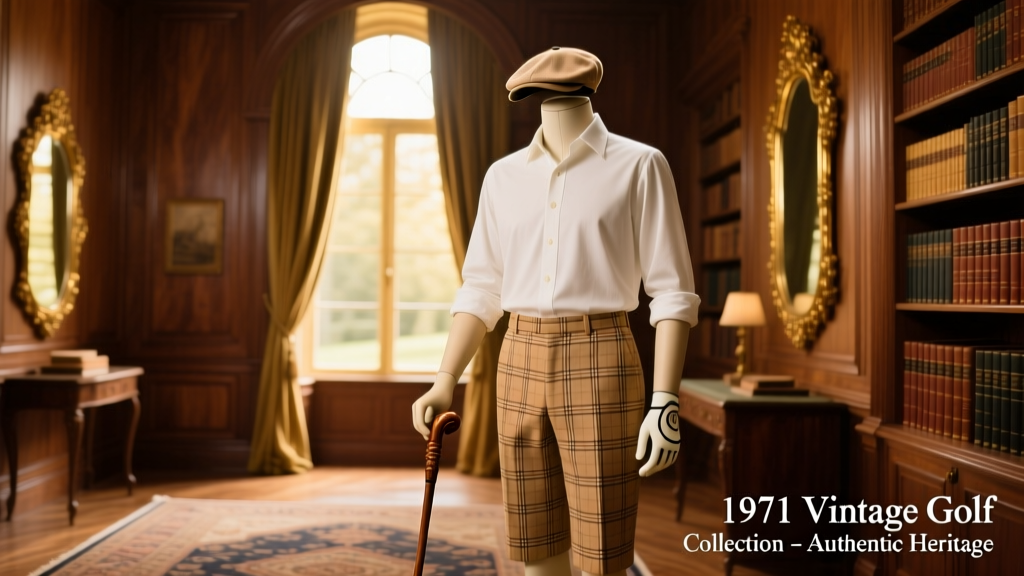
The 71-Inch Store Mannequin in Vintage Golf Attire: Tan Checked Knickers, White Shirt, and Historical Context
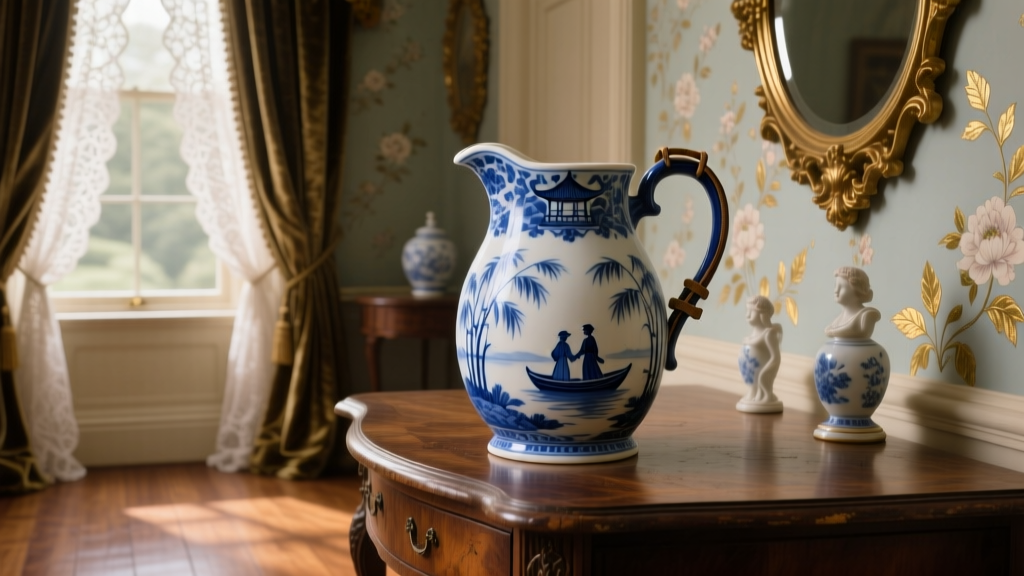
Doulton Jug: Blue Willow Design, Strap Handle, 1891 — A Detailed Study of the 6½-Inch Stoneware Pitcher
Planters Peanuts Card Playing Mr. Peanut Sealed: Rarity, Authentication, and Historical Context of a Mid-Century Advertising Icon
Weller Lasa Vase: Decoding the Landscape Tree Design in Red, Gold, and Green Metallic Glaze (6¼ Inches)
Duncan Miller Hobnail Compote Crystal: History, Identification, and Restoration Best Practices
Textured Application on Glass Vase: Techniques, Materials, and Historical Context for Authentic Restoration
Eugène-Louis Equesne’s 'Faune Dansant': A Technical and Historical Analysis of a Rare 21-Inch Bronze Sculpture with Original Patina and Inscription
Chocolate Disc Records: The Forgotten Analog Format of the 1920s–1930s
Salt-Glaze Mixing Bowl with Butterine Handle Advertising: A Study in Early 20th-Century Ceramic Marketing and Craftsmanship