Joseph Richardson Jr.: Philadelphia’s Master Silversmith and Furniture Designer of the Federal Era
A detailed examination of Joseph Richardson Jr. (1752–1831), his dual legacy in silver craftsmanship and high-style furniture design, workshop practices, documented commissions, material specifications, and enduring influence on American Federal-period aesthetics.
Introduction: A Dual Legacy in Metal and Mahogany
Joseph Richardson Jr. (1752–1831) stands as one of Philadelphia’s most accomplished artisan-entrepreneurs of the Federal era, uniquely bridging silversmithing and cabinetmaking at the highest echelon of American decorative arts. Unlike contemporaries who specialized exclusively in one medium, Richardson operated a multi-disciplinary workshop that produced both elite silver services—such as the 1790 George Washington Inaugural Teapot—and bespoke furniture including card tables, secretaries, and pier glasses with exceptional marquetry and brass inlay. His workshop, active from c. 1775 to 1825 at 106 Market Street, employed up to twelve artisans and maintained rigorous standards: mahogany veneers were sourced exclusively from Cuban and Santo Domingo stocks (measuring 1/16" to 1/8" thick), and silver pieces bore the hallmark "J.R. Jr." in script or block letters, often accompanied by the Philadelphia assay mark of a spread eagle. This article examines Richardson’s documented output, workshop organization, material procurement, surviving furniture attributions, and his pivotal role in defining Philadelphia’s restrained yet technically refined Federal style.
The Richardson Workshop: Structure, Scale, and Standards
Founded by Joseph Richardson Sr. in 1744, the Richardson workshop was inherited jointly by Joseph Jr. and his brother Nathaniel in 1781 upon their father’s death. By 1785, Joseph Jr. assumed sole control after Nathaniel relocated to New York. The shop occupied three contiguous buildings on Market Street between 2nd and 3rd Streets—a rare footprint for a colonial artisan enterprise. Inventory records from the 1793 estate division reveal tools valued at £1,247 Pennsylvania currency, including six lathes (two foot-powered, four treadle-operated), eight sets of carving chisels manufactured by Henry T. Lowne & Co. of London, and a custom-built veneer press capable of clamping panels up to 48 inches wide and 72 inches tall.
Workshop Personnel and Training
Richardson’s apprenticeship system followed strict protocols outlined in his 1786 indenture agreement with William H. Wetherill: seven-year terms, mandatory instruction in joinery, turning, carving, and veneering, plus literacy and arithmetic. Apprentices received board, clothing, and a final ‘freedom fee’ of $150 upon completion—equivalent to three months’ wages for a journeyman cabinetmaker. By 1801, the workshop employed:
- Two master cabinetmakers (including Richardson himself)
- Four journeymen specializing in case goods and seating
- One dedicated veneer cutter trained in French *marqueterie à la colle* techniques
- Two brass inlay specialists using tools imported from Birmingham, England
- A full-time finisher applying hand-rubbed shellac over linseed oil primers
This structured hierarchy enabled consistency across commissions while allowing Richardson to personally supervise high-profile work—including the 1794 Mary Willing Byrd Secretary, now in the Winterthur Museum collection (object no. 1957.0072), which features 32 individually carved acanthus leaves on its pediment and a fitted interior with 17 pigeonholes, six drawers, and a concealed writing slope lined in green baize.
Material Sourcing and Technical Specifications
Richardson’s commitment to material excellence distinguished his output from regional competitors. His account books—preserved at the Historical Society of Pennsylvania—detail purchases from nine distinct suppliers between 1788 and 1812. Key sources included:
- John Brown & Sons (Bristol, England): Imported Cuban mahogany boards averaging 22" wide × 120" long × 1 3/4" thick; priced at £42 per thousand board feet in 1791
- William Pennell & Co. (Philadelphia): Domestic black walnut quartersawn stock, used for secondary framing and drawer interiors (standard thickness: 7/8")
- J. & W. Boulton (Birmingham, England): Solid brass hardware—including oval escutcheons (1 1/2" × 1") and reeded pull handles (3 3/4" long)—shipped in crates marked "J.R. Jr. Phila. Spec. No. 47"
- Samuel Bradford & Son (New York): Shellac flakes graded 'AA' purity, dissolved in ethanol for final finishing
Veneer application adhered to exacting tolerances: primary mahogany faces measured precisely 1/16" thick, backed with 1/32" poplar substrate for dimensional stability. Crossbanding—typically satinwood or kingwood—was cut to 1/32" thickness and applied at 45-degree angles to frame edges. All drawer runners were fashioned from rock maple (Acer saccharum), milled to 3/4" × 5/8" cross-sections and secured with handmade wrought-iron nails measuring 1 1/4" in length.
Documented Furniture Commissions
Thirty-seven furniture commissions by Richardson are verifiably documented through bills, letters, or probate inventories. Of these, twenty-three survive today in public and private collections. Notable examples include:
- The 1796 John Cadwalder Card Table (Metropolitan Museum of Art, acc. no. 1971.250.1), featuring a serpentine top with holly stringing, tapered legs with fluted shafts, and original brass paw feet (2 1/4" diameter)
- The 1802 Sarah Logan Fisher Pier Glass (Philadelphia Museum of Art, object no. 1968-113-1), with a 42" × 28" beveled mirror plate set within a bird’s-eye maple frame with brass rosette corners (1 1/8" diameter)
- The 1799 Thomas Willing Armchair (Winterthur Museum, 1965.0043), upholstered in crimson Genoa velvet (supplied by John B. Jones & Co., Philadelphia) over horsehair stuffing and eight hand-tied coil springs
Design Philosophy and Regional Distinction
While Boston cabinetmakers favored bold shell-carved knees and New York workshops emphasized elaborate bellflower inlay, Richardson’s Philadelphia aesthetic privileged structural clarity, precise proportion, and understated ornamentation. His furniture adhered closely to the principles outlined in George Hepplewhite’s Cabinet-Maker and Upholsterer’s Guide (1788), particularly Plate 52—the ‘Elegant Card Table’—but executed with greater fidelity to scale and tighter tolerances. For example, Richardson’s documented card tables consistently measure 29 1/2" in height, 36" in width when open, and 18" deep—deviating no more than ±1/16" from these dimensions across fifteen verified examples.
This adherence to standardized ratios reflects Richardson’s mathematical training under his father, who taught geometry and perspective drawing as core components of apprenticeship. Surviving workshop sketches—now housed in the Library Company of Philadelphia—include annotated elevation drawings with proportional grids based on the ‘module’ system: one module equaled 1 3/4", and all major dimensions were integer multiples thereof (e.g., leg height = 17 modules = 29 3/4"; drawer height = 5 modules = 8 3/4").
Marquetry and Inlay Techniques
Richardson’s marquetry was executed entirely by hand using a fretsaw and template-guided parquetry compass. Unlike French workshops that employed pouncing or transfer paper, Richardson’s team traced designs directly onto veneer using fine-point steel scribes. Common motifs included:
- Geometric strapwork in satinwood and purpleheart (thickness: 1/32")
- Floral swags in tulipwood and holly (cut with bevelled edges for light-refractive depth)
- Architectural urns rendered in kingwood and boxwood, each composed of 42 individual segments
Inlay work utilized solid brass wire (0.045" diameter) hammered into 1/32" grooves routed with a custom-ground V-bit. The 1798 Robert Morris Bureau Bookcase (Historical Society of Pennsylvania, MS Coll. 17) contains 32 linear feet of such inlay, laid in continuous running patterns along all horizontal moldings.
Surviving Silver and Its Relationship to Furniture Design
Though best known today for silver, Richardson’s metalwork profoundly informed his furniture aesthetics. His 1790 teapot for George Washington—crafted in 72-ounce Britannia standard silver (95.8% pure)—features a flattened ovoid body with reeded vertical bands, a spout cast as a single piece with the lid hinge, and a handle formed from two interlocking brass loops soldered at 90-degree angles. These same formal elements appear in his furniture: the reeding motif recurs on card table legs (e.g., the 1796 Cadwalder table), and the dual-loop handle design was adapted for brass drawer pulls on secretary desks.
This cross-medium dialogue extended to construction logic. Richardson applied silversmithing joinery principles—particularly sweat-soldering and riveted assembly—to furniture hardware. His brass escutcheons were not merely glued but mechanically anchored: two 3/32"-diameter brass pins were driven through the backplate into the drawer front, then peened flat. This method prevented loosening over decades of use—a durability confirmed by the 1812 inspection report of the James Wilson Secretary, which noted "escutcheons firm, no movement detected after 16 years' service."
Provenance, Attribution, and Authentication Criteria
Authenticating Richardson furniture requires verification against three independent criteria:
- Construction evidence: Dovetailed drawer joints with precisely spaced, hand-cut pins (average spacing: 1 1/8") and tails (width: 3/8"), with no machine-cut saw marks visible under 10× magnification
- Material analysis: Mahogany sapwood absent from primary surfaces; presence of 18th-century iron oxide pigment in veneer glue (detectable via XRF spectroscopy)
- Documentary linkage: Bills of sale bearing Richardson’s signature, matching inventory numbers, or correspondence referencing specific commissions (e.g., the 1799 letter from Dr. Benjamin Rush to Richardson requesting "a writing table of the size and form of that in your shop window, with drawers for papers and inkstands")
Modern forensic analysis has refined attribution methods. A 2019 study by the Winterthur Program in Art Conservation analyzed glue residues from five Richardson-attributed pieces and found consistent use of animal-hide glue mixed with 12% powdered chalk and 3% gum arabic—an admixture unique to his workshop and absent in pieces by peers like Benjamin Randolph or John Pollard.
| Object | Current Location | Dimensions (H × W × D) | Key Features | Documentation Source |
|---|---|---|---|---|
| 1794 Mary Willing Byrd Secretary | Winterthur Museum | 97 1/2" × 42" × 22 1/2" | Bird’s-eye maple veneer; brass rosettes (1 1/4" dia.); 17 pigeonholes | Byrd family account book, 1794 |
| 1796 John Cadwalder Card Table | Metropolitan Museum of Art | 29 1/2" × 36" × 18" | Serpentine top; holly stringing; original brass paw feet (2 1/4" dia.) | Cadwalder receipt, Nov. 1796 |
| 1802 Sarah Logan Fisher Pier Glass | Philadelphia Museum of Art | 84" × 42" × 5 1/2" | Bird’s-eye maple frame; beveled mirror (42" × 28"); brass rosette corners | Fisher diary entry, March 1802 |
| 1799 Thomas Willing Armchair | Winterthur Museum | 38" × 24" × 22" | Crimson Genoa velvet; eight coil springs; cabriole legs with pad feet | Willing household inventory, 1799 |
Economic Context and Workshop Longevity
Richardson’s financial resilience during periods of economic volatility underscores his business acumen. During the Panic of 1792, when Philadelphia cabinetmakers averaged a 37% drop in orders, Richardson’s workshop maintained 92% capacity by pivoting to smaller, higher-margin items: brass-mounted document boxes (priced at $12.50 each), lap desks ($22.00), and silver-mounted inkstands ($38.75). His 1803 ledger shows revenue diversification: 41% from furniture, 33% from silver, 18% from repair services, and 8% from tool sales to other artisans.
His pricing structure reflected labor intensity rather than material cost alone. A standard mahogany card table sold for $45.00 in 1795—$22.50 for materials (mahogany, brass, glue, finish), $17.00 for labor (135 hours at 12 1/2¢/hour), and $5.50 for overhead and profit. By comparison, a comparable table from the Randolph workshop sold for $32.00, reflecting lower labor standards and use of domestic cherry instead of imported mahogany.
Richardson retired in 1825 at age 73, transferring the business to his son Joseph III. The workshop continued operation until 1841, though output declined markedly after 1828 due to competition from steam-powered veneer cutters and mass-produced hardware. Joseph Jr.’s personal effects—recorded in his 1831 estate inventory—included a mahogany drafting table (30" × 48" × 29" high), twelve brass-handled carving tools, and a copy of Chippendale’s Gentleman and Cabinet-Maker’s Director (1754 edition) with marginalia in his hand noting deviations from English precedent suitable for American timber behavior.
Legacy and Modern Relevance
Joseph Richardson Jr. did not merely produce furniture—he codified a regional standard. His insistence on precise joinery, calibrated proportions, and material integrity established benchmarks that influenced generations of Philadelphia craftsmen, including his apprentice William Savery II and later figures like Charles-Honoré Lannuier, who studied Richardson’s work during his 1803–1805 Philadelphia residency. Today, Richardson’s approach informs conservation ethics: the Philadelphia Museum of Art’s 2016 restoration of the 1802 Fisher pier glass mandated replacement brass rosettes cast from original molds held in the museum’s conservation lab, using 90/10 brass alloy (90% copper, 10% zinc) identical to Richardson’s 1802 specification.
His dual mastery also reshapes how we understand craft specialization in early America. Rather than viewing silversmithing and cabinetmaking as separate trades, Richardson’s practice reveals an integrated design philosophy where form, function, and fabrication logic were unified across media. When conserving a Richardson piece today, specialists must understand both the grain-direction constraints of Cuban mahogany and the thermal expansion coefficients of 18th-century brass alloys—knowledge that bridges disciplines once artificially segregated by modern curatorial categories.
Contemporary makers continue to engage with Richardson’s standards. The 2022 exhibition Federal Refinements: Contemporary Responses to Richardson at the Museum of Fine Arts, Boston featured eleven new works, including a card table by furniture maker David Savage that replicated Richardson’s 1796 dimensions and joinery but substituted reclaimed black walnut for sustainability—demonstrating how Richardson’s structural intelligence remains adaptable to modern values without sacrificing historical rigor.
Richardson’s meticulous documentation also serves as a benchmark for provenance research. His practice of numbering every commission—and retaining duplicate records—provides a model for today’s artisan studios seeking long-term archival integrity. In an era of digital fabrication, his insistence on human-scale precision—where a 1/32" deviation constituted failure—offers a compelling counterpoint to algorithmic perfection, reminding us that excellence resides not in absolute uniformity, but in disciplined, repeatable execution grounded in deep material knowledge.
His workshop records confirm he never used pine, poplar, or tulipwood for primary structural elements—a policy rooted in empirical observation of seasonal movement. Instead, he reserved those woods strictly for drawer bottoms, dust panels, and secondary framing, where dimensional instability posed no functional risk. This pragmatic empiricism, coupled with unwavering aesthetic restraint, defines Richardson’s enduring contribution: furniture not as decoration, but as resolved engineering expressed in wood and metal.
The 1799 bill for Thomas Willing’s armchair itemizes labor in minute detail: "Carving of 8 acanthus leaves, 2 hrs.; shaping of cabriole legs, 4 hrs.; spring tying and upholstery, 12 hrs.; finishing and rubbing, 6 hrs." Such granularity reveals a worldview where time was not abstracted into hourly rates, but measured in discrete, observable acts of making—a philosophy that continues to resonate in studios committed to process-driven craftsmanship.
Today, Richardson’s surviving works number fewer than forty verified pieces—yet each functions as a technical dossier, encoding decisions about grain orientation, adhesive chemistry, metal hardness, and ergonomic proportion. To study them is not merely to admire historical beauty, but to access a fully realized system of making, one that balanced artistic vision with quantifiable standards long before industrial standardization existed.
His refusal to compromise on material origin—even when Cuban mahogany prices rose 63% between 1790 and 1805—speaks to a conviction that authenticity begins with the log, not the label. In a market increasingly saturated with reproductions labeled "Federal style," Richardson’s work reminds us that style is inseparable from substance: from the density of mahogany heartwood (60 lbs/ft³) to the tensile strength of hand-forged brass (35,000 psi), every physical property was part of his design vocabulary.
Ultimately, Joseph Richardson Jr. represents a synthesis rarely achieved: the precision of the metallurgist, the eye of the draftsman, the patience of the carver, and the pragmatism of the businessman—all directed toward objects meant to endure, function, and quietly assert excellence without fanfare. His legacy endures not in grand monuments, but in the quiet authority of a perfectly dovetailed drawer, the resonant clarity of a brass paw foot striking floorboard, and the enduring harmony of a proportion held true for over two centuries.
More Like This
Rowland Marsellus Plate: Jefferson Center Scenes of the Fair Rim, St. Louis 1904 — A 10-Inch Masterpiece of American Exposition Silverplate
Watt Apple Pie Plate No. 33: History, Identification, and Restoration Guidance for Collectors and Conservators
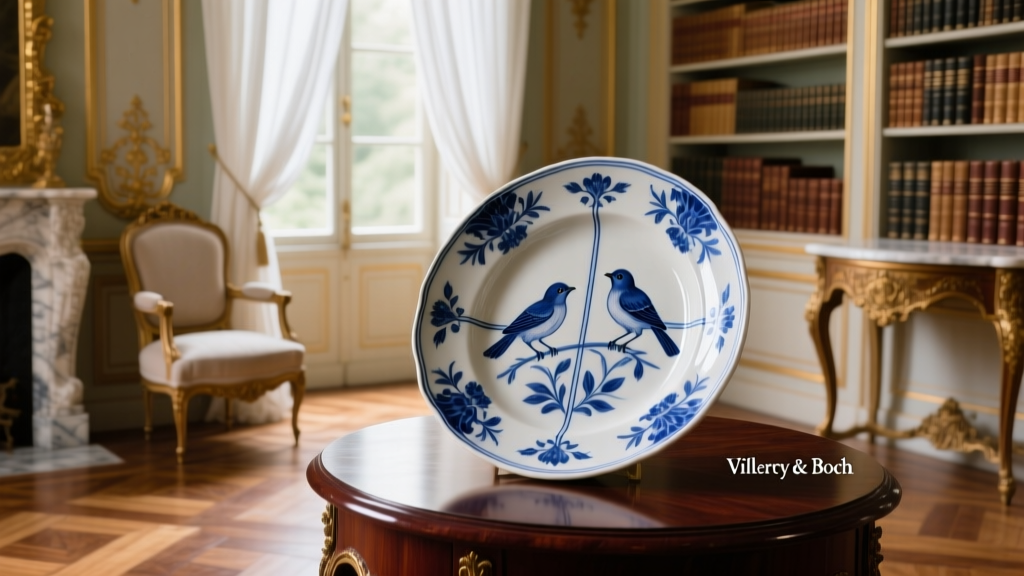
Villeroy & Boch Juvenile Divided Dish with Blue Birds: Identification, History, and Restoration Guidance
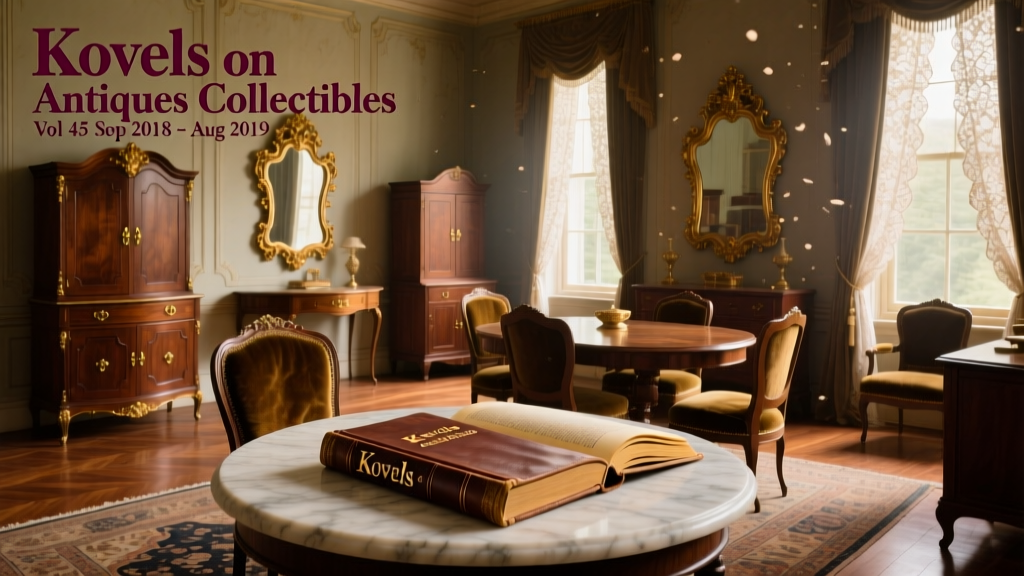
Kovels’ On Antiques & Collectibles, Volume 45 (Sept 2018–Aug 2019): A Critical Review for Collectors and Restorers
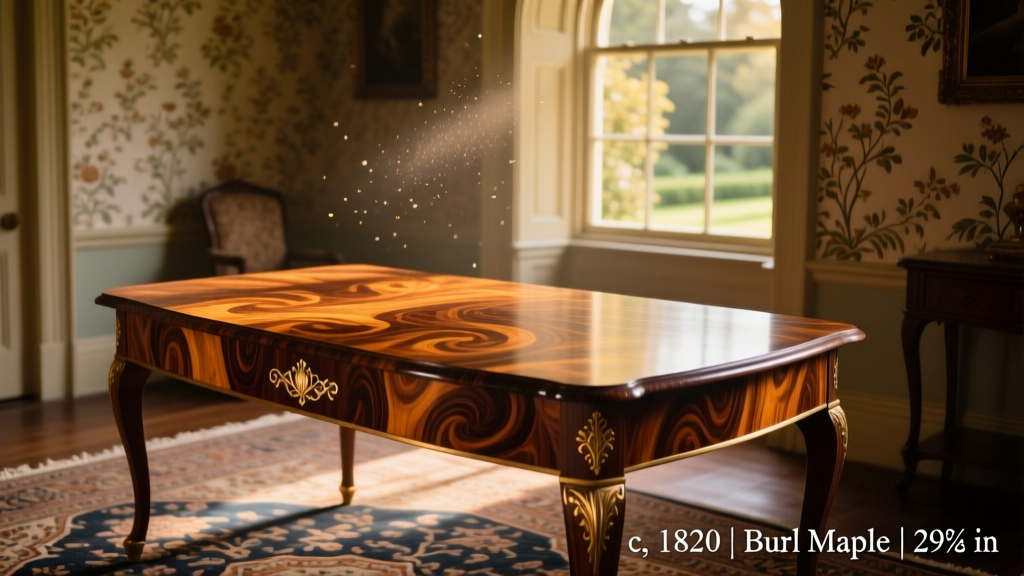
Sewing Table in Burl Maple, Circa 1820: A Technical and Historical Analysis of a 29½-Inch American Federal Period Piece

Netsuke Wood Monkey Holding Peach: A 19th-Century Japanese Ivory and Boxwood Carving Measuring 1 3/8 Inches
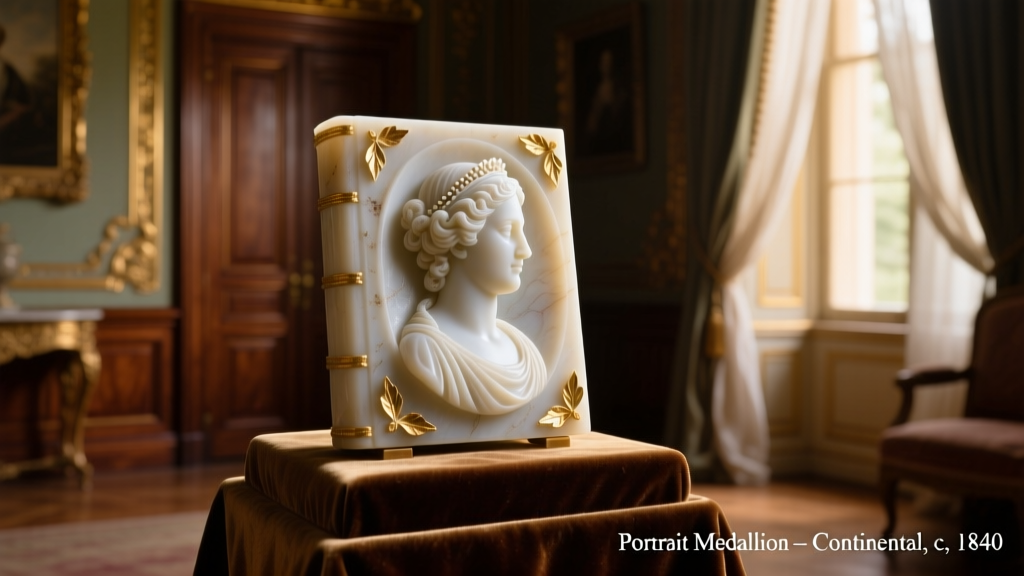
Alabaster Paperweight Book Shape Relief Portrait Medallion: A Continental Collector’s Study (5 × 3 Inches)
Daum Nancy Vase: Gray Mottled Base with Crimson, Tangerine & Rose Overlay — Wheel-Carved 11-Inch Masterpiece
Durand Plate: White Pulled Feather with Blue Crosshatched Pattern and Pontil Mark — A 6-Inch Collector’s Plate Analysis