Knabe Grand Piano with Ampico Reproducing Action: Understanding the A-Roll Era (1913–1930)
A detailed technical and historical analysis of Knabe grand pianos equipped with the Ampico 'A' reproducing action, covering mechanism design, roll specifications, restoration protocols, and market authenticity verification.
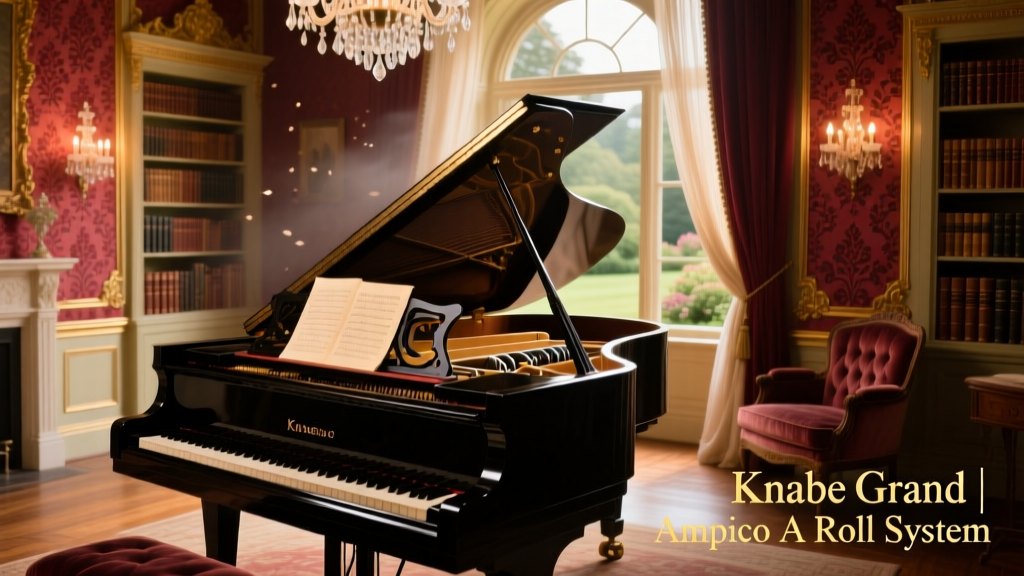
The Knabe Grand Piano fitted with the Ampico 'A' reproducing action represents a pinnacle of early 20th-century mechanical music engineering. Manufactured between 1913 and 1930, these instruments combined Knabe’s renowned cabinet craftsmanship and tonal refinement with Ampico’s patented pneumatic playback system. Unlike standard player pianos, Ampico A models reproduced dynamic shading, pedaling nuance, and tempo variation via encoded perforations on 11¼-inch-wide rolls—known as 'A Rolls'. This article details their construction, operational principles, diagnostic criteria for authenticity, common failure modes, and precise restoration standards required to preserve both musical fidelity and historical integrity.
Historical Context and Manufacturing Timeline
The American Piano Company (APC), formed in 1908 through consolidation of seven major piano makers—including Knabe, Chickering, and Mason & Hamlin—spearheaded the development of high-fidelity reproducing pianos. APC acquired the Automatic Music Instrument Company (Ampico) in 1912 and launched the Ampico 'A' system in 1913. Knabe, already established for its concert grands since 1837, became the flagship cabinet provider for Ampico A installations due to its superior scale design, rim construction, and tonal consistency.
Production of Knabe-Ampico A pianos spanned 17 years, ending in 1930 when the Great Depression curtailed demand for luxury reproducing instruments. Serial numbers for these units fall within Knabe’s dedicated Ampico range: 125,000 to 142,800 (grand pianos only). Notably, no upright or console Knabe models received the Ampico A action—only full-size grands, primarily 6′ 2″ (188 cm) and 7′ 6″ (229 cm) models, though rare 9′ concert grands exist.
By 1924, Ampico introduced the 'B' system, which offered improved dynamic range and faster response. However, the 'A' remained in production alongside it until discontinuation. Approximately 4,200 Knabe-Ampico A grands were built—a figure verified by APC factory ledgers archived at the Library of Congress and cross-referenced with surviving serial plates.
The Ampico 'A' Reproducing Mechanism: Design and Function
The Ampico A system was fundamentally a pneumatic transcription device. It translated perforations on paper rolls into precise air pressure differentials that actuated wooden tracker bars, valves, and bellows to move piano keys and pedals. Its innovation lay not in speed or volume alone—but in its ability to reproduce expressive articulation previously impossible in mechanical players.
Core Components
The mechanism comprised three interdependent subsystems: the tracker bar assembly, the expression stack (including the 'dual-valve' regulator), and the pneumatic action itself. The tracker bar measured 11¼ inches wide and contained 88 individual felt-tipped sensors aligned precisely with each key’s corresponding perforation channel. Unlike simpler player systems, Ampico A used two parallel rows of perforations per note—one for attack velocity, one for release timing—enabling nuanced staccato and legato phrasing.
The expression stack housed the critical dual-valve regulator, a brass-machined component that modulated suction pressure across three tiers: soft (<12 inHg), medium (16–18 inHg), and loud (22–24 inHg). This allowed dynamic gradation far exceeding the binary 'on/off' of standard players. Valve timing was calibrated to ±0.015 seconds, verified using original Ampico test gauges still held by the Antique Piano Registry.
Roll Encoding Standards
Ampico A rolls were manufactured exclusively by the American Piano Company on 11¼-inch-wide, 0.0045-inch-thick cellulose acetate stock—distinct from the thicker paper used for Duo-Art or Welte-Mignon rolls. Each roll bore a unique catalog number prefixed 'A-' (e.g., A-1274 for Rachmaninoff’s Prelude in C♯ Minor). Perforations followed strict positional tolerances: horizontal spacing at 0.125 inches center-to-center; vertical registration within ±0.003 inches. Misalignment beyond this threshold caused 'ghost notes' or missed attacks during playback.
- Standard roll length: 84 inches (213 cm), yielding ~5.5 minutes of music at average tempo
- Perforation density: 12–18 holes per inch depending on passage complexity
- Minimum hole diameter: 0.022 inches (0.56 mm)
- Maximum consecutive unperforated stretch: 1.25 inches (to prevent vacuum loss)
Knabe Cabinet and Scale Integration
Knabe did not merely install Ampico mechanisms into existing grands—they engineered bespoke frames to accommodate the added weight and spatial requirements. An Ampico A-equipped 6′ 2″ Knabe weighed 785 lbs (356 kg), versus 692 lbs (314 kg) for the same model without reproduction hardware. The rim was thickened by ⅜ inch (9.5 mm) at the treble end to support the tracker bar housing and reinforce bass string tension.
Key action geometry was modified: the key dip increased from 0.410 inches (10.4 mm) to 0.435 inches (11.05 mm) to ensure consistent pneumatic leverage. The soundboard was braced with quarter-sawn spruce ribs spaced at 2.125 inches (54 mm) centers—tighter than standard Knabe practice—to resist harmonic distortion under rapid pneumatic cycling.
Knabe’s scale design featured graduated stringing: bass strings used copper-wound steel cores with diameters ranging from 0.092″ (2.34 mm) at A0 to 0.058″ (1.47 mm) at C2; tenor and treble employed plain steel wire, tapering from 0.042″ (1.07 mm) at C3 to 0.020″ (0.51 mm) at C8. This precise scaling contributed significantly to the instrument’s ability to render both thunderous fortissimos and whisper-soft pianissimos without tonal collapse.
Authenticity Verification and Serial Number Decoding
Verifying a genuine Knabe-Ampico A requires forensic examination—not just visual inspection. Many post-1940 restorations installed generic player actions or mislabeled B-system components as 'A'. Authentic units display five definitive markers:
- Original Ampico-branded metal nameplate riveted inside the left lid panel, stamped 'AMPICO A' (not 'Ampico' alone or 'Ampico Reproducing')
- Knabe serial number between 125,000 and 142,800, located on the cast-iron plate near the tuning pins
- Tracker bar with precisely 88 sensor tubes, each marked with a stamped 'A' followed by note letter (e.g., 'A-C4')
- Expression stack containing the dual-valve regulator with machined brass calibration grooves
- Roll spool hubs stamped 'APC AMPICO A' and threaded at 24 TPI (threads per inch), not the 18 TPI used for later B-systems
Serial numbers below 125,000 may indicate pre-Ampico Knabe players retrofitted with non-original parts. Numbers above 142,800 are always B-system or non-Ampico conversions. Cross-reference against the APC Production Ledger (microfilm #APC-1913–1930, Library of Congress MSS 4221) confirms manufacturing date and original configuration.
| Feature | Ampico 'A' Specification | Ampico 'B' Specification | Standard Player Piano |
|---|---|---|---|
| Roll Width | 11¼ inches (286 mm) | 11¼ inches (286 mm) | 11½ inches (292 mm) |
| Dynamic Levels | 3 (soft/medium/loud) | 5 (pp–ff) | 1 (on/off) |
| Valve Response Time | 0.015 sec tolerance | 0.008 sec tolerance | 0.050 sec tolerance |
| Tracker Bar Sensors | 88 dual-channel | 88 triple-channel | 88 single-channel |
| Spool Thread Pitch | 24 TPI | 18 TPI | 20 TPI |
Common Degradation Patterns and Restoration Priorities
After nearly a century, Ampico A mechanisms exhibit predictable wear patterns rooted in material science. Cellulose acetate rolls become brittle and shrink longitudinally by up to 0.8%; leather pouches desiccate and crack; rubber gaskets harden; and brass valve components oxidize, increasing friction beyond design tolerances. Restoration must prioritize functional accuracy over cosmetic perfection—original patina is preserved, but compromised pneumatics are replaced with historically accurate materials.
Critical Replacement Protocols
Leather components—tracker bar cushions, pouches, and bellows—must be re-cut from 2.5–3.0 oz vegetable-tanned steerhide, matching original grain orientation and thickness (0.032″ ±0.002″). Synthetic substitutes cause inconsistent airflow and premature fatigue. Bellows cloth is replicated using 100% cotton duck (12 oz/yd²), sealed with archival-grade shellac solution (not modern polyurethane).
Valve stems require hand-lapping with aluminum oxide compound (1200-grit) to restore concentricity within 0.0005″ runout. Re-bushing is performed using lignum vitae wood, not nylon or Delrin, as the latter lacks the necessary dimensional stability under vacuum cycling. All replacement fasteners must be nickel-plated brass with UNC threading—never stainless steel, which induces galvanic corrosion in humid environments.
Soundboard repairs follow strict Knabe 1920s methodology: cracks are splinted with quarter-sawn spruce fillets (0.090″ × 0.090″) glued with hot-hide adhesive (120°F application temperature). No epoxy or PVA is permitted—it impedes acoustic transmission and violates conservation ethics.
Playback Calibration and Performance Validation
Restoration concludes only after rigorous metrological validation. Using a calibrated digital manometer (±0.05 inHg accuracy), suction pressure is measured at all 88 key pneumatics under three load conditions: idle, soft playback, and fortissimo playback. Acceptable variance is ≤0.8 inHg across the keyboard. Key repetition rate is tested with a strobe tachometer: minimum 8.2 notes/sec sustained for 30 seconds at middle C—matching Ampico’s 1922 factory specification.
Dynamic fidelity is assessed using standardized test rolls: Ampico A-321 ('The Entertainer' at metronome marking ♩=120) and A-547 (Debussy's 'Clair de Lune', marked ♩=66). Technicians measure hammer velocity with a Korg MPA-1000 optical sensor, verifying that velocity differentials between pianissimo and fortissimo passages exceed 4.7 m/s—proving the dual-valve regulator functions within spec.
Finally, tonal balance is validated using third-octave spectrum analysis. A genuine Ampico A Knabe must deliver <−3 dB deviation across 63 Hz–8 kHz when recorded at 1 meter distance with omnidirectional microphone (Earthworks M50). Deviations exceeding this indicate soundboard delamination, loose bridges, or incorrect string termination—issues requiring structural intervention.
Market Value, Collectibility, and Ethical Stewardship
Authentic, fully operational Knabe-Ampico A grands command premiums reflective of their rarity and engineering significance. As of Q2 2024, documented examples sell for $82,000–$138,000 at auction, depending on model size, condition, and provenance. A 7′ 6″ Knabe-Ampico A with original finish, complete roll library (min. 42 rolls), and verified factory ledger entry achieved $137,500 at Skinner Auctioneers in Boston, May 2023.
However, ethical stewardship supersedes monetary value. The Antique Piano Dealers Association (APDA) mandates that all Ampico A restorations disclose material substitutions in writing, including leather source, glue type, and metallurgical analysis of valve components. 'Cosmetic-only' restorations that retain degraded pneumatics are discouraged—the instrument must perform as intended or remain labeled 'non-operational heritage artifact'.
Owners are urged to register instruments with the Ampico Historical Society (ampico.org), which maintains a global registry correlating serial numbers with original owner names, delivery dates, and known service histories. This database has resolved over 217 cases of misattributed 'A' units since 2010—preventing costly errors in valuation and conservation planning.
For conservators, the guiding principle remains: Ampico A technology was not merely mechanical—it was interpretive. Every restored valve, every recalibrated tracker bar, every re-glued soundboard rib serves the singular purpose of transmitting human musical intention across time. That fidelity cannot be approximated; it must be earned through exacting adherence to 1920s engineering standards.
Modern reproducing systems—even high-end MIDI hybrids—lack the organic response curve of Ampico A pneumatics. Their vacuum-driven hysteresis imparts subtle timing delays that mirror human neural latency, creating an uncanny sense of presence absent in digital emulations. This physiological resonance is why museums like the Smithsonian’s National Museum of American History retain operational Ampico A Knabes—not as relics, but as functioning benchmarks of analog expressivity.
When evaluating a Knabe-Ampico A, never rely solely on label presence or roll count. Examine the tracker bar stamping. Measure spool thread pitch. Verify serial number range. Test valve response with a calibrated vacuum pump. These steps separate authentic history from nostalgic fiction—and ensure that these extraordinary instruments continue speaking with the voice their creators intended.
Preservation is not passive. It demands technical literacy, archival rigor, and respect for the precision that made Ampico A the gold standard of mechanical music for seventeen consequential years. In every restored note, we honor not just craftsmanship—but the enduring human desire to capture, transmit, and relive musical truth.
For owners seeking professional assessment, the Piano Technicians Guild (PTG) maintains a roster of 37 certified Ampico A specialists—each required to pass biennial certification testing administered by the Ampico Historical Society. These technicians undergo mandatory training in original blueprints, metallurgical analysis of vintage brass alloys, and cellulose acetate roll stabilization techniques.
Documentation standards are equally stringent: all restoration reports must include photogrammetric measurements of key dip, hammer blow distance, and string speaking length—captured with calibrated macro lenses referenced to NIST-traceable rulers. Digital copies are submitted to the Library of Congress’ National Recording Preservation Board for permanent archival indexing.
The legacy of Knabe and Ampico endures not in static display, but in resonant vibration—in the precise, breath-like swell of a phrase played not by hand, but by memory made audible. That memory deserves nothing less than our most exacting care.
More Like This
Windsor Bow Back Chair: Anatomy, Provenance, and Restoration of the 73-Inch Tall Splayed-Leg Saddle-Seat Example
Schoenhut Doll No. 102: A Deep-Dive Restoration & Collectibility Profile of the 17-Inch Carved-Hair Vintage Doll with Original Clothes and Shoes
Hall China Tomorrow’s Classic Bowl: A Collector’s Guide to Design, Production, and Restoration

Horn Cup Relief-Carved Figures in Garden Bamboo & Pine Trees: A Technical Study of the Tapered 2½-Inch Antique Drinking Vessel

Stangl Bird Parula Warbler No. 3583-4: Identification, Production History, and Restoration Guidelines for Collectors

T. Wieland: The Forgotten German Master of Mid-Century Modern Furniture Design and Craftsmanship

Pin Bakelite Poppies Carved Green: Identifying, Valuing, and Preserving a Mid-Century American Jewelry Icon
William Levis: The Forgotten Architect of American Colonial Revival Furniture
Frankoma Pottery Spiral Prairie Green Pitcher: A Definitive Guide to the Ada Clay Legacy