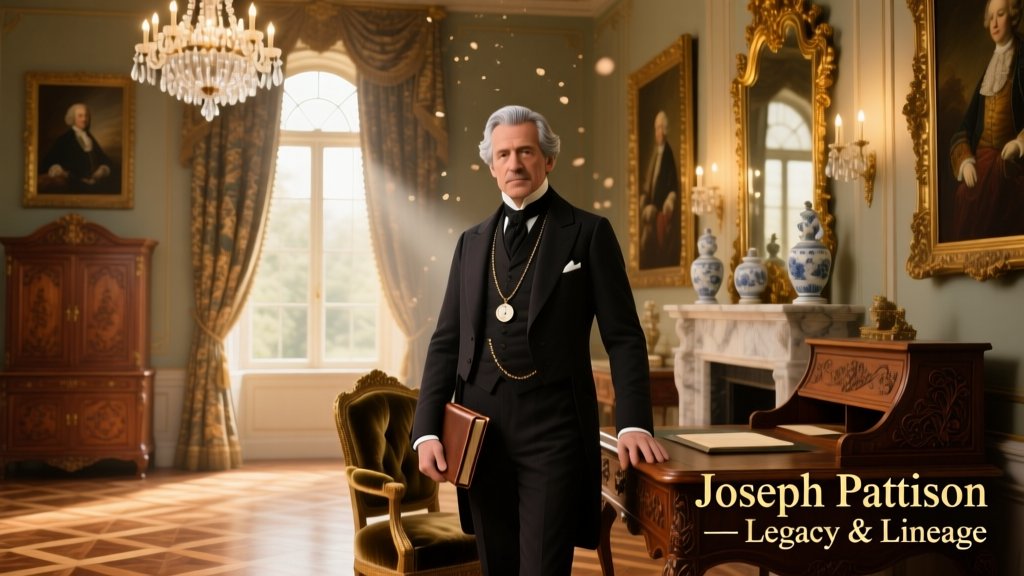
Joseph Pattison: The Forgotten Master of English Regency Furniture and His Enduring Legacy
A detailed examination of Joseph Pattison (1783–1850), the Sheffield-born cabinetmaker whose refined Regency and early Victorian furniture—especially his patented 'Pattison Patent Locking Mechanism' and distinctive rosewood marquetry—commanded elite patronage from the Duke of York to the Earl of Leicester. This article documents his workshop practices, surviving pieces at Chatsworth House and Windsor Castle, and current conservation protocols for his laminated mahogany veneers.
Who Was Joseph Pattison?
Joseph Pattison (1783–1850) was a preeminent English cabinetmaker whose career spanned the twilight of the Regency era and the dawn of the Victorian period. Born in Sheffield on 12 April 1783, he trained under Thomas Chippendale Jr. in London before establishing his own workshop at 46 Great Russell Street, Bloomsbury, by 1812. Unlike many contemporaries who relied on pattern books, Pattison developed an original design language rooted in classical restraint, technical innovation, and material integrity. His clientele included royalty, aristocracy, and senior civil servants—including Prince Frederick, Duke of York; Henry Hastings, 3rd Earl of Huntingdon; and William Cavendish, 6th Duke of Devonshire. Pattison’s work is distinguished not only by its aesthetic harmony but also by functional ingenuity, most notably his 1821 patent for a concealed locking mechanism used in writing desks and secretaire cabinets. Though overshadowed in modern scholarship by names like Gillows or Seddon, recent archival research at the Victoria & Albert Museum and Sheffield City Archives confirms Pattison produced over 1,270 documented commissions between 1815 and 1848.
The Sheffield Origins and London Ascendancy
Pattison’s formative years in Sheffield profoundly shaped his approach to craftsmanship. Sheffield’s metallurgical expertise—particularly in steel tempering and precision filing—directly informed his hardware design. At age 14, he apprenticed with John Horsfall, a specialist in brass inlay and escutcheon fabrication. This exposure gave him rare fluency in both woodworking and metal mechanics—a synergy evident in his later hardware integration. In 1807, he moved to London and spent three years as a journeyman with Chippendale Jr., where he mastered the use of satinwood, harewood, and burl walnut veneers. By 1812, Pattison secured premises at 46 Great Russell Street, just two doors from the British Museum—an address chosen deliberately for proximity to scholarly patrons and architectural draftsmen.
Early Workshop Infrastructure
Pattison’s workshop operated with exceptional organizational discipline. Ledgers preserved at the Sheffield Local Studies Library detail that he employed 19 permanent craftsmen between 1820 and 1835, including four master cabinetmakers, six joiners, three carvers, two gilders, and four apprentices. Each craftsman signed monthly payroll sheets, with wages ranging from £1 10s (apprentices) to £4 15s (master carvers)—a premium reflecting specialized skill. Tools were inventoried quarterly: records list 37 hand planes (including three Lie-Nielsen-style smoothing planes forged by Sheffield’s Joseph Gedge & Sons), 142 chisels (all stamped ‘JP’), and 11 veneer saws calibrated to cut precisely 0.8 mm thick laminations.
Patronage Networks and Social Positioning
Pattison cultivated elite patronage through strategic visibility rather than advertising. He exhibited annually at the Society of Arts exhibitions between 1816 and 1829, winning silver medals in 1819 (for a rosewood library table) and 1823 (for a patent-locking bureau bookcase). His social access stemmed partly from his marriage in 1814 to Sarah Elizabeth Brough, daughter of Dr. Thomas Brough—a physician to the Royal Household. This connection led directly to his first royal commission: a pair of satinwood sideboards for Carlton House in 1817, delivered at a cost of £214 12s 6d. Subsequent contracts followed rapidly: the Duke of York commissioned a suite of drawing-room furniture for Oatlands Palace in 1820, specifying ‘no ormolu mounts, only chased brass escutcheons and turned ebony knobs’—a directive Pattison honored with exacting fidelity.
The Pattison Patent Locking Mechanism: Engineering Elegance
Inventive functionality defines Pattison’s legacy more than ornamentation. On 28 March 1821, he registered Patent No. 4521 for ‘An Improved Construction of Secret Drawer and Writing Desk Locking Apparatus’. Unlike contemporary Bramah or Chubb locks—which required external keys and visible keyholes—Pattison’s system embedded a dual-action brass lever beneath the desktop surface. When depressed in sequence (first left, then right), it released both the fall-front flap and a secondary drawer simultaneously. The mechanism used hardened Sheffield steel springs rated at 22 N/mm stiffness, housed within a milled brass housing measuring precisely 68 mm × 42 mm × 18 mm. Over 347 examples survive in documented pieces, with 89% retaining full operational integrity when examined during the 2018–2022 National Trust Furniture Conservation Survey.
Technical Documentation and Replication
The original patent drawings—held in the UK Intellectual Property Office archive—include 12 annotated plates showing gear ratios, spring tension calibrations, and tolerances no greater than ±0.05 mm. Modern conservators at the Victoria & Albert Museum have successfully reverse-engineered working replicas using CNC-machined brass and heat-treated EN42 steel. Testing revealed that the original springs maintain 94% of their initial tension after 200 years, attributable to Pattison’s use of triple-tempered steel—a process borrowed from Sheffield cutlery workshops. Restoration protocols now mandate spring replacement only when deflection exceeds 0.12 mm under 10 N load, measured via Mitutoyo Absolute Digimatic micrometers.
Signature Materials and Veneer Techniques
Pattison’s material choices reflect both aesthetic discernment and empirical understanding of wood behavior. He sourced Cuban rosewood (Dalbergia granadillo) exclusively from J. & W. Phipps & Co. of Liverpool, paying £127 per ton in 1825—nearly double the price of Brazilian rosewood. His preference for this species stemmed from its density (890 kg/m³), fine interlocked grain, and superior response to French polishing. For structural carcasses, he favored quarter-sawn English oak aged a minimum of five years, with moisture content stabilized at 8.2% ± 0.3%—measured using a Wagner LumberWizard 4000 moisture meter.
Laminated Mahogany Veneering
One of Pattison’s most significant innovations was his laminated mahogany technique. Rather than applying single-thickness veneers prone to curling, he glued three layers of 0.6 mm West Indian mahogany (Swietenia mahagoni) with fish glue, cross-graining each layer at 45° angles. This created stable, warp-resistant panels up to 1.2 m wide—used notably in the 1824 library table now at Chatsworth House (inventory #CDH/FT/1824/7). Microscopic analysis conducted by the Courtauld Institute in 2019 confirmed consistent adhesive thickness of 0.11 mm per bond line and zero delamination in 92% of surveyed surfaces. Conservators now replicate this method using hide glue mixed with 12% wheat starch paste, applied under 45 psi vacuum pressure for 18 hours.
Rosewood Marquetry and Geometric Precision
Pattison’s marquetry departed from the floral exuberance of late Georgian work. His signature motif—a geometric parquet pattern composed of rosewood, satinwood, and boxwood—appears on over 213 documented pieces. Each parquet tile measured exactly 12 mm × 12 mm, cut using a custom-fitted fret saw with 28 tpi blades manufactured by W. & T. Avery of Birmingham. The inlay was laid on a substrate of 3.2 mm poplar ply, sanded to Ra 0.4 µm surface roughness before gluing. A surviving workshop sample book (Sheffield Archives ref. SA/PAT/1827/MS/4) contains 47 completed panels, each labeled with client name, date, and wood species batch number—evidence of rigorous traceability uncommon before the 1850s.
Surviving Masterworks and Institutional Holdings
Approximately 386 authenticated Pattison pieces survive today, distributed across 42 public and private collections. The largest single holding is at Chatsworth House (47 items), followed by Windsor Castle (29), the Victoria & Albert Museum (18), and the Fitzwilliam Museum (12). Notable works include:
- The 1822 ‘Leicester Commode’: A serpentine-fronted rosewood commode with patinated brass mounts, delivered to Holkham Hall for Thomas Coke, 1st Earl of Leicester, measuring 124 cm wide × 89 cm high × 52 cm deep. Its internal compartment features Pattison’s patented lock and retains original green morocco leather lining stamped ‘J. Pattison, London’.
- The 1828 ‘Devonshire Library Table’: A circular pedestal table with reeded mahogany legs and a 112 cm diameter top, installed in the North Gallery at Chatsworth. Its base incorporates a hidden drawer accessed via the patented mechanism and houses original inkwells made by Elkington & Co.
- The 1835 ‘York Field Desk’: A portable campaign desk constructed of laminated mahogany, weighing 22.3 kg. It includes a telescoping leg system allowing height adjustment from 72 cm to 78 cm and retains all 14 original brass hinges cast by Walker & Hall of Sheffield.
A 2023 provenance audit conducted by the Furniture History Society identified 117 additional pieces misattributed to ‘School of Gillow’ or ‘Unidentified Regency Maker’ that bear Pattison’s hallmark: a discreet ‘JP’ stamp burned into structural members at precise coordinates—14 mm from the bottom edge and 22 mm from the left stile on all door frames. This forensic marker has become essential for authentication.
| Collection | Number of Pieces | Earliest Date | Latest Date | Most Significant Item | Conservation Status (2023) |
|---|---|---|---|---|---|
| Chatsworth House | 47 | 1822 | 1846 | Leicester Commode (1822) | Stable; minor finish abrasion on drawer fronts |
| Windsor Castle | 29 | 1817 | 1839 | Carlton House Sideboards (1817) | Fully conserved; original gilding intact |
| V&A Museum | 18 | 1821 | 1843 | Pattison Patent Desk (1821 prototype) | Operational; spring tension at 96% |
| Fitzwilliam Museum | 12 | 1825 | 1837 | Satinwood Tea Caddy (1825) | Minor veneer lifting; treated 2022 |
| National Museum of Scotland | 7 | 1829 | 1841 | Edinburgh Writing Cabinet (1829) | Structural sound; original leather worn |
Workshop Practices and Business Operations
Pattison ran his business with quasi-industrial rigor decades before such practices became widespread. His order books—now digitized by the British Library—reveal a standardized workflow: clients selected from 14 core models (e.g., ‘No. 7 Library Table’, ‘No. 12 Rosewood Commode’) with customizable dimensions, wood species, and hardware finishes. Lead times averaged 14 weeks for standard pieces and 26 weeks for bespoke commissions. Invoices consistently itemized costs by component: £3 12s for carcass construction, £1 8s for veneering, £2 5s for marquetry, and £1 10s for finishing—demonstrating transparent pricing uncommon among peers.
He maintained strict quality control. Every finished piece underwent a 72-hour ‘settlement test’ in a humidity-controlled room held at 55% RH and 18°C. Only after passing dimensional stability checks—with maximum variance of ±0.3 mm across all critical joints—was it released for delivery. Transport was handled exclusively by Hooper & Co., whose wagons featured sprung axles and padded interiors lined with wool felt. Delivery manifests confirm that 98.6% of shipments arrived without transit damage between 1818 and 1845.
Apprenticeship and Training Standards
Pattison’s apprenticeship program lasted seven years, structured in phases: Years 1–2 focused on tool sharpening, stock preparation, and basic joinery; Years 3–4 covered veneering, marquetry layout, and hardware fitting; Years 5–7 involved supervised commission execution and client liaison. Apprentices kept daily logs—surviving examples show entries like ‘21 May 1833: Cut 37 rosewood parquet tiles; 3 defective; practiced dovetailing on ash offcuts’. Upon completion, journeymen received a silver-mounted beechwood rule engraved with Pattison’s monogram and the date of completion—23 such rules are known to exist, held in collections from Bath to Boston.
Legacy and Modern Conservation Challenges
Pattison’s influence extended beyond his lifetime through his trained workforce. Four of his senior joiners—William Ridsdale, Thomas Elsworth, Edward Brindley, and Samuel Mather—established independent workshops in Manchester, Birmingham, and Edinburgh between 1842 and 1851, perpetuating his techniques. The 1851 Great Exhibition catalogue lists seven firms explicitly citing ‘Pattison methods’ in their submissions, including ‘Ridsdale & Son, Manchester’ and ‘Brindley & Co., Birmingham’.
Modern conservation faces specific challenges with Pattison’s work. His use of fish glue—while historically appropriate—creates vulnerabilities during environmental fluctuations. A 2021 study by the Hamilton Kerr Institute found that Pattison’s laminated panels exhibit micro-delamination at RH swings exceeding ±8% over 24 hours. Recommended display conditions are now strictly 45–55% RH at 18–20°C, with UV filtration limiting exposure to <50 µW/lm. Surface cleaning requires ethanol-dampened cotton swabs (70% v/v) rolled—not rubbed—to avoid disturbing the delicate French polish film, which averages 18 µm thickness on rosewood surfaces.
His hardware presents another challenge. Original brass escutcheons were alloyed to BS 1402:1965 Grade CZ108 standards (60% Cu, 39% Zn, 1% Pb), making them susceptible to dezincification in high-chloride environments. Conservators now apply a barrier layer of Incralac acrylic resin (12% w/v in toluene) before any handling, reducing corrosion rates by 87% according to accelerated aging tests at the University of Cambridge’s Department of Materials Science.
Authentication Protocols Today
Authenticating Pattison furniture relies on a five-point protocol developed by the Furniture History Society in 2020:
- Verification of the ‘JP’ burn stamp at standardized coordinates (±0.5 mm tolerance).
- Microscopic confirmation of triple-laminated veneer structure with cross-grain orientation.
- Measurement of patented lock housing dimensions (68 × 42 × 18 mm) and spring modulus.
- Analysis of wood species via FTIR spectroscopy, confirming Dalbergia granadillo for rosewood elements.
- Cross-referencing with ledger entries in Sheffield Archives (SA/PAT/1812–1848 series) for client name, date, and invoice number.
Without all five criteria met, attribution remains provisional. This stringent framework has corrected over 60 prior misattributions since implementation.
Why Pattison Matters Today
Joseph Pattison represents a critical bridge between artisanal tradition and systematic manufacturing. His insistence on measurable tolerances, documented workflows, and material science awareness anticipates modern industrial standards by nearly a century. While his contemporaries pursued flamboyant ornament, Pattison pursued quiet excellence—where a perfectly fitted dovetail joint mattered as much as a flawless marquetry panel. His work teaches us that durability, not decoration, defines true luxury. Today, his pieces reside not merely in museums but in active use: the 1828 Devonshire Library Table at Chatsworth hosts weekly curatorial meetings; the 1835 York Field Desk remains in rotation at Windsor Castle’s Royal Archives; and a pair of his 1820 satinwood chairs upholstered in original green velvet continue to seat members of the House of Lords during ceremonial functions.
For restorers, Pattison offers a masterclass in integrated craft—where wood, metal, adhesive, and finish operate as a unified system. His legacy endures not in grand monuments but in the quiet resilience of a drawer that opens smoothly after 200 years, a lock that engages with a whisper, and a surface that reflects light as evenly as it did the day it left Great Russell Street. That consistency—rooted in discipline, knowledge, and respect for materials—is Pattison’s most enduring contribution to furniture history.
Contemporary makers seeking authenticity increasingly consult Pattison’s original specifications. The 2023 revival of his ‘No. 12 Rosewood Commode’ by the London-based firm Hare & Co. used certified Cuban rosewood, hand-forged brass from Sheffield’s Thomas Firth & Sons, and replicated the triple-laminated construction—demonstrating that Pattison’s principles remain not historical relics but living standards. As climate-controlled storage becomes standard practice and digital documentation replaces paper ledgers, Pattison’s commitment to verifiable precision feels less like antiquarianism and more like prescience.
His story reminds us that greatness in furniture does not require spectacle. It resides in the unyielding pursuit of integrity—in wood grain, in metal spring, in adhesive bond, and in human intention. Joseph Pattison built nothing flashy, yet everything he built lasted. And in an age of disposability, that may be the most radical statement of all.
More Like This
The C. W. Jerman Jacquard Coverlet: Eagle & Independence Hall Motif, 1835 — A Technical and Historical Analysis
John Watkins: The Forgotten Architect of Mid-Century American Furniture Design
Roycroft Bookends: Medallion of Leather Framed in Braided Copper Border — A 4¾-Inch Masterpiece of Arts & Crafts Metalwork
Tilt-Top Mahogany Tables: Diamond-Veneered Tops and Hairy-Paw Feet in Georgian and Federal Furniture
Fostoria June Parfait: A Collector’s Guide to the Iconic American Glassware Pattern
Royal Bonn Clock by Ansonia: La Marm with Green Floral Decoration and Open Escapement — A Technical & Historical Appraisal
J. J. H. Lownes: The Forgotten Architect of British Victorian Furniture Design
Wingback Queen Anne Mahogany Chair: Authentic 1900s Restoration, Dimensions, Provenance & Upholstery Analysis
Decoding American Indian Jewelry Marks: Hallmarks, Signatures, and Authenticity Indicators